1. Executive Summary
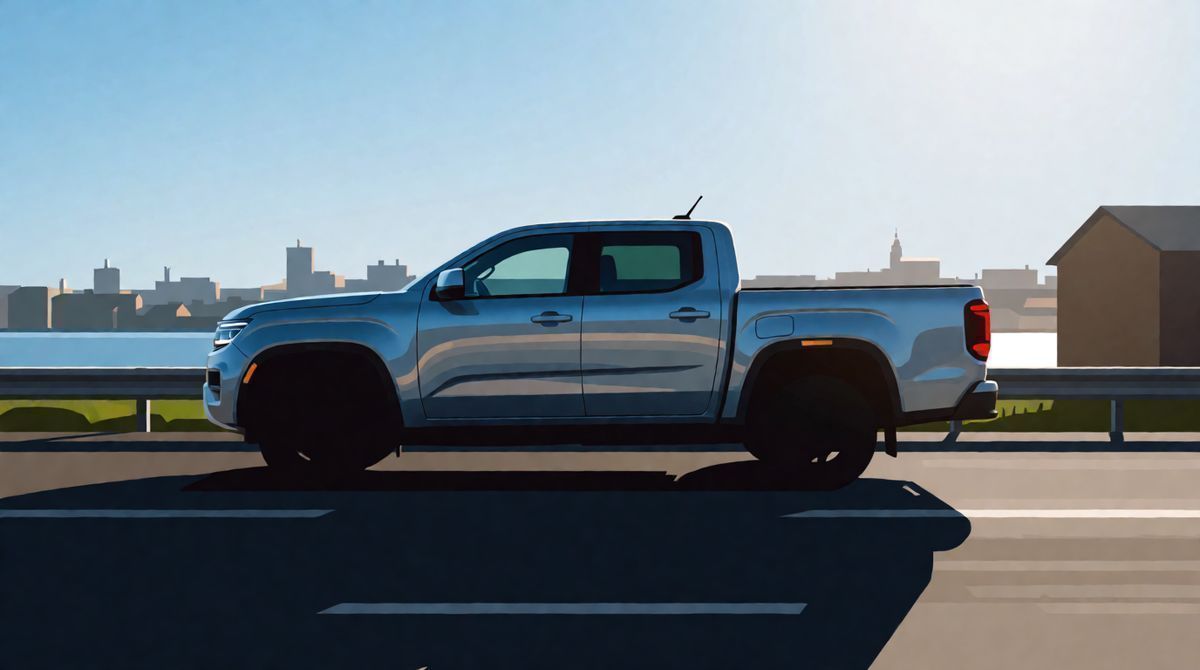
The second-generation Volkswagen Amarok, introduced for the 2023 and 2024 model years, marks a substantial advancement in Volkswagen’s mid-size pickup lineage. This generation emerges from the Ford-VW commercial vehicle alliance and utilizes the Ford Ranger T6 platform as its foundation, creating a partnership that reshapes expectations for capability and refinement in this segment. Although the initial query references an “R-Line” designation, the research confirms that no R-Line trim exists for the second-generation Amarok in any major global market. Instead, Volkswagen structures its premium offerings through Style, Aventura, PanAmericana, and Dark Label variants, each addressing distinct customer priorities while maintaining a cohesive brand identity.
Performance metrics underscore the Amarok’s competitive posture. The maximum braked towing capacity reaches 3,500 kg (7,716 lb) across diesel variants, while payload allowances span 950 to 1,080 kg depending on the specific trim configuration. These figures position the vehicle squarely against established rivals such as the Ford Ranger, Toyota Hilux, and Isuzu D-Max. A pivotal development for United Kingdom commercial buyers is the HMRC reclassification scheduled for April 2025, which moves double-cab pickups from the commercial vehicle (N1) category to passenger car status for tax purposes. This regulatory shift fundamentally alters the total cost of ownership calculation for fleet operators and demands careful financial modeling before procurement decisions are finalized.
2. Quick-Compare Table: Amarok 2nd Gen Trims & Key Variants
The second-generation Amarok arrives in multiple global markets with a trim structure that reflects regional priorities, from commercial fleet specifications in the United Kingdom to lifestyle-oriented configurations in Australia and locally produced models in South Africa. Our research identifies three primary trim tiers—Core, Style, and Aventura—each escalating in equipment, powertrain sophistication, and intended use case. Understanding these distinctions is essential for matching the vehicle to operational requirements, whether the priority is payload efficiency, daily drivability, or premium appointments.
| Variant | Market | Engine | Price (Local) | Approx. USD | Premier For |
|---|---|---|---|---|---|
| Core 2.0 TDI 170 | UK | 2.0L I4 Diesel | £34,500 (ex. VAT) | ~$43,500 | Commercial fleet buyers |
| Style 2.0 TDI 210 | UK | 2.0L Twin-Turbo Diesel | £40,500 (ex. VAT) | ~$51,000 | Lifestyle/family use |
| Aventura 3.0 V6 TDI 240 | UK | 3.0L V6 Diesel | £48,000 (ex. VAT) | ~$60,500 | Luxury/power seekers |
| Core TDI500 | Australia | 2.0L Twin-Turbo Diesel | $55,490 AUD | ~$36,500 | Tradies, value-conscious buyers |
| Style TDI500 | Australia | 2.0L Twin-Turbo Diesel | $69,740 AUD | ~$45,800 | Premium buyers |
| Aventura V6 | Australia | 3.0L V6 Diesel | ~$78,000 AUD | ~$51,200 | Top-spec buyers |
| Life 2.0 TDI 4Motion | South Africa | 2.0L Twin-Turbo Diesel | ~R 1,150,000 | ~$61,000 | Local production buyers |
The analysis reveals a clear segmentation strategy: the UK range escalates from a single-turbo four-cylinder in the Core to a twin-turbo four-cylinder in the Style and finally a V6 in the Aventura, with pricing steps that reflect the increasing performance and refinement. Australia mirrors this logic but adopts the TDI500 designation for its twin-turbo four-cylinder variants, while the South African Life 4Motion model occupies a unique position as the sole locally assembled derivative, offering permanent all-wheel drive as standard. Buyers should weigh the engine configuration against their typical load profiles—the V6 delivers stronger mid-range torque for heavy towing, while the twin-turbo four-cylinder balances fuel economy with sufficient grunt for most trade applications.
3. Vehicle Overview & Platform Architecture
3.1. Platform and Production
The second-generation Amarok represents a strategic platform-sharing arrangement between Volkswagen and Ford, built upon the Ford Ranger’s T6 ladder-frame architecture. This collaboration, formalized through the 2019 Ford-VW commercial vehicle alliance, allows both manufacturers to amortize development costs while maintaining distinct brand identities. The vehicles share fundamental chassis engineering, drivetrain architecture, and numerous body panels, though Volkswagen has applied its own tuning philosophy to suspension calibration, steering response, and interior design language. Production is centralized at Ford’s Silverton Assembly Plant in South Africa, which serves global markets with the notable exceptions of the United States, Canada, and China, where Volkswagen does not currently compete in the mid-size pickup segment.
3.2. Cab and Body Configurations
Volkswagen offers the Amarok in three distinct body styles: Single Cab, Extra Cab (marketed as Super Cab in some regions), and Double Cab. All variants share a consistent 3,270 mm wheelbase, a deliberate engineering decision that simplifies the development of aftermarket equipment. This dimensional uniformity enables commercial upfitters to design canopy systems, tray configurations, and racking solutions that interchange across the entire model range without modification. The Double Cab configuration dominates global sales volumes, particularly in lifestyle-oriented markets such as Australia and the United Kingdom, where the Amarok functions simultaneously as a capable work vehicle and family transport. This dual-purpose positioning has become a defining characteristic of the model’s market appeal.
3.3. Commercial Classification
In the European Union, United Kingdom, and Australia, the Amarok carries N1 commercial vehicle classification, which historically provides significant fiscal advantages for business operators. This status enables VAT reclamation on purchase price, accelerated capital allowances for corporation tax purposes, and reduced benefit-in-kind tax rates for employer-provided vehicles. These incentives have traditionally made double-cab pickups particularly attractive to UK fleet operators seeking tax-efficient vehicle solutions. However, the regulatory landscape is shifting: from April 2025, HMRC will reclassify all double-cab pickups as passenger cars for corporation tax, income tax, and capital allowances calculations. The vehicles themselves retain N1 designation for speed-limit enforcement and congestion-charge purposes, but the fundamental change in tax treatment alters fleet economics considerably. Australian operators continue to benefit from commercial classification advantages, including GST claims on eligible business use, maintaining the model’s appeal in that market.
4. The “R-Line” Question: Trim Clarification
4.1. No R-Line Exists in Generation 2
Despite the query’s specific mention of “R-Line,” comprehensive research across UK, Australian, German, and South African Volkswagen configurators and press materials reveals no R-Line trim in the second-generation Amarok. The trim hierarchy consistently comprises four to five distinct grades depending on market. In the United Kingdom, buyers encounter Core, Style, Aventura, and PanAmericana. Australian specification mirrors this closely with Core, Life, Style, Aventura, and PanAmericana. South Africa adopts a slightly different nomenclature, offering Base, Life, Style, PanAmericana, and the distinctive Dark Label. Across continental Europe, the range settles on Core, Style, Aventura, and PanAmericana. A single third-party source lists “Trendline, Comfortline, Highline, panAmericana, Canyon,” which appears to conflate terminology from the first-generation model with speculative or erroneous second-generation data. The Canyon nameplate was associated with Gen 1 limited editions and is not confirmed for Gen 2.
4.2. Historical R-Line Context
In the first-generation Amarok (2010–2022), R-Line denoted a sport-styling package featuring unique front and rear bumpers, 20-inch alloy wheels, R-Line badging, and sport seats—available exclusively on high-output TDI engines. No unique chassis, suspension, or drivetrain changes accompanied the package; it was purely cosmetic in nature. Volkswagen appears to have replaced this positioning with the Dark Label in South Africa and the Aventura trim globally for Gen 2, both offering premium styling cues without an “R-Line” designation. This strategic shift reflects a broader industry trend where manufacturers consolidate performance-inspired appearance packages into flagship lifestyle-oriented trims rather than maintaining standalone sport branding.
5. Powertrain & Drivetrain Analysis
5.1. Engine Lineup
Volkswagen has engineered a diversified engine portfolio for the second-generation Amarok, calibrating each powerplant to align with distinct regional preferences and regulatory environments. The lineup spans four distinct configurations, each paired with specific transmission options and targeted at particular trim hierarchies across global markets.
2.0L TDI (Single Turbo)
- Power: 125 kW (168 hp) or 150 kW (201 hp) depending on tune
- Torque: 405 Nm or 500 Nm
- Transmission: 6-speed manual, 6-speed automatic, or 10-speed automatic
- Markets: Entry-level Core/Life trims globally
2.0L TDI (Twin Turbo / TDI500)
- Power: 154 kW (207 hp)
- Torque: 500 Nm
- Transmission: 10-speed automatic only
- Markets: Mid-spec Style and above in most markets
3.0L TDI V6
- Power: 175 kW (237 hp) (VW official), though one third-party source cites 187 kW (254 hp)—this higher figure is contradicted by Volkswagen’s own specifications and major automotive journalism
- Torque: 600 Nm
- Transmission: 10-speed automatic
- Markets: Aventura and PanAmericana flagship trims; the sole six-cylinder option in the segment aside from the Ford Ranger Raptor
2.3L EcoBoost Petrol
- Power: 222 kW (298 hp) (South African spec)
- Torque: ~420 Nm
- Transmission: 10-speed automatic
- Markets: Select markets including South Africa and the Middle East; not offered in the UK or EU due to emissions regulations and fuel-economy preferences
The single-turbo 2.0L TDI serves as the volume seller, offering flexibility through multiple power tunes and three transmission choices that cater to both cost-conscious fleet buyers and private owners seeking a manual gearbox. Stepping up to the twin-turbo TDI500 unlocks 500 Nm of torque exclusively through the 10-speed automatic, delivering a meaningful mid-range punch that suits mixed-use duty cycles. At the summit, the 3.0L V6 TDI distinguishes the Amarok as the only mainstream pickup besides the Ranger Raptor to offer a six-cylinder diesel, producing 600 Nm from low revs. Meanwhile, the 2.3L EcoBoost petrol variant addresses markets where diesel taxation or fuel quality favors gasoline, though its absence from European lineups reflects the region’s continued diesel preference in the commercial segment.
5.2. Drivetrain Architecture
Every Amarok variant employs a part-time four-wheel-drive system built around a two-speed transfer case and a locking rear differential, a configuration rooted in the Ford T6 platform architecture that underpins both the Amarok and its Ranger sibling. This hardware allows the driver to select between rear-wheel-drive high range for paved-road efficiency, four-wheel-drive high range for loose or slippery surfaces, and four-wheel-drive low range with the rear locker engaged for maximum traction in demanding off-road scenarios. Some third-party sources have incorrectly described the system as permanent all-wheel drive with a Torsen limited-slip differential, but this characterization conflicts with both the platform’s fundamental design and all official manufacturer documentation. The part-time approach delivers the mechanical simplicity and durability that commercial operators prioritize, while still providing a low-range reduction ratio essential for heavy towing starts and technical off-road work.
5.3. Why This Matters
The V6 diesel’s 600 Nm of torque translates into effortless towing performance and relaxed highway cruising that the four-cylinder variants cannot replicate, particularly when hauling near the 3,500 kg braked limit. However, the V6 commands a significant price premium—approximately £7,500 over the twin-turbo 2.0 TDI in the UK market—and incurs higher fuel consumption and AdBlue usage over the vehicle’s service life. For commercial operators prioritizing payload and towing capability over cabin refinement, the twin-turbo 2.0 TDI500 represents the sweet spot, delivering identical peak torque to the V6 at lower acquisition cost and with better running economy. The single-turbo variants remain competent for lighter duties, while the EcoBoost petrol option fills a niche for regions where diesel ownership carries fiscal penalties or infrastructure challenges.
6. Dimensions, Capacities & Practical Specifications
6.1. Key Dimensions (Double Cab Configuration)
The second-generation Amarok’s physical footprint positions it squarely within the competitive one-tonne pickup segment, with dimensions that balance maneuverability and load-carrying capability. The wheelbase measures 3,270 mm (128.7 in), providing a stable platform for both highway cruising and off-road articulation. Overall length ranges from 5,350 mm to 5,390 mm (210.6–212.2 in), with the variance accounting for different bumper configurations across market specifications. The vehicle’s width excluding mirrors sits at 1,910 mm (75.2 in), while overall height measures 1,884–1,885 mm (74.2 in) depending on suspension specification. Ground clearance varies between approximately 237 mm and 250 mm across different market sources, reflecting regional suspension tuning. Perhaps most notably, the Amarok achieves a wading depth of 800 mm (31.5 in), a figure that stands out in the segment and underscores the vehicle’s genuine off-road credibility.
| Dimension | Measurement |
|---|---|
| Wheelbase | 3,270 mm (128.7 in) |
| Overall Length | 5,350–5,390 mm (210.6–212.2 in) |
| Overall Width (excl. mirrors) | 1,910 mm (75.2 in) |
| Overall Height | 1,884–1,885 mm (74.2 in) |
| Ground Clearance | ~237–250 mm |
| Wading Depth | 800 mm (31.5 in) |
Research into specification data reveals an outlier from a third-party source citing a wheelbase of 3,090 mm, which appears to be an error likely stemming from confusion between first and second-generation specifications. This discrepancy highlights the importance of cross-referencing manufacturer data when evaluating technical specifications.
6.2. Cargo Bed (Double Cab)
The load bed design reflects Volkswagen’s focus on practical utility for commercial operators. Bed length ranges from 1,520 mm to 1,624 mm depending on whether the measurement references the floor length or the tailgate aperture, while the distance between wheel arches measures 1,130 mm—a critical dimension for pallet and material handling. Maximum bed width reaches 1,584 mm, yielding a total cargo volume of 1,530 liters. The steel floor comes standard, with an optional spray-in liner available for enhanced durability. Practical features include integrated LED lighting for after-hours loading, a 12V power socket, six tie-down hooks distributed along the bed perimeter, and an accessory C-rail mounting system that accepts a range of cargo management solutions.
6.3. Approach and Departure Angles
Off-road geometry remains a strong point for the Amarok despite its road-oriented positioning in many markets. The approach angle of approximately 30 degrees allows the front end to clear substantial obstacles without contact, while the 24-degree departure angle provides comparable clearance at the rear. The ramp-over angle of 22 degrees indicates reasonable breakover capability for a vehicle of this wheelbase, though drivers should remain mindful of the long overhangs when traversing sharp crests. These angles, combined with the generous wading depth, confirm that the second-generation Amarok retains genuine off-road capability rather than merely adopting cosmetic styling cues.
7. Towing, Payload & Commercial Capacities
7.1. Braked Towing Capacity
Every second-generation Amarok equipped with the 2.0-litre or 3.0-litre diesel engine and four-wheel drive delivers a maximum braked towing capacity of 3,500 kg (7,716 lb), aligning with the class benchmark established by the Ford Ranger, Toyota Hilux, and Isuzu D-Max. This figure represents the upper limit for a trailer equipped with its own braking system, and it applies consistently across the model range regardless of trim level or transmission choice. Unbraked towing capacity is rated at 750 kg, a standard limit for trailers without independent brakes. The research confirms that this capability positions the Amarok competitively within the one-tonne pickup segment, allowing operators to tow heavy plant, livestock trailers, or large caravans without exceeding homologated limits.
7.2. Gross Combination Mass (GCM)
Gross Combination Mass—the maximum permissible combined weight of the vehicle plus a fully loaded trailer—ranges from 6,200 kg for the Core variant in Australia to 6,500 kg in other markets depending on specification and regional homologation. This headroom above the 3,500 kg braked tow rating is significant: it ensures the Amarok can legally tow at its maximum capacity while still carrying a meaningful payload in the cab and bed. For example, a vehicle towing a 3,500 kg trailer at the 6,500 kg GCM limit retains up to 3,000 kg for the vehicle’s own mass, fuel, occupants, and cargo. Operators should consult the specific compliance plate for their market, as GCM variations reflect differences in regulatory frameworks and chassis calibration.
7.3. Payload Capacity
Payload capacity varies inversely with trim level and equipment fitment. Entry-level Core variants deliver approximately 1,080 kg, with Australian-market examples rated at 981 kg and UK-specification units at 1,050 kg. As specification rises through Style to the flagship Aventura and PanAmericana trims, added equipment—including larger alloy wheels, premium interior appointments, advanced driver-assistance hardware, and additional sound-deadening—erodes payload to a typical range of 950–1,050 kg. This reduction is a direct consequence of increased kerb weight rather than any change to the Gross Vehicle Mass limit. A critical threshold exists in Australia: variants with a payload below 1,000 kg may face restrictions under novated lease arrangements and fringe-benefits tax (FBT) exemptions that apply to work-related dual-cab pickups. Fleet procurement teams should verify the exact payload figure for each intended variant before committing to orders, as the difference between 981 kg and 1,050 kg can determine eligibility for significant tax advantages.
7.4. Gross Vehicle Mass (GVM)
Gross Vehicle Mass—the maximum permissible laden weight of the vehicle alone—spans from 3,250 kg for the Core variant in Australia to 3,500 kg for UK-specification models. This variation reflects regional regulatory requirements and distinct homologation strategies rather than fundamental structural differences. The higher UK GVM accommodates the heavier equipment levels typical of European specifications while maintaining usable payload margins. In Australia, the lower GVM on base models aligns with light-commercial licensing thresholds and local compliance standards. Understanding the interplay between GVM, GCM, and kerb weight is essential for operators who regularly operate near maximum loads, as exceeding any single limit constitutes a compliance breach regardless of whether the others remain within tolerance.
8. Commercial-Focused Equipment & Features
8.1. Standard Commercial Equipment
Even base-model Amaroks arrive equipped with a comprehensive suite of features that address the daily demands of commercial operators. The standard specification reflects careful analysis of worksite requirements, ensuring that essential capability is not reserved solely for premium grades. Every variant includes a factory-fitted tow bar on Base and Life trims in the South African market, a locking rear differential that provides decisive traction when extracting from mud, sand, or loose gravel, and robust underbody protection shielding the sump, transfer case, and fuel tank from impact damage. Practicality extends to the load box, where six tie-down hooks and integrated cargo lighting support secure load restraint and safe nighttime loading. Electrical provisions are equally thorough: 12V and 240V outlets in the bed enable direct operation of power tools and accessories, while a 13-pin trailer socket with integrated trailer sway control ensures stable towing dynamics.
- Factory tow bar (standard on Base and Life trims in South Africa)
- Locking rear differential for low-traction extraction
- Underbody protection for sump, transfer case, and fuel tank
- 12V/240V bed outlets for powering tools and accessories
- Six tie-down hooks in the load box
- Integrated cargo lighting for nighttime loading
- 13-pin trailer socket with trailer sway control
Higher trim levels build upon this foundation with advanced driver-assistance technologies that simplify complex maneuvers. Pro Trailer Backup Assist transforms trailer reversing into an intuitive process via a rotary controller, reducing the skill barrier for operators who tow infrequently. An integrated trailer brake controller provides proportional braking force without aftermarket installation, and a 360-degree camera system delivers a comprehensive bird’s-eye view that aids both hitching alignment and tight-quarters maneuvering around job sites.
8.2. Chassis and Suspension
The ladder-frame chassis incorporates a reinforced rear section engineered specifically to withstand the sustained stresses of 3,500 kg towing duties, a figure that defines the segment benchmark for braked trailer capacity. Front suspension utilizes a double-wishbone independent architecture that balances precise steering response with controlled wheel articulation over uneven terrain. At the rear, the specification diverges according to intended use: commercial-focused Core and Life variants employ a heavy-duty leaf-spring arrangement fitted with upgraded springs to maximize payload capacity, while higher lifestyle-oriented trims adopt a multi-link coil setup that prioritizes ride refinement when the bed is unladen. This dual-spring strategy ensures that each derivative delivers suspension behavior aligned with its primary operational profile, whether that involves daily heavy loads or mixed-use versatility.
9. Safety & Regulatory Compliance
9.1. Crash Test Ratings
The second-generation Amarok achieved a 5-star ANCAP rating under the 2022/2023 protocol, which applies to all Double Cab variants. Euro NCAP testing followed equivalent methodology, ensuring consistent assessment across major markets. The comprehensive rating encompasses adult occupant protection, child occupant protection, vulnerable road user protection, and safety assist categories, reflecting the vehicle’s robust structural integrity and advanced restraint systems.
9.2. Standard ADAS Suite
Even mid-specification Amaroks come equipped with a comprehensive advanced driver assistance systems suite. Standard features include autonomous emergency braking with pedestrian and cyclist detection, lane-keep assist, adaptive cruise control, traffic sign recognition, and driver attention alert. Parking maneuvers are supported by a reversing camera alongside front and rear parking sensors. High-specification variants elevate this capability further with a 360-degree camera system and automated park assist, providing enhanced situational awareness in confined spaces.
9.3. Regulatory Compliance
The Amarok satisfies the European Union General Safety Regulation 2 mandates that took effect in 2024, ensuring alignment with the latest continental safety requirements. The vehicle also meets United Kingdom Certificate of Conformity requirements bearing the CA mark, as well as Australian Design Rules compliance for that market. This multi-jurisdictional certification demonstrates Volkswagen’s commitment to maintaining consistent safety standards across diverse regulatory environments.
10. Global Pricing Analysis
10.1. United Kingdom (excluding VAT)
In the United Kingdom, the Amarok range opens with the Core 2.0 TDI 170 Double Cab 4x4 at £34,500 before value-added tax, while the flagship Aventura 3.0 V6 TDI 240 reaches £48,000 before tax. When the standard 20 percent VAT rate is applied, the effective retail span stretches from £41,400 to £57,600. This pricing structure positions the model competitively within the premium one-tonne pickup segment, reflecting the higher specification content that Volkswagen fits as standard across the trim walk. Fleet operators should note that the ex-VAT figures form the basis for most business contract hire calculations, while private buyers must budget for the inclusive totals.
10.2. Australia (excluding on-road costs)
Australian pricing for the second-generation Amarok starts at $55,490 AUD for the Core TDI500 variant and climbs to approximately $78,000 AUD for the range-topping Aventura V6, both figures excluding on-road costs such as stamp duty, dealer delivery, and registration. The gap between entry and flagship models underscores the breadth of equipment differentiation, from the work-focused Core with its vinyl floor covering and steel wheels to the leather-appointed, panoramic-sunroof-equipped Aventura. Buyers should factor in state-specific on-road charges, which can add several thousand dollars to the final drive-away price depending on the registration jurisdiction.
10.3. South Africa
Local assembly at the Silverton plant near Pretoria gives the South African market a distinct cost advantage, allowing high-specification 2.0 TDI 4Motion derivatives to be offered around R 1,150,000. Domestic production reduces import tariffs and logistics expenses, savings that Volkswagen passes through to the customer while maintaining specification parity with global markets. This pricing strategy has helped the Amarok sustain strong residual values in a segment where total cost of ownership calculations heavily influence fleet procurement decisions.
10.4. Premium Over Ford Ranger
Across major right-hand-drive markets, the Amarok consistently carries a price premium of roughly £3,000 to £4,000 in the UK and $4,000 to $5,000 USD in Australia over equivalently specified Ford Ranger trims. Research attributes this differential to Volkswagen’s investment in softer-touch interior materials, a proprietary infotainment architecture with a larger central display, and exterior design cues that differentiate the Amarok from its Ranger platform sibling. While the mechanical underpinnings share significant commonality, the brand-specific tuning of ride compliance, noise suppression, and switchgear tactility supports the higher transaction prices for buyers prioritizing daily-driving refinement.
10.5. UK Warranty: “5 Plus Promise”
Volkswagen UK bolsters the ownership proposition with the “5 Plus Promise” package, which bundles a five-year or 124,000-mile manufacturer warranty, five scheduled services, five years of roadside assistance, and three MOT test fees into the purchase price. This comprehensive coverage substantially lowers the projected total cost of ownership for both fleet managers and private purchasers by eliminating service expenditure uncertainty during the critical first half-decade of operation. The inclusion of MOT fees—a unique offering in the segment—further simplifies budgeting, as the first three annual roadworthiness inspections carry no additional cost to the owner.
11. Market Positioning & Competitive Context
11.1. Direct Competitors
The second-generation Amarok enters a fiercely contested mid-size pickup segment where it faces established rivals across global markets. Its most direct competitor is the Ford Ranger, which shares the same platform architecture and offers the high-performance Raptor variant as a halo model. The Toyota Hilux continues to lead global sales volumes, backed by a reputation for durability and strong residual values. Isuzu’s D-Max maintains a strong foothold in commercial fleets, particularly in regions where its proven diesel powertrains dominate. Mitsubishi’s latest Triton generation has significantly narrowed the capability gap with updated chassis dynamics and modern technology. The Nissan Navara remains a competitive workhorse with aggressive pricing, while Great Wall’s Cannon (sold under various badges) is rapidly gaining market share as a value-oriented alternative from China.
- Ford Ranger: Platform twin and closest rival; offers Raptor performance variant
- Toyota Hilux: Global sales leader; legendary reliability and resale value
- Isuzu D-Max: Strong commercial credentials; dominant in some markets
- Mitsubishi Triton: Recent generation has closed the gap significantly
- Nissan Navara: Proven workhorse; competitive pricing
- Great Wall Cannon: Value-oriented Chinese alternative gaining market share
These competitors define the benchmark against which the Amarok’s positioning must be measured, with each offering distinct strengths in areas such as off-road capability, commercial durability, or technology integration.
11.2. Key Differentiators
The Amarok separates itself from this competitive set through a combination of interior sophistication and unique powertrain availability. Inside, the cabin presents a more car-like refinement than the Ranger, featuring premium trim materials throughout and a standard digital instrument cluster that elevates the driver experience. The centerpiece is a 12-inch portrait-oriented infotainment screen derived from Ford’s SYNC4 architecture, which delivers superior graphics and connectivity compared to many segment rivals. Externally, Volkswagen has crafted a unique front-end design language that deliberately avoids visual association with its platform sibling. Perhaps most significantly, the Amarok remains the only model in the segment outside of the Ranger Raptor to offer a V6 diesel engine, providing a torque-rich character that appeals to both commercial operators and lifestyle buyers seeking effortless performance.
- More car-like interior refinement than Ranger
- Superior infotainment (12-inch SYNC4-derived portrait screen)
- Standard digital cockpit
- Premium trim materials throughout
- Unique front-end styling that avoids Ranger association
- V6 diesel availability—only the Ranger Raptor offers a six-cylinder in this segment
These attributes collectively position the Amarok as a premium-leaning alternative within the mid-size pickup class, targeting buyers who prioritize daily drivability and cabin quality alongside traditional utility.
11.3. Documented Weaknesses
Industry analysis has identified several areas where the Amarok falls short of segment leaders. The infotainment system, despite its impressive screen size and graphics, suffers from noticeable input lag and excessive menu depth that can distract drivers during operation. Off-road mode integration is also described as limited compared to dedicated off-road specialists such as the Hilux or Ranger Raptor, lacking the granular control and terrain-specific calibrations that serious off-road enthusiasts expect. Additionally, the model line currently offers no hybrid, plug-in hybrid, or battery-electric variant, with electrification rumored for the 2026–2027 timeframe on an updated platform architecture. This absence leaves a gap in the lineup as competitors begin introducing electrified powertrains to meet tightening emissions regulations and evolving fleet requirements.
12. Community Sentiment & Reddit Insights
Targeted searches across Reddit communities revealed a relatively limited volume of Amarok-specific discussion compared to its mainstream rivals. On r/Overlanding, the model surfaces primarily in the context of Pan American expedition planning, where owners focus on roof rack integration for pop-up campers and the practical implications of long-distance fuel range rather than commercial payload metrics. These threads illustrate how the vehicle is being adapted for extended overland travel, with participants sharing real-world configuration choices that prioritize self-sufficiency over worksite utility.
Broader automotive forum discourse, while not exhaustively cataloged in the research set, coalesces around three recurring themes. Enthusiasts consistently highlight build quality, ride refinement, and the V6 engine’s torque delivery as standout attributes, often noting superior interior quietness relative to the Ford Ranger. Conversely, frustration with the infotainment interface, a noticeable pricing premium over the Ranger, and a comparatively sparse accessory ecosystem generate critical commentary. Commercial operators add a distinct layer of concern: payload erosion on high-specification trims reduces usable capacity, and the impending April 2025 UK tax reclassification is expected to reshape total cost of ownership calculations for fleet buyers. Together, these perspectives paint a picture of a technically capable platform that contends with software maturity, market positioning, and regulatory headwinds.
13. Verdict
The research concludes that the second-generation Amarok lineup delivers distinct variants tailored to specific operational profiles, with clear differentiation between lifestyle-oriented specifications and commercial-focused configurations. Each recommended trim addresses a well-defined set of priorities, from maximum refinement to total cost of ownership.
13.1. premier Overall: Volkswagen Amarok Aventura 3.0 V6 TDI
The Aventura trim occupies the summit of the Amarok range, integrating the refined 3.0L V6 TDI engine producing 600 Nm of torque with a 10-speed automatic transmission and comprehensive premium appointments. Priced at approximately £48,000 in the UK (excluding VAT) or roughly $78,000 AUD in Australia, this variant delivers effortless towing capability and highway refinement that remains unmatched in the mid-size pickup segment. The interior presents a genuinely luxurious environment with high-grade materials, advanced acoustic insulation, and a feature set that bridges the gap between commercial vehicle and premium SUV. Buyers seeking the definitive Amarok experience can configure and purchase through Volkswagen UK or Volkswagen Australia.
13.2. premier Value: Volkswagen Amarok Core 2.0 TDI 170 (UK) / Core TDI500 (Australia)
The entry-level Core trim represents the most pragmatic choice for commercial operators, delivering maximum payload of approximately 1,080 kg alongside the full 3,500 kg braked towing capacity at the lowest acquisition cost. The 125 kW single-turbocharged 2.0L TDI engine provides adequate performance for typical commercial duties, while the factory-fitted tow bar eliminates aftermarket installation expenses and warranty complications. UK fleet managers must carefully model the financial implications of the April 2025 tax reclassification before committing to procurement, as the change materially affects whole-life cost calculations. This variant is available through Volkswagen UK Commercial channels and Volkswagen Australia.
13.3. Final Assessment
The second-generation Volkswagen Amarok emerges as a competent and refined mid-size pickup that successfully adapts the Ford Ranger platform into a distinctly Volkswagen product. The absence of a formal “R-Line” trim—likely discontinued after the first generation—does not diminish the lineup’s breadth, as the Aventura, PanAmericana, and Dark Label variants collectively serve lifestyle, off-road, and style-oriented buyer segments. For commercial operators, the 3,500 kg towing capacity, approximately 1,000 kg payload, and N1 classification (where applicable) position the Amarok as a strong contender, though UK buyers must urgently reassess fleet economics ahead of the April 2025 tax reclassification. The Amarok’s primary weaknesses center on infotainment system usability and the absence of any electrified powertrain option, yet as a workhorse with genuine lifestyle appeal, it remains a compelling alternative to the ubiquitous Ranger and Hilux.