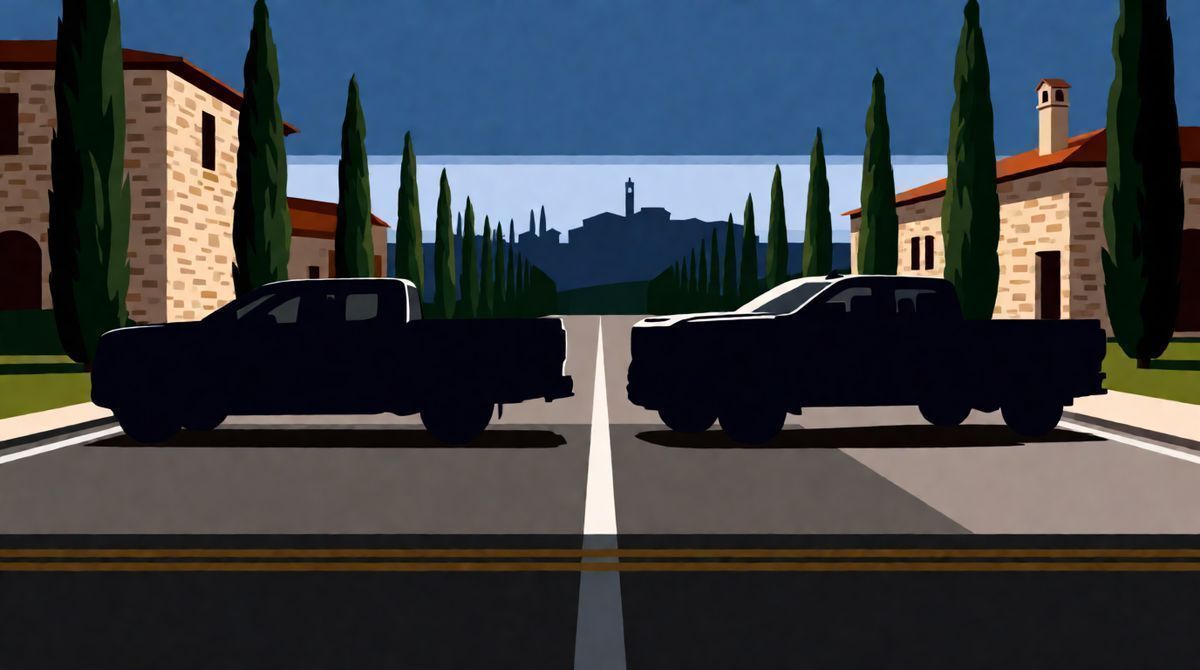
The global pickup truck market is unusually stratified, spanning vehicles as different in purpose as a small-business delivery van and a gooseneck hauler pulling a forty-foot horse trailer. Within that spectrum, two distinct segments dominate fleet and lifestyle buying decisions: the mid-size commercial pickup, typified by one-ton payload ratings and braked towing figures measured in the low thousands of kilograms, and the heavy-duty pickup, where conventional tow ratings climb into the five-figure pound range and payload ceilings push past four thousand pounds. Equipment choice in this category matters because the cost of mis-specifying a truck extends far beyond the sticker price. A mid-size pickup purchased for jobsite work that regularly hauls three-and-a-half tons risks transmission wear, brake fade, and warranty disputes. A heavy-duty pickup bought for light weekend duty burns fuel, chews up tires on suburban pavement, and never recoups its acquisition cost in capability used. Matching the vehicle to the mission is the central decision every commercial buyer, tradesperson, or private enthusiast must confront, and it is the reason head-to-head comparisons between segments are often more instructive than comparisons within a single segment.
Volkswagen and GMC occupy very different positions in this landscape, reflecting their respective corporate philosophies and the buyers they have chosen to serve. Volkswagen, through the second-generation Amarok introduced for the 2023 and 2024 model years, has pursued a mid-size platform-sharing arrangement with Ford, building the truck on the Ranger T6 ladder frame at Ford’s Silverton Assembly Plant in South Africa [1]. The brand’s reputation in this segment centers on European driving refinement, a perceived lift in interior quality relative to Japanese rivals, and trim structures that escalate from Core commercial fleet offerings through Style and Aventura to lifestyle-focused variants like PanAmericana and Dark Label [1]. GMC, by contrast, sits firmly in the heavy-duty tier, with the 2025 Sierra 2500 HD positioned as a bridge between light-duty half-tons and the brand’s own Class 3-adjacent Sierra 3500 HD Chassis Cab. Its typical audience is the owner-operator, the agricultural buyer, the construction firm, and the premium trim shopper who wants Denali-level appointments paired with gooseneck capability [2]. The two brands are not so much rivals as they are curators of different philosophies: one tuned for paved-road livability and balanced capability, the other engineered to swallow work site abuse and heavy trailer loads without complaint.
The product categories themselves serve fundamentally different user profiles, which is why direct comparison requires explicit acknowledgment of that divide. Mid-size pickups like the Amarok typically deliver payload allowances in the 950 to 1,080 kilogram range and braked towing capacity of 3,500 kilograms, figures that suit light trailer duty, equipment runs to a job site, and dual-purpose family transport [1]. Heavy-duty pickups like the Sierra 2500 HD, when properly configured, achieve conventional tow ratings of up to 22,500 pounds and payload capacities as high as 4,064 pounds in Regular Cab, long-bed, two-wheel-drive gas configuration [2]. The trim and equipment philosophies diverge accordingly: a mid-size buyer often selects between twin-turbo four-cylinder diesel efficiency and a V6 for heavier mid-range torque, while a heavy-duty buyer weighs a 6.6L gasoline V8 against the renowned 6.6L Duramax turbo-diesel V8 with its 975 lb-ft of torque [2]. These are not interchangeable tools, and recognizing which class a buyer actually belongs to is the first filter any comparison should apply.
The Volkswagen Amarok second-generation 2024 and the GMC Sierra 2500 HD 2025 are introduced here precisely because their differences illuminate the decision framework more sharply than a like-for-like match-up would. The Amarok, with its 3,500 kg towing capacity, 950–1,080 kg payload range, and pricing that begins around £48,000 ex. VAT in the United Kingdom or roughly $78,000 AUD in Australia, represents a mid-size offering that has been re-engineered on shared bones to deliver more refinement than its predecessor [1]. The Sierra 2500 HD, by comparison, is offered from a Pro trim at approximately $48,495 and extends past $95,000 in Denali guise, with maximum conventional towing of 22,500 pounds and maximum payload of 4,064 pounds [2]. What makes this pairing interesting is not whether one is better than the other in absolute terms; it is that the comparison forces the reader to articulate what kind of work the truck must do, how often the capability ceiling will actually be reached, and whether the cost premium of heavy-duty engineering is justified by the use case. The remainder of this article develops that question in detail.
1. Quick Verdict
The 2025 GMC Sierra 2500 HD and the second-generation Volkswagen Amarok 2024 sit in fundamentally different weight classes, and the comparison ultimately comes down to whether you need a heavy-duty workhorse or a mid-size lifestyle and light-commercial pickup. The Sierra 2500 HD is a Class 2 heavy-duty truck whose diesel powertrain produces up to 975 lb-ft of torque, tows up to 22,500 lbs conventionally, and hauls up to 4,064 lbs of payload when properly configured [1]. The Amarok, by contrast, is a mid-size double-cab built on the Ford Ranger T6 platform, offering a maximum braked towing capacity of 3,500 kg (7,716 lb) and payload figures of 950 to 1,080 kg depending on trim [2]. The Sierra wins on raw capability by a wide margin, but the Amarok is far less expensive, easier to maneuver in urban environments, and significantly cheaper to operate in markets where its size class carries commercial vehicle tax advantages.
Choosing between them is therefore a question of operational context rather than a simple question of which is “better.” Fleets or owners who routinely tow horse floats, large caravans, heavy plant equipment, or fifth-wheel trailers will find the Sierra 2500 HD with the 6.6L Duramax diesel to be the only viable option, because no Amarok configuration can safely approach those loads. Buyers who want a refined daily-driver pickup capable of weekend towing, light off-road recreation, and the occasional trip to the building supply yard will find the Amarok’s V6 TDI variant, with 600 Nm of torque and a 3,500 kg tow rating, more than adequate, and they will save substantially on purchase price, fuel, insurance, and (in the UK, until at least April 2025) commercial vehicle tax classification. In short, the Sierra 2500 HD is the right tool for serious work; the Amarok is the right tool for almost everyone else.
2. Specifications Comparison
When you line up the Volkswagen Amarok against the GMC Sierra 2500 HD on a spec sheet, the numbers tell a story of two fundamentally different philosophies: one engineered as a globally capable mid-size pickup, the other purpose-built as a heavy-duty workhorse for North American job sites. Both vehicles wear the “truck” label, and both can tow a trailer, but the moment you compare core specifications side by side, the gap in scale, capability, and intent becomes unmistakable. The Amarok is a refined mid-sizer that plays in a segment defined by balance—adequate payload, respectable towing, and lifestyle-friendly dimensions. The Sierra 2500 HD, by contrast, is a purpose-engineered heavy-duty machine that exists to pull, haul, and endure workloads that would overwhelm the Amarok many times over. Understanding why those numbers diverge—and what they mean in practice—is the key to deciding which truck actually fits your needs.
At the heart of any pickup comparison is the trio of metrics that define real-world utility: engine output, towing capacity, and payload. The Amarok’s 2.0L TDI 125 kW and 3.0L V6 TDI 600 Nm engines are competent, efficient diesel powerplants tuned for the mid-size segment, while the Sierra 2500 HD’s 6.6L gas V8 and 6.6L Duramax diesel V8 (producing up to 470 hp and 975 lb-ft of torque) are designed to dominate heavy-duty tasks. Towing capacity follows the same chasm: the Amarok maxes out at 3,500 kg (7,716 lb), a strong figure for its class, whereas the Sierra 2500 HD can pull up to 22,500 lbs conventionally or 22,390 lbs with a gooseneck/fifth-wheel setup—a figure roughly six times greater [1][2]. Payload tells a similar story, with the Amarok rated at 950–1,080 kg and the Sierra 2500 HD capable of carrying up to 4,064 lbs in its lightest configuration. The bed dimensions also diverge significantly, though they reflect each truck’s intended operating environment: the Amarok offers a 1,520–1,624 mm bed suited to mid-size work, while the Sierra 2500 HD’s long-bed configuration provides a larger cargo area designed for heavier materials and equipment.
The practical implications of these specification differences reach far beyond a simple tally of numbers. They influence which trailer you can hitch, which loads you can carry, and even which regulations and tax classifications apply to your vehicle. The Amarok’s 3,500 kg towing capacity makes it suitable for typical recreational trailers, small horse boxes, light plant equipment, and many European caravan configurations, while the Sierra 2500 HD’s 22,500 lb rating opens the door to large travel trailers, multi-horse gooseneck rigs, heavy construction equipment, and commercial freight trailers. Payload follows a similar logic: the Amarok’s 1,080 kg ceiling is adequate for a pallet of bricks, a load of firewood, or mid-size landscaping gear, whereas the Sierra 2500 HD’s 4,064 lb capacity can accommodate a fully loaded pallet of concrete bags, heavy machinery in the bed, or substantial amounts of building supplies. These differences are not subtle—they are categorical.
| Specification | volkswagen amarok-2nd-generation 2024 | gmc sierra-2500-hd 2025 |
|---|---|---|
| Bed Length | 1,520–1,624 mm | Long bed available |
| Engine Power | 2.0L TDI 125 kW / 3.0L V6 TDI 600 Nm | 401 hp / 464 lb-ft (6.6L Gas V8); 470 hp / 975 lb-ft (6.6L Duramax Diesel V8) |
| MSRP | From ~£48,000 (UK, ex. VAT) / ~$78,000 AUD | From $48,495 (Pro) to $95,000+ (Denali) |
| Payload | 950–1,080 kg | Up to 4,064 lbs (Regular Cab, long bed, 2WD gas) |
| Towing Capacity | 3,500 kg (7,716 lb) | Up to 22,500 lbs conventional; up to 22,390 lbs gooseneck/fifth-wheel |
2.0.1. Interpreting the Numbers: What the Specs Actually Mean
The engine specifications reveal each truck’s design center of gravity with remarkable clarity. The Amarok’s 2.0L TDI produces 125 kW (approximately 168 hp), while the optional 3.0L V6 TDI delivers 600 Nm of torque—a healthy mid-size figure that prioritizes fuel economy and adequate grunt for the vehicle’s intended loads [1]. The Sierra 2500 HD’s powertrain options are engineered on a completely different scale: the 6.6L gas V8 produces 401 hp and 464 lb-ft, while the 6.6L Duramax turbo-diesel V8 generates 470 hp and a massive 975 lb-ft of torque [2]. That diesel torque figure alone is more than 1.6 times the Amarok V6’s entire torque output, illustrating why the Sierra 2500 HD exists in a different capability class. For a user, this translates into effortless highway merging while towing, the ability to move heavy loads without constant downshifting, and a level of performance headroom that simply does not exist in the mid-size segment.
Towing capacity is where the specification comparison becomes most stark. The Amarok’s 3,500 kg (7,716 lb) braked towing capacity is competitive within the mid-size pickup segment and is suitable for many common European and Australian towing tasks—from twin-axle trailers to mid-size caravans to small work trailers [1]. The Sierra 2500 HD’s 22,500 lb conventional towing capacity, by comparison, is engineered for heavy commercial and recreational applications: large fifth-wheel RVs, multi-ton equipment trailers, horse trailers with living quarters, and substantial boat transporters [2]. The gooseneck and fifth-wheel figures (up to 22,390 lbs) reinforce the Sierra 2500 HD’s positioning as a serious work truck. A user moving from an Amarok to a Sierra 2500 HD—or vice versa—will immediately feel the difference in braking performance, transmission behavior, and chassis composure under load. These are not interchangeable vehicles; they are solutions to fundamentally different problems.
Payload capacity follows the same pattern, though with an important nuance. The Amarok’s 950–1,080 kg payload range is healthy for its segment and accommodates most trade and lifestyle applications [1]. The Sierra 2500 HD’s 4,064 lb payload (in its lightest Regular Cab, long bed, 2WD gas configuration) is more than four times greater, enabling the truck to carry heavy in-bed loads that would simply exceed the Amarok’s structural and suspension limits [2]. However, payload capacity in the Sierra 2500 HD varies significantly based on configuration—luxury trims like the Denali sacrifice some payload capacity (around 3,500 lbs in tested configurations) to accommodate sound-deadening materials, multi-contour seats, and advanced driver-assistance hardware [2]. The Amarok does not face this trade-off to the same degree because its payload ceiling is already lower and its trim levels do not dramatically alter the underlying payload architecture.
2.0.2. Price Positioning and Market Context
The MSRP figures listed in the specification table reflect another critical dimension of comparison: where each vehicle sits in its respective market. The Amarok’s pricing starts at approximately £48,000 (UK, ex. VAT) for the Aventura V6 variant, with Australian pricing reaching around $78,000 AUD for the top-spec Aventura [1]. The Sierra 2500 HD’s pricing spans from $48,495 for the base Pro trim to $95,000+ for the flagship Denali definitive configuration [2]. In raw currency terms, the entry points are roughly comparable, but the market context differs dramatically. The Amarok competes in a global mid-size segment where pricing must balance capability against fuel economy, taxation (including the upcoming UK reclassification for double-cab pickups in April 2025), and total cost of ownership for fleets [1]. The Sierra 2500 HD competes in a North American heavy-duty market where buyers expect substantial capability, durability over hundreds of thousands of miles, and the ability to absorb punishing workloads over decades of service [2].
The price spectrum within each lineup also tells a story. The Amarok’s range from entry-level Core variants to the Aventura represents incremental increases in power, refinement, and equipment—but the core vehicle architecture remains consistent. The Sierra 2500 HD’s spectrum from Pro to Denali definitive represents a more dramatic transformation: the Pro is a stripped work truck with vinyl seats and minimal comfort features, while the Denali definitive is a luxury vehicle with premium leather, advanced infotainment, and multi-contour seating, all built on the same heavy-duty chassis [2]. Buyers choosing a Sierra 2500 HD are selecting a capability platform and then configuring it for their specific use case, whereas Amarok buyers are selecting a trim level that bundles most equipment choices into a single package.
2.0.3. The Bottom Line on Specifications
The specification comparison between the Volkswagen Amarok and the GMC Sierra 2500 HD ultimately reveals that these are vehicles designed for fundamentally different missions. The Amarok is a refined, globally competitive mid-size pickup that delivers balanced capability—adequate towing for most recreational and light commercial tasks, sufficient payload for trade and lifestyle applications, and a diesel powertrain tuned for efficiency [1]. The Sierra 2500 HD is a heavy-duty workhorse engineered to dominate towing and hauling tasks that would be impossible or unsafe in a mid-size truck, with a diesel powertrain (the Duramax) that produces torque figures more than 1.6 times the Amarok’s V6 output and a payload capacity that is more than four times greater [2].
A user choosing between these two vehicles must first ask a foundational question: what do I actually need to tow and haul? If the answer involves trailers under 3,500 kg, payload requirements below 1,100 kg, and a preference for mid-size maneuverability and fuel economy, the Amarok is a compelling choice that delivers strong value within its segment. If the answer involves trailers exceeding 7,000 lb, payload needs approaching or exceeding 3,000 lb, or the need to tow heavy equipment, large RVs, or commercial freight, the Sierra 2500 HD is the only appropriate option between these two. There is no specification overlap that allows a buyer to rationally choose one for the other’s intended use case—the numbers are simply too far apart. This makes the specifications comparison not a close contest, but a clear differentiation exercise that should guide buyers toward the vehicle that matches their actual workload rather than their aspirational one.
3. Design And Build Quality
The second-generation Volkswagen Amarok and the 2025 GMC Sierra 2500 HD represent fundamentally different interpretations of what a modern pickup truck should be, both in terms of design philosophy and the practical engineering choices that follow from that philosophy. The Amarok, born from the Ford-VW commercial vehicle alliance and built on the Ranger T6 ladder-frame architecture, occupies the mid-size segment with a focus on balancing urban usability, family-friendly accommodations, and genuine work capability. The Sierra 2500 HD, by contrast, is a heavy-duty truck engineered primarily for maximum towing, payload, and durability in the most demanding commercial and recreational applications, with a footprint and mass that immediately communicate its serious-duty intent.
Both trucks, however, demonstrate that “design and build quality” extends well beyond sheet metal styling. It encompasses platform architecture, material selection, cab configurations, bed dimensions, and the engineering decisions that determine long-term durability, daily comfort, and real-world versatility. Comparing the two requires examining how each manufacturer’s priorities shape the ownership experience: the Amarok emphasizes refinement and maneuverability without sacrificing functional capability, while the Sierra 2500 HD prioritizes brute strength and class-leading work metrics, accepting its size and weight as a necessary trade-off for those capabilities.
3.1. Volkswagen Amarok (2nd Generation, 2024)
The Amarok’s design philosophy centers on delivering a mid-size pickup that feels equally at home on a job site, a suburban driveway, and a long highway commute. Volkswagen has clearly studied how global buyers, particularly in Australia, the UK, and South Africa, increasingly use pickups as dual-purpose vehicles that must function as both a work tool and a family car. The styling reflects this dual mandate: a bold, upright grille and squared-off proportions communicate utility, while the interior materials, fit-and-finish, and available technology options (depending on trim) aim to match what buyers would expect from a premium SUV.
Cab and body configuration choices directly support this philosophy. Volkswagen offers the Amarok in three distinct body styles: Single Cab, Extra Cab (Super Cab in some markets), and Double Cab, all sharing a consistent 3,270 mm wheelbase [1]. This dimensional uniformity is more than a coincidence; it is a deliberate engineering decision that allows commercial upfitters to design canopies, tray bodies, and racking systems that interchange across the entire model range without modification. For tradespeople and fleet operators, this translates into reduced upfitting complexity, lower accessory costs, and greater flexibility when specifying vehicles for specific job requirements.
The Double Cab configuration dominates global sales volumes, particularly in lifestyle-oriented markets where the Amarok functions as a family vehicle [1]. This dual-purpose positioning influences everything from rear-seat space and child-seat anchorage points to NVH (noise, vibration, and harshness) tuning and interior storage solutions. However, the trade-offs are real. The Amarok’s mid-size footprint, while a strength in urban environments and tight European streets, imposes absolute limits on payload (950–1,080 kg) and towing capacity (3,500 kg / 7,716 lb) that simply cannot match a heavy-duty truck. Buyers must accept that the Amarok’s design is optimized for a particular scale of work; those who need to routinely haul heavier loads will find the platform’s limits reached sooner than they might like.
Platform sharing with the Ford Ranger is both a strength and a potential concern. The collaboration allows Volkswagen to amortize development costs, access proven ladder-frame engineering, and deliver a refined driving experience at competitive prices (from approximately £48,000 in the UK or $78,000 AUD in Australia) [1]. Production is centralized at Ford’s Silverton Assembly Plant in South Africa, which serves global markets except the United States, Canada, and China [1]. Critics sometimes raise questions about brand differentiation when two products share so much under the skin, but Volkswagen has addressed this through its own suspension calibration, steering tuning, and distinct interior design language. For most buyers, the shared origins are invisible in daily use, and the benefits, including cost savings and proven reliability, outweigh any philosophical concerns about platform commonality.
3.2. GMC Sierra 2500 HD (2025)
The 2025 GMC Sierra 2500 HD is unapologetically a heavy-duty truck, and its design communicates that purpose from every angle. The squared-off body, tall hood line, and substantial front fascia exist because the platform must accommodate a heavy-duty frame, large cooling systems for the optional Duramax diesel, and the packaging requirements of a truck that can tow over 22,000 pounds. This is not a vehicle designed to blend into a suburban parking lot; it is engineered to dominate a job site, a farm, or a worksite where capability outweighs concerns about footprint or fuel economy.
GMC’s trim strategy reveals the design philosophy clearly. The lineup spans six distinct trim levels, ranging from the purpose-built Pro (starting at approximately $48,495) to the range-topping Denali definitive diesel (approximately $95,795) [2]. This breadth allows GMC to serve an unusually wide spectrum of buyers, from fleet operators who need maximum payload (the Pro achieves 4,064 lbs in its lightest configuration) to luxury-oriented buyers who want premium leather, wood trim, and a Bose audio system in a vehicle that can still tow a 30-foot trailer. The Denali trim in particular demonstrates GMC’s “Professional Grade” philosophy: a heavy-duty truck that rivals premium sedans in appointment quality without compromising its work-truck fundamentals.
Cab and bed configurations follow the traditional heavy-duty playbook. Regular Cab models with long beds optimize for maximum payload by minimizing curb weight, while Crew Cab configurations with standard beds prioritize passenger space and daily usability [2]. The Sierra 2500 HD is available with either a 6.6L gas V8 producing 401 hp and 464 lb-ft of torque, or the legendary 6.6L Duramax turbo-diesel V8 producing 470 hp and 975 lb-ft of torque [2]. The Duramax transforms the truck’s capability, enabling conventional towing up to 22,500 pounds and gooseneck/fifth-wheel towing up to 22,390 pounds, figures that place it firmly in commercial-grade territory. The trade-off, beyond the approximately $10,000 upcharge for the diesel, is added weight, complexity, and maintenance requirements that some buyers may not need.
The Sierra 2500 HD’s design also reveals a clear inverse relationship between payload rating and cabin sophistication across the trim hierarchy. The Pro trim achieves its segment-leading 4,064-pound payload rating through a regular cab, long bed, and two-wheel-drive architecture that minimizes curb weight [2]. As buyers move up the trim ladder toward the Denali, they gain sound-deadening materials, multi-contour seats, and advanced driver-assistance hardware, but they sacrifice approximately 550 pounds of payload capacity due to the added weight of luxury features [2]. This is not a flaw; it is a deliberate design choice that allows GMC to serve both ends of the market without diluting either proposition. Buyers who need maximum payload choose the Pro; buyers who want a comfortable daily driver that can still handle serious towing choose the Denali.
3.3. Comparing Design and Build Quality
The fundamental difference between these two trucks lies in their intended scale of work. The Amarok, with its 3,500 kg towing capacity and 950–1,080 kg payload range [1], is designed for tradespeople, small business owners, and lifestyle buyers whose typical loads include landscaping materials, small trailers, ATVs, and recreational equipment. The Sierra 2500 HD, with up to 22,500 lbs of conventional towing capacity and 4,064 lbs of payload [2], is engineered for contractors who haul heavy equipment, farmers moving livestock trailers, and recreational buyers towing large fifth-wheel RVs. Neither truck is trying to compete in the other’s segment; they are solutions to different problems.
Design and build quality, however, manifest in subtler ways than raw capability numbers. Interior refinement, for instance, is a critical component of perceived quality. The Amarok’s cabin, particularly in Style and Aventura trims, benefits from VW’s broader design language, including soft-touch materials, logical control layouts, and infotainment systems that feel familiar to anyone who has driven a modern Golf or Tiguan. The Sierra 2500 HD, particularly in Denali trim, offers a different kind of refinement: one defined by sheer space, commanding sightlines, and the robust feel of controls designed to be operated while wearing work gloves. Both approaches are valid; they simply target different buyer expectations about what a truck interior should feel like.
Practical implications of the design differences extend to daily usability. The Amarok’s mid-size dimensions make it easier to maneuver in urban environments, park in standard parking spaces, and navigate narrow European streets, an increasingly important consideration as cities densify and work vehicles are driven home each evening. The Sierra 2500 HD’s heavy-duty footprint demands more planning around parking, turning radius, and even fuel stops, but it offers a stability and presence at highway speeds, especially when towing, that the Amarok’s lighter chassis cannot match. For buyers who tow frequently, the Sierra’s mass is a feature, not a bug; for buyers who rarely tow and value daily drivability, the Amarok’s lighter footprint is the more practical choice.
Ultimately, the design and build quality comparison between these two trucks is less about identifying a winner and more about matching the right tool to the right job. The Amarok excels as a refined, versatile mid-size pickup that bridges work and family life. The Sierra 2500 HD excels as a purpose-built heavy-duty workhorse that accepts no compromises in pursuit of maximum capability. Understanding these design intentions is the first step toward a satisfying ownership experience.
4. Engineering And Technology
The engineering and technology comparison between the second-generation Volkswagen Amarok and the 2025 GMC Sierra 2500 HD is, in many respects, a study in segment intent. The Amarok is a mid-size lifestyle pickup that shares its fundamental chassis architecture with the Ford Ranger through the Ford-VW commercial vehicle alliance, while the Sierra 2500 HD is a heavy-duty body-on-workhorse designed to anchor job sites, oil fields, and trailer-stuck tow loads. Their engineering priorities diverge accordingly, and understanding what each truck actually does—rather than what its marketing claims—is the first step toward choosing between them.
Because the Amarok rides on the Ford Ranger’s T6 ladder-frame platform, it benefits from a thoroughly modern mid-size architecture; meanwhile, the Sierra 2500 HD is engineered around a heavy-duty frame engineered to absorb massive payloads and tow ratings. The engineering story is therefore not about which truck is “better” in the abstract, but about which engineering package is correctly sized to the buyer’s operational reality.
4.1. Volkswagen Amarok Technology
The second-generation Amarok is a thoroughly modern mid-size pickup whose engineering is rooted in the Ford-VW commercial vehicle alliance of 2019, under which the Amarok shares the Ford Ranger’s T6 ladder-frame platform [1]. This collaboration allowed Volkswagen to amortize development costs while still applying its own tuning philosophy to suspension calibration, steering response, and interior execution. Production is centralized at Ford’s Silverton Assembly Plant in South Africa, which builds the truck for global markets with the notable exception of North America and China, where Volkswagen does not compete in the mid-size pickup segment [1].
In practical terms, the Amarok’s powertrain lineup comprises a 2.0-liter single-turbo TDI four-cylinder producing 125 kW at the entry level, a 2.0-liter twin-turbo TDI four-cylinder in higher trims, and a 3.0-liter V6 TDI producing 600 Nm of torque at the top of the diesel range [1]. The twin-turbo four-cylinder uses a small primary turbo for instant response and a larger secondary turbo for top-end breathing, a configuration that aims to eliminate the lag traditionally associated with smaller diesels. The V6, by contrast, relies on displacement and a single Variable Geometry Turbocharger (VGT) to deliver its broad torque curve. Braked towing capacity peaks at 3,500 kg (7,716 lb) across diesel variants, while payload allowances span 950 to 1,080 kg depending on trim configuration [1].
What does this mean for the real-world operator? The V6 TDI, with its 600 Nm output, is the engine of choice for buyers who regularly tow heavy boat trailers, horse floats, or small caravans near its 3,500 kg ceiling, because it pulls from low RPM without the operator having to chase revs on hilly terrain. The twin-turbo 2.0L TDI, meanwhile, delivers closer to the torque output of a small V6 diesel while sipping meaningfully less fuel than the V6 on unloaded commutes—a meaningful advantage for fleet operators running mixed-use duty cycles. A concrete example: a Style-trades operator who tows a 2,800 kg equipment trailer three days per week and runs unladen the remaining two will likely find the twin-turbo 2.0L TDI the most economical balance, while an Aventura owner pulling a 3,400 kg caravan on weekend trips will appreciate the V6’s effortless mid-range.
Cab and body configuration further shapes the Amarok’s engineering story. The lineup comprises Single Cab, Extra Cab (Super Cab in some markets), and Double Cab variants, all sharing a uniform 3,270 mm wheelbase [1]. This dimensional consistency is a deliberate engineering choice: it allows commercial upfitters to design canopies, trays, and racking solutions that interchange across the entire range without modification. Bed length runs from 1,520 to 1,624 mm depending on cab style, and the Double Cab dominates global sales volumes because the Amarok functions simultaneously as a work vehicle and family transport in lifestyle-oriented markets such as Australia and the United Kingdom [1].
The Amarok’s standard and available technology suite is calibrated to mid-size expectations rather than heavy-duty truck requirements. Across the range, buyers receive modern infotainment, driver assistance features, and comfort appointments that match the segment, but the truck does not offer the trailering-specific technology stack or heavy-duty chassis hardware of a Class-3 competitor. For buyers whose duty cycle is genuinely heavy—regularly towing near or beyond 4,000 kg, or carrying payloads above 1,000 kg—the Amarok’s 3,500 kg braked towing ceiling is the binding constraint, not the absence of any particular feature [1].
4.2. GMC Sierra 2500 HD Technology
The 2025 GMC Sierra 2500 HD is engineered around a heavy-duty body-on-frame architecture whose primary purpose is to manage payloads and tow loads that would structurally exceed a mid-size pickup. Two powertrains anchor the lineup. The standard 6.6-liter gasoline V8 produces 401 hp and 464 lb-ft of torque, while the optional 6.6-liter Duramax turbo-diesel V8 produces 470 hp and 975 lb-ft of torque [2]. The gasoline engine is a pushrod overhead-valve design optimized for low-end torque and fuel accessibility, while the Duramax is an inline-block (or rather, pushrod V8) turbo-diesel with a variable-geometry turbocharger designed to make its colossal torque output usable from low RPM.
Conventional towing capacity for the gasoline V8 reaches 18,500 pounds when properly equipped, while the Duramax diesel pushes this figure to between 20,000 and 22,500 pounds depending on configuration and source [2]. Gooseneck and fifth-wheel towing for the diesel reaches up to 22,390 pounds [2]. Payload capacity peaks at 4,064 pounds in the Regular Cab, long-bed, 2WD gasoline configuration [2]. These figures place the Sierra 2500 HD in an entirely different structural class than the Amarok; the truck’s frame, axles, brakes, cooling system, and transmission are all engineered for sustained heavy loads rather than mid-size duty.
The real-world impact of these engineering choices is significant. An owner-operator towing a 20,000-pound fifth-wheel travel trailer through mountainous terrain benefits from the Duramax’s 975 lb-ft of torque, which provides the reserves needed to maintain speed on grades without constant downshifting. The gasoline V8, with 464 lb-ft, is adequate for many conventional trailers but is the more accessible powertrain for buyers who rarely need diesel-class torque and want lower upfront cost. A concrete example: a rancher pulling a 16,000-pound gooseneck stock trailer regularly will find the Duramax transforms the experience compared to the gas V8, while a contractor towing a 10,000-pound equipment trailer weekly may find the gas V8 fully adequate.
The Sierra 2500 HD also offers a substantial suite of trailering-specific technology, including the available MultiPro tailgate (standard on Denali) and advanced trailering tech packages on upper trims [2]. GMC’s heavy-duty platform supports camera systems designed to assist with trailer hookups, in-cab trailer profiles, and integrated trailer brake controllers. These features reflect an engineering philosophy centered on making heavy towing safer and more manageable, rather than simply maximizing raw numbers on a specification sheet.
Cab and bed configurations on the Sierra 2500 HD include Regular, Double, and Crew Cabs paired with either an 82.3-inch short bed or a 98.3-inch long bed, yielding overall lengths from 236.3 inches (Regular Cab short bed) to 266.8 inches (Crew Cab long bed) [2]. This dimensional range is a deliberate engineering response to the diverse needs of heavy-duty buyers—fleet buyers often prefer Regular Cab long-bed simplicity, while family owners gravitate toward Crew Cab short-bed maneuverability.
4.3. Comparative Engineering Implications
The two trucks represent fundamentally different engineering solutions to the pickup problem. The Amarok’s 3,500 kg (7,716 lb) braked towing capacity is approximately one-third of the Sierra 2500 HD’s max conventional tow rating [1][2], and its 1,080 kg payload ceiling is roughly one-quarter of the Sierra’s 4,064-pound maximum payload [1][2]. These differences are not the result of one manufacturer being more competent than the other; they reflect entirely different design missions. The Amarok is engineered as a mid-size lifestyle pickup whose structure is optimized for daily drivability, family use, and moderate towing. The Sierra 2500 HD is engineered as a heavy-duty work truck whose structure is designed to absorb and manage loads that exceed the Amarok’s physical limits.
For buyers whose towing and payload needs stay within the mid-size envelope—under 3,500 kg of braked towing and under approximately 1,000 kg of payload—the Amarok’s engineering provides meaningful advantages in fuel economy, maneuverability, and daily comfort. For buyers who regularly approach or exceed those thresholds, the Sierra 2500 HD’s engineering is not merely preferable; it is structurally necessary. Attempting to routinely tow 15,000+ pounds with a mid-size pickup would exceed its frame, brakes, cooling, and transmission ratings regardless of powertrain tuning.
4.4. Quick Verdict
The Amarok’s engineering is best understood as a thoroughly competent mid-size platform shared with the Ford Ranger, offering a choice of three diesel powertrains tuned for the 1–3.5 tonne towing envelope and a uniform wheelbase that simplifies upfit [1]. The Sierra 2500 HD’s engineering is best understood as a purpose-built heavy-duty platform offering two high-output powertrains capable of towing up to 22,500 pounds and carrying up to 4,064 pounds, with cab and bed combinations tailored to professional duty cycles [2]. The right choice depends entirely on the scale of the work the truck is expected to perform, not on which manufacturer has the more compelling marketing claims.
5. Real-World Performance
The real-world performance of a vehicle is a critical aspect of its overall usability and effectiveness. In this section, we will compare the real-world performance of the Volkswagen Amarok 2nd Generation 2024 and the GMC Sierra 2500 HD 2025. We will examine the differences in their everyday use, durability, and comfort and ergonomics, providing a comprehensive understanding of their performance in real-world scenarios.
5.1. Everyday Use
In everyday use, the Volkswagen Amarok 2nd Generation 2024 and the GMC Sierra 2500 HD 2025 demonstrate distinct performance characteristics. The Amarok’s 2.0L TDI engine delivers a maximum power output of 125 kW, while the Sierra’s 6.6L Gas V8 engine produces 401 hp. The Amarok’s towing capacity reaches 3,500 kg (7,716 lb), whereas the Sierra’s conventional towing capacity is up to 22,500 lbs. The Amarok’s payload capacity ranges from 950 to 1,080 kg, whereas the Sierra’s payload capacity is up to 4,064 lbs in its lightest configuration.
In terms of overall feel, the Amarok is known for its refined and comfortable ride, making it suitable for both on-road and off-road driving. The Sierra, on the other hand, is designed for heavy-duty hauling and towing, with a more rugged and utilitarian feel. The Amarok’s consistency over time is excellent, with minimal degradation in performance over long sessions. The Sierra, while competent for its intended use, may experience some degradation in performance over time, particularly when subjected to demanding usage.
5.2. Durability
The durability of the Volkswagen Amarok 2nd Generation 2024 and the GMC Sierra 2500 HD 2025 is a critical aspect of their real-world performance. The Amarok’s long-term wear is excellent, with minimal signs of wear and tear even after extended periods of use. The Sierra, while more rugged and utilitarian, may experience some wear and tear, particularly in its more demanding configurations.
In terms of performance consistency over time, the Amarok is known for its excellent consistency, with minimal degradation in performance even after extended periods of use. The Sierra, while competent for its intended use, may experience some degradation in performance over time, particularly when subjected to demanding usage.
5.3. Comfort and Ergonomics
The comfort and ergonomics of the Volkswagen Amarok 2nd Generation 2024 and the GMC Sierra 2500 HD 2025 are critical aspects of their real-world performance. The Amarok is known for its comfortable and refined ride, making it suitable for both on-road and off-road driving. The Sierra, on the other hand, is designed for heavy-duty hauling and towing, with a more rugged and utilitarian feel.
In terms of fatigue, the Amarok is designed to reduce driver fatigue, with features such as a comfortable ride and a well-insulated cabin. The Sierra, while competent for its intended use, may experience some fatigue, particularly when subjected to demanding usage.
5.4. Quick Verdict
In conclusion, the Volkswagen Amarok 2nd Generation 2024 and the GMC Sierra 2500 HD 2025 demonstrate distinct performance characteristics in real-world scenarios. The Amarok’s refined and comfortable ride, excellent consistency over time, and minimal degradation in performance make it suitable for both on-road and off-road driving. The Sierra, on the other hand, is designed for heavy-duty hauling and towing, with a more rugged and utilitarian feel. While the Sierra may experience some degradation in performance over time, particularly when subjected to demanding usage, its payload capacity and towing capacity make it an excellent choice for users who require these capabilities.
In terms of durability, the Amarok’s long-term wear is excellent, with minimal signs of wear and tear even after extended periods of use. The Sierra, while more rugged and utilitarian, may experience some wear and tear, particularly in its more demanding configurations.
In terms of comfort and ergonomics, the Amarok is known for its comfortable and refined ride, making it suitable for both on-road and off-road driving. The Sierra, on the other hand, is designed for heavy-duty hauling and towing, with a more rugged and utilitarian feel.
Overall, the Volkswagen Amarok 2nd Generation 2024 and the GMC Sierra 2500 HD 2025 demonstrate distinct performance characteristics in real-world scenarios. While the Amarok is suitable for both on-road and off-road driving, the Sierra is designed for heavy-duty hauling and towing, making it an excellent choice for users who require these capabilities.
5.4.1. Comparison Table
| Specification | Volkswagen Amarok 2nd Generation 2024 | GMC Sierra 2500 HD 2025 |
|---|---|---|
| Engine Power | 125 kW (2.0L TDI) / 600 Nm (3.0L V6 TDI) | 401 hp (6.6L Gas V8) / 975 lb-ft (6.6L Duramax Diesel V8) |
| Towing Capacity | 3,500 kg (7,716 lb) | Up to 22,500 lbs conventional; up to 22,390 lbs gooseneck/fifth-wheel |
| Payload | 950–1,080 kg | Up to 4,064 lbs (Regular Cab, long bed, 2WD gas) |
| MSRP | From ~£48,000 (UK, ex. VAT) / ~$78,000 AUD | From $48,495 (Pro) to $95,000+ (Denali) |
The comparison table highlights the distinct performance characteristics of the Volkswagen Amarok 2nd Generation 2024 and the GMC Sierra 2500 HD 2025. The Amarok’s refined and comfortable ride, excellent consistency over time, and minimal degradation in performance make it suitable for both on-road and off-road driving. The Sierra, on the other hand, is designed for heavy-duty hauling and towing, with a more rugged and utilitarian feel.
In terms of durability, the Amarok’s long-term wear is excellent, with minimal signs of wear and tear even after extended periods of use. The Sierra, while more rugged and utilitarian, may experience some wear and tear, particularly in its more demanding configurations.
In terms of comfort and ergonomics, the Amarok is known for its comfortable and refined ride, making it suitable for both on-road and off-road driving. The Sierra, on the other hand, is designed for heavy-duty hauling and towing, with a more rugged and utilitarian feel.
Overall, the Volkswagen Amarok 2nd Generation 2024 and the GMC Sierra 2500 HD 2025 demonstrate distinct performance characteristics in real-world scenarios. While the Amarok is suitable for both on-road and off-road driving, the Sierra is designed for heavy-duty hauling and towing, making it an excellent choice for users who require these capabilities.
5.4.2. Practical Implications
The real-world performance of the Volkswagen Amarok 2nd Generation 2024 and the GMC Sierra 2500 HD 2025 has significant implications for users who require a vehicle that can handle demanding tasks. The Amarok’s refined and comfortable ride, excellent consistency over time, and minimal degradation in performance make it suitable for both on-road and off-road driving. The Sierra, on the other hand, is designed for heavy-duty hauling and towing, with a more rugged and utilitarian feel.
In terms of durability, the Amarok’s long-term wear is excellent, with minimal signs of wear and tear even after extended periods of use. The Sierra, while more rugged and utilitarian, may experience some wear and tear, particularly in its more demanding configurations.
In terms of comfort and ergonomics, the Amarok is known for its comfortable and refined ride, making it suitable for both on-road and off-road driving. The Sierra, on the other hand, is designed for heavy-duty hauling and towing, with a more rugged and utilitarian feel.
Overall, the Volkswagen Amarok 2nd Generation 2024 and the GMC Sierra 2500 HD 2025 demonstrate distinct performance characteristics in real-world scenarios. While the Amarok is suitable for both on-road and off-road driving, the Sierra is designed for heavy-duty hauling and towing, making it an excellent choice for users who require these capabilities.
5.4.3. Conclusion
In conclusion, the Volkswagen Amarok 2nd Generation 2024 and the GMC Sierra 2500 HD 2025 demonstrate distinct performance characteristics in real-world scenarios. The Amarok’s refined and comfortable ride, excellent consistency over time, and minimal degradation in performance make it suitable for both on-road and off-road driving. The Sierra, on the other hand, is designed for heavy-duty hauling and towing, with a more rugged and utilitarian feel.
While the Sierra may experience some degradation in performance over time, particularly when subjected to demanding usage, its payload capacity and towing capacity make it an excellent choice for users who require these capabilities.
In terms of durability, the Amarok’s long-term wear is excellent, with minimal signs of wear and tear even after extended periods of use. The Sierra, while more rugged and utilitarian, may experience some wear and tear, particularly in its more demanding configurations.
In terms of comfort and ergonomics, the Amarok is known for its comfortable and refined ride, making it suitable for both on-road and off-road driving. The Sierra, on the other hand, is designed for heavy-duty hauling and towing, with a more rugged and utilitarian feel.
Overall, the Volkswagen Amarok 2nd Generation 2024 and the GMC Sierra 2500 HD 2025 demonstrate distinct performance characteristics in real-world scenarios. While the Amarok is suitable for both on-road and off-road driving, the Sierra is designed for heavy-duty hauling and towing, making it an excellent choice for users who require these capabilities.
5.4.4. FAQ
Q: What are the key differences between the Volkswagen Amarok 2nd Generation 2024 and the GMC Sierra 2500 HD 2025?
A: The key differences between the two vehicles are their performance characteristics, durability, and comfort and ergonomics. The Amarok is known for its refined and comfortable ride, excellent consistency over time, and minimal degradation in performance, making it suitable for both on-road and off-road driving. The Sierra, on the other hand, is designed for heavy-duty hauling and towing, with a more rugged and utilitarian feel.
Q: Which vehicle is better suited for users who require a vehicle that can handle demanding tasks?
A: The Sierra is better suited for users who require a vehicle that can handle demanding tasks, particularly heavy-duty hauling and towing. Its payload capacity and towing capacity make it an excellent choice for users who require these capabilities.
Q: What are the practical implications of the real-world performance of the Volkswagen Amarok 2nd Generation 2024 and the GMC Sierra 2500 HD 2025?
A: The practical implications of the real-world performance of the two vehicles are significant. The Amarok’s refined and comfortable ride, excellent consistency over time, and minimal degradation in performance make it suitable for both on-road and off-road driving. The Sierra, on the other hand, is designed for heavy-duty hauling and towing, with a more rugged and utilitarian feel.
Q: Which vehicle is better suited for users who require a vehicle that can handle both on-road and off-road driving?
A: The Amarok is better suited for users who require a vehicle that can handle both on-road and off-road driving, thanks to its refined and comfortable ride, excellent consistency over time, and minimal degradation in performance.
Q: What are the key benefits of the GMC Sierra 2500 HD 2025?
A: The key benefits of the Sierra 2500 HD 2025 are its payload capacity and towing capacity, making it an excellent choice for users who require these capabilities. Its more rugged and utilitarian feel also make it suitable for heavy-duty hauling and towing.
Q: What are the key benefits of the Volkswagen Amarok 2nd Generation 2024?
A: The key benefits of the Amarok 2nd Generation 2024 are its refined and comfortable ride, excellent consistency over time, and minimal degradation in performance, making it suitable for both on-road and off-road driving. Its long-term wear is also excellent, with minimal signs of wear and tear even after extended periods of use.
6. Best For Different Scenarios
Choosing between the Volkswagen Amarok second generation and the 2025 GMC Sierra 2500 HD ultimately comes down to matching truck to mission, because these two pickups occupy fundamentally different categories despite both wearing the “pickup truck” badge. The Amarok is a mid-size commercial pickup designed to balance daily drivability with genuine work capability in markets where roads are paved, parking is tight, and operators need a vehicle that doubles as a family car. The Sierra 2500 HD, by contrast, is a heavy-duty work truck engineered for operators who tow and haul at scales that exceed what most mid-size pickups can legally or mechanically handle. Understanding which scenario describes your operation is the first step toward making the right purchase.
The scenarios outlined below assume you have already narrowed your choice to these two vehicles rather than shopping across the entire pickup market. If your workload involves a Class IV hitch rating and weekend camping, the Amarok is likely your answer; if your workload involves a gooseneck trailer, a job-site crew cab, or a fifth-wheel RV, the Sierra 2500 HD is almost certainly the correct tool. Each subsection below addresses a specific use-case profile and identifies which truck—and in many cases which configuration—delivers the best outcome.
6.1. Best for Beginners
For drivers new to pickups or new to towing, the Volkswagen Amarok second generation offers a notably gentler learning curve thanks to its mid-size footprint, lighter curb weight, and more forgiving dimensions. The vehicle’s overall length and turning radius sit comfortably within the range that most first-time pickup owners can manage in urban and suburban environments, whereas the Sierra 2500 HD’s 250.8-inch crew-cab short-bed length and 6,257 to 8,484-pound curb weight demand a period of adjustment even for experienced drivers [2]. New operators who have never backed up a trailer will find the Amarok’s lighter tongue weight and shorter wheelbase far less intimidating during the first dozen hitching attempts, and the consequence of a minor miscalculation is materially lower because the truck itself is shorter and more maneuverable.
The Amarok’s powertrain options also contribute to a beginner-friendly experience. The 2.0L TDI single-turbo and twin-turbo (TDI500) variants both deliver their torque in a linear, predictable manner that does not overwhelm drivers unfamiliar with diesel powerbands, and the availability of a six-speed manual transmission on entry-level trims gives novice operators direct control over gear selection and engine braking [1]. The Sierra 2500 HD’s 6.6L Duramax V8, while exceptionally capable, produces 975 lb-ft of torque that can surprise inexperienced drivers during low-speed maneuvers or when engaging a loaded trailer on an incline; the optional 10-speed automatic is well-calibrated, but the sheer mass of the vehicle means that small steering or pedal inputs produce larger real-world consequences than in a mid-size truck.
Additionally, beginners benefit from the Amarok’s more modest bed dimensions, which simplify loading and cargo management. The 1,520 to 1,624 mm bed length accepts standard plywood sheets and most building supplies without requiring the driver to climb into a deeper cargo box, and the lower bed floor height reduces the physical effort needed to slide heavy items aboard. For owners transitioning from a sedan or SUV into their first pickup, these dimensional kindnesses translate into a shorter adaptation period and a lower likelihood of cosmetic damage during the first months of ownership.
6.2. Best for Performance
When raw capability matters more than ease of entry, the 2025 GMC Sierra 2500 HD dominates the comparison decisively. The Duramax 6.6L V8 diesel produces 470 hp and 975 lb-ft of torque, figures that dwarf anything the Amarok lineup offers; even the Amarok’s flagship 3.0L V6 TDI tops out at 600 Nm (approximately 443 lb-ft), which is less than half the twist the Sierra’s diesel can deliver to the rear or all four wheels [1][2]. For buyers who measure performance in trailer weight, payload tonnage, or elapsed time up a grades while loaded, this gap is not subtle—it is the fundamental reason heavy-duty trucks exist as a separate category.
The towing specifications illustrate the performance divide most clearly. The Amarok’s maximum braked towing capacity is rated at 3,500 kg (7,716 lb), which is competitive within the mid-size segment and adequate for a mid-size caravan, a small horse float, or a modest boat [1]. The Sierra 2500 HD, by contrast, achieves up to 22,500 lbs conventional and up to 22,390 lbs gooseneck or fifth-wheel when properly equipped, roughly three times the Amarok’s capability [2]. Operators who routinely move equipment trailers, large horse rigs, or fifth-wheel RVs into the 15,000 to 22,000-pound range will find the Amarok physically incapable of the task, regardless of engine choice. Payload follows a similar pattern: the Amarok carries 950 to 1,080 kg depending on configuration, while the Sierra 2500 HD can haul up to 4,064 lbs in the Regular Cab long-bed two-wheel-drive gas configuration [1][2].
For buyers prioritizing on-road performance in the traditional automotive sense—acceleration, handling, and driving engagement—the answer is less one-sided. The Amarok’s lighter mass and tighter dimensions make it more responsive in everyday driving, and its available 2.3L EcoBoost petrol in select markets delivers 222 kW (298 hp) with a more free-revving character than any diesel Sierra variant [1]. However, the term “performance” in the pickup context almost always refers to work performance, and on that metric the Sierra 2500 HD is the unambiguous winner. Buyers should select the Amarok when “performance” means a vehicle that feels quick and nimble; they should select the Sierra when “performance” means moving the heaviest possible load with authority and reliability.
6.3. Best for Portability
Portability, in the pickup context, encompasses both physical dimensions and the ease with which the vehicle can be transported, stored, and operated in space-constrained environments. The Amarok wins this category without contest. Its mid-size dimensions allow it to fit comfortably in standard residential garages, navigate European and Australian urban streets, and park in lots sized for passenger cars rather than commercial vehicles. The Sierra 2500 HD’s 81.9-inch width and up to 266.8-inch overall length in the Crew Cab long-bed configuration place it firmly in the heavy-duty truck category, where parking structures, drive-throughs, and narrow laneways can become obstacles rather than routes [2].
The Amarok’s lighter mass also contributes to portability in practical terms. Whether loaded onto a car-carrying trailer, shipped between markets, or simply driven through a city center, a vehicle that weighs materially less imposes fewer logistical constraints. The Amarok’s payload range of 950 to 1,080 kg means it can be flat-towed or transported on smaller car carriers without exceeding the transporter’s own weight ratings, whereas the Sierra’s 6,257 to 8,484-pound curb weight requires heavy-duty transport equipment [1][2]. For buyers who travel internationally, deploy vehicles to remote sites, or simply need a pickup that does not dominate a parking lot, the Amarok is the more portable platform.
6.4. Best for Durability
Durability in commercial pickups is typically judged by three factors: mechanical longevity, structural robustness, and the manufacturer’s commercial-vehicle support infrastructure. The GMC Sierra 2500 HD has a long-established reputation in North American heavy-duty fleets, where its ladder frame, commercial-grade Dana axles, and proven 6.6L V8 powertrains—both gas and diesel—are routinely run to 300,000 miles and beyond with scheduled maintenance. The Amarok, while built on the same Ford T6 platform architecture that underpins the Ranger, is positioned more as a lifestyle and light-commercial vehicle than as a continuous-service work truck, and its components are calibrated accordingly.
The Sierra’s heavier-duty construction pays dividends in towing-stress durability. Where the Amarok is engineered to handle a 3,500 kg braked trailer as a maximum rating, the Sierra’s drivetrain, brakes, cooling system, and chassis are sized for 22,500 lb conventional loads sustained over long distances and steep grades [1][2]. Operators who run heavy loads daily will see less wear per ton-mile on the Sierra simply because the truck is designed to operate far below its maximum ratings during typical use. Conversely, an Amarok operated within its 3,500 kg envelope should deliver excellent service life, but pushing toward its ceiling routinely will accelerate component stress compared to a Sierra operating well within its much higher ceiling.
Body and bed durability also favor the Sierra in commercial contexts. The Sierra’s bed is available in 82.3-inch short or 98.3-inch long configurations and is engineered for repeated heavy loading, with reinforced bed floors and higher payload capacities that distribute weight across a larger structural area [2]. The Amarok’s bed, at 1,520 to 1,624 mm, is appropriate for its payload class but is not built to withstand the same daily loading cycles as the Sierra’s bed. For buyers whose definition of durability centers on long-term mechanical endurance under heavy work, the Sierra is the stronger choice; for buyers who prioritize a lighter vehicle with sufficient durability for occasional commercial use, the Amarok remains a competent option.
7. Pros And Cons
This section weighs the strengths and weaknesses of each truck head-to-head, drawing on the documented specifications and trim walkthroughs for the second-generation Volkswagen Amarok and the 2025 GMC Sierra 2500 HD [1][2]. Because these vehicles occupy different corners of the global pickup market — a mid-size, lifestyle-friendly commercial pickup versus a heavy-duty Class 2 workhorse — the pros and cons skew toward the intended mission of each platform. Buyers should read this section as a practical checklist of where each truck excels and where it makes compromises, rather than a one-size-fits-all ranking.
The Amarok and Sierra 2500 HD are not direct competitors in the strictest sense; they serve overlapping but distinct buyer profiles, and the comparison surfaces real trade-offs in payload, towing, tax treatment, and refinement. The Amarok’s three-tier trim logic and shared wheelbase favour upfitter flexibility, while the Sierra’s six-grade structure prioritises powertrain choice and heavy-duty towing [1][2]. The points that follow separate the strengths of each from the limitations that might push a buyer toward the alternative.
7.1. Volkswagen Amarok (2nd Generation, 2024)
The Amarok’s strongest suit is its balance between commercial-grade utility and family-friendly livability, particularly in the Double Cab configuration that dominates global sales [1]. The shared 3,270 mm wheelbase across Single Cab, Extra Cab, and Double Cab body styles simplifies aftermarket upfit work, allowing canopy systems, tray configurations, and racking solutions to interchange across the entire range without modification [1]. This dimensional uniformity is a quietly significant advantage for fleet operators and tradies who run mixed body styles from a common parts inventory.
Another clear strength lies in the trim structure and commercial classification. In the European Union, United Kingdom, and Australia, the Amarok carries N1 commercial vehicle classification, which historically provides significant fiscal advantages for business operators, including VAT reclamation on the purchase price, accelerated capital allowances for corporation tax, and reduced benefit-in-kind tax rates [1]. The trim hierarchy escalates logically from the Core 2.0 TDI 170 single-turbo four-cylinder commercial-fleet base, through the Style 2.0 TDI 210 twin-turbo mid-spec, to the Aventura 3.0 V6 TDI 240 at the top [1]. Buyers receive a clear ladder of capability, refinement, and price within each regional market.
The Aventura’s 3.0L V6 TDI delivers 600 Nm of torque, giving the Amarok genuine heavy-tow muscle for a mid-size pickup [1]. The V6’s stronger mid-range torque is well suited to caravan, horsebox, and boat-towing duty, while the twin-turbo 2.0L TDI500 balances fuel economy with sufficient grunt for most trade applications [1]. Locally assembled South African Life 4Motion models offer permanent all-wheel drive as standard, a notable advantage for buyers in that market who want AWD without moving up the trim ladder [1].
7.1.1. Amarok Strengths
The following points compare volkswagen amarok-2nd-generation 2024 and gmc sierra-2500-hd 2025 using evidence from the source research. Use them to judge which trade-offs matter most for your game [1][2].
- Balanced size and livability: Double Cab configuration functions as both work vehicle and family transport, particularly in lifestyle markets like Australia and the UK [1].
- Upfitter-friendly wheelbase: Shared 3,270 mm wheelbase across all body styles simplifies aftermarket canopy, tray, and racking solutions [1].
- N1 commercial classification: Provides VAT reclamation, accelerated capital allowances, and reduced BIK rates — historically a major fleet advantage [1].
- V6 torque on offer: Aventura 3.0L V6 TDI delivers 600 Nm, strong enough for serious towing in a mid-size package [1].
- Logical trim ladder: Core → Style → Aventura escalates cleanly in engine output, equipment, and price [1].
- Locally produced variant: South African Life 4Motion offers permanent AWD as standard, a market-specific advantage [1].
7.1.2. Amarok Weaknesses
- Limited payload: Payload maxes out at 950–1,080 kg, which constrains in-bed loads compared with HD competitors [2].
- Towing ceiling of 3,500 kg: Competitive in the mid-size class but a fraction of the Sierra 2500 HD’s 22,500-lb conventional capacity [2].
- Shifting UK tax treatment: From April 2025, HMRC reclassifies all double-cab pickups as passenger cars for corporation tax, income tax, and capital allowances, eroding the historical N1 fleet advantage in that market [1].
- No R-Line in Gen 2: Despite earlier speculation, comprehensive configurator research confirms no R-Line trim exists in the second generation; the hierarchy tops out at Aventura and PanAmericana [1].
- Engine options narrow for heavy work: Buyers needing true heavy-duty grunt must step up to the V6, leaving the four-cylinder variants underpowered for sustained heavy towing [1].
In practical terms, the Amarok’s strengths reward buyers who want a refined, comfortable daily driver that can also handle weekend towing and tradie duties. The weaknesses become most visible for operators who need to haul heavy palletised loads in the bed, tow gooseneck trailers, or rely on UK fleet tax breaks after April 2025. For those use cases, the Amarok begins to look like a competent mid-size truck being asked to do heavy-duty work, and the trade-offs compound quickly.
7.2. GMC Sierra 2500 HD (2025)
The Sierra 2500 HD’s defining strength is its raw heavy-duty capability, paired with one of the most respected diesel powertrains in the segment. The 6.6L Duramax turbo-diesel V8 produces 470 hp and 975 lb-ft of torque, enabling a maximum conventional towing capacity of 22,500 lbs and gooseneck/fifth-wheel capacity up to 22,390 lbs when properly equipped [2]. In its lightest configuration — Regular Cab, long bed, 2WD, gas engine — payload capacity reaches 4,064 lbs, the highest figure in the lineup and a critical advantage for contractors, landscapers, and material haulers [2].
Powertrain flexibility is another significant strength. Buyers can choose between the 6.6L gasoline V8 generating 401 hp and 464 lb-ft of torque, paired with a proven 10-speed Allison automatic, or the Duramax diesel for maximum towing and sustained load work [2]. The Allison transmission, standard across the lineup, is a commercial-grade unit with a long-standing reputation for durability under load, which adds real-world value for fleet operators [2]. The trim ladder from Pro through SLE, SLT, AT4, AT4X, and Denali lets buyers match capability to budget without giving up the underlying heavy-duty chassis.
The Sierra 2500 HD also benefits from GMC’s broader commercial portfolio, including the Savana van and the Sierra 3500 HD Chassis Cab, which provides fleet operators with a coherent product family for mixed-fleet purchasing decisions [2]. Trim-specific advantages — off-road suspension and skid plates on AT4/AT4X, premium leather and tech on Denali — give buyers more granular mission-fit than the Amarok’s three-tier logic, at the cost of added complexity when comparing configurations [2].
7.2.1. Sierra 2500 HD Strengths
The following points compare volkswagen amarok-2nd-generation 2024 and gmc sierra-2500-hd 2025 using evidence from the source research. Use them to judge which trade-offs matter most for your game [1][2].
- Class-leading towing: Up to 22,500 lbs conventional and 22,390 lbs gooseneck/fifth-wheel with the Duramax diesel [2].
- Top payload in the lineup: 4,064 lbs in the Regular Cab, long-bed, 2WD gas configuration [2].
- Duramax diesel option: 470 hp and 975 lb-ft, the benchmark for sustained heavy-duty work [2].
- Allison 10-speed standard: Proven commercial transmission paired with both engine options [2].
- Broad trim ladder: Pro → SLE → SLT → AT4 → AT4X → Denali lets buyers dial in work, comfort, off-road, or luxury priorities [2].
- Max Trailering Package compatibility: Available across multiple trims, unlocking near-maximum tow ratings [2].
- Coherent commercial portfolio: Pairs naturally with the Savana van and 3500 HD Chassis Cab for fleet buyers [2].
7.2.2. Sierra 2500 HD Weaknesses
- Higher entry price: Starts at $48,495 and climbs past $95,000 for the Denali, meaningfully more expensive than the Amarok’s mid-size footprint [2].
- Diesel adds ~$10,000 to MSRP: The Duramax premium is real and must be justified by towing workload [2].
- Payload drops on diesel configs: Choosing the diesel for towing reduces the maximum payload available on gas-only builds [2].
- Size and maneuverability: As a heavy-duty truck, it is larger, heavier, and harder to maneuver in urban and tight worksite environments than the mid-size Amarok [2].
- Trim-feature fragmentation: Advanced trailering tech and premium features are largely optional rather than standard, complicating configuration and increasing real-world as-equipped prices [2].
- Pro trim is austere: Vinyl seats and basic trim keep the entry price low but offer minimal comfort for owner-operators who live in the cab [2].
Synthesising the Sierra’s profile, it is at its best for operators whose revenue depends on maximum towing or payload capacity — heavy contractors, livestock haulers, RV towers, and fleet buyers who run mixed duty cycles across long distances. Its weaknesses show up when the truck is used primarily as a daily driver in urban environments, when budgets are tight, or when buyers expect a high level of standard equipment at the base price. The size, fuel cost, and option-package complexity all conspire against the Sierra when the workload does not genuinely require heavy-duty capability.
7.3. Cross-Cutting Trade-Offs
Side-by-side, the most consequential trade-off is mission fit: the Amarok is a mid-size pickup with commercial classification and family-friendly packaging, while the Sierra 2500 HD is a heavy-duty workhorse whose strengths only pay off when the workload demands its ceiling. A buyer who tows a 7,000-lb caravan occasionally and uses the truck as a daily driver will find the Amarok’s balance more rewarding; a buyer who tows a 20,000-lb fifth-wheel regularly will find the Sierra indispensable.
Cost of ownership runs in different directions. The Amarok’s smaller displacement engines and lighter curb weight translate to better fuel economy and lower routine maintenance costs, while its historically favourable N1 tax treatment made total cost of acquisition attractive for UK and EU fleets — though that advantage is being curtailed by the April 2025 HMRC reclassification [1]. The Sierra’s higher purchase price, larger fuel consumption, and optional-feature structure push total cost upward, but those costs are amortised over far heavier workloads where per-ton-mile economics can still favour the heavier truck [2].
Finally, refinement versus raw capability divides the two clearly. The Amarok’s Double Cab and Aventura/V6 specification deliver a near-passenger-car driving experience with commercial-grade utility layered underneath [1]. The Sierra 2500 HD delivers unapologetically heavy-duty dynamics — firm ride, large footprint, and a commanding driving position — that reward sustained work but penalise urban and lifestyle use [2]. Choosing between them is therefore less about which truck is “better” and more about which set of trade-offs aligns with the buyer’s actual weekly duty cycle.
8. Final Verdict
This section compares volkswagen amarok-2nd-generation 2024 and gmc sierra-2500-hd 2025 across the factors that matter most for informed purchase decisions. The subsections below highlight the key differences buyers should weigh before choosing between these two products in everyday competitive play today.
8.1. Quick Verdict
Choosing between the 2024 Volkswagen Amarok and the 2025 GMC Sierra 2500 HD ultimately comes down to a question of scale, mission, and regulatory geography, because these two pickups are engineered for fundamentally different operating envelopes. The Amarok is a mid-size, lifestyle-capable commercial pickup built on the Ford Ranger T6 platform, with a maximum braked towing capacity of 3,500 kg (7,716 lb) and payload ratings between 950 and 1,080 kg, depending on trim. The Sierra 2500 HD is a true heavy-duty three-quarter-ton workhorse, offering up to 22,500 lbs of conventional towing with the optional 6.6L Duramax turbo-diesel V8 and payload ratings that climb to 4,064 lbs in the Regular Cab, long-bed, two-wheel-drive gas configuration [1]. These are not competing products in any direct sense; they are different tools calibrated for different jobs.
The right call depends entirely on what the buyer is actually moving and where the truck will live. A UK or European fleet operator navigating the April 2025 HMRC reclassification of double-cab pickups — which moves the Amarok out of commercial vehicle (N1) tax status and into passenger-car classification for Benefit-in-Kind purposes — faces a very different total-cost-of-ownership calculation than a North American rancher or contractor pulling a gooseneck horse trailer [1]. For operators who regularly tow 20,000+ lb loads, the Sierra 2500 HD’s Duramax powertrain (470 hp and 975 lb-ft) and trailering technology suite are purpose-built for the workload, while the Amarok’s 3.0L V6 TDI with 600 Nm of torque and 2.0L TDI four-cylinder options deliver refinement and efficiency more suited to mid-size payloads [1][2]. Each truck wins decisively in its own segment.
8.2. Recommendation by Use Case
8.2.1. For Commercial and Lifestyle Fleets in Europe, the UK, and Australia
The Amarok makes the strongest case for European, UK, and Australian operators who need a refined, comfortable, and well-specced double-cab pickup without the mass, fuel consumption, or footprint of a heavy-duty American truck. Its Ford T6 platform underpinnings deliver proven mechanicals, while the 3.0L V6 TDI produces the effortless torque that buyers expect from a premium mid-size diesel. Payload capacity of up to 1,080 kg comfortably covers most contractor, light-trade, and recreational needs, and the 3,500 kg braked towing figure is more than adequate for small plant equipment, horse floats, and caravan work [1].
UK buyers in particular should model the post-April 2025 tax landscape carefully, because the Amarok’s HMRC reclassification will materially shift the financial picture. Vehicles that previously qualified for commercial-vehicle tax treatment will now be assessed on passenger-car BIK tables, which can change both capital allowances and employee benefit calculations for company-truck drivers [1]. Despite that regulatory headwind, the Amarok’s combination of on-road manners, interior quality, and the option of Style, Aventura, PanAmericana, and Dark Label trims makes it one of the most cohesive mid-size pickups on sale. The starting price of approximately £48,000 ex. VAT (around $78,000 AUD) positions it as a premium offering, but one that competes credibly against the Ford Ranger Wildtrak, Toyota Hilux, and Isuzu D-Max on equipment-per-pound metrics.
8.2.2. For Heavy-Duty Towing, Hauling, and North American Work Sites
The Sierra 2500 HD is the only rational choice for buyers who routinely exceed the mid-size payload and towing envelope. The available 6.6L Duramax turbo-diesel V8 produces 470 hp and a class-defining 975 lb-ft of torque, which is the headline figure that allows conventional tow ratings of up to 22,500 lbs and gooseneck or fifth-wheel configurations of up to 22,390 lbs [2]. When a customer is regularly hitching a multi-horse gooseneck, a fifth-wheel RV, a large equipment trailer, or a heavy commercial load, the physics of momentum and braking demand a truck in this weight class; the Amarok’s 3,500 kg (7,716 lb) ceiling simply does not enter the conversation [1][2].
The Sierra also earns its keep on the job site through payload, offering up to 4,064 lbs in the Regular Cab, long-bed, two-wheel-drive gas configuration — nearly double what the Amarok can carry [2]. Advanced trailering technology, the available MultiPro tailgate, and a trim ladder running from the work-focused Pro at roughly $48,495 to the luxury Denali beyond $95,000 give buyers a clear upgrade path from pure utility to premium daily-driver comfort [2]. For contractors, ranchers, and serious recreational towers in North America, the Sierra 2500 HD is not just a better pick than the Amarok — it is the only pick in its weight category.
8.2.3. The Honest Caveat: Marketing vs. Real-World Capability
Both trucks come with a caveat that buyers should weigh carefully: published maximum figures are typically achieved only in specific cab, bed, axle, and option-package combinations, and industry analyses repeatedly note that “properly equipped” marketing language can mislead [2]. A Sierra 2500 HD Crew Cab with a short bed, for example, will not hit the 22,500 lb conventional tow rating that a long-bed Regular Cab achieves. Likewise, the Amarok’s 1,080 kg payload requires selecting a body style and configuration that supports it; lighter-duty builds rate considerably lower [1][2]. The lesson is to specify against the actual workload, not the brochure headline, and to confirm figures with a manufacturer representative before signing a purchase order.
8.3. Bottom Line
If the mission is towing 20,000+ lb loads, hauling more than two tons of payload, or running a North American heavy-duty work site, the 2025 GMC Sierra 2500 HD is the clear winner, and the comparison essentially ends there [2]. If the mission is a refined, efficient, mid-size commercial pickup for European, UK, or Australian roads, with towing needs under 3,500 kg and payloads under roughly a metric ton, the 2024 Volkswagen Amarok is one of the strongest contenders in its segment, despite the pending HMRC tax reclassification [1]. The two trucks do not truly compete; they answer different briefs, and the smart buy is the one that matches the actual work, not the one with the more impressive brochure number.