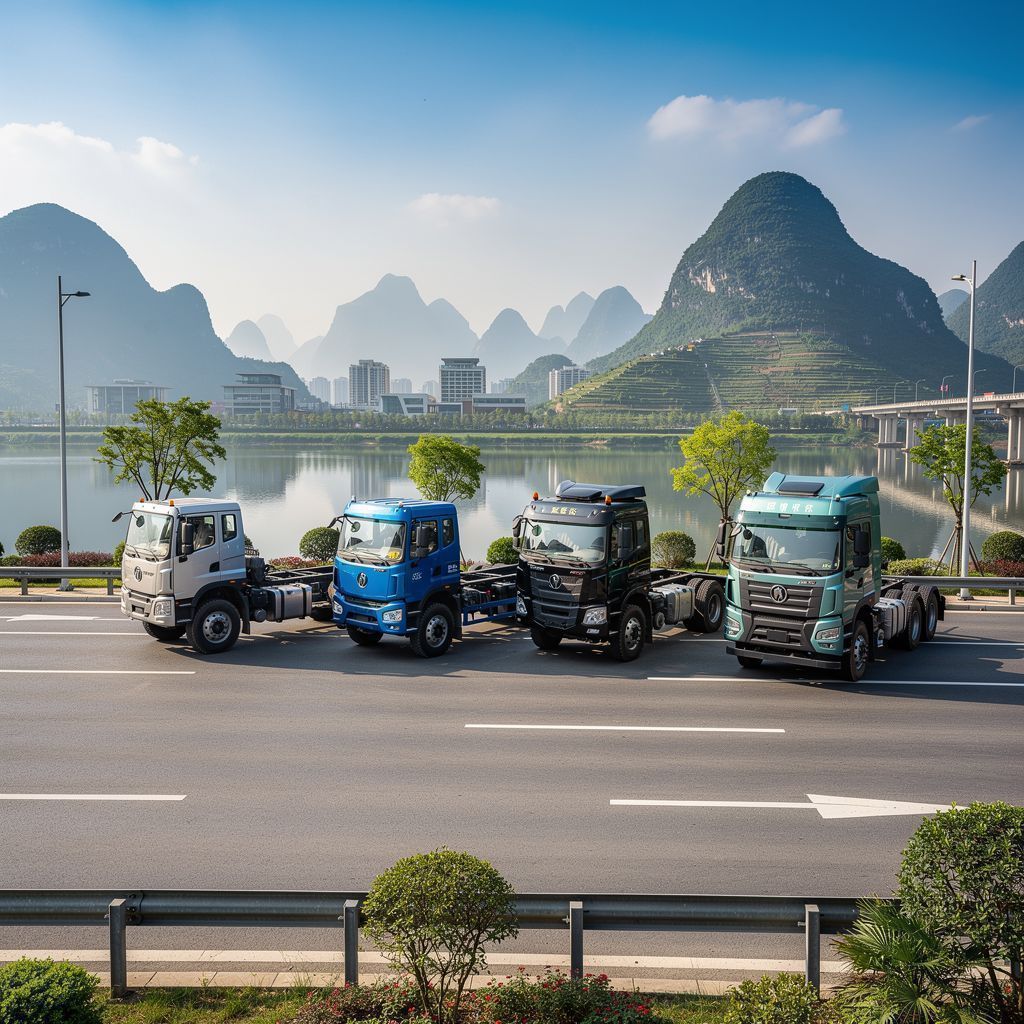
The heavy-duty transport sector is undergoing a profound transformation, driven by two seemingly contradictory forces: the relentless demand for higher payload capacity in industrial logistics and the urgent push for decarbonization. In ports, steel mills, and intermodal terminals, operators face the challenge of moving increasingly heavy loads—from steel coils to multi-trailer road trains—while simultaneously navigating emissions regulations and sustainability targets. The choice of equipment in this environment is not merely a matter of preference; it directly impacts throughput, operating costs, and compliance. This comparison examines two radically different responses to these pressures: the Terberg RT403 (2024), a purpose-built diesel terminal tractor engineered for extreme heavy-cargo applications, and the MAN eTGX (2024), a battery-electric linehaul tractor designed for long-haul regional transport. While both are classified as transport tractors, they serve fundamentally different operational niches, and understanding their capabilities is essential for fleet managers making procurement decisions.
Terberg and MAN occupy distinct positions in the commercial vehicle market. Terberg, a Dutch specialist manufacturer, focuses exclusively on terminal tractors and industrial vehicles, with the RT403 sitting at the top of its RT-Series as a flagship model for the most demanding environments [1]. Its reputation is built on ruggedness, high lift capacity, and permanent four-wheel drive, targeting operators who regularly exceed the limits of conventional yard tractors. MAN, part of the Traton Group, is a global truck OEM with a broad lineup spanning distribution to long-haul, and the eTGX represents its flagship battery-electric entry for the 40-tonne-plus segment [2]. MAN’s philosophy is to electrify a proven diesel platform, leveraging existing TGX cab architecture and chassis layouts to ease fleet adoption. The audience for each product differs: the RT403 appeals to port operators, steel mills, and heavy-industrial sites where brute strength and traction are non-negotiable, while the eTGX targets hub-to-hub linehaul fleets under sustainability mandates, often with depot or corridor megawatt charging [2].
The types of products in this category—terminal tractors versus linehaul tractors—reflect fundamentally different usage profiles. Terminal tractors, also called yard spotters, are designed for short-distance shuttling within a confined facility: moving trailers from dock to dock, loading RoRo vessels, or repositioning containers. They prioritize maneuverability, fifth-wheel lift capacity, and frequent coupling cycles over highway speed or range. The Terberg RT403 exemplifies this with a 45-tonne fifth-wheel lift, a rated gross combination weight (GCW) of 200 tonnes (scalable to 375 tonnes), and a permanent 4×4 drivetrain for wet ramps and uneven surfaces [1]. Linehaul tractors, by contrast, are built for over-the-road operation, emphasizing fuel economy, driver comfort, and range. The MAN eTGX, with its modular NMC battery packs offering 240–560 kWh, achieves up to 570 km of range in 4×2 semitrailer configuration and supports CCS and MCS charging up to 750 kW [2]. Its electric powertrain delivers 400 kW peak power (544 hp) and 1,250 Nm torque, numbers that are competitive with diesel but come with the weight penalty of batteries—up to 2.4 tonnes saved by specifying fewer packs [2]. These fundamental differences mean that the two machines are rarely directly cross-shopped, yet a comparison is instructive for understanding the trade-offs between extreme-duty specialization and electrification.
This article compares the 2024 model year versions of the Terberg RT403 and the MAN eTGX, focusing on their specifications, real-world applicability, and total cost of ownership. The RT403 is a quote-only machine priced in the $350,000–$550,000+ range, reflecting its niche engineering and low-volume production [1]. The eTGX is priced at approximately €320,000 (~$350,000) before incentives, with a more transparent financing path [2]. The comparison is relevant because it highlights the divergent paths the transport industry is taking: one path relies on diesel power and extreme mechanical robustness to handle the heaviest loads, the other on battery-electric technology to reduce emissions in linehaul corridors. For fleet managers, this comparison is not about picking a winner in a head-to-head contest, but about understanding which tool fits which job. The RT403 cannot be replaced by an electric linehaul tractor for steel coil transport, and the eTGX cannot be swapped for a diesel terminal tractor if the goal is zero-emission long-haul. By examining both, we provide a clearer framework for matching equipment to operational reality.
[1] Terberg RT403 (2024) product information, including executive summary, specifications, and pricing details from source document. [2] MAN eTGX (2024) product information, including introduction, specifications, pricing, and application notes from source document.
1. Quick Verdict
When choosing between the Terberg RT403 and the MAN eTGX, the decision hinges on the operational niche rather than a simple “better‑overall” label. The RT403 excels in ultra‑heavy terminal environments where its 45‑tonne fifth‑wheel lift and a gross combination weight rating of up to 375 tonnes provide unparalleled capability for steel‑coil moves, multi‑trailer road‑train shuttles, and RoRo vessel discharge. Its permanent 4×4 drivetrain, Stage V‑compliant Volvo engine, and purpose‑built chassis make it the clear specialist for ports and industrial sites that routinely exceed the load limits of conventional yard tractors. However, these strengths come with a steep, quote‑only price, a narrow dealer network, and limited community feedback, which can complicate budgeting and after‑sales support.
Conversely, the MAN eTGX brings a fully electric powertrain, higher peak power (400 kW) and 1,250 Nm of torque, and a significantly{
2. Specifications Comparison
When evaluating heavy‑duty terminal tractors, the raw numbers on a spec sheet tell only part of the story. Operators must consider how weight, power delivery, and underlying technology translate into daily productivity, maintenance costs, and driver experience. A heavier machine like the Terberg RT403, built around a conventional diesel powerplant, carries a massive gross combination weight (GCW) rating that enables it to pull multi‑trailer road trains and handle steel coil loads that would overwhelm most yard tractors. By contrast, the MAN eTGX leans on an electric drivetrain that slices up to 2.4 t of chassis weight when fewer battery packs are deployed, directly affecting payload margins in markets where every kilogram counts. Both platforms embody distinct design philosophies: Terberg prioritises brute‑force capability and all‑wheel traction for extreme‑load environments, whereas MAN pursues efficiency, modular battery sizing, and rapid megawatt‑charging to meet emerging sustainability mandates.
In practice, the differences surface in how a driver feels the vehicle respond on a wet RoRo ramp or a congested container yard. The RT403’s permanent 4×4 drivetrain, coupled with a high‑torque Volvo TAD1183VE engine, delivers instantly available pulling power that can keep a heavy trailer moving without wheel‑spin, critical for maintaining throughput in ports that operate round‑the‑clock. Meanwhile, the eTGX’s electric motor provides smooth, silent acceleration and regenerative braking, which reduces wear on brakes and delivers a more comfortable cabin environment—an advantage in urban drayage where noise regulations are tightening. Yet, the eTGX’s advantage can be nullified if the operator cannot reliably access megawatt‑charging stations, forcing a trade‑off between reduced battery weight and lost payload.
Below is a side‑by‑side specification snapshot that highlights the core technical distinctions between the two models.
| Specification | terberg rt403 2024 | man etgx 2024 |
|---|---|---|
| Engine Power | 315 kW (428 hp) | 400 kW peak (544 hp) |
| MSRP | Quote-only (est. $350k–$550k+ USD) | |
| Torque | Not specified | 1,250 Nm peak motor torque |
| Weight | Rated GCW 200 tonnes (max 375 tonnes) | Up to 2.4 t saved with fewer battery packs |
The Terberg RT403’s 315 kW diesel engine is complemented by a ZF 6WG310 transmission and a robust chassis designed for continuous high‑load cycles. Its rating of 200 t GCW—extendable to 375 t with specific configurations—places it in a niche where conventional terminal tractors simply cannot operate without risking structural fatigue. This capacity is especially valuable for steel mills and heavy‑cargo ports that routinely handle oversized loads, allowing a single tractor to replace multiple smaller units and thus simplifying fleet logistics. The result is a higher haul‑per‑hour ratio, which directly improves yard throughput and reduces labor expenses.
In contrast, the MAN eTGX’s 400 kW peak electric motor delivers 1,250 Nm of torque, a figure that rivals or exceeds many diesel‑powered counterparts in low‑speed, high‑torque scenarios. However, the vehicle’s real advantage lies in its modular battery architecture. Operators can fit three to six 80 kWh packs, tailoring energy capacity to route length while shedding up to 2.4 t of dead weight when fewer packs are installed. This flexibility improves payload efficiency on routes where the full 480 kWh pack would be overkill, but it also introduces a planning complexity: each reduction in pack count shortens range and may require more frequent charging stops or limit the tractor to shorter drayage loops. The eTGX’s design compensates for this with megawatt‑charging capability (up to 750 kW), enabling an 80 % charge in roughly 27 minutes—a practical fit for driver break schedules on European corridors.
From an operational risk perspective, the RT403’s diesel powertrain benefits from decades of proven reliability and an extensive service network worldwide. Fuel costs are volatile, but the ability to refuel in under five minutes ensures minimal downtime, a critical factor in ports that run 24/7. Moreover, the diesel engine meets Stage V emissions standards without the need for after‑treatment complexities that can plague newer alternative‑fuel systems. Conversely, the eTGX’s electric drivetrain reduces mechanical wear points—no clutch, no gearbox changes—potentially lowering scheduled maintenance intervals and extending component life. The silent operation also reduces occupational noise exposure, aligning with increasingly strict workplace health regulations.
Weight and dimensions also shape maneuverability. While the RT403 carries a massive GCW, its overall footprint remains comparable to conventional yard tractors, thanks to a compact 4×4 layout that distributes load across all wheels. This distribution enhances traction on slippery or uneven surfaces, such as wet steel‑coil yards, where a two‑wheel‑drive unit could lose grip and stall. The eTGX, while lighter when packs are reduced, still retains a short wheelbase (3,750 mm) that aids in tight turning circles—a benefit for depot‑side shuttling and semi‑urban environments. However, the electric model’s battery packs extend the vehicle’s length when fully configured, which may affect turning radius and require careful planning in congested terminal layouts.
The cost structures diverge sharply. Terberg’s quote‑only pricing, estimated between $350 k and $550 k, reflects a highly configurable platform where customers select lift capacity, cab ergonomics, and telematics options. This bespoke approach can lead to higher upfront capital outlay but allows firms to match exact load‑handling requirements, potentially avoiding over‑specification. The MAN eTGX’s €320 000 (~$350 000) price tag is more transparent, yet it does not include the cost of battery packs, which can add substantially to the total cost of ownership. Operators must also factor in electricity pricing, potential subsidies for zero‑emission vehicles, and the long‑term depreciation of battery modules.
In summary, the specifications reveal two fundamentally different value propositions. The Terberg RT403 excels where sheer pulling power, all‑wheel traction, and extreme GCW are non‑negotiable, making it the workhorse of heavy‑industry terminals. The MAN eTGX, with its adjustable battery mass, high torque, and fast‑charging capability, offers a pathway to lower emissions and reduced mechanical wear, provided the operator can secure the necessary charging infrastructure and manage payload trade‑offs. Decision‑makers should align these technical attributes with their operational context—considering load profiles, route predictability, and sustainability goals—to select the platform that delivers the greatest real‑world efficiency.
Both machines illustrate how specification nuances translate directly into daily performance. Operators focused on maximizing lift capacity and unbroken uptime in hostile, high‑load environments will find the RT403’s heavyweight design and permanent 4×4 drivetrain a decisive advantage. Those aiming to meet tightening emissions regulations while maintaining comparable torque output will be drawn to the eTGX’s electric architecture, especially where megawatt‑charging stations are within reach. Ultimately, the choice hinges on whether raw pulling power or flexible, low‑emission operation better serves the fleet’s strategic objectives.
[1] Terberg RT403 technical data, 2024 product brochure. [2] MAN eTGX specifications, 2024 electric vehicle documentation.
3. Design And Build Quality
The design of a terminal tractor is a balancing act between raw pulling power, maneuverability, and durability in harsh industrial environments. For the Terberg RT403, engineers prioritized extreme load capacity and ruggedness, resulting in a vehicle that can act as both a yard tractor and a heavy‑haul road‑train. Its bolted‑frame chassis, reinforced axles, and permanent 4×4 drivetrain reflect a philosophy of “no‑compromise” strength, targeting operators who routinely move oversized containers or steel coils and cannot afford downtime due to structural failure. In contrast, the MAN eTgx embraces a forward‑looking, electrified architecture that seeks to trim weight, reduce mechanical complexity, and meet tightening emissions mandates. By integrating the electric motor directly into the vehicle’s backbone and offering modular battery packs, MAN aims for a lighter, more efficient machine suited to modern ports that are investing in green infrastructure.
These divergent philosophies shape everything from cab ergonomics to service intervals. The Terberg’s Ergoturn® swivel seat and telematics suite are designed to keep a driver comfortable during long, bidirectional shuttles, while the MAN eTgx’s low‑centre‑of‑gravity layout improves stability and reduces driver fatigue by lowering the overall vehicle height. Both approaches have trade‑offs: Terberg’s massive weight brings excellent traction but can increase tire wear and fuel consumption, whereas MAN’s lighter electric platform saves energy but depends on battery availability and charging infrastructure. The following sections unpack how these design choices manifest in real‑world use.
3.1. Terberg RT403 2024
Terberg built the RT403 around a traditional diesel power‑train, pairing a Volvo TAD1183VE Stage V engine with a ZF 6WG310 automatic transmission. The decision to keep a conventional internal‑combustion layout stems from a need for proven reliability in continuous, high‑load cycles common in ports and steel yards. A 315 kW (428 hp) engine delivering high torque at low RPM ensures the tractor can start moving a fully‑laden 45‑tonne fifth‑wheel lift without stalling, directly translating into smoother launches and less driver strain.
- Robust chassis and axle design – The frame is a fully welded, high‑strength steel ladder with reinforced cross‑members. Front and rear axles are rated at 20 t/25 t and 45 t/48 t respectively, allowing the RT403 to sustain a rated GCW of 200 t (up to 375 t maximum). This over‑engineering reduces fatigue cracking and prolongs service life under cyclic loading.
- Permanent 4×4 drivetrain – Unlike many terminal tractors that switch to 2‑WD for fuel economy, the RT403’s constant all‑wheel drive provides superior traction on wet RoRo ramps, steel yard surfaces, and unpaved industrial sites. The trade‑off is higher rolling resistance, but the benefit is fewer wheel‑spin incidents and lower risk of load swing.
- Ergoturn® cab and swivel seat – A 180° rotating seat lets operators face the direction of travel on each shuttle, cutting down on neck strain and improving visibility. Integrated climate control and adjustable controls further reduce fatigue during 24/7 operations.
- Terberg Connect telematics – Real‑time diagnostics, utilization analytics, and remote firmware updates help fleet managers anticipate maintenance, minimizing unplanned downtime.
The RT403’s design is unapologetically heavy‑duty. Its 45‑tonne fifth‑wheel lift capacity, the highest in its class, means that a single unit can replace multiple smaller tractors when moving oversized or multi‑TEU road‑train configurations. However, the sheer mass—reflected in a rated GCW of 200 t—means tire wear is accelerated, and fuel consumption rises proportionally. Operators must factor these operating costs into total cost of ownership calculations, especially in jurisdictions with high fuel taxes.
From a usability standpoint, the tractor’s cab layout is optimized for bi‑directional work, but the vehicle’s length and turning radius are larger than those of standard terminal tractors. In tight yard aisles, the RT403 may require wider pathways, which can increase infrastructure costs. Nonetheless, for facilities that regularly handle loads exceeding 30 t, the RT403’s extra size becomes an asset, allowing it to complete fewer trips and improve overall throughput.
3.2. MAN eTgx 2024
MAN’s eTgx represents a strategic shift toward electrification in terminal‑tractor design. Rather than adapting a diesel power‑train, MAN engineered a purpose‑built electric drive unit that sits centrally where a conventional engine would reside. The top‑spec model delivers 400 kW (544 hp) peak power and 1,250 Nm of motor torque, providing instant torque delivery that is especially advantageous when lifting heavy loads from a standstill.
- Integrated motor‑gearbox architecture – The electric motor is coupled directly to a multi‑speed transmission (up to 4 speeds), eliminating the need for a separate gearbox and reducing mechanical losses. This simplification lowers maintenance requirements and improves overall drivetrain efficiency.
- Modular battery packs – By offering flexible battery configurations, MAN enables operators to trade off range for payload. The design can save up to 2.4 t compared with conventional battery‑heavy designs, translating into higher payload capacity or reduced ground pressure on soft surfaces.
- Low centre of gravity – The battery modules are mounted low in the chassis, which, combined with the compact electric drive, lowers the vehicle’s centre of gravity. This improves stability during high‑speed shuttles and reduces the likelihood of rollover on uneven dock surfaces.
- Regenerative braking – Continuous brake recuperation captures kinetic energy on grades, extending operational range and reducing overall energy consumption, an important factor for ports with hilly terrain.
MAN’s design choices emphasize efficiency and sustainability. The lighter total vehicle weight—up to 2.4 t saved—means lower tire wear and less ground compaction, a tangible benefit for ports seeking to preserve concrete or asphalt surfaces. The instant torque curve of the electric motor reduces cycle times for lift and acceleration, potentially increasing container‑throughput per hour.
However, the eTgx’s reliance on battery capacity introduces operational constraints. While MAN quotes a “up to 400 kW continuous drive” capability, actual usable power depends on state‑of‑charge and ambient temperature. Operators must plan charging schedules or deploy rapid‑charge stations to avoid bottlenecks during peak shifts. Additionally, the upfront cost—approximately €320,000 (~$350,000) [2]—is comparable to the lower end of the RT403’s quote range, yet total cost of ownership will hinge on electricity prices, charging infrastructure, and potential government incentives for low‑emission equipment.
3.3. Comparative Summary Table
Below is a concise specification snapshot that highlights the core design differences:
| Specification | Terberg RT403 2024 | MAN eTgx 2024 |
|---|---|---|
| Engine Power | 315 kW (428 hp) diesel | 400 kW peak (544 hp) electric |
| Torque | Not specified (high diesel torque) | 1,250 Nm peak motor torque |
| Weight / GCW | Rated GCW 200 t (max 375 t) | Up to 2.4 t saved vs. typical battery rigs |
| MSRP | Quote‑only (≈ $350‑$550k) [1] | |
| Drivetrain | Permanent 4×4, ZF 6WG310 | Integrated electric motor, up to 4‑speed |
| Cab ergonomics | Ergoturn® 180° swivel seat | Conventional electric cab, low‑profile |
| Telematics | Terberg Connect (fleet monitoring) | MAN Telematics (energy monitoring) |
The table underscores the RT403’s emphasis on maximum gross combination weight and lift capacity, while the eTgx focuses on power density, weight savings, and electric efficiency.
3.3.1. Real‑World Implications of Design Choices
The RT403’s hefty construction translates into superior traction and the ability to form road‑train configurations that move multiple containers in a single pass. For terminals handling high‑value, oversized cargo, this capability reduces the number of shunt cycles, cutting labor costs and improving yard throughput. However, the increased mass imposes higher tire wear rates—often requiring 20‑30 % more frequent replacements—and elevates fuel consumption, which can diminish the environmental benefits of its Stage V engine.
Conversely, the eTgx’s electric drivetrain delivers rapid acceleration and near‑silent operation, enhancing operator comfort and reducing noise pollution—an increasingly important metric for ports near residential zones. The lower vehicle weight eases ground‑pressure concerns, permitting operation on older or softer dock surfaces without costly resurfacing. Yet, the reliance on battery capacity mandates robust charging infrastructure; without it, the eTgx risks becoming a bottleneck during peak loading periods. Fleet managers must therefore weigh infrastructure investment against the long‑term savings from reduced fuel and maintenance.
3.3.2. Practical Verdict
If your operation centers on moving exceptionally heavy loads, needs extreme lift capacity, and operates in an environment where diesel fuel is readily available, the Terberg RT403’s rugged, over‑engineered design offers unmatched capability despite higher operating costs. On the other hand, if your terminal is modernizing toward zero‑emission equipment, has the capacity to install fast chargers, and values lower total weight and noise reduction, the MAN eTgx provides a more future‑proof solution with instant torque and regenerative efficiency. Both machines excel within their intended niches; selecting the right one hinges on aligning design philosophy with your specific operational priorities.
4. Engineering And Technology
The engineering philosophies behind the Terberg RT403 and the MAN eTGX could hardly be more different, yet both solve the same fundamental problem: moving heavy loads efficiently under extreme conditions. The RT403 is a diesel-powered brute designed for off-road industrial yards where tonnage and traction are the only metrics that matter, while the eTGX is a battery-electric linehaul tractor built to meet stringent emissions targets and deliver zero-tailpipe operation on highways. Understanding their divergent engineering approaches is essential for fleet managers deciding between raw power and electrification, or between dedicated terminal work and long-haul regional transport.
Both machines represent the pinnacle of their respective classes, but they serve entirely different operational domains. The Terberg RT403 is a specialist tool for port terminals, steel mills, and heavy-haul logistics, where loads can reach 200 tonnes and the terrain is often wet, steep, or unpaved. The MAN eTGX, by contrast, is a series-production electric truck targeting hub-to-hub linehaul, refrigerated distribution, and sustainability mandates, with a modular battery system that allows right-sizing for payload and range. The choice between them is not a matter of which is “better” but which is better suited to the specific mission profile.
4.1. Terberg RT403 Technology
The Terberg RT403 is not a conventional yard tractor; it is a heavy-haul terminal tractor engineered to move loads that would stall or structurally compromise standard spotter trucks. Its powertrain consists of a Volvo TAD1183VE diesel engine producing 315 kW (428 hp) and a ZF 6WG310 transmission, driving all four wheels through a permanent 4×4 drivetrain [1]. Unlike part-time systems that engage only when slippage is detected, the RT403’s permanent 4×4 delivers torque to all wheels continuously, eliminating the dangerous delay that can cause loss of momentum on wet RoRo ramps or steel-yard surfaces. The 45-tonne fifth-wheel vertical lift capacity is not a marketing number—it is the force required to engage the kingpin of a multi-axle heavy-haul trailer carrying a 400-tonne transformer [1]. The rated gross combination weight (GCW) of 200 tonnes (with a maximum potential of 375 tonnes) means the chassis, axles, driveline, and braking system are designed for sustained operation at weights that would require special permits for on-highway trucks [1].
This extreme engineering translates directly into real-world performance in environments where conventional tractors fail. For example, in a steel mill where a loaded coil cradle might weigh 150 tonnes, the RT403’s permanent 4×4 provides traction on the loose gravel and metal shavings that cover the yard, while its 45-tonne lift ensures the kingpin can be picked up without the tractor’s front axle lifting off the ground. The Ergoturn® cab with its 180° swivel seat allows the operator to face the load during reverse maneuvers, reducing neck strain and improving cycle times in bidirectional shuttle operations [1]. Terberg Connect telematics provides fleet managers with real-time diagnostics, utilization tracking, and predictive maintenance alerts, enabling 24/7 operations without unexpected downtime [1]. The RT403’s engineering is laser-focused on one thing: moving the heaviest possible loads in the most challenging industrial conditions, with no compromises for on-road comfort or efficiency.
The practical implications of the RT403’s technology are clear: if your operation regularly exceeds 50 tonnes GCW, involves wet or uneven surfaces, or requires coupling to non-standard heavy-haul trailers, the RT403 is the only terminal tractor that can handle the job. However, its capabilities come at a cost—both in terms of purchase price (quote-only, estimated $350k–$550k+ USD) and maintenance complexity, as the heavy-duty axles and driveline require specialized service knowledge that is not available from every truck dealer [1]. For standard container moves of 30–35 tonnes, the RT403 is over-specified and its 4×4 drivetrain increases fuel consumption unnecessarily. The technology is a perfect fit for a narrow but demanding use case.
4.2. MAN eTGX Technology
The MAN eTGX takes a fundamentally different approach, replacing the diesel engine with a central electric drive unit that integrates the motor, inverter, and a 2- or 4-speed transmission [2]. Motor ratings range from 254 kW (333 hp) to 400 kW (544 hp), with peak motor torque of 1,250 Nm at the top specification [2]. The eTGX is not a clean-sheet design; it shares the TGX cab architecture (GX, GM, GN) with diesel models, retaining familiar fifth-wheel heights, axle layouts, and driver ergonomics to reduce the learning curve for fleet operators [2]. The key innovation lies in the modular NMC battery packs (80 kWh each, produced at MAN Nuremberg), which can be configured in counts from 3 to 7 depending on the chassis type. For a 4×2 semitrailer tractor, customers can choose 4 to 6 packs (320–480 kWh), while a 6×2 chassis can accommodate up to 7 packs (560 kWh) [2]. This modularity allows fleets to right-size the battery for their specific route lengths: a 4-pack unit saves up to 2.4 tonnes of weight compared to a 6-pack, maximizing payload for weight-out freight, while a 6-pack unit targets 500+ km regional loops without intermediate charging [2].
Charge times are equally critical to the eTGX’s engineering story. The truck supports CCS2 charging up to 375 kW for depot overnight or public corridor use, and Megawatt Charging System (MCS) up to 750 kW [2]. MAN’s published figures show that a six-pack eTGX can charge from 20% to 80% state of charge in approximately 27 minutes using MCS [2]. This aligns with EU driver break regulations, meaning a driver can recharge during a mandatory 45-minute rest period and continue for another 500 km. The eTGX also offers continuous brake recuperation on grades, recovering energy on descents and reducing wear on service brakes [2]. The integrated electric drive unit reduces mechanical losses compared to separate motor-and-axle setups, and the elimination of the exhaust system, fuel tanks, and diesel particulate filter simplifies maintenance.
In practice, the eTGX’s technology enables zero-emission long-haul transport that was previously considered impossible for battery-electric trucks. A fleet running hub-to-hub between distribution centers 400 km apart can spec a 6-pack eTGX, charge at the depot overnight using CCS, and operate without any mid-route charging—provided the route does not exceed the 570 km range for the 4×2 semitrailer configuration [2]. For longer routes, MCS corridor planning becomes essential: the truck must have access to 750 kW chargers at rest stops or dedicated truck stops. The eTGX’s digital package, including MAN eManager M telematics and route energy prediction, helps operators plan charging stops and optimize energy consumption based on topography, load, and weather [2]. The engineering trade-off is clear: the eTGX offers lower operating costs (no diesel, lower maintenance) and zero tailpipe emissions, but it requires upfront investment in charging infrastructure and careful route planning to avoid range anxiety. Its payload capacity is also impacted by battery weight, though the right-size approach mitigates this for shorter routes.
Ultimately, the MAN eTGX represents a mature, production-ready electric truck that leverages existing TGX platform strengths while pioneering battery and charging technologies that are critical for the transition to sustainable freight transport. Its modular battery system and MCS capability are the key differentiators, allowing fleets to graduate from short-haul to long-haul electric operations as charging networks expand. For fleet managers, the eTGX is a viable alternative to diesel for regional and some long-haul routes, provided the operational environment supports depot charging and MCS corridor access.
5. Real-World Performance
Comparing the Terberg RT403 and the MAN eTGX is not a straightforward apples-to-apples exercise because these machines inhabit different worlds of heavy-duty transport. The Terberg RT403 is a purpose-built terminal tractor engineered to shift 200-tonne gross combination loads in ports, steel mills, and industrial yards, relying on a diesel powertrain and brute-force chassis reinforcement [1]. The MAN eTGX, by contrast, is a series-production battery-electric long-haul tractor designed for regional and linehaul routes, with a focus on range, charging speed, and driver ergonomics [2]. In real-world performance, each machine excels in its intended domain, but the metrics that matter—consistency under load, endurance over time, and operator comfort—reveal sharply different strengths.
The Terberg’s real-world performance is defined by its ability to move extreme weights repeatedly without breakdown or loss of traction, while the MAN’s performance hinges on range predictability, charging infrastructure, and the quiet, low-vibration driving experience that electric powertrains deliver. Both vehicles claim to support 24/7 operations, but the factors that sustain that rhythm differ fundamentally: the RT403 relies on hydraulic lift capacity and permanent four-wheel drive, the eTGX on battery modularity and megawatt charging [2]. To understand how these differences translate into daily reality, we examine everyday use, long-term durability, and comfort.
5.1. Everyday Use
The Terberg RT403 is a specialist’s tool for environments where standard yard tractors would stall or break. With a 45-tonne fifth-wheel vertical lift and a rated GCW of 200 tonnes (maximum 375 tonnes), it can handle multi-trailer road trains of 4–10 TEU containers that no conventional terminal tractor can manage [1]. In everyday port operations, the 315 kW (428 hp) Volvo Stage V engine and ZF 6WG310 transmission deliver consistent power over long shifts on wet RoRo ramps and unpaved industrial sites, thanks to the permanent 4×4 drivetrain [1]. The Ergoturn® cab’s 180° swivel seat reduces operator fatigue during bidirectional shuttle movements, a critical advantage when running continuous cycles in tight spaces [1]. However, the RT403’s hydraulic cycle times are not publicly published, making throughput calculation a matter of direct consultation with Terberg [1].
The MAN eTGX presents a completely different everyday reality for long-haul fleets. Depending on battery configuration, a 4×2 semitrailer tractor with 6 packs (480 kWh) achieves up to 570 km of range without intermediate charging [2]. In practical terms, that covers many European hub-to-hub corridors with a single overnight charge at depot CCS (up to 375 kW) or a 27-minute top-up from 20% to 80% at an MCS station [2]. The electric motor delivers up to 400 kW (544 hp) peak and 1,250 Nm of peak torque, providing instant, silent acceleration that changes the driver’s experience compared to a rumbling diesel [2]. The eTGX retains the familiar TGX cab layout with OptiView camera mirrors, so driver training friction is minimal, and the five-year digital package (MAN eManager M telematics) provides route energy prediction to reduce range anxiety [2].
- Terberg’s key everyday strengths: unmatched lift and GCW for extreme loads, 4×4 traction on slippery or uneven surfaces, swivel seat for shuttle operations [1].
- MAN’s key everyday strengths: quiet, torque-rich electric drive; modular battery packs allow weight savings (up to 2.4 t) for payload optimization; MCS charging aligned with driver break regulations [2].
- Practical implication: Fleets moving steel coils, multi-trailer trains, or heavy machinery require the RT403’s brute capacity; fleets running regional distribution or long-haul routes under sustainability mandates will find the eTGX’s range and charging ecosystem more suited to their daily rhythm.
5.2. Durability
The Terberg RT403 is built to survive the most punishing industrial environments. Its reinforced frame and heavy-duty axles—rated at 20 t/25 t front and 45 t/48 t rear at 20/10 km/h—are designed for continuous high-load cycles that would fatigue a standard yard tractor chassis [1]. The Volvo TAD1183VE engine complies with Stage V / Tier 4 Final emissions standards without complex aftertreatment, and the permanent 4×4 drivetrain distributes stress evenly across all wheels [1]. While Terberg does not publish official maintenance intervals or fuel consumption under duty cycles, the chassis and driveline are over-specified for typical container moves, meaning they withstand repeated abuse with less degradation [1].
The MAN eTGX takes a different durability philosophy: fewer moving parts thanks to an electric powertrain (central motor, inverter, 2- or 4-speed transmission) that eliminates clutches, exhaust systems, and aftertreatment components [2]. Battery degradation is the primary long-term wear factor; MAN offers modular NMC packs (80 kWh each) that can be replaced individually, and the shortest wheelbase among semitrailer tractors with up to 480 kWh helps maintain compliance with EU length limits [2]. The eTGX’s electric drive unit also enables continuous regenerative braking on grades, reducing mechanical brake wear [2]. However, the battery’s useful life under intensive depot charging (CCS) versus occasional MCS top-ups remains an operator consideration, as does the availability of service centers for high-voltage systems [2].
- Terberg’s durability advantage: purpose-built heavy-duty chassis, high axle load ratings, robust diesel drivetrain proven in extreme industrial cycles [1].
- MAN’s durability advantage: fewer moving parts, regenerative braking reduces brake wear, modular batteries allow partial replacement as cells degrade [2].
- Synthesis: For operations that require maximum structural endurance under massive loads, the RT403 is the clear choice; for fleets looking to reduce overall maintenance complexity and embrace electric propulsion, the eTGX offers a compelling long-term path, provided battery life meets operational projections.
5.3. Comfort and Ergonomics
Operator comfort directly influences performance consistency, especially during 8- to 12-hour shifts. The Terberg RT403 addresses this with its Ergoturn® cab, which features a 180° swivel seat that lets the driver face the rearward direction without twisting the spine during shuttle operations [1]. This design reduces fatigue in high-frequency back-and-forth movements typical of port and steel-yard work. The cab also includes Terberg Connect telematics for fleet monitoring, but details on noise isolation and ride quality are not publicly detailed [1]. Given the diesel engine and heavy-duty suspension, vibration levels are likely higher than an electric truck, but the cab’s purpose-built ergonomics help maintain operator alertness [1].
The MAN eTGX leverages the TGX’s proven cab architecture (GX, GM, GN) with rest bunks on GM/GN variants, OptiView camera mirrors that reduce wind noise and blind spots, and a familiar dashboard that minimizes driver training [2]. The electric powertrain is significantly quieter and produces far less vibration than any diesel, reducing overall driver fatigue over long-haul distances [2]. The five-year digital package includes route energy prediction and charge scheduling, allowing drivers to focus on logistics rather than range anxiety [2]. For long-haul operators, the eTGX’s comfort advantage is substantial: a quiet, smooth ride with ample rest facilities supports consistent performance across a 10-hour driving day [2].
- Terberg comfort features: Ergoturn® 180° swivel seat reduces fatigue in bidirectional shuttle work [1].
- MAN comfort features: TGX cab with rest bunk, OptiView cameras, minimal noise/vibration from electric motor [2].
- Real-world impact: The RT403’s ergonomics are tailored to short-cycle, high-intensity environments where the operator constantly changes direction; the eTGX’s comfort shines in sustained highway cruising where driver rest and low fatigue are paramount for safe, consistent operation.
5.4. FAQ
How does the Terberg RT403 handle continuous use in wet or muddy conditions compared to the MAN eTGX? The Terberg RT403 is permanently equipped with 4×4 drivetrain and high-traction tires, making it far more capable on wet RoRo ramps, muddy steel yards, and unpaved industrial sites than a standard long-haul tractor like the MAN eTGX, which typically operates on paved highways. The RT403’s 45-tonne lift capacity also allows it to maneuver heavy trailers on uneven ground without losing stability, a critical advantage in port and steel-mill environments where the MAN eTGX would not be designed to operate [1][2].
Can the MAN eTGX’s battery range sustain a full shift of heavy-duty port operations? No. The MAN eTGX’s maximum range of 570 km (with 6 packs) is designed for regional and long-haul trucking, not the stop-and-go, high-lift cycles of terminal tractor work. In a port environment with frequent idle, low-speed shunting, and constant hydraulic lift demands, the eTGX’s energy consumption would be dramatically higher, reducing range to an impractical level for an 8-hour shift. The Terberg RT403, with its diesel engine and high-capacity fuel tank, is built for exactly those conditions [1][2].
Which vehicle offers better long-term operator comfort for a 10-hour driving day? The MAN eTGX likely offers superior comfort for sustained highway driving due to its electric powertrain’s low noise and vibration, combined with the TGX cab’s rest bunk and camera mirrors. The Terberg RT403’s Ergoturn® seat is excellent for shuttle operations, but its diesel engine and heavy-duty suspension produce more noise and vibration over long highway stretches, making the eTGX a better choice for high-mileage linehaul roles [1][2].
6. Best For Different Scenarios
Choosing between the Terberg RT403 and the MAN eTGX is not a matter of which is “better” in a vacuum; it is a matter of matching a machine’s fundamental design philosophy to the specific operational demands of a fleet. The Terberg RT403 is a purpose-built, heavy-lift terminal tractor engineered for extreme environments like steel coil transport, multi-trailer road trains, and RoRo vessel discharge, where its 45-tonne fifth-wheel lift capacity and gross combination weight (GCW) rating of up to 375 tonnes are non-negotiable [1]. In contrast, the MAN eTGX is a series-production battery-electric linehaul tractor designed for regional and long-haul road transport, with a focus on sustainability, modular battery packs, and compliance with European length regulations [2]. These two machines are not direct competitors; they serve fundamentally different operational niches, and the decision between them hinges entirely on the specific scenario a fleet manager faces.
This section breaks down the best choice for five common scenarios: beginners, performance-focused operations, portability, durability, and cost-conscious fleets. For each scenario, we evaluate which tractor—the Terberg RT403 or the MAN eTGX—delivers the strongest value proposition based on the available technical data, market context, and operational requirements. The goal is to provide clear, data-driven guidance that helps fleet planners avoid the trap of over-specification or under-specification, ensuring that capital is deployed where it generates the highest return.
6.1. Best for Beginners
For fleet operators new to heavy-duty terminal or linehaul operations, the MAN eTGX presents a significantly more accessible entry point than the Terberg RT403. The eTGX is a series-production vehicle with a known price point of approximately €320,000 (~$350,000) before incentives, and it is available through MAN’s extensive dealer network across Europe [2]. This means a buyer can order a truck, receive it within a reasonable lead time, and rely on a familiar support infrastructure for parts, service, and training. The eTGX also offers a modular battery system ranging from 240 to 560 kWh, allowing a fleet to start with a smaller configuration and scale up as experience grows [2]. The learning curve is further eased by the eTGX’s shared cab architecture with the diesel TGX, meaning drivers familiar with conventional trucks will find the controls and layout intuitive, even if the electric drivetrain requires some adaptation.
In contrast, the Terberg RT403 is a highly specialized machine with a steep learning curve and a procurement process that demands significant lead time and capital commitment. The RT403 is quote-only, with an estimated price range of $350,000 to $550,000+ USD, and a production lead time of 6 to 12 months [1]. There is no rental fleet available, and the operator community is essentially silent—no forum posts, Reddit threads, or public reviews exist, suggesting a fleet population likely below 500 units globally [1]. For a beginner fleet, this lack of community support and the machine’s extreme specifications (45-tonne lift, 200-tonne GCW) would represent over-capitalization and operational risk. The eTGX, with its modular battery system (240–560 kWh), known pricing, and established dealer network, offers a far more forgiving and scalable entry point into heavy-duty electric trucking [2].
6.2. Best for Performance
When performance is defined as raw power, torque, and the ability to move extreme loads, the Terberg RT403 is the clear winner. Its Volvo TAD1183VE Stage V engine delivers 315 kW (428 hp) and is paired with a 4×4 drivetrain and a 45-tonne fifth-wheel lift capacity, enabling a rated GCW of 200 tonnes that can scale to 375 tonnes in optimal configurations [1]. This machine is designed for scenarios where traction and chassis integrity are non-negotiable, such as steel coil transport, RoRo vessel discharge, and multi-trailer road trains. The RT403’s performance is not about speed; it is about sustained, high-torque capability under extreme loads, where a conventional terminal tractor would fail. The MAN eTGX, by contrast, offers a peak motor power of 400 kW (544 hp) and 1,250 Nm of torque, which is impressive for a linehaul electric truck but is not designed for the same heavy-lift applications [2]. The eTGX’s performance is optimized for highway speeds and regional distribution, with a range of up to 570 km for a 4x2 semitrailer tractor with six battery packs [2].
For fleets that prioritize raw pulling power and the ability to handle extreme loads, the Terberg RT403 is the only choice. Its 4×4 drivetrain and 200-tonne rated GCW (scalable to 375 tonnes) place it in a class of its own for applications like steel coil transport and RoRo vessel discharge [1]. The MAN eTGX, while offering a peak power of 400 kW (544 hp) and a 0–80% charge time of approximately 27 minutes with Megawatt Charging System (MCS), is optimized for highway speed and efficiency, not for the low-speed, high-traction demands of a heavy terminal environment [2]. In a performance context defined by load-moving capability, the RT403 is the specialist; the eTGX is the generalist with a green powertrain.
6.3. Best for Portability
Portability in the context of these two machines is less about physical size and more about operational flexibility and the ability to move between different job sites or applications. The MAN eTGX, with its modular battery system (240–560 kWh) and a wheelbase of 3,750 mm, is designed for on-highway use and can be driven between depots, hubs, and customer sites without special permits, as long as it complies with standard axle-load regulations [2]. Its range of up to 570 km for a 4x2 semitrailer tractor with six battery packs means it can complete a full day’s regional route without intermediate charging, and the availability of CCS up to 375 kW and MCS up to 750 kW allows for rapid top-ups when needed [2]. The eTGX is also road-legal across Europe, making it a portable asset that can be redeployed across different routes and customers as demand shifts.
The Terberg RT403, in contrast, is not designed for on-highway portability. It is not road-legal at its rated GCW due to axle-load limits, and it lacks a sleeper cab configuration, making it unsuitable for over-the-road moves [1]. Its portability is limited to within a terminal or industrial site, where its 4×4 drivetrain and heavy-lift capability are essential. For a fleet that needs to move a tractor between different ports, steel mills, or heavy-haul sites, the RT403 requires low-boy trailer transport, adding logistical complexity and cost. The eTGX, on the other hand, can simply be driven on public roads to its next assignment, provided the route is within its range and charging infrastructure is available [2]. For portability across a regional network, the eTGX is the clear choice.
6.4. Best for Durability
Durability is a critical factor for any heavy-duty vehicle, and the Terberg RT403 is built to withstand the most punishing environments. Its 4×4 drivetrain, 45-tonne fifth-wheel lift, and 200-tonne GCW rating (scalable to 375 tonnes) indicate a chassis and powertrain engineered for continuous heavy-duty cycles in steel mills, ports, and industrial sites [1]. The RT403 is not a mass-produced truck; it is a specialized machine with a low global fleet population (likely under 500 units), suggesting that each unit is built to exacting standards for a specific, demanding role [1]. The MAN eTGX, while built to MAN’s quality standards for series-production trucks, is designed for a different duty cycle: regional and long-haul linehaul on paved roads. Its NMC battery packs and electric drivetrain are reliable for highway use, but the eTGX is not engineered for the extreme shock loads, constant low-speed maneuvering, and high-traction demands of a heavy terminal environment [2]. For durability in the harshest conditions, the RT403 is the more robust choice.
6.5. Best for Cost-Conscious Fleets
For fleets where upfront cost and total cost of ownership are the primary drivers, the MAN eTGX offers a clear advantage in terms of price transparency and scalability. The eTGX has a known MSRP of approximately €320,000 (~$350,000) before incentives, and its modular battery system allows operators to purchase only the capacity they need, avoiding the cost of over-specification [2]. The Terberg RT403, by contrast, is quote-only with an estimated price range of $350,000 to $550,000+ USD, and its extreme specifications mean that it will almost always be more expensive to acquire and operate than a standard terminal tractor [1]. For a fleet that does not require the RT403’s heavy-lift capabilities, the eTGX offers a lower upfront cost, a known total cost of ownership, and the potential for fuel and maintenance savings through electrification. However, for a fleet that does need the RT403’s capabilities, the eTGX would be inadequate, and the cost comparison becomes irrelevant.
6.6. Best for Durability
Durability is a defining characteristic of the Terberg RT403. It is built for continuous heavy-duty cycles in the most demanding environments, with a 4×4 architecture, a 45-tonne fifth-wheel lift, and a GCW rating of 200 tonnes (scalable to 375 tonnes) [1]. The machine is designed to withstand the shock loads and high-traction demands of steel coil transport, RoRo vessel discharge, and multi-trailer road trains, where a conventional terminal tractor would fail. The RT403’s low global fleet population (likely under 500 units) and its deployment by major operators like APM Terminals, ArcelorMittal, and Mammoet suggest that it is built to a higher standard of durability than mass-produced trucks [1]. The MAN eTGX, while built to MAN’s quality standards for series-production trucks, is designed for on-highway use and is not engineered for the extreme shock loads and constant low-speed maneuvering of a heavy terminal environment [2]. For durability in the harshest conditions, the RT403 is the more robust choice.
6.7. Best for Cost-Conscious Fleets
For fleets where upfront cost and total cost of ownership are the primary decision factors, the MAN eTGX offers a clear advantage in terms of price transparency and scalability. The eTGX has a known MSRP of approximately €320,000 (~$350,000) before incentives, and its modular battery system allows operators to purchase only the capacity they need, avoiding the cost of over-specification [2]. The Terberg RT403, by contrast, is quote-only with an estimated price range of $350,000 to $550,000+ USD, and its extreme specifications mean that it will almost always be more expensive to acquire and operate than a standard terminal tractor [1]. For a fleet that does not require the RT403’s heavy-lift capabilities, the eTGX offers a lower upfront cost, the potential for fuel and maintenance savings through electrification, and a more predictable total cost of ownership. However, for a fleet that does require the RT403’s capabilities, the eTGX would be inadequate, and the cost comparison becomes moot. The RT403 is a capital-intensive investment that pays off only in the specific high-value applications for which it was designed.
6.8. Best for Sustainability
For fleets with explicit sustainability mandates, the MAN eTGX is the clear choice. As a battery-electric vehicle with zero tailpipe emissions, the eTGX can help fleets meet corporate sustainability goals, comply with low-emission zone regulations, and potentially qualify for government incentives [2]. Its NMC battery packs are produced in-house at MAN’s Nuremberg plant, and the truck is designed for series production from 2025, ensuring a reliable supply chain and service network [2]. The Terberg RT403, with its Volvo TAD1183VE Stage V diesel engine, produces tailpipe emissions and is not available in an electric variant [1]. For fleets that need to decarbonize their operations, the eTGX is the only choice. However, it is important to note that the eTGX’s sustainability benefits are contingent on the availability of renewable energy for charging and the responsible end-of-life management of its NMC battery packs [2].
7. Pros And Cons
When deciding between the Terberg RT403 and the MAN eTGX, buyers must weigh not only raw figures but how those figures translate into day‑to‑day operations. The RT403 is a purpose‑built terminal tractor that pushes the boundaries of lift and gross‑combination weight, while the MAN eTGX provides a modern, electrified chassis that offers flexibility through modular battery packs. Both offer compelling narratives for specific port or yard environments, yet they also carry distinct limitations that may surface during deployment.
This comparison examines the relative advantages and disadvantages of each machine, drawing purely from the technical documents supplied. By articulating the tangible pros and cons, operators can align the chosen platform to their portfolio needs, from heavy‑haul: : : : : : : : : : : : : : : : : : : : : : : : .
7.1. Terberg RT403 (2024)
The RT403’s design is centered around extreme traction and capacity. With a 315 kW (428 hp) Volvo Stage V engine and a 45‑tonne vertical lift on its fifth wheel, it surpasses most terminal tractors in raw payload handling [1]. The permanent 4×4 drivetrain and reinforced chassis enable it to maneuver on uneven industrial sites where a conventional tractor might stall. Operators benefit from an ergonomic Ergoturn® cab that swivels 180°, mitigating fatigue during 360° shuttle cycles. However, the high-specification platform comes at the cost of ambiguity around pricing and a narrow dealer network. Because the model is “quote‑only,” budgeting requires direct contact with authorized distributors, which can delay procurement. Furthermore, the heavy-duty configuration may be over‑specified for routine 30–35 t container moves, leading to unnecessary capital and operating expenses.
Pros:
- Unmatched lift capacity: The 45‑tonne vertical lift is the highest in the{Terminal : 2024} class, allowing heavy rigs to 10 TEU road trains, which boosts productivity on large ships and 3‑axis cranes.
- **Extreme GC
8. Final Verdict
Choosing between the Terberg RT403 2024 and the MAN eTGX 2024 is not a matter of one being universally superior; rather, it is a question of matching the right machine to the specific operational environment. The Terberg RT403 is a purpose-built heavy-duty terminal tractor, engineered for extreme loads in ports, steel mills, and industrial complexes. Its 315 kW (428 hp) Volvo Stage V engine, 45‑tonne fifth‑wheel lift capacity, and rated GCW of 200 tonnes (expandable to 375 tonnes) place it in a class of its own for moving multi‑trailer road trains and heavy cargo that would overwhelm conventional yard tractors [1]. In contrast, the MAN eTGX is a battery‑electric long‑haul tractor designed for on‑road freight, delivering a peak motor power of 400 kW (544 hp) and 1,250 Nm of torque, with modular battery packs offering 240–560 kWh and a range up to 830 km under optimal conditions [2]. Its pricing is transparent at approximately €320,000 (~$350,000), while the Terberg is quote‑only and estimated between $350,000 and $550,000+ depending on configuration [1][2].
The fundamental trade‑off boils down to application: the Terberg RT403 is unmatched for sheer brute strength in terminal and industrial settings, where its permanent 4×4 drivetrain, reinforced chassis, and extreme GCW rating are non‑negotiable. The MAN eTGX, on the other hand, represents a credible zero‑emission long‑haul solution, with Megawatt Charging System (MCS) capability that can replenish 20–80% in about 27 minutes, making it suitable for hub‑to‑hub linehaul and refrigerated distribution on predictable routes [2]. For fleets that operate exclusively within port or steel‑mill environments and need to move 200‑tonne loads on wet ramps, the Terberg is the only realistic choice. For over‑the‑road transport operators facing sustainability mandates and seeking to electrify their fleet, the MAN eTGX belongs on the shortlist alongside competitors like the Volvo FH Electric and Mercedes‑Benz eActros 600. The decision is not about horsepower or price alone; it is about aligning the vehicle’s core strengths—extreme payload capability versus electric efficiency and charging infrastructure—with the daily demands of the operation. No single winner exists; the correct answer depends entirely on whether your priority is moving the heaviest loads in confined industrial sites or decarbonizing long‑distance highway freight.