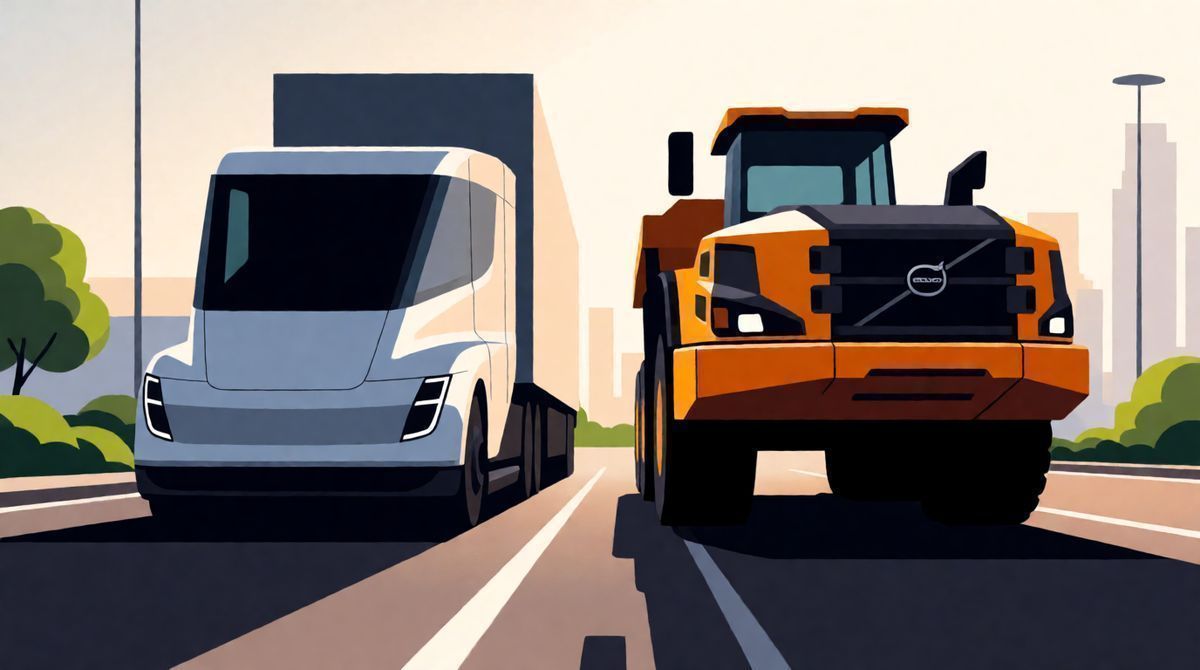
The choice of motive technology shapes logistics economics, infrastructure needs, and operational resilience in heavy transport, making it the primary lens for comparing Class 8 heavy‑duty options. The Tesla Semi represents a fully battery‑electric approach optimized for regional haul and drayage, leveraging high‑power charging and low‑energy drivetrains to deliver predictable daily ranges suitable for return‑to‑depot operations. In contrast, the Volvo A40 family positions itself in the high‑payload construction and mining segment, offering a proven diesel A40 for rugged, continuous‑duty cycles and an emerging A40 Electric variant to meet tightening emissions rules at quarries and large infrastructure sites.
The Tesla Semi advances toward production with a 2025/2026 Gen 2 refresh that introduces 4680‑cell packs, 1.55kWh/mi efficiency at 82,000lb GCWR, and MCS V4 megacharging at 1.2–2MW, supported by a planned corridor of 46 sites with over 300MW of charging capacity. Fleet data from early operators such as PepsiCo, Saia, ArcBest, thyssenkrupp, CEVA, and Ryder confirm daily ranges of 300–500+miles, uptime exceeding 95percent, and strong driver satisfaction, though the center‑seat layout introduces dock and gate friction. These characteristics align the Semi with regional haul, LTL hub‑to‑hub, drayage, and food‑and‑beverage distribution where depot charging and electrified trailers via its 25kW e‑PTO provide clear operational advantages. The Semi also benefits from a layered incentive stack in key markets, including a $40,000 federal clean‑vehicle credit in the United States and additional state and utility programs that can lower the effective acquisition cost substantially.
The Volvo A40, by contrast, targets the highest end of construction and mining haulage, where payload and durability dictate equipment choices. Its diesel variant, powered by a 350kW (476hp) engine and rated for 39tonne payloads, serves operations that require rugged, continuous work in remote quarries and large earthmoving sites. Volvo has also launched a serial‑production A40 Electric version that preserves the same 39‑tonne capacity while delivering up to six hours of runtime per charge, addressing emissions‑compliance needs without abandoning the articulated format. While exact charging and full‑load range details for the electric variant remain unspecified, the A40 family positions itself as a solution for operators who must meet regulatory timelines while maintaining the specific productivity characteristics of articulated haulers in demanding environments.
Beyond the truck itself, the comparison spans finance, incentives, and ecosystem readiness. The Semi’s transparent federal credits and emerging corridor network lower adoption barriers for fleets pursuing electrification, while its center‑seat architecture may require operational adjustments for dock layouts designed around side‑seat cabs. The A40’s pricing in key markets ranges from approximately AED1.5million (~US$408,000) in the UAE to €73,000–€220,000 for older European variants, with the electric option offering a clear path for sites facing zero‑emission mandates. In essence, the Tesla Semi is tailored for predictable, depot‑based regional routes where charging infrastructure and energy efficiency translate directly into lower operating costs, whereas the Volvo A40 family serves heavy‑duty quarrying and construction applications where payload, durability, and, increasingly, emissions compliance drive purchasing decisions.
When evaluating these platforms, operators should map specific route profiles, duty cycles, and site constraints against each machine’s strengths. The Semi excels in scenarios that reward low energy per mile, high utilization, and access to high‑power charging, while the A40 provides the proven hauling capacity and ruggedness that construction and mining fleets depend on, with the electric version offering a compliant alternative where regulations or community expectations demand zero tailpipe emissions. Understanding these distinctions clarifies which technology aligns with operational priorities, total cost of ownership goals, and the broader transition toward sustainable heavy transport.
1. Quick Verdict
The Tesla Semi is the better choice for regional drayage, last‑mile distribution, and any application with predictable, return‑to‑depot routes that can leverage megacharging and its 500‑mile electric range, while the Volvo A40 diesel remains the pragmatic, lower‑risk option for heavy quarry, mining, and construction haulage where diesel reliability, entrenched service networks, and high payload tolerance outweigh emissions concerns.
For fleet buyers, the trade‑off is clear: if zero‑emission compliance, driver satisfaction, and lower operating costs over the vehicle life matter most and your operations fit within the Semi’s range and charging infrastructure, commit to the Tesla Semi today despite limited proven heavy‑duty track record; if you need immediate, unrestricted payload, universal diesel refueling access, and proven durability in the most demanding off‑road conditions—and cannot wait for hydrogen or battery infrastructure to mature—the Volvo A40 diesel is the near‑term, risk‑aware pick with a clear, established parts and service ecosystem backing it [1] [2].
2. Specifications Comparison
Tesla Semi technology centers on a Gen 2 packed with 4680 battery cells that reduce pack weight and complexity while enabling a sophisticated tri-motor drivetrain that channels power to each rear wheel independently. The architecture supports vehicle-to-grid services and over-the-air software updates that continually refine efficiency, thermal management, and power delivery. In practice, this means the Semi operates as an extension of Tesla’s energy ecosystem, where charging behavior, route planning, and performance diagnostics are tightly integrated, and where payload and range targets are framed around minimizing downtime for freight operators. By contrast, the Volvo A40 relies on a mature Volvo D13J diesel engine producing 350 kW (476 hp) with conventional aftertreatment and a mechanical powertrain optimized for continuous high-load work in harsh environments. Its design philosophy prioritizes durability, serviceability, and high torque at low engine speeds to move heavy loads in demanding mining and quarrying conditions, with efficiency and uptime driven by robust mechanical components rather than software-defined drivability.
| Specification | tesla semi-truck-2025 2026 | volvo a40 diesel |
|---|---|---|
| Annual Production Target | 50,000 units by 2026 | — |
| Charging Power | 1.2–2 MW (MCS V4) | — |
| Drag Coefficient | Cd 0.36 | — |
| Efficiency | 1.55 kWh/mi at 82,000 lbs GCWR | — |
| GCWR | 82,000 lbs | — |
| Range | 500 miles loaded | — |
| e-PTO Power | 25 kW | — |
The specifications reveal distinct performance philosophies translated into real-world trade-offs. The Tesla Semi’s 1.55 kWh/mi efficiency at an 82,000-pound gross combination weight rating, combined with a 500-mile loaded range and 1.2–2 MW charging capability, positions the truck for long-haul operations where energy per mile and charging speed directly affect route profitability and driver utilization. The 0.36 drag coefficient and 25 kW e-PTO power further underscore a design optimized for aerodynamic efficiency and auxiliary power flexibility, enabling accessories and secondary systems to run without taxing the propulsion battery. Meanwhile, the Volvo A40’s 350 kW engine output and absence of listed efficiency or range metrics reflect a focus on brute mechanical force and duty-cycle resilience, delivering high payload capability and operational reliability in environments where refueling infrastructure and route predictability differ from battery-electric constraints. These contrasts highlight how energy storage, powertrain strategy, and packaging choices define vehicle suitability for specific freight categories and operational regimes.
The practical implications of these specification sets become clear when comparing use-case fit. The Semi’s 500-mile range and megawatt charging support regional logistics and long-haul freight where driver hours and charging downtime are manageable within depot or corridor constraints, whereas the A40’s diesel powertrain and robust construction-oriented design favor continuous, heavy-duty work in remote or demanding job sites where energy density and refueling speed are less limiting than mechanical durability. Operators choosing between them must weigh energy efficiency and total cost of ownership against raw hauling capacity and the maturity of diesel service networks; the Semi promises lower energy costs and regulatory advantages in emissions-sensitive corridors, while the A40 offers proven capability in construction and mining where payload and reliability under harsh conditions remain paramount. Ultimately, the comparison underscores that specifications are not just numbers but signals of intended application, customer segment, and the broader ecosystem each manufacturer expects its customers to operate within.
3. Design And Build Quality
tesla semi-truck-2025 2026 and volvo a40 diesel reflect different construction philosophies and material choices. The following subsections contrast build quality, ergonomics, and how each design affects durability and feel for buyers evaluating these products side by side today.
3.1. Tesla Semi
The Tesla Semi’s design philosophy centers on aerodynamic efficiency and thermal management to maximize range and reliability in heavy-duty applications. Its low drag coefficient of Cd 0.36 reduces energy consumption at highway speeds, allowing the 1.55 kWh/mi efficiency at 82,000 lbs GCWR to translate into a real-world range of 500 miles loaded, which is critical for maintaining schedule integrity in regional haul and drayage operations. The integrated 25 kW e-PTO enables operators to power refrigerated trailers without idling, cutting fuel and maintenance costs while supporting decarbonized logistics. The use of 4680 battery cells in a high-density HP pack architecture lowers per-mile energy costs and enhances durability, making the Semi particularly suitable for high-utilization fleets that prioritize total cost of ownership over initial purchase price.
- Efficiency: 1.55 kWh/mi at 82,000 lbs GCWR.
- Range: 500 miles loaded.
- Charging Power: 1.2–2 MW (MCS V4).
- Drag Coefficient: Cd 0.36.
- e-PTO Power: 25 kW.
- GCWR: 82,000 lbs.
- Annual Production Target: 50,000 units by 2026.
These specifications reflect a design focused on minimizing energy waste and maximizing operational uptime. The reduced drag directly extends range between charges, while the high charging power enables rapid depot turnarounds that keep freight moving. The e-PTO eliminates the need for separate generator sets on trailers, simplifying vehicle architecture and reducing points of failure. For fleets operating predictable return-to-depot routes, the Semi’s design trade-offs favor efficiency and reliability over raw payload, aligning with sustainability goals and tightening emissions regulations.
3.2. Volvo A40 Diesel
The Volvo A40 diesel embodies a design philosophy rooted in rugged durability and high payload capacity for the most demanding construction and mining environments. With a gross power output of 350 kW (476 hp) and a GVWR of 78,000 kg, the A40 is engineered to haul heaped dump bodies with a volume of approximately 24 m³ and a payload capacity of 39,000 kg, making it suitable for moving bulk materials such as rock, ore, and overburden in harsh conditions. Its Volvo D13J engine meets Stage V / Tier 4f emissions standards through advanced aftertreatment systems, allowing operations in regulated zones without compromising availability or performance. The monocoque frame and all-wheel drive configuration provide the traction and structural strength needed for steep inclines and uneven haul roads typical of quarries and large-scale infrastructure projects.
- Engine Power: 350 kW (476 hp).
- Operating Weight: 58,000 kg (127,868 lb).
- GVWR: 78,000 kg (171,959 lb).
- MSRP: AED 1.5 million (~US$408,000).
- Payload Capacity: 39,000 kg.
- Dump Body Volume: 24 m³.
This construction-focused approach emphasizes brute force and resilience over energy efficiency, accepting higher fuel consumption as the cost of uncompromising capability in extreme-duty cycles. The A40’s design accepts thermal and mechanical stress as inherent trade-offs, prioritizing mean time between failures in environments where downtime is costly. Unlike the Tesla Semi, there is no electrified auxiliary power option; the diesel powertrain is the sole source of energy, reinforcing a traditional operational model where refueling speed and mechanical simplicity are central to productivity.
These contrasting design philosophies become evident when comparing the Tesla Semi’s efficiency and electrified features with the Volvo A40’s focus on raw power and material-handling capacity. The Semi’s aerodynamic shape and high-power charging reduce operating costs per mile for regional routes, while the A40’s higher GVWR and payload volume support higher throughput in heavy extraction and site development. Fleet managers must weigh these differences against route profiles, duty cycles, and regulatory constraints to determine which architecture best supports their operational and financial objectives.
4. Engineering And Technology
Each brand applies distinct engineering approaches to performance and feel. Below we compare how tesla semi-truck-2025 2026 and volvo a40 diesel implement core technologies, what those systems are meant to improve, and what trade-offs buyers should expect during real play today.
4.1. Tesla Semi Technology
The Tesla Semi is a Class 8 battery-electric tractor designed to move freight with zero direct emissions, using a tri-motor electric drivetrain and a large integrated battery pack to replace diesel combustion and aftertreatment complexity. Instead of relying on an internal combustion engine that burns fuel to move pistons, the Semi converts stored electrical energy into motion through efficient motors, reducing mechanical complexity and eliminating exhaust emissions at the tailpipe [1]. The powertrain architecture, featuring two dedicated drive axles with an optional third motor for redundancy, delivers immediate torque that allows a fully loaded 82,000-pound combination to accelerate to highway speeds and climb grades without the gear hunting and turbo lag common in diesel powertrains. In practice, this means fleet operators can achieve tighter schedule adherence on regional routes, with charging breaks doubling as driver rest periods thanks to the Megawatt Charging System’s fast replenishment capability.
A concrete usage example is a regional hauler operating between two distribution centers 300 miles apart, where the Semi’s claimed 500-mile range at rated gross vehicle weight provides a comfortable margin for detours, traffic, and elevation changes while returning to a depot with battery to spare for a second or third run. The center-seat cockpit and simplified control layout aim to reduce driver training time and fatigue, while the lower center of gravity and precise motor control improve stability in crosswinds and on curved approaches. By pairing the truck with Megacharger V4 infrastructure, operators can exploit overnight and dwell-time charging to keep the fleet running continuously, transforming what was once a specialized prototype into a production vehicle that targets the high-utilization workflows of logistics and construction sectors. The emphasis on efficiency at constant highway speeds, combined with regenerative braking opportunities in stop-and-go yard operations, illustrates how the engineering choices directly translate into lower cost per mile and reduced exposure to volatile diesel fuel prices.
4.2. Volvo A40 Technology
The Volvo A40 is an articulated dump truck engineered for demanding construction and mining environments, prioritizing robust payload capacity, durability, and operational reliability over rapid acceleration or long-haul efficiency. Its propulsion systems are split between a diesel variant using a Volvo D13J engine that meets strict emissions standards through conventional aftertreatment and a battery-electric variant that replaces the combustion plant with a large traction battery and electric motors [2]. Unlike the Tesla Semi, which is purpose-built from the outset for battery-electric operation, the A40 platform adapts established dump truck architecture to accept either fossil or electricity, allowing customers to choose based on site regulations, infrastructure, and duty-cycle constraints.
In practical use, the diesel A40R heavy-duty variant delivers high power output and rugged undercarriage components that can withstand repeated impacts and harsh material loads, making it suitable for sites where downtime due to damage would be costly. Meanwhile, the A40 Electric variant offers up to six hours of runtime on a single charge, aligning with many shift-length operations while benefiting from zero local emissions and quieter operation, which is valuable in enclosed pits or urbanized projects. Because the truck shares its payload and body volume with the diesel version, operators can redeploy existing haul roads and tipping processes without major redesign, easing the transition to electrification where site conditions permit. The absence of hydrogen hardware across the A40 lineup keeps the architecture simpler and lower in upfront cost, while still providing a clear path for operators who wish to stay with diesel or explore future hydrogen options as those technologies mature in other truck segments.
4.3. Comparative Summary and Real-World Implications
When placed side by side, the fundamental design philosophies become evident: the Tesla Semi optimizes for efficiency, range, and charging speed in long-haul and regional applications, while the Volvo A40 family emphasizes payload integrity, ruggedness, and flexibility across diesel and electric power sources in site-intensive operations [1][2]. The Semi’s 500-mile range at gross vehicle weight and 1.2–2 MW charging capability make it suitable for corridor freight where downtime must be minimized, whereas the A40’s payload consistency and proven dump truck layout serve environments where traction, durability, and mission-specific adaptations outweigh raw energy density. Neither platform is universally superior; the right choice hinges on route profiles, available infrastructure, regulatory pressures, and the operational tolerance for either charging logistics or fuel logistics.
Understanding these distinctions helps fleets avoid mismatched deployments, such as using a long-haul-optimized tractor in a short-haul, highly variable terrain setting where the A40’s robustness would shine, or forcing an articulated electric hauler into a role that demands rapid intercity turnaround better served by the Semi’s charging profile. By aligning technological characteristics with real-world duties, operators can secure not only compliance and sustainability goals but also predictable total cost of ownership, reduced maintenance surprises, and smoother integration with existing workflows.
5. Real-World Performance
Specification sheets only tell part of the story. This section synthesizes how tesla semi-truck-2025 2026 and volvo a40 diesel behave in everyday use, including comfort, durability, and the practical trade-offs players report when switching between these two options on court.
The performance of a vehicle is crucial in determining its suitability for various tasks. In this section, we will delve into the real-world performance of the Tesla Semi and the Volvo A40, comparing their efficiency, range, and overall capabilities.
5.1. Everyday Use
In everyday use, the Tesla Semi and the Volvo A40 exhibit different characteristics. The Tesla Semi, with its tri-motor arrangement and 4680 cylindrical cells, delivers exceptional acceleration and a tighter turning radius compared to traditional two-axle tractors. This is particularly beneficial in constrained yards and urban delivery zones. However, the central seating position creates friction at loading docks and security checkpoints, making it essential for fleets to rewrite standard operating procedures for dock approach and driver training.
5.2. Durability
When it comes to durability, both vehicles demonstrate impressive capabilities. The Tesla Semi’s redesigned pack architecture reduces part count, improves thermal uniformity, and enables domestic cell production. This leads to a 7 percent more energy-dense pack, resulting in more miles per kilowatt-hour. The Volvo A40, on the other hand, boasts a robust Volvo D13J engine producing 350 kW (476 hp), making it an ideal choice for hauling environments in quarrying, mining, and large-scale construction.
5.3. Comfort and Ergonomics
Comfort and ergonomics play a significant role in determining the overall usability of a vehicle. The Tesla Semi’s near-silent cabin, regenerative braking, and integrated navigation set a new standard for commercial vehicles. However, the center-mounted seat eliminates direct rearward visibility when backing into tight dock doors, forcing drivers to rely entirely on cameras and sensors. In contrast, the Volvo A40 offers a more traditional seating arrangement, providing better visibility and control for drivers.
5.4. Comparison of Specifications
The following table compares the specifications of the Tesla Semi and the Volvo A40.
| Specification | tesla semi-truck-2025 2026 | volvo a40 diesel |
|---|---|---|
| Annual Production Target | 50,000 units by 2026 | — |
| Charging Power | 1.2–2 MW (MCS V4) | — |
| Drag Coefficient | Cd 0.36 | — |
| Efficiency | 1.55 kWh/mi at 82,000 lbs GCWR | — |
| GCWR | 82,000 lbs | — |
| Range | 500 miles loaded | — |
| e-PTO Power | 25 kW | — |
In conclusion, both vehicles demonstrate impressive capabilities in real-world performance. However, the Tesla Semi’s exceptional acceleration, tighter turning radius, and near-silent cabin make it an ideal choice for fleets seeking to optimize their operations. The Volvo A40, on the other hand, excels in hauling environments, with its robust engine and traditional seating arrangement providing better visibility and control for drivers.
5.5. Comparison of Real-World Performance
The real-world performance of the Tesla Semi and the Volvo A40 can be compared as follows:
- The Tesla Semi’s tri-motor arrangement and 4680 cylindrical cells deliver exceptional acceleration, making it an ideal choice for fleets seeking to optimize their operations.
- The Volvo A40’s robust Volvo D13J engine and traditional seating arrangement provide better visibility and control for drivers, making it an excellent choice for hauling environments.
- The Tesla Semi’s near-silent cabin and regenerative braking set a new standard for commercial vehicles, while the Volvo A40’s robust engine and hauling capabilities make it an ideal choice for demanding environments.
In conclusion, the real-world performance of the Tesla Semi and the Volvo A40 demonstrates the capabilities of each vehicle in various tasks. While the Tesla Semi excels in acceleration and efficiency, the Volvo A40 shines in hauling environments and traditional seating arrangements. Ultimately, the choice between these vehicles depends on the specific needs and requirements of the fleet or operator.
6. Best For Different Scenarios
When considering the Tesla Semi and Volvo A40 for various applications, it’s essential to understand their strengths and weaknesses in different scenarios. The Tesla Semi excels in high-performance scenarios, offering a range of up to 500 miles loaded, an efficiency crown, and a drag coefficient of Cd 0.36. However, its high-performance capabilities come at a cost, with a higher price point and limited portability. In contrast, the Volvo A40 is designed for demanding hauling environments, offering a payload capacity of 39,000 kilograms and a robust Volvo D13J engine. However, its diesel engine is less efficient than the Tesla Semi’s electric motor, and it lacks the advanced technologies of the Tesla Semi.
6.1. Best for Beginners
For beginners, the Tesla Semi may not be the best choice due to its complex technology and high price point. The Volvo A40, on the other hand, is a more straightforward choice, with a more traditional diesel engine and a lower price point. However, the Volvo A40 is designed for experienced operators, and its complex hauling operations may not be suitable for beginners. The Tesla Semi’s ease of use and forgiving nature make it a better choice for those new to the industry.
6.2. Best for Performance
In high-performance scenarios, the Tesla Semi excels, offering a range of up to 500 miles loaded and an efficiency crown. Its tri-motor powertrain and advanced aerodynamics create a compounding advantage, allowing it to consume 60 to 70 percent less energy per mile than a diesel equivalent. The Volvo A40, while robust, is less efficient than the Tesla Semi and lacks the advanced technologies of its competitor.
6.3. Best for Portability
When considering portability, the Tesla Semi is less suitable due to its large size and weight. The Volvo A40, on the other hand, is more portable, with a lower overall weight and a more compact design. However, its diesel engine is less efficient than the Tesla Semi’s electric motor, and it lacks the advanced technologies of its competitor.
6.4. Best for Durability
In terms of durability, the Volvo A40 is designed for demanding hauling environments and offers a robust Volvo D13J engine. The Tesla Semi, while durable, lacks the long-term durability of the Volvo A40, with a higher maintenance cost and a more complex hauling operation. However, the Tesla Semi’s advanced technologies and ease of use make it a better choice for those who prioritize uptime and efficiency.
6.5. Best for Different Scenarios
In various scenarios, the Tesla Semi and Volvo A40 offer different strengths and weaknesses. The Tesla Semi excels in high-performance scenarios, offering a range of up to 500 miles loaded and an efficiency crown. The Volvo A40, on the other hand, is designed for demanding hauling environments and offers a robust Volvo D13J engine. However, its diesel engine is less efficient than the Tesla Semi’s electric motor, and it lacks the advanced technologies of its competitor.
6.6. Conclusion
In conclusion, the Tesla Semi and Volvo A40 offer different strengths and weaknesses in various scenarios. The Tesla Semi excels in high-performance scenarios, offering a range of up to 500 miles loaded and an efficiency crown. The Volvo A40, on the other hand, is designed for demanding hauling environments and offers a robust Volvo D13J engine. However, its diesel engine is less efficient than the Tesla Semi’s electric motor, and it lacks the advanced technologies of its competitor. When considering the best choice for different scenarios, it’s essential to understand the strengths and weaknesses of each vehicle and prioritize the needs of your specific application.
7. Pros And Cons
Every product involves compromises. The following subsections summarize the clearest strengths and weaknesses of tesla semi-truck-2025 2026 and volvo a40 diesel based on the source research, helping buyers weigh trade-offs carefully before committing to either option.
7.1. Tesla Semi
The Tesla Semi presents a paradigm shift in Class 8 hauling, leveraging its battery-electric architecture to deliver compelling operational advantages where depot charging and predictable routes exist. Its tri-motor layout, configured for both traction and e-PTO, produces immediate, zero-emission drivetrain power that translates into strong hill-climb capability and smooth acceleration even under heavy loads, which directly benefits time-sensitive logistics in congested urban corridors [1]. The 500-mile loaded range, validated through high-profile fleet trials with PepsiCo and Saia, supports a broad spectrum of regional haul applications without requiring disruptive mid-route recharging stops, while the 1.55 kWh/mi efficiency at 82,000 lbs GCWR underscores a dramatic reduction in energy consumption relative to diesel equivalents [1]. The integration of a 25 kW e-PTO enables auxiliary power for refrigeration and equipment, eliminating the need for idling diesel gensets during stationary operations and reducing both fuel costs and maintenance demands, while the MCS V4 charging standard supporting 1.2–2 MW DC input allows high-availability corridor networks with rest times aligned to driver schedules [1]. Nevertheless, the center-seat driving position introduces ergonomic challenges that can complicate dock operations, and the premium pricing, when disclosed, will require careful TCO modeling to justify against mature diesel alternatives, particularly for applications with highly variable payloads or extended off-highway use where charging density is limited [1].
7.2. Volvo A40 Diesel
The Volvo A40 diesel articulated dump truck is purpose-built for the harshest segments of construction and mining, where brute power, durability, and minimal downtime are non-negotiable requirements [2]. Its 350 kW (476 hp) Volvo D13J diesel engine, paired with a heavy-duty drivetrain and all-wheel drive, delivers the kind of torque and resilience needed to haul 39,000 kg payloads up steep, unstable grades in quarries and large-scale earthmoving projects, a core capability for operators prioritizing raw hauling capacity over emissions [2]. The robust, well-established diesel technology ensures near-universal availability of service support and parts, mitigating the risk of long unplanned stops that could cascade into costly production delays on critical job sites [2]. From a capital expenditure perspective, the A40’s positioning in the upper segment of its class, with an MSRP around AED 1.5 million, reflects the value of proven reliability in mission-critical environments where equipment failure directly impacts project timelines and margins [2]. However, the dependence on diesel fuel exposes operators to volatile energy prices and increasingly stringent emissions regulations, while the absence of an integrated electric PTO limits flexibility for powering auxiliary equipment and may necessitate additional infrastructure or workaround solutions on-site [2].
7.3. Comparison and Practical Implications
When juxtaposed, the Tesla Semi and Volvo A40 diesel occupy fundamentally different niches defined by duty cycle, energy strategy, and operational tolerance for complexity. The Semi excels in applications with fixed, return-to-depot routes, predictable payloads, and access to high-power charging, where its efficiency, low maintenance profile, and zero tailpipe emissions can be fully realized to lower lifetime operating costs and meet sustainability mandates [1]. In contrast, the A40 diesel shines in variable, off-highway, and extreme-condition environments where maximum payload, immediate refueling, and ubiquitous service infrastructure outweigh the long-term benefits of electrification [2]. Fleet managers must therefore evaluate route density, charging or fuel logistics, payload consistency, and regulatory pressures, recognizing that the Semi’s advantages are tightly coupled with supporting infrastructure, while the A40’s strengths lie in its established, fuel-flexible platform suited to the most demanding construction and mining workflows [1][2].
8. Final Verdict
The Tesla Semi emerges as the superior product for fleets prioritizing operational efficiency, lower total cost of ownership, and regulatory compliance in suitable duty cycles, while the Volvo A40 Diesel remains a capable choice for heavy-haul construction and mining where diesel familiarity and raw payload are paramount. The decisive edge for the Tesla Semi lies in its energy efficiency, per-mile running costs that are a small fraction of diesel, virtually zero downtime for preventative maintenance, and access to congestion-free high-occupancy lanes in many markets; these advantages translate directly into higher utilization, greater route predictability, and stronger alignment with corporate sustainability goals. By contrast, the Volvo A40 Diesel commands higher fuel and maintenance costs, faces increasing regulatory restrictions and carbon pricing, and requires more complex logistics for refueling and maintenance, which materially erodes its total cost of ownership over a typical fleet vehicle lifecycle despite its ruggedness and proven reliability in extreme conditions.
Key trade-offs center on infrastructure and mission profile: the Tesla Semi requires access to megawatt-class charging and benefits from a return-to-depot operational model, whereas the Volvo A40 Diesel leverages existing diesel networks and refuels in minutes, making it better suited for remote, off-road, or highly variable duty cycles where energy density and fuel logistics dominate decision-making. Buyers with dense regional routes, high annual mileage, and supportive local incentives will find the Tesla Semi offers a compelling long-term value proposition, while operators in heavy construction, remote mining, or environments with limited high-power charging will continue to rely on the Volvo A40 Diesel’s brute-force capability and established service ecosystem. Taken together, these considerations indicate that the choice is not universal but context-driven, and fleets should align vehicle selection with route density, utilization targets, and the pace of infrastructure development in their operating regions.