1. Executive Summary
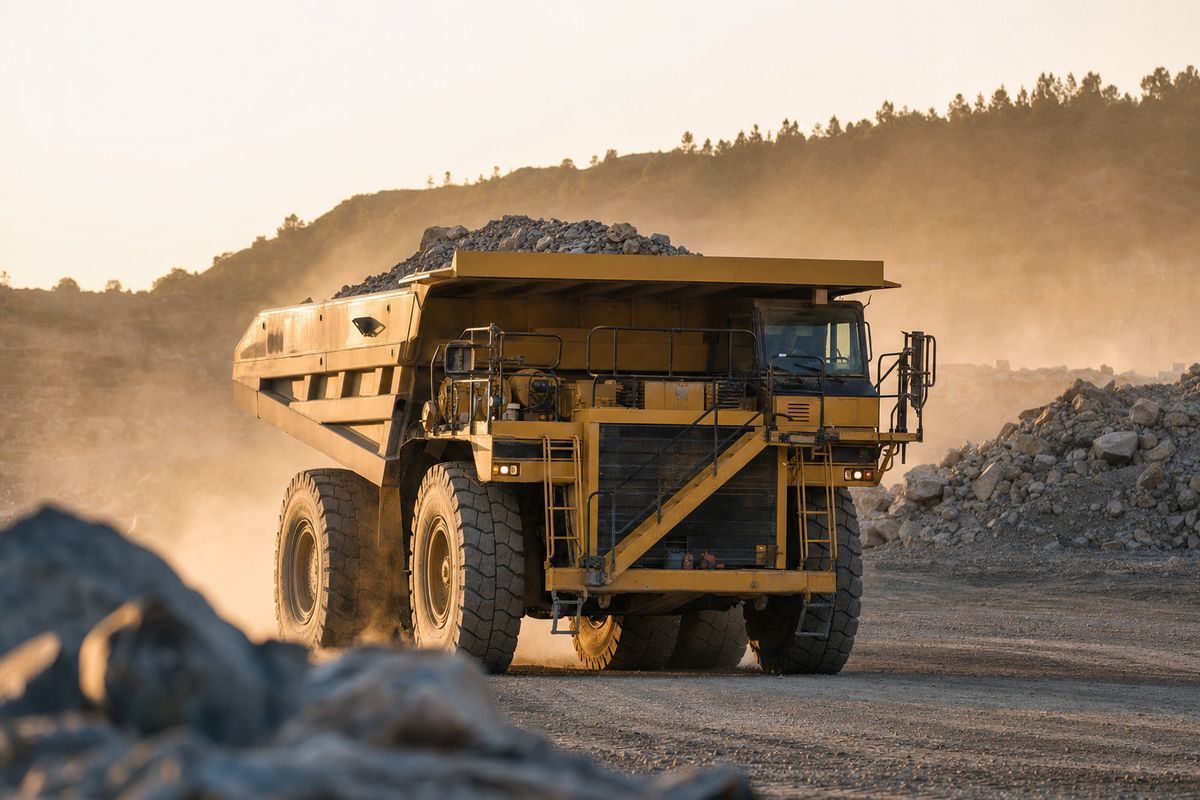
The Caterpillar 777 (07) is the latest evolution of Caterpillar’s 100-ton-class mechanical-drive off-highway truck, introduced as the successor to the 777G with the new Cat C32B engine, Tier 4 Final/Stage V emissions compliance, and optional Cat MineStar Command autonomous haulage integration. Target payload is 101.1 short tons (91.7 tonnes) with a gross machine weight near 363,000 lb (164,654 kg). The C32B delivers 1,025 hp (765 kW) gross at 1,800 rpm with 916 hp (683 kW) net, paired with a seven-speed powershift transmission enabling loaded top speeds of 40.9 mph (65.9 km/h). Body capacity is 83.1 yd³ (63.5 m³) SAE 2:1 heaped. For construction and quarry transport fleets, the 777 (07) emphasizes fuel efficiency per ton-mile, improved access systems, autostall and delayed engine shutdown for component life, and Product Link telematics for payload and cycle monitoring. Pricing is typically negotiated through Cat dealers and varies by region, body configuration, and emissions tier; list-equivalent new units in this class commonly exceed $2–3 million USD depending on options. This report synthesizes OEM specifications, generational context, and fleet-application guidance for transport and construction operators evaluating rigid-frame haul trucks.
2. Introduction: The 100-Ton Mechanical Standard
Since the original 777 debuted in 1974, Caterpillar’s 90–100-ton rigid hauler has anchored mid-scale mining, quarry, and large earthmoving sites worldwide. The 777 (07) generation, building on the 777G (2012) and regionally optimized 777E (2016), positions itself as “the most efficient 100-ton mechanical truck in the industry” per Caterpillar product literature. Unlike articulated dump trucks common on highway-adjacent jobsites, the 777 is a rear-dump, rigid-frame off-highway truck designed for high-cycle production in mines, large dam projects, and major infrastructure earthworks where sustained payload and downhill retarding capability matter more than on-road licensing.
For construction transport applications—moving overburden, shot rock, sand, and aggregate between cut, crusher, and stockpile—the 777 (07) competes with the Komatsu HD325-8, Volvo R100E (where available), and legacy 777G fleets. Its mechanical drive train remains preferred by many operators for simplicity, field serviceability, and lower capital complexity versus diesel-electric alternatives in this tonnage class.
3. Engine and Powertrain
The 777 (07) powertrain pairs the Cat C32B with a heavy-duty powershift transmission tuned for high-cycle quarry and construction haul routes. Together they deliver the loaded speed, grade retarding, and field serviceability that define productivity in the 100-ton mechanical class.
Cat C32B Engine
| Specification | Tier 4 Final / Stage V | Tier 2 Equivalent |
|---|---|---|
| Engine Model | Cat C32B | Cat C32B |
| Gross Power (SAE J1995) | 1,025 hp / 765 kW @ 1,800 rpm | 1,025 hp / 765 kW |
| Net Power (SAE J1349) | 916 hp / 683 kW | 945 hp / 704 kW |
| ISO 14396 Power | 1,008 hp / 752 kW | 1,012 hp / 755 kW |
| Peak Torque Speed | 1,200 rpm | 1,200 rpm |
| Net Torque Rise | 39% | 37% |
| Cylinders | 12 | 12 |
| Displacement | 32.1 L (1,959 in³) | 32.1 L |
The C32B replaces the C32 ACERT used on the 777G, maintaining the 1,025 hp headline rating while improving torque delivery and emissions aftertreatment integration. Tier 4 Final/Stage V configurations use selective catalytic reduction and diesel particulate filter strategies consistent with other Cat large mining products.
Transmission and Travel Speeds
The powershift transmission provides seven forward speeds and one reverse. Maximum loaded travel speed (40.9 mph / 65.9 km/h) is achieved in seventh gear with standard 27.00R49 (E4) tires. Gear spread:
| Gear | Speed |
|---|---|
| Forward 1 | 6.6 mph (10.7 km/h) |
| Forward 2 | 9.1 mph (14.6 km/h) |
| Forward 3 | 11.9 mph (19.2 km/h) |
| Forward 4 | 16.6 mph (26.7 km/h) |
| Forward 5 | 22.5 mph (36.2 km/h) |
| Forward 6 | 30.2 mph (48.6 km/h) |
| Forward 7 | 40.9 mph (65.9 km/h) |
| Reverse | 7.5 mph (12.1 km/h) |
Autostall and delayed engine shutdown features protect the torque converter and turbocharger from hot shutdown damage—meaningful for construction fleets with irregular shift ends.
4. Payload, Weight, and Body Capacity
| Operating Spec | Value |
|---|---|
| Target Payload (100%) | 101.1 ton US / 91.7 t |
| Maximum Working Payload (110%) | 111.2 ton US / 100.9 t |
| Maximum Allowable Payload (120%)* | 121.3 ton US / 110.1 t |
| Target Gross Machine Weight | ~363,000 lb / 164,654 kg |
| Body Capacity (SAE 2:1, X Body, flat floor with liner) | 83.1 yd³ / 63.5 m³ |
*Per Caterpillar 10/10/20 Payload Policy for gross vehicle weight limitations.
Why it matters: In quarry-to-crusher loops, the 777 (07)‘s ~101-ton target balances legal axle and tire loading with cycle time. Overloading to 110–120% may be permitted under Cat policy but increases tire, brake, and powertrain wear—critical TCO variables for construction transport managers.
5. Telematics and Autonomy
Fleet managers increasingly spec connectivity and autonomy readiness at purchase. Caterpillar bundles telematics on current 777 builds and offers a graduated path to autonomous hauling where site geometry, traffic control, and production volume justify the investment on large quarry sites.
Product Link / MineStar
Caterpillar integrates Product Link telematics on current 777 models, enabling:
- Payload monitoring and cycle counting
- Fuel burn and idle-time reporting
- Fault code forwarding to dealer portals
- Integration with Cat MineStar fleet management
Cat MineStar Command for Hauling
The 777 (07) supports autonomous hauling via Cat MineStar Command, with demonstrations in aggregates operations reported from 2024 onward. Autonomous configurations add capital cost and site infrastructure requirements but can reduce unit cost per ton in 24/7 high-volume quarries. Construction sites with mixed traffic and public interfaces typically remain manned; autonomy is niche in general building construction but relevant for large dam, tunnel muck, and remote quarry projects.
6. Global Pricing and TCO Context
Caterpillar does not publish global MSRP for the 777 (07); pricing is dealer-negotiated and depends on:
- Emissions tier (Tier 4 Final vs Tier 2 export)
- Body type (X Body, dual-slope, coal, ejector)
- Tire package (27.00R49 standard)
- Autonomy and MineStar bundles
- Regional duties and financing
Industry benchmarks for new 100-ton-class rigid trucks commonly range $2.0–3.5 million USD equipped, with major rebuilds and used 777G units trading substantially lower. Operating cost drivers include fuel per ton-mile, tire life (often the largest OPEX line), and maintenance under high daily cycle counts typical of construction transport.
7. Construction and Transport Applications
Best-fit use cases:
- Quarry overburden and shot-rock haul routes (>500 m one-way)
- Large dam and reservoir earthmoving
- Mine development where ADT flotation is unnecessary
- Crusher feed and stockpile redistribution at high daily tonnage
Less ideal:
- Urban or highway-adjacent jobs requiring on-road registration
- Soft underfoot sites where articulated dump trucks provide better traction
- Low-volume projects where capital intensity cannot be amortized
Compared to the Komatsu HD325-8 (also ~100-ton class) and Volvo R100E (diesel-electric), the 777 (07) leads on mechanical-drive field support density and Cat dealer network breadth in North America, Australia, and parts of Africa/Latin America.
8. Operator Experience and Safety
Caterpillar emphasizes an improved access system (stairs, handrails, platforms) to reduce slips and falls—a significant injury category on large haul trucks. The cab offers enhanced visibility and stability control for uneven haul roads common on construction sites. Automatic retarding control on grades reduces brake fade risk versus manual retarder management.
9. Information Gaps
| Gap | Impact |
|---|---|
| Exact list MSRP by region | Budgeting requires dealer quote |
| Fuel consumption curves by load/grade | TCO modeling needs site trials |
| Autonomous package pricing | ROI unclear without MineStar scope |
| Lead times (2025–2026) | Supply chain varies by factory |
10. Strategic Recommendations
- Benchmark cycle times against existing 777G or competitor 100-ton fleets before capital commit.
- Spec Product Link from day one for payload and fuel benchmarking—essential for construction transport KPIs.
- Match body liner and capacity to material density (rock vs coal vs overburden) to avoid under-body or over-weight citations.
- Evaluate Tier 4 vs export Tier 2 based on site fuel sulfur and local emissions enforcement.
- Pilot autonomy only on controlled, high-volume quarry loops—not general construction multi-trade sites.
11. Conclusion
The Caterpillar 777 (07) series reinforces Cat’s dominance in the 100-ton mechanical haul segment with a proven C32B powerplant, class-leading loaded speed, and a clear path to autonomous operation via MineStar. For construction transport fleets moving millions of tonnes annually between cut and process plant, it remains a default reference truck—provided haul roads, production volume, and dealer support justify the capital outlay. Operators should pair the truck with disciplined payload monitoring, tire management, and realistic cycle modeling before committing to autonomy bundles that only pay back on the highest-volume quarry loops.