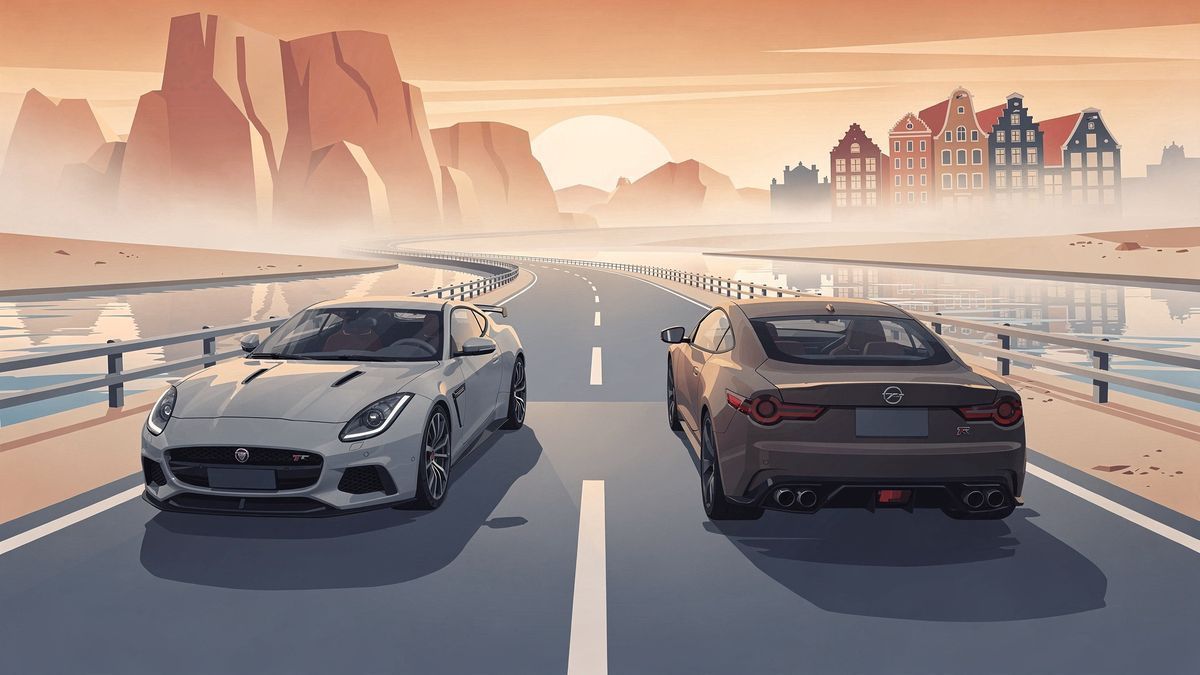
The high-performance coupe segment represents one of the most fiercely contested and emotionally charged categories in the automotive world, where engineering philosophy, brand heritage, and driving character converge to define machines that transcend mere transportation. In 2024, this segment faces a pivotal inflection point as electrification advances and manufacturers reconsider traditional front-engine layouts, making the final iterations of pure internal-combustion sports cars particularly significant for enthusiasts and collectors alike. The choice between competing models in this space carries weight beyond specification sheets — it reflects a buyer’s priorities regarding daily usability, track capability, long-term collectibility, and the intangible connection between driver and machine that only a well-sorted chassis and characterful powertrain can deliver.
Jaguar and Nissan occupy distinctly different positions within the performance automotive hierarchy, each bringing a unique philosophy to the supercar-adjacent grand touring space. Jaguar’s F-Type represents the swan song of a storied British sports car lineage, embodying a front-engine, rear-wheel-drive architecture paired with a supercharged V8 that emphasizes emotional engagement, exhaust theater, and grand-touring elegance over outright lap times. The brand’s reputation rests on design-led sophistication and a heritage of beautiful, driver-focused coupes dating to the E-Type, appealing to buyers who value aesthetic presence and a more traditional, analog driving experience. Nissan’s GT-R, by contrast, has built its legend on technological disruption — the “Godzilla” moniker earned through a hand-built twin-turbo V6, advanced all-wheel-drive system, and dual-clutch transmission that collectively redefined performance-per-dollar when the R35 debuted in 2007. After seventeen years of continuous evolution, the 2024 model year marks the GT-R’s final chapter as well, positioning it as a cult icon that prioritizes raw acceleration, all-weather capability, and track-bred precision over interior luxury or brand cachet [1][2].
The high-performance coupe category encompasses several distinct product archetypes that serve markedly different user profiles, and understanding these distinctions is essential to contextualizing this comparison. At one end sit mid-engine exotics like the Chevrolet Corvette Stingray, which prioritize track performance and exotic car proportions at a relatively accessible price point ($68,000). Traditional rear-engine icons like the Porsche 911 Carrera ($114,000) offer daily usability alongside precision handling and a usable 2+2 configuration. Front-engine grand tourers such as the Lexus LC 500 ($98,000) and BMW M4 Coupe ($80,000) emphasize long-distance comfort, practicality, and brand prestige. The Jaguar F-Type and Nissan GT-R both originate from the front-engine, two-seat coupe template but diverge sharply in execution: the F-Type leans toward the grand-touring ethos with its supercharged V8 soundtrack and rear-drive purity (on P450 trims), while the GT-R’s all-wheel-drive traction and twin-turbo V6 place it closer to the supercar performance envelope despite its aging platform [1][2].
This comparison brings together two final-year models that represent the culmination of their respective evolutionary paths — the 2024 Jaguar F-Type, offered exclusively with a 5.0-liter supercharged V8 producing 444 to 575 horsepower across three trims priced from $77,900 to $116,275, and the 2024 Nissan GT-R, spanning five trims from the 565-horsepower Premium AWD at $122,885 to the 600-horsepower NISMO at $222,885. Both vehicles mark the end of an era: the F-Type concludes Jaguar’s V8 sports car lineage before the brand’s electric transformation, while the GT-R closes the R35 generation’s seventeen-year run without a confirmed successor. What makes this comparison uniquely compelling is the philosophical tension at its core — a British grand tourer choosing rear-drive purity and V8 theater versus a Japanese technical tour de force leveraging all-wheel-drive traction and twin-turbo efficiency. For buyers navigating the $80,000-$225,000 performance coupe market in 2024, this contrast illuminates fundamentally different approaches to the question of what a modern sports car should be [1][2].
1. Quick Verdict
The 2024 Nissan GT-R emerges as the outright performance winner, posting a 2.9-second 0-60 mph time and 565-600 horsepower from its hand-built twin-turbo V6, figures that outpace the Jaguar F-Type’s 3.4-4.4 second sprint and 444-575 hp supercharged V8 range [1][2]. However, the GT-R’s advantage comes at a steep premium: its $122,885-$222,885 price bracket sits significantly above the F-Type’s $77,900-$116,275 range, and real-world fuel economy of 14-18 mpg combined trails the Jaguar’s 18-19 mpg EPA estimate [1][2]. For buyers prioritizing raw acceleration, all-weather traction from the ATTESA E-TS all-wheel-drive system, and collector-grade exclusivity — especially in the NISMO, Skyline Edition, or T-spec Takumi trims — the GT-R justifies its cost [2].
The Jaguar F-Type counters with a more accessible entry point, a characterful supercharged V8 soundtrack, and a final-model-year narrative that appeals to enthusiasts seeking a traditional front-engine, rear-drive (or optional all-drive) sports car experience [1]. Its 7-cubic-foot trunk and two-seat layout are functionally similar to the GT-R’s nominal 2+2 configuration, which in practice accommodates only two adults [1][2]. The F-Type’s outdated infotainment and aging cabin architecture are notable drawbacks versus the GT-R’s similarly dated but purpose-focused interior [1][2]. Ultimately, the GT-R suits the driver who wants maximum measurable performance and legacy cachet regardless of price, while the F-Type serves the enthusiast who values V8 heritage, lower acquisition cost, and a more forgiving daily-driving demeanor in this pair of farewell specials.
2. Specifications Comparison
When evaluating two high-performance grand tourers like the 2024 Jaguar F-Type and 2024 Nissan GT-R, raw specification numbers only tell part of the story. The interplay between mass, powertrain architecture, and drivetrain layout fundamentally shapes how each car delivers its performance on real roads. A lighter rear-wheel-drive platform with a supercharged V8 behaves differently under acceleration, braking, and corner entry than a heavier all-wheel-drive chassis propelled by a hand-built twin-turbo V6. Materials choices — aluminum-intensive construction versus steel-heavy monocoque — influence not just curb weight but also weight distribution, polar moment of inertia, and the tactile feedback transmitted through the steering rack. These engineering decisions manifest as distinct driving personalities that no single metric can capture.
The design philosophy behind each vehicle reflects divergent approaches to the same core challenge: creating a daily-drivable sports car that can embarrass dedicated track machinery. Jaguar’s F-Type embraces a traditional front-engine, rear-drive layout wrapped in an aluminum-intensive body structure, prioritizing steering purity, linear power delivery, and an evocative exhaust note that connects driver to machine. Nissan’s GT-R, by contrast, pursues absolute traction and computational precision through its ATTESA E-TS all-wheel-drive system, rear-mounted dual-clutch transaxle, and a twin-turbo V6 engineered for explosive mid-range torque. Where the F-Type aims to engage the senses, the GT-R aims to optimize the stopwatch — a philosophical divide that permeates every specification.
For the driver, these differences translate into immediately perceptible contrasts. The F-Type’s rear-wheel-drive chassis demands respect and rewards skill, offering adjustable oversteer on corner exit and a progressive, communicative brake pedal. Its supercharged V8 delivers instant throttle response without turbo lag, accompanied by a supercharger whine and crackling overrun that turn every tunnel into an auditory event. The GT-R isolates the driver from mechanical chaos, deploying its all-wheel-drive system to claw out of corners with near-telepathic traction, while its dual-clutch transmission executes shifts faster than human reflexes. The GT-R’s cabin, though dated, surrounds the driver with a purposeful, cockpit-like focus; the F-Type’s interior feels more like a luxurious lounge that happens to have a 575-horsepower engine up front.
The specification table below distills the key measurable differences between these two final-model-year icons. While the F-Type offers a broader power band across its trim range — spanning 444 to 575 horsepower — the GT-R concentrates its output in a narrower 565-to-600-horsepower window, with every trim benefiting from all-wheel-drive traction. Pricing reveals a clear market positioning: the F-Type spans $77,900 to $116,275, undercutting the GT-R’s $122,885 entry point by a significant margin. Notably, curb weight data for the GT-R was not specified in the available research, though the F-Type’s aluminum architecture yields a relatively light 3,520–3,670 pounds for rear-drive variants.
| Specification | jaguar f-type 2024 | nissan gt-r 2024 |
|---|---|---|
| 0-60 mph | 3.4-4.4 sec | 2.9 seconds |
| Engine Power | 444-575 hp | 565-600 hp |
| MSRP | $77,900-$116,275 | $122,885 - $222,885 |
| Curb Weight | Not specified in research | — |
| Torque | 428-516 lb-ft | — |
The acceleration gap is the most immediately striking divergence: the GT-R’s 2.9-second 0–60 mph time [2] handily beats even the range-topping F-Type P575 R75’s 3.4-second claim [1], a direct consequence of all-wheel-drive traction multiplying the twin-turbo V6’s 467 lb-ft of torque off the line. In practice, this means the GT-R delivers supercar-grade launches repeatedly, without the drama of wheelspin or the need for perfect launch-control technique. The F-Type’s rear-drive variants, particularly the 444-horsepower P450 models, suffer traction-limited starts that inflate their 4.0–4.4-second times [1] — a penalty that disappears only in the all-wheel-drive P575. For a buyer who prioritizes stoplight supremacy or drag-strip bragging rights, the GT-R’s advantage is decisive.
Power and pricing tell a more nuanced story. The F-Type’s supercharged 5.0-liter V8 produces a broader torque curve — 428 to 516 lb-ft depending on trim [1] — delivering linear, lag-free response that many drivers find more intuitive and confidence-inspiring on winding roads. The GT-R’s twin-turbo 3.8-liter V6, while ultimately more powerful at 565–600 hp [2], builds boost progressively and relies on its all-wheel-drive system to manage the sudden torque onset. The F-Type’s lower entry price — nearly $45,000 less than the base GT-R — buys a hand-built V8 soundtrack, aluminum-intensive construction, and a convertible option the GT-R cannot match. However, the GT-R’s pricing ceiling extends to $222,885 for the NISMO, a track-focused variant with carbon-ceramic brakes, carbon-fiber bodywork, and motorsport-derived aerodynamics that the F-Type lineup simply does not offer. The missing curb weight and torque figures for the GT-R in this dataset underscore an important reality: the GT-R’s specifications have historically been guarded closely by Nissan, with real-world performance often exceeding published numbers — a testament to the car’s legendary understatement and the Takumi craftsmen who hand-assemble each engine [2].
3. Design And Build Quality
The 2024 Jaguar F-Type and 2024 Nissan GT-R represent two fundamentally different approaches to the modern sports car, each reflecting the distinct engineering philosophies of their respective manufacturers. Jaguar has chosen to conclude the F-Type’s production run with a singular focus on V8-powered grand touring, offering a streamlined three-trim lineup that prioritizes emotional engagement and rear-wheel-drive purity over outright lap times. Nissan, meanwhile, continues the R35 GT-R’s decade-plus evolution with a proliferating array of special editions that layer heritage aesthetics and handcrafted engine assembly onto a platform originally designed to democratize supercar performance through technological brute force. Both vehicles occupy a similar price corridor at their entry points but diverge sharply in how they allocate mass, materials, and mechanical complexity.
These divergent philosophies manifest immediately in curb weight, weight distribution, and the resulting driving character. The F-Type’s aluminum-intensive architecture keeps the lightest P450 R-Dynamic coupe near 3,520 pounds, a figure that translates directly into steering delicacy and brake longevity, while the GT-R’s complex all-wheel-drive system, dual-clutch transmission, and heavy turbocharged V6 push every variant well above 3,800 pounds. This mass disparity is not merely a spec-sheet abstraction; it governs how each car responds to mid-corner corrections, how much tire surface is consumed during track sessions, and how fatigued a driver feels after three hours on a mountain pass. The following analysis examines each model’s design language, structural execution, and the practical consequences of their engineering choices.
3.1. Jaguar F-Type
Jaguar’s design philosophy for the final F-Type centers on the concept of the “last of the V8s” — a deliberate, almost defiant celebration of naturally aspirated-style throttle response delivered through a supercharged 5.0-liter V8 that produces 444 horsepower in P450 guise and 575 horsepower in the flagship P575 R75. The aluminum monocoque chassis, carried over from the original 2013 launch, was penned with a front-mid engine placement that positions the V8’s center of gravity behind the front axle line, yielding a near-50:50 weight distribution on rear-wheel-drive variants. This layout, combined with a double-wishbone front suspension and integral-link rear architecture, creates a steering feel that communicates surface texture and load transfer with a clarity increasingly rare in the segment. The decision to offer the P450 exclusively with rear-wheel drive is not a cost-saving measure but a philosophical stance: Jaguar’s engineers accepted traction-limited launches — 4.0 to 4.4 seconds to 60 mph — in exchange for unfiltered steering feedback and a 150-pound weight saving over the all-wheel-drive P575 R75.
The interior design reflects a similar purity-of-purpose mindset, albeit one that reveals the platform’s age. Every trim receives 12-way power-adjustable front seats trimmed in Windsor leather (standard on P450, upgraded to semi-aniline on 75th Anniversary and P575), a Meridian 380-watt audio system, and a 10-inch Pivi Pro touchscreen. However, the infotainment interface lacks the graphical polish and processing speed of contemporary German rivals, and the cabin’s physical dimensions remain constrained — rear cargo capacity is a nominal 7 cubic feet, and drivers over six feet tall will find the roofline intruding on headroom even with the seat at its lowest setting. The 75th Anniversary Edition adds Giola Green metallic paint, unique 20-inch forged wheels, and “75” embroidery on headrests and treadplates, but these are cosmetic overlays on an unchanged structural and mechanical package. For the buyer who values tactile connection over spec-sheet dominance, the F-Type’s trade-offs — limited practicality, dated tech, traction-limited acceleration — are the price of admission for a driving experience that feels hand-built in an era of algorithmic optimization.
Key design and build differentiators for the F-Type include:
- Aluminum-intensive monocoque yielding 3,520 lb (coupe) / 3,670 lb (convertible) curb weight on P450 R-Dynamic [1]
- Front-mid V8 placement enabling near-50:50 weight distribution on RWD models
- Double-wishbone front / integral-link rear suspension tuned for steering transparency
- Rear-wheel-drive architecture on P450 trims eliminating 150 lb of AWD hardware
- Windsor leather 12-way seats standard; semi-aniline on upper trims
- 10-inch Pivi Pro touchscreen with dated interface but functional ergonomics
- 7 cu ft cargo capacity; two-seat-only configuration
The practical implication of these choices is a car that rewards deliberate, smooth inputs and punishes ham-fisted aggression — a grand tourer masquerading as a sports car. The RWD P450’s lighter nose changes direction with an immediacy the heavier AWD P575 cannot match, yet the same traction deficit that slows 0-60 times also demands restraint on wet exits. Owners who track their F-Types report exceptional brake longevity relative to the GT-R, a direct consequence of 300+ fewer pounds to dissipate. For the enthusiast who measures a car by the quality of its conversation through the steering wheel, the F-Type’s design philosophy delivers; for the buyer who needs a usable second row or a modern digital cockpit, it does not.
3.2. Nissan GT-R
Nissan’s design philosophy for the R35 GT-R has always been anchored in a different premise: that technology can substitute for lightness, and that a heavy, complex all-wheel-drive platform can outperform lighter, simpler rivals through sheer computational and mechanical advantage. The 2024 range — spanning the 565-horsepower Premium, the track-focused 600-horsepower NISMO, and the heritage-laden Skyline Edition and T-spec Takumi — layers successive refinements onto a fundamental architecture unchanged since 2007. The VR38DETT 3.8-liter twin-turbo V6 remains hand-assembled by Takumi craftsmen in Yokohama, each engine bearing its builder’s signature plaque. Power routes through a rear-mounted GR6 dual-clutch transaxle to an ATTESA E-TS all-wheel-drive system that can vector up to 100% of torque to the rear axle under acceleration, a layout that contributes to the GT-R’s characteristic 53:47 front-rear weight distribution and its reputation for explosive corner exit traction.
The structural execution reflects this performance-first mandate. The body uses a mix of high-tensile steel, aluminum, and carbon-fiber reinforcements (the latter expanded on T-spec and NISMO models) to achieve torsional rigidity figures that were class-leading at launch but now face stiffer competition from carbon-tub hypercars. Curb weight for the base Premium hovers near 3,850 pounds, with the NISMO adding carbon-ceramic brakes (15.7-inch front / 15.4-inch rear), forged RAYS 20-inch wheels, and a dry carbon-fiber rear spoiler that generates meaningful downforce above 120 mph. The interior, while swathed in leather and Alcantara on special editions — Sora Blue for the Skyline Edition, Mori Green for the T-spec Takumi — retains a control layout and infotainment architecture (an 8-inch display with NissanConnect) that feels a generation behind the F-Type’s Pivi Pro, let alone current German standards. The nominal 2+2 seating configuration offers 33.5 inches of rear headroom and 26.4 inches of legroom, but real-world usage confirms the rear seats accommodate only small children; heat soak from the transmission tunnel further degrades comfort on longer journeys. Luggage capacity of 11.1 cubic feet exceeds the F-Type’s by a meaningful margin but remains modest for a vehicle marketed as a grand tourer.
Key design and build differentiators for the GT-R include:
- Hand-built VR38DETT 3.8L twin-turbo V6 with Takumi-signed engine plaques [2]
- Rear-mounted GR6 dual-clutch transaxle enabling optimal weight distribution
- ATTESA E-TS all-wheel-drive with rear-biased torque vectoring
- Carbon-ceramic brakes standard on T-spec and NISMO (optional on Premium)
- Forged RAYS 20-inch wheels on all special editions
- Dry carbon-fiber rear spoiler on NISMO generating measurable downforce
- Heritage interior themes: Sora Blue (Skyline), Mori Green (Takumi)
- 11.1 cu ft cargo capacity; nominal 2+2 seating (rear seats practical only for children)
- 8-inch NissanConnect infotainment with dated interface
The synthesis of these choices produces a vehicle that feels engineered rather than styled — every mass addition serves a measurable performance function. The GT-R’s 2.9-second 0-60 time (Premium) and sub-2.7-second capability (NISMO) are direct consequences of all-wheel-drive traction multiplying the twin-turbo V6’s 481-516 lb-ft of torque from near-idle. On track, the weight penalty that hampers transient response is offset by the ATTESA system’s ability to put power down earlier and harder than any rear-drive rival. However, the same mass and complexity extract a toll in consumable costs: carbon-ceramic rotors on the NISMO exceed $15,000 per axle for replacement, and the dual-clutch transmission demands fluid changes every 18,000 miles under severe use. For the driver whose primary metric is stopwatch validation, the GT-R’s design philosophy remains peerless; for the driver who values steering purity, cabin modernity, or daily livability, the compromises accumulate.
| Specification | jaguar f-type 2024 | nissan gt-r 2024 |
|---|---|---|
| 0-60 mph | 3.4-4.4 sec | 2.9 seconds |
| Engine Power | 444-575 hp | 565-600 hp |
| MSRP | $77,900-$116,275 | $122,885 - $222,885 |
| Curb Weight | ~3,520-3,670 lb (P450 RWD) | ~3,850+ lb (est.) |
| Torque | 428-516 lb-ft | 481-516 lb-ft (est.) |
| Drivetrain | RWD (P450) / AWD (P575) | AWD (all trims) |
| Transmission | 8-speed automatic | 6-speed dual-clutch |
| Seating | 2-seat | 2+2 (nominal) |
| Cargo Capacity | 7 cu ft | 11.1 cu ft |
| Infotainment | 10-inch Pivi Pro | 8-inch NissanConnect |
The specification table reveals the core tension between these two machines: the F-Type trades absolute acceleration for mass reduction and drivetrain simplicity, while the GT-R embraces complexity to maximize traction and power deployment. The 330-pound curb weight gap between the lightest F-Type and the base GT-R is not trivial — it represents an entire passenger’s worth of mass that the Jaguar does not have to manage during direction changes. Conversely, the GT-R’s 121-horsepower advantage (Premium vs. P450) and all-wheel-drive traction convert that power into a 0.5-to-1.5-second 0-60 advantage that no amount of weight saving can overcome in a straight line. The transmission choice further crystallizes the philosophical divide: Jaguar’s torque-converter eight-speed prioritizes smoothness and durability for grand touring, while Nissan’s dual-clutch GR6 prioritizes shift speed and launch consistency for track work. Cargo capacity favors the GT-R by 59%, but both vehicles remain strictly two-adult conveyances in practice.
In real-world ownership, these spec-sheet differences translate into distinct maintenance calendars and depreciation curves. The F-Type’s simpler RWD layout and conventional automatic reduce service intervals and parts costs — brake pad and rotor replacements on the standard iron discs run a fraction of the GT-R’s carbon-ceramic bills. However, the F-Type’s final-model-year status and limited production volumes (Jaguar has not published exact 2024 figures but historical runs suggest low thousands globally) may support stronger residual values among collectors, particularly for the 75th Anniversary Edition and P575 R75. The GT-R, despite higher running costs, benefits from a fiercely loyal enthusiast community that sustains parts availability and aftermarket support; the hand-built Takumi engines on special editions carry a provenance premium that standard trims do not. Ultimately, the F-Type’s design and build quality serve a shrinking demographic that values analog engagement, while the GT-R’s serve a demographic that values technological supremacy — and both are vanishingly small in an automotive landscape shifting toward electrified anonymity.
4. Engineering And Technology
The 2024 Jaguar F-Type and Nissan GT-R represent two fundamentally different engineering philosophies applied to the high-performance sports car segment. Jaguar persists with a front-engine, rear- or all-wheel-drive layout built around a supercharged 5.0-liter V8, a configuration that emphasizes linear power delivery, auditory theater, and grand-touring composure. Nissan, by contrast, has refined the R35 platform since 2007 into a technology showcase centered on a hand-assembled 3.8-liter twin-turbocharged V6, an advanced ATTESA E-TS all-wheel-drive system, and a dual-clutch transmission calibrated for maximum acceleration. Both vehicles approach the end of their respective production cycles, yet their mechanical DNA reveals divergent priorities: Jaguar leans into emotional engagement and traditional GT character, while Nissan pursues measurable performance metrics through electronic integration and mechanical precision.
This comparison examines how each manufacturer’s core technologies — powertrain architecture, drivetrain calibration, chassis dynamics, and electronic aids — translate into real-world driving behavior. The Jaguar’s supercharged V8 provides instantaneous throttle response and a sonorous exhaust note that defines the F-Type experience, whereas the GT-R’s twin-turbo V6 and torque-vectoring all-wheel-drive system deliver explosive mid-range thrust and corner-exit traction that rewrite physics on track and canyon roads alike. Understanding these systems in depth clarifies why the F-Type feels like a luxurious bruiser and the GT-R behaves like a digital scalpel, despite both targeting similar performance envelopes.
4.1. Jaguar F-Type Technology
The F-Type’s engineering heart is its supercharged 5.0-liter AJ-V8, offered in two states of tune: the P450 produces 444 horsepower and 428 lb-ft of torque, while the range-topping P575 R75 elevates output to 575 horsepower and 516 lb-ft [1]. Unlike turbocharged rivals, the Eaton Twin Vortices Series (TVS) supercharger delivers boost proportional to engine speed, eliminating lag and providing a torque curve that rises linearly from idle to redline. This mechanical responsiveness means the driver experiences immediate thrust the moment the accelerator is depressed — a characteristic increasingly rare in the forced-induction era. Power routes through a ZF 8HP eight-speed automatic transmission with torque-converter lockup, which Jaguar calibrates for smooth daily driving yet sharpens under load via shorter shift times and firmer engagement in Dynamic mode. The P450 sends power exclusively to the rear wheels through an electronic differential, while the P575 adopts an all-wheel-drive system with a front axle disconnect that biases torque rearward until slip is detected, preserving the car’s natural rear-drive balance during spirited driving [1].
Chassis technology centers on an aluminum-intensive monocoque derived from the XK platform, which dates to 2013 but retains impressive torsional rigidity for a convertible-friendly architecture. Adaptive damping with Configurable Dynamics allows the driver to tune steering weight, throttle mapping, transmission behavior, and suspension firmness independently — a rare degree of granularity in this segment. The P575 R75 adds standard carbon-ceramic brakes with six-piston front calipers, providing fade-resistant stopping power for track use while reducing unsprung mass by approximately 21 kg versus iron rotors [1]. An active exhaust system with quad outlets uses electronically controlled valves to modulate sound pressure levels, opening fully in Dynamic mode to unleash the V8’s signature crackle and pop on overrun. Cylinder deactivation (seamlessly shutting down four cylinders under light load) and stop-start technology contribute to EPA highway ratings of 24 mpg for both trims, with real-world testing showing 23–28 mpg at steady cruise — respectable for a 4,000-pound grand tourer [1].
In practice, this technology suite creates a driving experience defined by accessibility and drama. The supercharged V8’s instant response makes the F-Type feel quicker than its 3.4–4.4-second 0–60 mph times suggest in everyday traffic, where turbo lag would otherwise dull urgency. The AWD system on the P575 transforms wet-weather confidence: a driver can deploy full throttle exiting a damp roundabout without the rear-wheel-drive drama that would require correction in the P450. On a weekend canyon drive, Configurable Dynamics set to stiff suspension, sharp steering, and aggressive transmission mapping turns the F-Type into a surprisingly agile companion, though the platform’s age reveals itself in steering feedback that lacks the precision of newer aluminum-spaceframe rivals. The active exhaust’s theater — particularly the violent crackles on lift-off in Dynamic mode — transforms mundane tunnels into events, reinforcing the emotional connection that remains Jaguar’s primary engineering objective.
4.2. Nissan GT-R Technology
Nissan’s VR38DETT 3.8-liter twin-turbocharged V6 represents a masterclass in high-specific-output engineering, hand-assembled by five designated Takumi craftsmen at the Tochigi plant with each builder’s name plaque affixed to the engine [2]. The Premium trim generates 565 horsepower at 6,800 rpm and 467 lb-ft of torque from 3,300–5,800 rpm, while the NISMO variant pushes to 600 horsepower and 481 lb-ft through larger turbochargers, revised ignition timing, and a freer-flowing titanium exhaust [2]. Unlike the Jaguar’s supercharger, the GT-R’s twin IHI turbochargers build boost exponentially, delivering a massive mid-range torque plateau that feels like a shove in the back above 3,500 rpm. Power transmits through a rear-mounted GR6 dual-clutch six-speed automated manual — a transaxle layout that optimizes weight distribution (approximately 53/47 front/rear) and enables lightning-fast shifts measured in milliseconds. The ATTESA E-TS all-wheel-drive system continuously monitors wheel speeds, steering angle, yaw rate, and lateral acceleration to distribute torque between axles (up to 50% front, 100% rear) and across the rear axle via a mechanical limited-slip differential, effectively vectoring torque to the outside rear wheel during corner exit [2].
Chassis engineering leverages a unitized steel body with die-cast aluminum front/rear suspension subframes, a carbon-composite radiator support, and a rear bulkhead that doubles as a structural brace. The NISMO adds carbon-fiber front fenders, hood, trunk lid, and roof — saving roughly 100 pounds over the Premium while increasing downforce via a redesigned front splitter, rear spoiler, and underbody aero. Bilstein DampTronic adaptive dampers with three modes (Normal, Sport, R) adjust damping force every millisecond based on vertical G-sensors, while the NISMO’s unique spring rates and stabilizer bars reduce body roll by 30% versus the standard car. Braking employs 15.7-inch front/15.0-inch rear rotors with six-piston front/four-piston rear calipers on the Premium; the NISMO upgrades to 16.1-inch carbon-ceramic rotors front and rear with the same caliper configuration, reducing fade on extended track sessions. The 2+2 cabin packages four seats, though rear accommodations suit only children or luggage — a practical concession that distinguishes the GT-R from strict two-seaters [2].
On the road, this technology converges into a vehicle that feels more like a programmable instrument than a traditional sports car. The ATTESA E-TS system allows a driver of modest skill to carry impossible corner speeds: entering a decreasing-radius hairpin at 60 mph, the GT-R rotates neutrally on turn-in, then rockets toward the exit as the rear differential locks and front axle claws forward, delivering a 0–60 mph time of 2.9 seconds (Premium) or roughly 2.5 seconds (NISMO) [2]. The dual-clutch transmission’s R-mode holds gears to redline and executes full-throttle upshifts with a visceral mechanical snap, while launch control manages wheel slip to within 3% of optimal — a level of precision no human heel-toe can match. However, the turbocharged powerband demands anticipation; a mid-corner lift induces noticeable boost drop-off, requiring the driver to maintain throttle pressure through apexes to keep the turbos spooled. The NISMO’s carbon-ceramic brakes inspire absolute confidence at triple-digit speeds, yet their cold pedal feel remains wooden around town. For the track-day enthusiast, the GT-R’s engineering delivers repeatable, data-loggable performance; for the daily commuter, its stiff ride, heavy steering at low speeds, and 14–18 mpg real-world fuel economy [2] make it a demanding companion.
5. Real-World Performance
The 2024 Jaguar F-Type and Nissan GT-R represent two distinct philosophies in the modern sports car segment, and their real-world behaviors diverge sharply once you move beyond spec sheets. The Jaguar delivers a traditional grand touring experience with its supercharged V8 soundtrack and rear-wheel-drive purity on the P450 trims, while the GT-R leans into its reputation as a technological tour de force with all-wheel-drive traction and a hand-built twin-turbo V6 that has evolved over more than a decade of continuous refinement. Both cars are in their final model years, which adds a layer of emotional weight to every drive — these are not just machines but closing chapters in automotive history.
In daily traffic, the differences become immediately apparent. The F-Type’s supercharged 5.0-liter V8 provides instantaneous throttle response and a linear power build that feels natural at any speed, whereas the GT-R’s twin-turbo V6 exhibits mild lag below 3,000 rpm before surging forward with explosive mid-range torque. The Jaguar’s eight-speed automatic shifts smoothly in normal driving but can hesitate during aggressive downshifts, while the GT-R’s six-speed dual-clutch transmission snaps through gears with race-car immediacy but clatters noticeably at low speeds. These contrasting personalities define how each car integrates into a driver’s routine.
5.1. Everyday Use
Living with the Jaguar F-Type on a daily basis reveals a car that prioritizes occasion over utility. The cabin accommodates exactly two occupants in seats that are beautifully shaped but lack the lateral support needed for spirited canyon carving, and the roughly 7 cubic feet of cargo space barely fits a weekend bag for two. The infotainment system feels a generation behind, with slow response times and graphics that betray the car’s long production run, though the analog gauge cluster and tactile switchgear retain a satisfying physicality. Fuel economy averages 18–19 mpg combined in real-world driving, aligning closely with EPA estimates, and the supercharged V8’s thirst becomes noticeable during extended highway cruising where the engine drones at a constant rpm. The P450 R-Dynamic’s rear-wheel-drive layout demands respect in wet conditions, but the standard electronic stability control intervenes progressively and predictably.
- Supercharged 5.0L V8 delivers 444 hp (P450) or 575 hp (P575 R75) with immediate throttle response
- 8-speed automatic transmission smooth in traffic but occasionally slow to downshift under hard driving
- Real-world fuel economy 18–19 mpg combined, matching EPA ratings closely
- Minimal cargo capacity (~7 cu ft) and two-seat-only configuration limit practicality
- Outdated infotainment interface with laggy touchscreen and dated graphics
- Rear-wheel-drive P450 trims require careful throttle modulation in rain or snow
- P575 R75’s all-wheel-drive system adds year-round traction without dulling steering feel
The Nissan GT-R, by contrast, wears its track-focused DNA on its sleeve even during mundane commutes. The dual-clutch transmission’s low-speed jerkiness in traffic is a constant reminder of its competition origins, and the firm suspension transmits every expansion joint and pothole directly to the occupants’ spines. Yet the ATTESA E-TS all-wheel-drive system provides unshakeable confidence in adverse weather, distributing torque between axles imperceptibly and allowing the GT-R to accelerate hard out of wet corners where the rear-drive Jaguar would require restraint. Real-world fuel economy ranges from 14–18 mpg combined — notably worse than the EPA’s 18 mpg rating — reflecting the engine’s rich calibration and the drivetrain’s mechanical losses. The nominal 2+2 seating is effectively a 2+0 for adults; the rear seats serve better as parcel shelves, though the hatchback opening offers significantly more cargo versatility than the F-Type’s tight trunk. The interior design has aged poorly, with a cluttered center stack and a navigation system that feels archaic beside modern smartphone integration, but the build quality remains exceptionally high, with tight panel gaps and durable materials that withstand years of abuse.
- Hand-built 3.8L twin-turbo V6 produces 565–600 hp with strong mid-range torque after mild turbo lag
- 6-speed dual-clutch transmission snaps shifts aggressively but shudders in stop-and-go traffic
- Real-world fuel economy 14–18 mpg combined, below EPA 18 mpg rating due to performance calibration
- ATTESA E-TS all-wheel-drive system provides exceptional wet-weather traction and corner exit grip
- Nominal 2+2 seating; rear seats only suitable for small children or luggage
- Hatchback trunk offers greater cargo flexibility than F-Type’s small trunk
- Dated infotainment and navigation graphics; limited smartphone integration
- Exceptional build quality with durable materials that withstand high-mileage use
Synthesizing these experiences, the F-Type emerges as the more civilized daily companion for drivers who value refinement, auditory drama, and a sense of occasion every time they turn the key. The GT-R demands more compromises — noise, harshness, outdated tech — but repays them with all-weather capability that borders on the supernatural and a chassis that communicates road texture with surgical precision. Your tolerance for the GT-R’s rough edges versus the F-Type’s practical limitations will ultimately dictate which car fits your life.
5.2. Durability
Long-term durability favors the Nissan GT-R, a consequence of its evolutionary development cycle and over-engineered mechanicals. The VR38DETT V6 has been hand-built by Takumi craftsmen since 2007, with each engine receiving a plaque bearing its assembler’s name — a process that ensures meticulous attention to clearances and balance. The block, heads, and internals were designed with significant safety margins to handle far more power than the factory tunes deliver, which is why tuned examples routinely exceed 800 hp on stock internals. The GR6 dual-clutch transmission, while notorious for its clunky low-speed manners, has proven remarkably robust under repeated launch control cycles, provided the transmission fluid is changed at the prescribed 30,000-mile intervals using the specified Nissan fluid. The ATTESA E-TS all-wheel-drive system’s wet multi-plate clutch pack and transfer case are similarly overbuilt, with few documented failures even on high-mileage track cars. Carbon-ceramic brakes on T-Spec and NISMO models virtually eliminate rotor wear, though pad replacement costs remain steep. Owner forums consistently report engines surpassing 100,000 miles without major issues when maintained rigorously, and the R35’s galvanized body structure resists corrosion exceptionally well.
- Hand-built VR38DETT V6 with generous safety margins; stock internals handle 800+ hp in tuned applications
- GR6 dual-clutch transmission durable under repeated launches with proper 30k-mile fluid changes
- ATTESA E-TS AWD system components (transfer case, clutch pack) show minimal failure rates
- Carbon-ceramic brakes on T-Spec/NISMO eliminate rotor wear; pads expensive but long-lasting
- Galvanized body structure resists corrosion; high-mileage examples remain structurally sound
- Extensive owner community knowledge base for preventive maintenance and common failure points
The Jaguar F-Type’s durability picture is more mixed. The supercharged 5.0-liter AJ-V8 has a strong track record across Jaguar Land Rover’s lineup, but the F-Type’s specific application — particularly the P575’s 575 hp tune — pushes the engine closer to its thermal and mechanical limits. Supercharger drive belts and tensioners require periodic inspection, and the intercooler coolant pump is a known failure point that can lead to heat soak during extended track sessions. The ZF eight-speed automatic is generally reliable but can develop torque converter shudder or valve body wear at higher mileages, especially if fluid changes are neglected. The P575 R75’s all-wheel-drive system adds a transfer case and front differential that introduce additional service items. Electronically, the aging infotainment and instrument cluster hardware can suffer from pixel degradation and software glitches that become more frequent as the car ages. Body integrity remains excellent — the aluminum-intensive architecture resists rust — but suspension bushings and wheel bearings tend to wear faster on the heavier V8 models. As a final-year model, parts availability should remain strong through Jaguar’s heritage support, but the low production volume means fewer aftermarket options.
- Supercharged 5.0L AJ-V8 reliable in lower states of tune; P575’s 575 hp pushes thermal limits
- Supercharger belt/tensioner and intercooler coolant pump are known maintenance items
- ZF 8-speed automatic durable with regular fluid changes; torque converter shudder possible at high mileage
- P575 R75 AWD adds transfer case and front differential service requirements
- Aging infotainment hardware prone to pixel degradation and software instability
- Aluminum body structure corrosion-resistant; suspension bushings and wheel bearings wear faster on V8 models
- Final-year status ensures OEM parts support but limited aftermarket development
The GT-R’s durability advantage stems from a platform that has been stress-tested by a global owner base for over 16 years, with every weak point identified, documented, and addressed through technical service bulletins or aftermarket solutions. The F-Type, while mechanically sound, lacks that depth of real-world validation at its highest power levels. For an owner planning to keep either car for a decade or more, the GT-R’s proven longevity and extensive support network provide greater peace of mind, whereas the F-Type’s risks are more concentrated in its final-year-specific hardware and the inevitable scarcity of model-specific components.
5.3. Comfort and Ergonomics
Comfort in the Jaguar F-Type is a study in contradictions. The front seats are upholstered in supple Windsor leather with available 14-way power adjustment, heating, and ventilation, and they cradle the driver in a low, cockpit-like position that feels intentionally sporting. However, the seat bottom cushioning is relatively thin, and the lack of adjustable thigh support becomes apparent on drives exceeding two hours. The steering wheel telescopes and tilts sufficiently for most drivers, but the fixed pedal box means shorter drivers may struggle to find an ideal relationship between wheel and pedals. Wind noise is well suppressed with the coupe’s fixed roof, but the convertible exhibits noticeable header buffeting above 60 mph even with the wind deflector deployed. The climate control system is powerful and intuitive, with physical knobs for temperature and fan speed — a welcome relief from touchscreen-buried menus. Ride quality on the standard adaptive dampers strikes a commendable balance: compliant enough for broken pavement in Comfort mode, yet controlled enough to prevent float in Dynamic mode. The P575 R75’s all-wheel-drive hardware adds roughly 100 pounds over the nose, slightly firming the front end’s response to sharp impacts.
- 14-way power seats with heating/ventilation; thin bottom cushion causes fatigue on 2+ hour drives
- Fixed pedal box limits positioning for shorter drivers; steering wheel adjusts adequately
- Coupe: excellent wind noise suppression; Convertible: header buffeting above 60 mph
- Physical climate controls intuitive; adaptive dampers balance compliance and control well
- P575 R75’s AWD adds ~100 lbs front weight, marginally firming ride over sharp bumps
- Low roofline and thick A-pillars reduce outward visibility; rear quarter blind spots significant
The Nissan GT-R makes no pretense of being a grand tourer. The Recaro front seats (standard on Premium, T-Spec, and NISMO) offer superb lateral bolstering and a deep seating position that locks the driver in place during high-g corners, but the firm padding and aggressive thigh bolsters become punishing on long highway stints. The rear seats are vestigial — suitable only for very small children or as additional cargo space — and the front seatbacks cannot recline far enough to accommodate rear passengers comfortably even if they could fit. The driving position is excellent for track use: the steering wheel is perfectly round, thick-rimmed, and positioned close to the dash, with pedals spaced for heel-and-toe downshifts. However, the fixed steering column (no telescope, tilt only) forces taller drivers to sit farther back than ideal, compromising pedal leverage. Noise insulation is minimal by modern standards; tire roar, transmission whine, and exhaust drone create a constant auditory backdrop that exceeds 75 dB at 70 mph. The climate system struggles to maintain temperature in extreme heat, and the vent placement favors the windshield over occupant faces. Ride quality is uncompromisingly stiff — even in the so-called “Comfort” damper setting, the GT-R transmits every road imperfection with jarring clarity, making it a poor choice for deteriorated urban surfaces.
- Recaro front seats: exceptional lateral support, firm padding causes fatigue on long trips
- Fixed steering column (tilt only) forces tall drivers to compromise pedal leverage
- Rear seats vestigial; front seatbacks don’t recline enough for rear passenger comfort
- High cabin noise (>75 dB at 70 mph) from tires, transmission, exhaust
- Climate system inadequate in extreme heat; vents prioritize windshield over occupants
- Ride extremely stiff even in Comfort mode; harsh on broken pavement
- Excellent forward visibility; thick C-pillars create large rear quarter blind spots
Connecting comfort to performance consistency reveals a fundamental divergence. The F-Type’s more forgiving seats and compliant ride allow a driver to remain fresh and focused over hundreds of miles, meaning the car’s performance envelope is accessible at the end of a long journey as it was at the start. The GT-R demands physical resilience; a driver who arrives at a mountain pass after three hours of highway pounding may find their concentration compromised by fatigue, back pain, and auditory overload, reducing their ability to exploit the car’s extraordinary chassis capabilities. Conversely, on a dedicated track day where sessions last 20 minutes, the GT-R’s aggressive ergonomics become assets — the Recaro seats hold the driver precisely, the fixed steering column provides immutable reference points, and the raw sensory input keeps the pilot hyper-aware of traction thresholds. The F-Type, in that same track context, begins to show its limits: seat bolsters allow torso movement under sustained lateral load, the adaptive dampers can overheat and fade after repeated hard laps, and the brake pedal travel increases as the standard iron rotors heat soak. Each car’s comfort profile is thus inextricably linked to its intended performance window — the Jaguar for grand touring with occasional spirited drives, the GT-R for concentrated track attacks with tolerable street manners.
6. Best For Different Scenarios
Choosing between the 2024 Jaguar F-Type and the 2024 Nissan GT-R ultimately depends on what kind of driving experience you prioritize, because these two cars occupy fundamentally different philosophies within the high-performance coupe segment. The F-Type represents the last of a dying breed: a front-engine, rear-wheel-drive (or all-wheel-drive on the range-topper) grand tourer with a supercharged V8 that delivers theater, soundtrack, and striking design at a comparatively accessible entry point [1]. The GT-R, by contrast, is a technological tour de force built around a twin-turbo V6, all-wheel-drive traction, and a reputation for demolishing lap times — but it commands a significantly higher price and carries the weight of a platform that has evolved incrementally over more than a decade [2].
Understanding which car fits your scenario means looking past the headline numbers and examining how each vehicle behaves in the contexts that matter to you: daily drivability, track capability, long-term ownership, and the intangible emotional connection that defines a true enthusiast car. The following breakdown examines four key buyer profiles to help you decide where your money is best spent.
6.1. Best for Beginners
For a driver stepping into the world of high-performance sports cars for the first time, the Jaguar F-Type P450 R-Dynamic presents a far more approachable and forgiving entry point. Its front-engine, rear-wheel-drive layout with a 444-horsepower supercharged V8 delivers linear, predictable power delivery that builds progressively rather than hitting with the sudden torque surge of a highly boosted turbocharged engine [1]. The eight-speed automatic transmission is calibrated for smoothness in daily driving, and the chassis — while capable — communicates its limits clearly through the steering and chassis balance, allowing a novice to learn car control without the snap oversteer or intimidating all-wheel-drive masking that can lull a beginner into overconfidence. The F-Type’s interior, though showing its age in screen technology, offers a driver-focused cockpit with excellent visibility and a seating position that feels natural rather than race-car claustrophobic.
The Nissan GT-R, by comparison, is a vastly more complex machine that demands respect and experience to exploit safely. Its 565-horsepower twin-turbo V6, all-wheel-drive system, and dual-clutch transmission combine to deliver 0-60 mph in 2.9 seconds — a figure that borders on supercar territory and can easily overwhelm a driver unfamiliar with managing that level of acceleration and traction [2]. The GT-R’s legendary ATTESA E-TS all-wheel-drive system can mask chassis balance issues, allowing a novice to carry too much speed into corners before the physics catch up abruptly. While the T-Spec trim adds forged wheels, carbon-ceramic brakes, and a mechanical front limited-slip differential that sharpen the car’s responses, these upgrades raise the performance ceiling even further without lowering the floor for inexperienced drivers [2]. For a true beginner, the F-Type’s $77,900 starting price also represents a significantly lower financial risk than the GT-R’s $122,885 base MSRP.
Bottom line: The Jaguar F-Type P450 R-Dynamic is the better choice for a first-time performance car buyer, offering a more communicative chassis, linear power delivery, and a lower price of admission.
6.2. Best for Performance
If outright acceleration, track capability, and technological sophistication define your performance metrics, the Nissan GT-R is the undisputed winner. Its 2.9-second 0-60 mph time puts it in territory typically reserved for cars costing twice as much, and the all-wheel-drive system provides traction advantages that the rear-drive F-Type simply cannot match out of slow corners or in adverse conditions [2]. The T-Spec trim, priced at $142,885, elevates this further with NISMO-spec carbon-ceramic brakes that resist fade under repeated hard stops, forged wheels that reduce unsprung mass for sharper turn-in, and a mechanical front limited-slip differential on select configurations that enhances corner-exit traction — hardware that transforms the GT-R from a straight-line missile into a genuinely balanced track weapon [2]. The dual-clutch transmission executes shifts with a speed and precision no torque-converter automatic can replicate, and the VR38DETT engine’s tuneability is legendary in the aftermarket world.
The Jaguar F-Type P575 R75, the range-topping model at $115,000-$116,275, counters with 575 horsepower, all-wheel drive, and a 3.4-second 0-60 mph claim — impressive figures that still fall short of the GT-R’s raw numbers [1]. The supercharged V8’s instant throttle response and evocative soundtrack deliver a more emotionally engaging experience, and the P575’s all-wheel-drive system adds security, but the F-Type’s older platform architecture and torque-converter automatic cannot match the GT-R’s track-focused hardware integration. In a straight-line drag race or a timed lap at a technical circuit, the GT-R’s combination of launch control precision, all-wheel-drive traction, and brake fade resistance will consistently prevail. However, the F-Type’s rear-drive bias (on P450 models) and V8 character offer a different kind of performance satisfaction — one rooted in driver involvement and adjustability rather than pure lap-time efficiency.
Bottom line: The Nissan GT-R, particularly the T-Spec, dominates on objective performance metrics: acceleration, braking, and track capability. The F-Type P575 R75 is thrilling but plays in a different league.
6.3. Best for Portability
n Portability in this context means daily usability: cargo space, passenger accommodation, ride comfort, and the ability to swallow a weekend’s luggage without compromise. The Nissan GT-R holds a surprising advantage here with its 2+2 seating configuration — the rear seats are tight but usable for children or short hops, and the trunk offers 8.8 cubic feet of space, enough for a couple of soft bags [2]. The ride, while firm, is controlled by a suspension tuned to absorb mid-corner bumps without unsettling the chassis, and the all-wheel-drive system provides genuine all-weather confidence that makes the GT-R a viable year-round daily driver in climates where the F-Type’s rear-drive P450 models would struggle. The dual-clutch transmission’s automatic mode is perfectly civilized in traffic, though low-speed maneuverability is hampered by a wide turning circle and limited outward visibility.
The Jaguar F-Type, strictly a two-seater in both coupe and convertible forms, sacrifices practicality for purity [1]. The coupe’s trunk measures a modest 7.0 cubic feet (convertible drops further with the top down), and the wide sills, low roofline, and thick rear pillars make ingress/egress and rear visibility challenging. The P450 R-Dynamic’s rear-wheel-drive layout demands winter tires or a garage in snow-prone regions, while the P575 R75’s all-wheel drive mitigates this at a $37,000 premium. Ride quality on the standard adaptive dampers is commendably compliant for a sports car, and the eight-speed automatic’s smoothness suits urban driving, but the F-Type is fundamentally a weekend toy — a car you choose to drive, not one you have to drive. For a buyer who needs a single vehicle to cover commute, grocery runs, and occasional track days, the GT-R’s marginal practicality edge is meaningful.
Bottom line: The Nissan GT-R’s 2+2 seating, usable trunk, and all-weather traction make it the more portable daily driver. The F-Type is a dedicated two-seater grand tourer best suited as a second or third vehicle.
6.4. Best for Durability
Long-term durability favors the Nissan GT-R, albeit with significant caveats. The VR38DETT engine is hand-built by Takumi craftsmen to tolerances that have proven capable of withstanding enormous power increases — 800+ horsepower on stock internals is common in the tuning community — and the GR6 dual-clutch transmission, while complex, has a well-documented service schedule and aftermarket support network that spans the globe [2]. The GT-R’s platform maturity means failure modes are known, parts are available, and specialist independent shops exist in most major metros. However, maintenance costs are high: brake rotors and pads (especially carbon-ceramic on T-Spec/NISMO), transmission fluid changes every 18,000 miles, and differential fluid services add up quickly. The T-Spec’s carbon-ceramic brakes, while superb on track, cost thousands per axle to replace when worn.
The Jaguar F-Type’s supercharged V8 (AJ133) is a proven, robust engine with a strong reliability record in Jaguar Land Rover applications, and the ZF eight-speed automatic is one of the industry’s most durable torque-converter units [1]. However, the F-Type’s lower production volumes mean fewer independent specialists, and Jaguar’s electrical architecture — particularly the infotainment and sensor systems — has historically been a source of gremlins as cars age. The convertible’s folding roof mechanism adds complexity, and the P575’s all-wheel-drive system introduces additional driveline components. Depreciation is also a durability-adjacent concern: the F-Type’s final model year status and niche appeal suggest steeper value loss than the GT-R, which has cultivated a collector following that supports residuals. For an owner planning to keep the car beyond warranty, the GT-R’s deeper aftermarket and specialist ecosystem provide more confidence, provided the budget exists for its demanding service schedule.
Bottom line: The Nissan GT-R’s proven engine strength, global specialist network, and collector status give it the edge for long-term ownership durability — but only for owners prepared for its high running costs. The F-Type is mechanically sound but less supported after warranty.
7. Pros And Cons
The 2024 Jaguar F-Type and 2024 Nissan GT-R represent two distinct philosophies in the waning era of internal-combustion sports cars: Jaguar offers a supercharged V8 grand tourer with rear-drive purity and a focus on emotional engagement, while Nissan delivers a twin-turbo V6 all-wheel-drive missile bred for outright acceleration and track capability. Both vehicles occupy their final model years, which amplifies their collectibility but also exposes aging architectures — Jaguar’s infotainment and cabin space feel a generation behind, and the GT-R’s interior ergonomics and fuel economy lag modern expectations. Understanding the trade-offs requires looking beyond spec sheets to how each car behaves in daily driving, on a back road, and at the limit.
Pricing further complicates the comparison. The F-Type spans approximately $77,900 to $116,275 across three V8 trims [1], while the GT-R commands $122,885 to $222,885 across four grades [2]. That gap means cross-shoppers are rare; instead, each car competes primarily against its own lineage and the used market. The following breakdown weighs the strengths and weaknesses of each model line as a whole, drawing on trim-level details to illustrate where value concentrates and where compromise bites hardest.
7.1. Jaguar F-Type 2024
The F-Type’s greatest strength lies in its V8 character and rear-wheel-drive honesty. The supercharged 5.0-liter engine delivers 444 to 575 horsepower with a linear power build and a soundtrack — supercharger whine, exhaust crackle, and a deep V8 bellow — that no turbocharged rival replicates [1]. On the P450 R-Dynamic and 75th Anniversary Edition, rear-wheel drive preserves steering purity and saves roughly 150 pounds versus the all-wheel-drive P575 R75, yielding a curb weight near 3,520 pounds for the coupe [1]. That lightness translates to agile turn-in, communicative chassis feedback, and less brake fade during spirited driving. The base P450 R-Dynamic emerges as the value anchor: it offers the same V8 theater as the flagship for nearly $37,000 less, sacrificing only 0.5–0.6 seconds in 0–60 mph acceleration [1]. Standard equipment is generous, including 12-way power seats, Meridian audio, and a 10-inch touchscreen, making the entry trim genuinely usable as a daily driver. For collectors, the 75th Anniversary Edition adds exclusive Giola Green paint, forged wheels, and “75” badging that may bolster long-term resale resilience, though mechanically it is identical to the base R-Dynamic [1].
- Purist RWD dynamics — No all-wheel-drive system to mute steering feedback or add roughly 150 lbs of mass on P450 trims [1]
- Premier value proposition — Approximately $37K savings versus the P575 R75 for only 0.5–0.6 seconds slower 0–60 mph acceleration [1]
- Lightest curb weight (~3,520 lb coupe / 3,670 lb convertible) enhances agility and brake preservation [1]
- Identical V8 soundtrack to the flagship — supercharger whine and overrun pops included without additional cost [1]
- Lower running costs — RWD trims achieve 19 mpg combined versus 18 mpg for AWD variants [1]
- Well-equipped base trim — Standard 12-way power seats, Meridian audio, 10-inch touchscreen for daily usability [1]
- Exclusive collector appeal on 75th Anniversary — Limited-run badging, unique paint, and forged wheels differentiate it from standard production [1]
- Potential resiliency in resale — Special editions on final model years often hold value better than standard trims [1]
The compromises are equally pronounced. Rear-wheel-drive traction limits launch performance: 4.0–4.4 second 0–60 mph times reflect the chassis struggling to deploy 428 lb-ft cleanly [1]. No manual transmission exists — the 8-speed automatic is the only choice, and the earlier V6’s 6-speed manual is gone [1]. Inside, the Pivi Pro infotainment feels dated against German rivals; the screen is small by 2024 standards and the interface lags [1]. The two-seat cabin is cramped for taller drivers, and cargo capacity is a nominal 7 cubic feet [1]. Pricing data also conflicts across sources — Jaguar USA lists $77,900 for the P450 R-Dynamic, while TrimAtlas shows $79,900 and Car and Driver reports $79,175 [1]. The 75th Anniversary Edition demands an estimated $5,000–$10,000 premium for purely cosmetic changes with no mechanical upgrades [1]. Ultimately, the F-Type rewards buyers who prioritize emotional engagement, V8 theater, and rear-drive balance over outright speed or modern tech.
7.2. Nissan GT-R 2024
The GT-R’s calling card remains its staggering acceleration: every trim posts a 2.9-second 0–60 mph time thanks to the hand-built VR38DETT 3.8L twin-turbo V6, ATTESA E-TS all-wheel drive, and a 6-speed dual-clutch transmission [2]. At $122,885, the Premium trim delivers supercar-rivaling performance for a fraction of European exotic pricing [2]. The rear-biased AWD system provides genuine year-round usability, putting power down in rain or cold where the F-Type’s RWD would struggle. For 2024, Nissan finally added wired Apple CarPlay and Android Auto, addressing a long-standing connectivity gap [2]. The T-Spec, at $142,885, adds factory carbon-ceramic brakes (saving $3,000–$7,000 versus aftermarket), forged wheels that reduce unsprung mass, wider fenders for aggressive fitments, and a mechanical front limited-slip differential on select configurations — hardware that genuinely transforms track behavior [2]. Limited editions like the Skyline Edition (<200 U.S. units) and T-Spec Takumi ($153,000) layer heritage styling and exclusive interiors that resonate deeply with enthusiasts and may support long-term collectibility [2].
- Sub-$125k supercar acceleration — 2.9-second 0–60 mph in the base Premium trim [2]
- Hand-built VR38DETT engine — Each unit assembled by a single Takumi craftsman, identical across all trims [2]
- Rear-biased AWD — Year-round traction and launch consistency the F-Type cannot match [2]
- Wired smartphone integration — Apple CarPlay and Android Auto finally standard for 2024 [2]
- T-Spec hardware value — Factory carbon-ceramic brakes, forged wheels, wider fenders, mechanical front LSD for $20K over base [2]
- Limited-edition collectibility — Skyline Edition (<200 units) and T-Spec Takumi offer heritage exclusivity [2]
- Proven reliability when maintained — Takumi build process underpins durability reputation [2]
- Track-ready braking — Carbon-ceramic rotors on T-Spec and above resist fade under sustained abuse [2]
The GT-R’s age shows in ways that daily driving amplifies. The interior, while updated with wired phone mirroring, still feels a generation behind German competitors at similar price points — materials, ergonomics, and screen integration lag [2]. Real-world fuel economy routinely falls to 14–16 mpg combined, well below the EPA’s 18 mpg rating [2]. The nominal 2+2 rear seats are unusable for adults or older children, making this a strict two-seater in practice [2]. End-of-production scarcity has triggered dealer markups of $5,000–$40,000+ above MSRP, distorting the value proposition [2]. The Skyline Edition charges roughly $10,000 over the Premium for cosmetic changes only [2], while the T-Spec’s $20,000 premium buys chassis hardware but no additional horsepower [2]. Carbon-ceramic brake replacements remain extraordinarily expensive when the time comes, and the T-Spec’s lowered suspension reduces ground clearance for street use [2]. The GT-R suits buyers who want maximum acceleration per dollar, all-weather capability, and track competence — and who can tolerate dated cabin tech and thirsty fuel consumption.
7.3. Quick Verdict
Choosing between these final-model-year sports cars comes down to what the driver values more: the Jaguar F-Type delivers a visceral, analog V8 experience with rear-drive purity, a glorious soundtrack, and a more livable cabin at a significantly lower price point, but it sacrifices launch traction, modern infotainment, and practical space. The Nissan GT-R counters with brutally effective all-wheel-drive acceleration, genuine track hardware on upper trims, and year-round usability, yet it demands a $45,000+ entry premium, suffers dated interior ergonomics, and drinks fuel heavily. For the enthusiast who wants the last naturally aspirated-style V8 theater and values steering feel over stopwatch numbers, the F-Type P450 R-Dynamic is the more rewarding ownership proposition. For the buyer who measures performance in 0–60 times, lap capability, and all-weather confidence — and who can stomach the markup climate — the GT-R T-Spec represents the sweet spot of hardware value. Neither car is a practical daily companion in the modern sense, but both offer a distinct, unrepeatable flavor of internal-combustion excellence that will vanish when production ends.
8. Final Verdict
This section compares jaguar f-type 2024 and nissan gt-r 2024 across the factors that matter most for informed purchase decisions. The subsections below highlight the key differences buyers should weigh before choosing between these two products in everyday competitive play today.
8.1. Quick Verdict
The 2024 Nissan GT-R emerges as the outright performance winner, delivering supercar-level acceleration of 2.9 seconds to 60 mph and 565–600 horsepower from its hand-built twin-turbo V6, backed by the legendary ATTESA E-TS all-wheel-drive system that has defined the R35 generation for fifteen years [2]. However, the 2024 Jaguar F-Type presents a compelling alternative for buyers prioritizing emotional engagement, classic V8 character, and a significantly lower entry price starting at $77,900 versus the GT-R’s $122,885 base MSRP [1]. The Jaguar’s supercharged 5.0-liter V8 offers a linear, sonorous power delivery that contrasts sharply with the GT-R’s turbocharged urgency, while its rear-wheel-drive P450 trims provide a more traditional, tactile sports car experience that the all-wheel-drive Nissan cannot replicate. Ultimately, the GT-R suits the buyer seeking maximum objective performance and technological sophistication in a daily-drivable package, whereas the F-Type appeals to the enthusiast who values analogue driving purity, striking design, and the final chapter of Jaguar’s V8 sports car legacy at a more accessible price point.
8.2. Performance and Powertrain Philosophy
The fundamental divergence between these two coupes lies in their powertrain philosophy and resulting driving character. The Nissan GT-R’s 3.8-liter VR38DETT twin-turbo V6 produces 565 horsepower in Premium trim and 600 horsepower in NISMO guise, each engine hand-assembled by a single Takumi craftsman—a process that imbues every unit with bespoke provenance [2]. This forced-induction approach yields explosive mid-range torque and a 0–60 mph time of 2.9 seconds, placing the GT-R firmly in supercar territory despite its aging platform. The ATTESA E-TS all-wheel-drive system continuously varies torque distribution between front and rear axles, enabling staggering grip and confidence-inspiring launches in all conditions. In contrast, the Jaguar F-Type relies on a supercharged 5.0-liter AJ-V8 generating 444 horsepower in P450 trims and 575 horsepower in the range-topping P575 R75 [1]. The supercharger provides immediate throttle response and a linear power curve reminiscent of naturally aspirated engines, accompanied by a distinctive V8 soundtrack that the GT-R’s turbocharged V6 cannot match. The Jaguar offers both rear-wheel-drive (P450 variants) and all-wheel-drive (P575 R75) configurations, allowing buyers to choose between traditional balance and all-weather security. While the GT-R’s 2.9-second sprint decisively beats the Jaguar’s 3.4–4.4-second range, the F-Type’s supercharged V8 delivers a more emotionally resonant, mechanically sympathetic experience that many purists prefer over the Nissan’s clinical efficiency.
| Specification | jaguar f-type 2024 | nissan gt-r 2024 |
|---|---|---|
| 0-60 mph | 3.4-4.4 sec | 2.9 seconds |
| Engine Power | 444-575 hp | 565-600 hp |
| MSRP | $77,900-$116,275 | $122,885 - $222,885 |
| Curb Weight | Not specified in research | — |
| Torque | 428-516 lb-ft | — |
The specification table underscores the performance gap: the GT-R holds a clear advantage in peak power, acceleration, and all-wheel-drive traction, while the Jaguar counters with a broader torque band (428–516 lb-ft across the rev range) and a price structure that undercuts the Nissan by $45,000 at the entry level. The absence of published curb weight data for the GT-R in our research prevents a direct power-to-weight comparison, though the Nissan’s carbon-fiber-intensive construction and compact V6 likely yield a favorable ratio. For the driver who measures performance in stopwatch numbers and lateral g-forces, the GT-R’s superiority is unambiguous. For the driver who measures it in steering feel, throttle linearity, and auditory theater, the Jaguar’s supercharged V8 and available rear-wheel-drive layout offer a qualitatively different and arguably more rewarding experience on public roads where outright speed is limited by law and traffic.
8.3. Value Proposition and Market Positioning
Pricing reveals a stark divergence in market positioning that extends beyond mere sticker numbers. The Jaguar F-Type spans $77,900 for the P450 R-Dynamic to $116,275 for the P575 R75 75th Anniversary Edition, positioning it as a premium sports car that competes with the Porsche 911 Carrera and BMW M4 on price while offering a unique V8 proposition [1]. The Nissan GT-R starts at $122,885 for the Premium trim and escalates to $222,885 for the NISMO, with the limited Skyline Edition at $133,000 and T-spec Takumi at $153,000 occupying a collector-focused niche [2]. This $45,000 baseline gap means a well-equipped F-Type P575 R75 costs roughly the same as a base GT-R Premium, yet delivers 575 horsepower, all-wheel drive, and exclusive 75th Anniversary appointments. However, the GT-R’s value argument rests on its hand-built engine, proprietary all-wheel-drive technology, and a performance envelope that approaches hypercar territory—attributes that justify its premium for buyers who prioritize engineering exclusivity. The GT-R also carries significant collector potential as the final R35 model year, with dealers already applying markups of $5,000–$40,000 above MSRP reflecting scarcity and the absence of a confirmed R36 successor [2]. The Jaguar, while also concluding its model run, lacks the same speculative investment narrative, making it a purer enthusiast purchase rather than a potential asset. Buyers must weigh whether the GT-R’s technological singularity and appreciating rarity warrant the substantial premium over the F-Type’s more accessible, emotionally rich V8 experience.
8.4. Interior, Usability, and Daily Driving
Both vehicles exhibit interior designs that betray their platform age, but the nature and impact of that aging differ significantly. The Jaguar F-Type’s cabin, while trimmed in premium materials and offering a driver-focused layout, suffers from an outdated infotainment interface and constrained interior dimensions that feel particularly tight for a modern grand tourer [1]. Cargo capacity is a minimal 7 cubic feet, and the two-seat configuration limits practicality to solo or duo journeys. The Nissan GT-R’s interior is similarly dated, with an infotainment system that lags contemporary standards and ergonomics that prioritize function over form [2]. Its nominal 2+2 seating configuration is effectively a two-seater for adults; the rear seats accommodate only small children or serve as parcel shelves, a limitation acknowledged by Nissan itself. Real-world fuel economy for the GT-R ranges from 14–18 mpg combined, notably below the EPA’s 18 mpg rating, while the Jaguar achieves 18–19 mpg combined with 24 mpg highway—both thirsty, but the Jaguar’s supercharged V8 proves slightly more efficient in gentle driving [1][2]. Ride quality on the GT-R’s run-flat tires and stiff suspension can be punishing on deteriorated pavement, whereas the Jaguar’s adaptive damping offers a more compliant grand touring demeanor, especially in rear-wheel-drive P450 trims. For the buyer intending regular daily use, the F-Type’s more forgiving ride, better highway economy, and slightly more modern cabin ergonomics (despite the aged infotainment) make it the more livable companion. The GT-R demands greater compromise tolerance but rewards it with capabilities that transform mundane commutes into occasions.
8.5. Buying Recommendations by Profile
For the Performance Purist: The 2024 Nissan GT-R Premium or T-spec Takumi delivers the highest objective performance per dollar in the segment. Its 2.9-second 0–60 mph, 600-hp NISMO variant, and Takumi-crafted engine represent engineering that has no direct equivalent at any price. Accept the dated interior and firm ride as the cost of admission to a disappearing breed of hand-built, all-wheel-drive supercar [2].
For the V8 Traditionalist: The 2024 Jaguar F-Type P575 R75 75th Anniversary Edition at $116,275 provides 575 supercharged horsepower, all-wheel-drive security, and a sonorous V8 soundtrack in a package that costs less than a base GT-R. The rear-wheel-drive P450 R-Dynamic at $77,900 offers the purest expression of Jaguar’s sports car ethos for those who prioritize balance and engagement over all-weather traction [1].
For the Collector/Investor: The GT-R Skyline Edition ($133,000) and T-spec Takumi ($153,000) carry explicit limited-edition status and the narrative of the R35’s final chapter, factors that historically support strong residual values. The F-Type 75th Anniversary Edition has commemorative appeal but lacks the GT-R’s cult following and speculative momentum [2].
For the Daily Driver: The Jaguar F-Type P450 R-Dynamic or P450 75th Anniversary Edition (both rear-wheel-drive) offers a more compliant ride, better fuel economy, and a cabin that feels less like a time capsule. The GT-R’s run-flat tires, stiff suspension, and subpar infotainment make it a less comfortable daily proposition despite its all-weather capability [1][2].
8.6. Frequently Asked Questions
Which car is faster in a straight line? The 2024 Nissan GT-R is decisively faster, achieving 0–60 mph in 2.9 seconds across all trims compared to the Jaguar F-Type’s 3.4–4.4 second range depending on variant. The GT-R’s 565–600 horsepower twin-turbo V6 and ATTESA E-TS all-wheel-drive system provide superior launch traction and mid-range acceleration that the Jaguar’s supercharged V8, while potent at 444–575 horsepower, cannot match in outright sprint performance [2].
Is the Nissan GT-R’s rear seat actually usable for adults? No, the GT-R’s nominal 2+2 configuration does not accommodate adults in the rear seats. The rear quarters are extremely tight, suitable only for small children on short trips or as additional cargo space. Nissan and owners alike acknowledge this as an effective two-seater for adult occupants, making the Jaguar’s dedicated two-seat layout more honest about its practical limitations [2].
Which car has better long-term reliability and ownership costs? Both vehicles carry elevated ownership costs typical of low-volume performance cars, but the GT-R’s hand-built VR38DETT engine, complex ATTESA E-TS all-wheel-drive system, and run-flat tire requirements generally result in higher maintenance and repair expenses. The Jaguar’s supercharged V8, while also complex, benefits from wider parts sharing within the Jaguar Land Rover portfolio and a less specialized drivetrain. Neither car offers the reliability of mainstream sports coupes, and both require specialist servicing [1][2].
Will either car appreciate in value as a collector item? The 2024 Nissan GT-R, particularly limited editions like the Skyline Edition and T-spec Takumi, shows stronger collector potential due to the R35’s 15-year legacy, hand-built engines, confirmed final model year status, and absence of a direct successor. Dealer markups of $5,000–$40,000 above MSRP already reflect this sentiment. The Jaguar F-Type 75th Anniversary Edition has commemorative significance but lacks the GT-R’s cult following and speculative momentum, making appreciation less certain [2].
How do the infotainment systems compare to modern standards? Both systems are significantly outdated by 2024 standards. The Jaguar F-Type’s interface suffers from dated graphics, slow response times, and limited smartphone integration compared to contemporary rivals. The Nissan GT-R’s system is similarly archaic, with a dated display, unintuitive menus, and poor smartphone connectivity. Neither supports wireless Apple CarPlay or Android Auto as standard, and both lag behind the systems found in a Porsche 911, BMW M4, or even mainstream sedans [1][2].
Which car is better for track use? The Nissan GT-R’s sophisticated all-wheel-drive system, track-tuned suspension (especially on NISMO and T-spec trims), and massive braking capability make it the superior track weapon. Its ATTESA E-TS system optimizes torque distribution corner-by-corner, and the car’s entire development philosophy centered on Nürburgring performance. The Jaguar F-Type, while capable and enjoyable on track, lacks the GT-R’s thermal management, aerodynamic refinement, and all-wheel-drive traction advantages, making it more of a road-biased grand tourer that can handle occasional track days rather than a dedicated track tool [2].