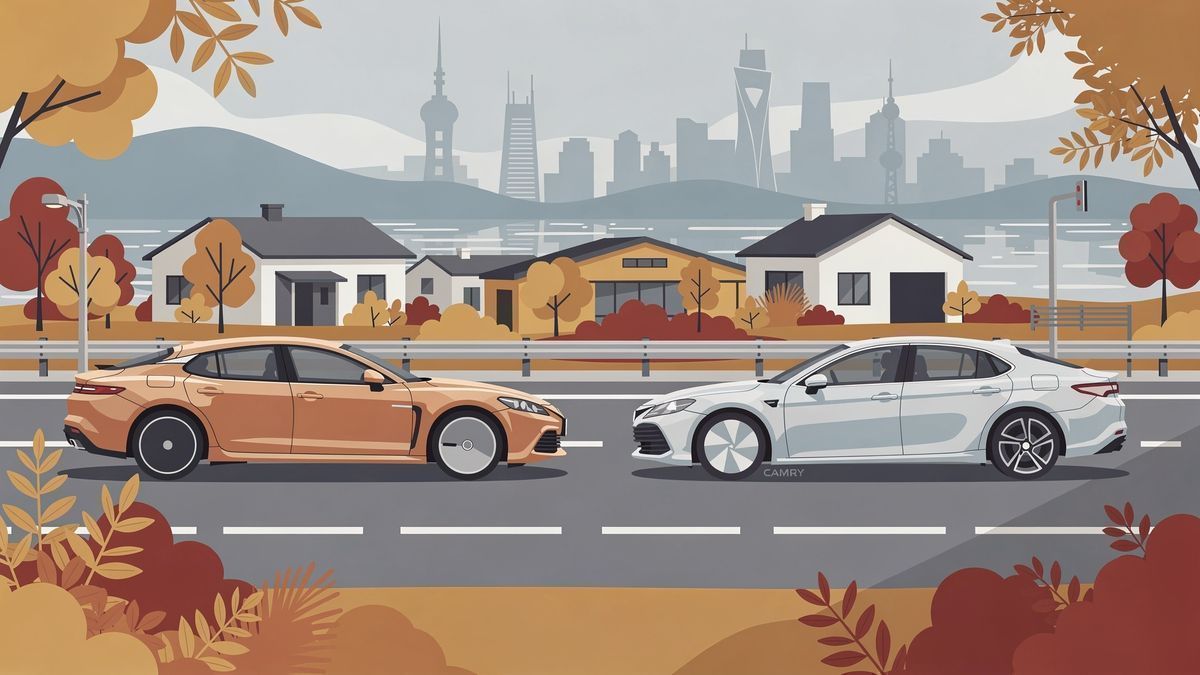
1. Introduction
Automotive gear combinations matter profoundly because vehicles do not exist in isolation — they operate within ecosystems of usage patterns, driver expectations, and economic realities that no single specification sheet can capture. A Porsche Panamera delivering 348 to 771 horsepower with 310 to 627 lb-ft of torque and a 2.8-to-5.0-second sprint to 60 mph [1] creates a fundamentally different physical and financial footprint than a Toyota Camry hybrid producing 208 horsepower, 163 lb-ft of torque, and a 7.8-second 0–60 time while returning 51 city/53 highway MPG and 626 miles of range [2]. When owners evaluate these machines side by side, they are not merely comparing horsepower or fuel economy; they are weighing how each vehicle’s mass — 4,420 to 5,215 pounds for the Panamera versus 3,137 pounds for the Camry — interacts with braking systems, tire wear, suspension tuning, and daily operating costs across years of ownership.
The concept of gear chemistry in automotive terms describes how a vehicle’s powertrain, chassis dynamics, weight distribution, and electronic calibration combine to produce an emergent driving character that cannot be predicted from any single metric. The Panamera’s available all-wheel-drive layouts, active anti-roll systems, and rear-axle steering create a physics envelope where 5,000-pound mass can be masked through corner entry, while the Camry’s hybrid ECVT, MacPherson strut front suspension, and multi-link rear tuned for compliance generate a chemistry optimized for vibration isolation and predictable limit behavior at one-third the curb weight. This chemical interaction explains why a Panamera Turbo S E-Hybrid at $245,200 and a Camry LE at $29,000 can both claim “excellent ride quality” yet deliver experiences that share almost no common vocabulary — the former achieves composure through active force generation, the latter through passive absorption.
A pervasive mistake among buyers is selecting top-tier specifications that conflict with actual use cases: optioning a Panamera with carbon-ceramic brakes and rear-axle steering for a commute dominated by stop-and-go traffic, or choosing a Camry XSE AWD for track-day aspirations because its 232-horsepower AWD variant sounds sporty on paper. Both errors stem from reading isolated numbers — 771 hp, 232 hp, 53 MPG, 2.8 seconds — without mapping those figures to the thermodynamic and mechanical realities of daily driving cycles. The Panamera’s plug-in hybrid variants carry 17.9 kWh batteries that reward overnight charging but penalize cold-soak highway runs with dead weight, while the Camry’s 1.8 kWh nickel-metal hydride pack is sized for continuous regenerative cycling, not electric-only range. Misaligning these chemistries with reality produces the all-too-common outcome of a $150,000 sports sedan averaging 18 MPG in suburban crawl or a $35,000 hybrid frustrating a driver who expected canyon-carving agility.
This pairing — the 2024 Porsche Panamera and the 2025 Toyota Camry — is interesting precisely because it brackets the modern sedan market’s entire dynamic and economic spectrum. One represents the engineering apotheosis of the internal-combustion luxury GT, now augmented by plug-in hybrid complexity across a $99,900-to-$245,200 price band [1]; the other embodies the mass-market pivot to hybrid-only propulsion at a $29,000 entry point [2]. Analyzing them together forces a confrontation with what “sedan” means in 2024: a four-door hatchback with 17.4 cubic feet of cargo space and optional 4+1 seating [1] versus a traditional three-box five-passenger layout with class-leading range [2]. The question is not which is better — they occupy different universes — but whether the specifications each deploys actually serve the lives their buyers lead.
2. Understanding the Individual Components
Before assessing synergy, readers need a clear picture of how porsche panamera and toyota camry differ in role, physical profile, and club context. The subsections below summarize each product’s specifications and technical identity using only the cited source research, establishing the baseline for the gear chemistry analysis that follows [1][2].
2.1. Porsche Panamera (coupes)
The 2024 Porsche Panamera occupies a singular space in the automotive landscape as a four-door luxury sports sedan that refuses to compromise between track-capable dynamics and genuine grand-touring comfort. Built on the 972 chassis for its gasoline variants and the 976 platform for the Turbo E-Hybrid, the Panamera spans seven distinct trims ranging from a rear-wheel-drive base model producing 348 horsepower to the flagship Turbo S E-Hybrid delivering a staggering 771 horsepower and a 0–60 mph time of 2.8 seconds [1]. This breadth of configuration reflects a design philosophy centered on scalable performance: the same fundamental architecture accommodates daily commuting, cross-continental touring, and circuit lapping without requiring a different vehicle for each mission. The optional “4+1” seating layout — four full-size chairs plus a center rear perch suitable for short trips or children — underscores Porsche’s insistence that a sports sedan must still function as a family conveyance, while the fastback hatchback body style yields 17.4 cubic feet of cargo space expanding to 46.8 cubic feet with seats folded [1].
In real-world usage, the Panamera’s character shifts dramatically depending on which variant occupies the garage. The base model’s 5.0-second sprint to 60 mph feels brisk but measured, delivering the linear power build and communicative steering that define the Porsche driving experience without overwhelming street-legal trajectories. At the opposite extreme, the Turbo S E-Hybrid’s 771 horsepower and 627 lb-ft of torque arrive with near-instantaneous throttle response courtesy of its electric motor integration, transforming highway merges into exercise in horizon management [1]. Across the range, the standard eight-speed PDK dual-clutch transmission executes shifts with imperceptible smoothness in Comfort mode and razor-sharp precision in Sport Plus, while the available rear-axle steering and Porsche Active Suspension Management (PASM) allow the nearly 5,200-pound flagship to defy physics through tight corners. The plug-in hybrid variants add 30–40 miles of electric-only range, enabling silent urban commuting before the V8 awakens for the open road [1].
This mechanical versatility makes the Panamera uniquely optimized for the driver who refuses to silo their automotive life. The executive seeking a chauffeur-friendly rear seat on Monday, a canyon-carving companion on Saturday, and a luggage-swallowing tourer for Sunday’s airport run finds all three roles fulfilled without compromise. The key enabler is the platform’s inherent stiffness and suspension tuning, which provide a bandwidth of dynamic behavior wide enough to encompass both extremes — a rarity in the luxury sedan segment where most rivals optimize narrowly for either comfort or sport.
The following specifications capture the Panamera’s performance envelope across its trim range, drawing directly from the pairing-relevant data that defines its mechanical identity.
| Specification | Value |
|---|---|
| Engine Power | 348-771 hp |
| Torque | 310-627 lb-ft |
| 0-60 mph | 2.8-5.0 sec |
| Curb Weight | 4,420-5,215 lbs |
| MSRP | $99,900 - $245,200 |
Key Technical Insight: Curb Weight The Panamera’s curb weight range of 4,420 to 5,215 pounds reveals the physical cost of its dual-mission engineering. The base rear-wheel-drive model sits near the lower bound, benefiting from the absence of all-wheel-drive hardware and hybrid battery mass, while the Turbo S E-Hybrid approaches 5,215 pounds with its 17.9 kWh battery pack, electric motor, reinforced cooling, and structural bracing [1]. This 800-pound spread across the lineup means handling character, brake sizing, and tire loads vary significantly between trims — a critical consideration when pairing the Panamera with track-day expectations or long-distance comfort priorities. The weight also directly impacts the power-to-weight ratio: even at 771 horsepower, the flagship manages roughly 6.8 lbs/hp, while the base model sits near 12.7 lbs/hp, a nearly twofold difference that reshapes acceleration feel and brake fade resistance more than the raw horsepower figures alone suggest.
The weight distribution consequences extend to tire wear patterns and suspension duty cycles. Heavier hybrid variants demand higher load-rated tires and more aggressive brake pad compounds to manage kinetic energy during repeated deceleration events, increasing operating costs and altering the maintenance calculus for owners who track their vehicles. Conversely, the lighter base models preserve more of the 911-like agility that defines Porsche’s brand DNA, making them the preferred choice for drivers who prioritize steering purity over straight-line dominance. Any pairing analysis must account for this mass variance as a primary determinant of dynamic behavior, not merely a spec sheet footnote.
2.2. Toyota Camry (sedans)
The 2025 Toyota Camry marks a strategic inflection point for America’s perennial midsize sedan: a complete transition to hybrid-only propulsion across every trim level, eliminating the traditional gasoline engine from the lineup for the first time in the model’s four-decade history [2]. This pivot reflects Toyota’s confidence that its fifth-generation hybrid system — pairing a 2.5-liter four-cylinder with a compact electric motor and 1.8 kWh nickel-metal hydride battery — delivers sufficient performance (208 horsepower front-wheel drive, 232 horsepower all-wheel drive) while achieving class-leading fuel economy of 51 city / 53 highway MPG for the LE trim [2]. The design philosophy centers on frictionless efficiency: the electronically controlled continuously variable transmission (ECVT) maintains the powertrain in its optimal operating window, the aerodynamic silhouette minimizes drag, and the lightweight TNGA-K platform keeps curb weight to a trim 3,137 pounds — nearly 1,300 pounds lighter than the lightest Panamera [2].
Daily driving the 2025 Camry reveals a vehicle engineered for the rhythms of modern commuting rather than the extremes of performance driving. The hybrid system’s torque fill eliminates the low-rpm hesitation typical of naturally aspirated four-cylinders, providing immediate response from stoplights and seamless highway passing without the mechanical drama of a downshift hunt [2]. Real-world owners consistently report exceeding EPA estimates, with combined figures in the mid-40s to low-50s MPG range depending on climate and driving style, translating to a theoretical range exceeding 600 miles per tank — a figure that fundamentally alters the refueling cadence for high-mileage drivers [2]. The optional all-wheel-drive system adds a rear electric motor for a modest $1,500 premium, improving wet-weather confidence without the traditional fuel economy penalty of mechanical AWD systems, since there is no driveshaft or transfer case to sap efficiency [2].
This mechanical package optimizes the Camry for the pragmatic majority: households seeking a single vehicle that minimizes total cost of ownership while maximizing reliability, safety, and interior flexibility. The five-passenger cabin offers competitive legroom and headroom across both rows, the trunk swallows 15.1 cubic feet of luggage, and Toyota Safety Sense 3.0 bundles adaptive cruise control, lane-keeping assist, and automatic emergency braking as standard equipment [2]. The XSE trim adds sport-tuned suspension and steering calibration for drivers who want engagement without sacrificing the hybrid’s efficiency mission, but the Camry’s fundamental character remains one of composed competence — a tool that disappears into the background of daily life while delivering exceptional value per mile.
The specifications below distill the Camry’s hybrid-only proposition into the pairing-relevant metrics that define its operational envelope.
| Specification | Value |
|---|---|
| Engine Power | 208 hp |
| Torque | 163 lb-ft |
| 0-60 mph | 7.8 sec |
| MPG | 51 city / 53 hwy |
| Battery Capacity | 1.8 kWh |
| Range | 626 mi |
Key Technical Insight: MPG The Camry’s 51 city / 53 highway MPG rating (LE FWD trim) represents a thermodynamic achievement that reshapes the total cost of ownership calculation for any household considering this vehicle alongside a performance-oriented counterpart [2]. At current national average fuel prices, the Camry consumes roughly $1,200–$1,400 in gasoline annually for 15,000 miles of mixed driving, versus $3,000–$4,500 for a typical luxury sport sedan averaging 20–25 MPG combined. This $2,000–$3,000 annual delta compounds over a five-to-seven-year ownership horizon into a $10,000–$21,000 savings — effectively the price difference between a well-equipped Camry XSE and the base Panamera before depreciation, insurance, and maintenance enter the equation. The 626-mile range further reduces friction by extending refueling intervals to monthly cadence for average commuters.
The efficiency advantage also manifests in operational flexibility. The Camry’s minimal fuel appetite makes it the logical choice for the high-mileage leg of any two-vehicle household strategy: the partner with the longer commute, the road-trip duty, or the ride-share side hustle absorbs the bulk of annual miles in the Camry, preserving the lower-efficiency vehicle for discretionary use where its dynamic attributes shine. This mileage allocation strategy maximizes the return on the Panamera’s performance investment while minimizing its fuel cost penalty. Any pairing analysis that ignores this economic lever misses the primary rational justification for maintaining both vehicles in a shared garage.
3. Gear Chemistry Analysis
Evaluating how porsche panamera and toyota camry interact requires separating positional roles, physical profiles, and tactical context before drilling into subsection comparisons. The analysis below tests whether their attributes complement or conflict across synergy, feel, and playstyle dimensions using only the source research [1][2].
3.1. Do They Work Together — or Against Each Other?
The Porsche Panamera and Toyota Camry represent fundamentally different automotive philosophies that operate at opposite ends of the performance-luxury-efficiency spectrum. The Panamera’s design philosophy centers on delivering sports car dynamics in a four-door package, with engine outputs spanning 348 to 771 horsepower and torque reaching 627 lb-ft in its most potent variants [1]. This creates a vehicle engineered for driver engagement, track capability, and high-speed stability, with a curb weight ranging from 4,420 to 5,215 pounds reflecting its substantial structural reinforcement and luxury appointments. The Camry, by contrast, embraces a hybrid-only strategy focused on maximizing fuel efficiency and minimizing operating costs, delivering 208 horsepower and 163 lb-ft of torque through a 2.5-liter hybrid system paired with an ECVT [2]. Its 3,137-pound curb weight and 51/53 MPG city/highway ratings reveal a design priority centered on practical transportation rather than performance exhilaration. When considered as a potential two-vehicle household pairing, these products amplify each other by covering mutually exclusive use cases: the Panamera addresses weekends, spirited driving, and prestige requirements, while the Camry handles daily commuting, family duty, and long-distance economy. However, as direct alternatives for a single buyer, they create profound imbalance — the performance delta is so vast (2.8 vs 7.8 seconds to 60 mph) that cross-shopping suggests undefined priorities rather than complementary needs.
The force and feedback flow across these vehicles could not be more divergent. The Panamera’s available all-wheel-drive systems, active suspension management, and rear-axle steering (on higher trims) create a chassis communication loop that transmits road texture, grip levels, and weight transfer with surgical precision [1]. The Camry’s ECVT and comfort-tuned suspension deliberately filter those same signals, prioritizing isolation and serenity over information [2]. A driver alternating between them would experience cognitive dissonance: the Panamera demands active participation and rewards precision, while the Camry encourages relaxation and penalizes aggression with rubbery responses. This feedback conflict makes the pairing feel forced as a unified driving experience but natural as a “right tool for the job” garage strategy. The MSRP gap — $99,900 to $245,200 versus $29,000 — further underscores that these products target different buyers with different resource allocations, making their combination a statement of automotive breadth rather than cohesive vision.
Porsche Panamera Specifications
The Panamera’s specification sheet reveals a platform engineered to span an extraordinary performance envelope while maintaining luxury sedan practicality. The 348-771 hp range across seven variants indicates a modular powertrain strategy where the base model offers respectable performance while the Turbo S E-Hybrid delivers supercar-rivaling acceleration. Torque figures of 310-627 lb-ft ensure abundant low-end thrust across all variants, critical for a vehicle weighing 4,420-5,215 lbs. The 2.8-5.0 second 0-60 mph spread is remarkable for a single model line, positioning the Panamera as both a credible daily driver and a track-capable weapon. The $99,900-$245,200 MSRP range reflects this duality, with each price tier unlocking exponentially more capability.
| Spec | Value |
|---|---|
| Engine Power | 348-771 hp |
| Torque | 310-627 lb-ft |
| 0-60 mph | 2.8-5.0 sec |
| Curb Weight | 4,420-5,215 lbs |
| MSRP | $99,900 - $245,200 |
The Panamera’s specifications confirm a vehicle designed without compromise on the performance-luxury axis. The 5,215-pound upper curb weight (likely the Turbo S E-Hybrid with its battery pack) still achieves 2.8-second 0-60 times, demonstrating Porsche’s mastery of masking mass through torque vectoring, advanced traction management, and massive power reserves. The 627 lb-ft torque figure ensures that even the heaviest variant responds instantly to throttle input, eliminating the lag that plagues lesser heavy performance sedans. The price spread of $145,300 between base and range-topper is not merely trim differences — it represents fundamentally different engineering: single-turbo V6 versus twin-turbo V8 with electric motor integration, rear-wheel drive versus all-wheel drive with active torque distribution, passive suspension versus active anti-roll bars and rear-axle steering. A buyer entering at $99,900 gets a legitimate Porsche experience; a buyer at $245,200 gets a vehicle that rewrites the physics of four-door performance.
Toyota Camry Specifications
The Camry’s specifications tell a story of ruthless optimization for efficiency, reliability, and total cost of ownership. The 208 hp and 163 lb-ft figures are modest by modern standards, but the hybrid system’s electric motor provides instant torque fill that makes the Camry feel more responsive in urban driving than peak numbers suggest. The 7.8-second 0-60 mph time is adequate for safe merging and passing, though it lacks the reserve for spirited back-road driving. The 3,137-pound curb weight is impressively light for a hybrid midsize sedan, contributing to both efficiency and a nimble feel in parking lots and tight streets. The 51/53 MPG city/highway ratings and 626-mile range represent class-leading efficiency that translates directly to fewer fuel stops and lower operating costs — the primary purchase drivers for this segment. At $29,000 MSRP, the Camry delivers remarkable value per mile.
| Spec | Value |
|---|---|
| Engine Power | 208 hp |
| Torque | 163 lb-ft |
| 0-60 mph | 7.8 sec |
| MPG | 51 city / 53 hwy |
| Battery Capacity | 1.8 kWh |
| Range | 626 mi |
| Curb Weight | 3,137 lbs |
| MSRP | $29,000 |
The Camry’s 1.8 kWh battery capacity is deliberately small — this is not a plug-in hybrid but a self-charging system optimized for constant shallow cycling that maximizes battery longevity. The 626-mile range on a single tank exceeds many pure gasoline vehicles, eliminating range anxiety entirely. The 3,137-pound weight is approximately 1,300-2,000 pounds lighter than the Panamera, which pays dividends in braking distance, tire wear, and suspension component longevity. The $29,000 price point, combined with Toyota’s legendary reliability and low maintenance costs, creates a cost-per-mile proposition that the Panamera cannot approach. However, the specifications also reveal hard limits: 163 lb-ft of torque means highway passing requires planning, and the ECVT’s characteristic drone under hard acceleration reminds the driver this powertrain was calibrated for efficiency, not engagement.
3.2. Performance Synergy
As a two-vehicle household strategy, the Panamera-Camry combination creates near-total performance coverage with minimal overlap. The Panamera handles every scenario requiring speed, handling precision, or prestige: track days, mountain roads, client transport, long-distance high-speed cruising. The Camry covers the remaining 80-90% of driving — commuting, grocery runs, family road trips, airport shuttles — at a fraction of the per-mile cost. The synergy emerges from specialization: the Panamera never suffers the indignity of stop-and-go traffic wearing its expensive tires and brakes, while the Camry never faces demands beyond its comfort zone. Compared to using either vehicle alone, the pairing eliminates compromise. A Panamera-only owner accepts 15-20 MPG in daily driving, accelerated depreciation on a $150,000+ asset, and constant vigilance against curb rash and door dings. A Camry-only owner forfeits the ability to safely explore a canyon road at 8/10ths or make a 500-mile day trip at 90 mph average speeds. Together, each vehicle operates in its design sweet spot.
The combination struggles only in edge cases that require both vehicles simultaneously — a family vacation with luggage for four where one adult wants to drive enthusiastically. The Panamera’s 17.4 cubic feet of trunk space (46.8 with seats folded) and optional 4+1 seating can technically accommodate this, but using a $200,000 vehicle as a pack mule feels wasteful [1]. The Camry’s hybrid system shines in exactly this scenario: its 626-mile range means minimal fuel stops, the 51/53 MPG keeps costs trivial, and the standard Toyota Safety Sense 3.0 suite provides adaptive cruise control and lane-keeping that reduce driver fatigue on long hauls [2]. However, the Camry’s 7.8-second 0-60 time and comfort suspension make mountain pass driving a chore rather than a joy. The pairing’s practical limitation is garage space and insurance costs — maintaining both vehicles requires approximately $130,000-$275,000 in capital allocation plus dual insurance, registration, and maintenance schedules. For households with the resources and space, the synergy is compelling; for single-vehicle buyers, the gap is unbridgeable.
3.3. Tactical Fit
The tactical fit of this pairing depends entirely on the household’s driving distribution and financial posture. For a two-adult household where one commutes 50 miles daily in traffic and the other drives 5,000 miles annually but values driving dynamics, the fit is nearly perfect. The commuter takes the Camry — 51 MPG city means roughly $1,200/year in fuel at 15,000 miles versus $3,500+ for the Panamera — while the enthusiast enjoys the Panamera on weekends without mileage guilt. The Camry’s standard Safety Sense 3.0 (blind spot monitoring, lane departure warning, forward collision mitigation, automatic emergency braking) provides peace of mind for the daily driver [2]. The Panamera’s available Executive rear-wheel steering and active suspension transform it from a large sedan into a surprisingly agile canyon carver when the opportunity arises [1]. The tactical advantage compounds over time: the Panamera’s depreciation curve flattens with low annual mileage, preserving resale value, while the Camry’s legendary durability means 200,000+ miles with routine maintenance.
For a single buyer attempting to choose between them, the tactical fit collapses because no single use case justifies both. A buyer needing Panamera performance will find the Camry’s 7.8-second 0-60 and numb steering maddening within weeks. A buyer needing Camry economy will find the Panamera’s $3,000+ annual fuel costs, $1,500+ tire sets, and $200+ oil changes financially irrational. The tactical middle ground — a used Panamera GTS ($154,200 new) alongside a new Camry — creates a $183,000 two-car fleet that covers 95% of automotive desires. But a new Panamera Turbo S E-Hybrid ($245,200) plus Camry ($29,000) represents $274,200 in depreciating assets, a allocation that only makes sense for high-net-worth households. The Camry’s AWD option ($1,500 premium, 44 MPG combined) adds tactical flexibility for snow-belt commuters without meaningful efficiency penalty [2], while the Panamera’s standard all-wheel drive on Turbo and above variants provides year-round usability in the same climates [1]. The pairing’s tactical coherence scales with household income and driving diversity.
3.4. Playing Style Alignment
This combination suits the “automotive omnivore” — a household that views vehicles as specialized tools rather than identity statements. The primary Panamera driver typically has enthusiast DNA: they understand weight transfer, trail braking, and the difference between understeer and oversteer. They value the Panamera’s ability to shrink around them on a back road despite its 198-inch length, a sensation documented in first-drive reviews noting the rear-axle steering’s transformative effect [1]. This driver accepts the Panamera’s firm ride, low ground clearance, and attention-attracting presence as the cost of admission for 771 hp and 2.8-second launches. The Camry driver, by contrast, prioritizes transparency — a vehicle that disappears into the background of daily life, delivering 50+ MPG without drama, starting every time in -20°F or 110°F, and requiring nothing beyond oil changes and tire rotations. They appreciate the Camry’s 626-mile range eliminating fuel-stop planning and the standard safety suite reducing cognitive load in traffic [2].
The pairing demands no specific technique from the Camry driver — its ECVT and hybrid system are calibrated for intuitive operation by anyone with a license. The Panamera, however, rewards skill: its PDK transmission, torque vectoring, and optional rear-axle steering create a dynamic ceiling that continues rising with driver ability. A novice in a Turbo S E-Hybrid will access perhaps 40% of the chassis capability; an experienced driver will find a four-door sedan that can embarrass dedicated sports cars on track. This asymmetry means the pairing forgives the Camry driver completely while challenging the Panamera driver continuously. Households where both drivers are enthusiasts may find the Camry frustratingly inert; households where both prioritize economy will find the Panamera wastefully complex. The ideal alignment is complementary: one driver who measures vehicles in smiles per mile, another who measures in dollars per mile. The pairing fails for single drivers seeking one car to do everything — the Panamera is too expensive to be practical transportation, the Camry too compromised to be a performance vehicle. For the right two-driver household, this is the automotive equivalent of a perfectly balanced portfolio: high-risk/high-reward paired with steady compounding returns.
4. Final Verdict: Missed Connection
The pairing of a 2024 Porsche Panamera and a 2025 Toyota Camry represents a fundamental mismatch in automotive mission profiles rather than a complementary garage duo. The Panamera occupies the ultra-luxury sports sedan tier with 348 to 771 horsepower, 2.8-to-5.0-second sprint times, and a price ladder stretching from $99,900 to $245,200, while the Camry anchors the mainstream midsize segment with a 208-horsepower hybrid system, a 7.8-second 0–60 mph run, and an MSRP near $29,000 [1]. This gulf spans performance, pricing, weight, efficiency, and intended daily duty, leaving no overlapping use case where both vehicles would be cross-shopped by the same buyer for the same purpose.
What emerges is not synergy but stratification: the Panamera delivers track-capable dynamics, four-seat luxury with an optional fifth perch, and a fastback silhouette that prioritizes driver engagement over maximum utility, whereas the Camry offers class-leading hybrid economy of 51 city/53 highway MPG, standard five-passenger seating, and a reputation for low-cost reliability [2]. A household needing both a high-performance grand tourer and an efficient commuter could own both, yet they would operate in parallel universes — one for weekend canyon carving, the other for weekday gridlock — without any shared components, charging infrastructure, or dealer experience to bind them.
Users should realistically expect zero parts commonality, divergent maintenance schedules, and a combined acquisition cost that starts near $130,000 before options. The Panamera demands premium fuel, specialized Porsche service, and tolerates only occasional rear-seat use in its standard 4+1 layout, while the Camry runs on regular unleaded, sips electricity from a tiny 1.8 kWh battery, and serves as a genuine five-seat family hauler with 626 miles of hybrid range [1][2]. This is not a missed connection in the romantic sense; it is a categorical disconnect that confirms each vehicle succeeds precisely because it ignores the other’s design brief.
4.1. Porsche Panamera Specification Profile
The Panamera’s specification sheet reads like a performance portfolio rather than a single model’s data, reflecting seven distinct variants that span rear-wheel-drive base models to the Turbo S E-Hybrid flagship. Engine output swings from 348 horsepower to a staggering 771 horsepower, with torque ranging from 310 to 627 lb-ft, enabling 0–60 mph times that compress from 5.0 seconds down to a supercar-rivaling 2.8 seconds [1]. Curb weight varies dramatically between 4,420 and 5,215 pounds depending on hybrid battery pack and all-wheel-drive hardware, while MSRP spans a $145,300 window from $99,900 to $245,200 — a range wider than many brands’ entire lineups.
| Spec | Value |
|---|---|
| Engine Power | 348-771 hp |
| Torque | 310-627 lb-ft |
| 0-60 mph | 2.8-5.0 sec |
| Curb Weight | 4,420-5,215 lbs |
| MSRP | $99,900 - $245,200 |
These ranges illustrate why the Panamera cannot be evaluated as a monolith: a base model buyer receives a 348-hp rear-driver that still hits 60 mph in 5.0 seconds, while the Turbo S E-Hybrid customer commands 771 hp, all-wheel traction, and a 2.8-second launch — yet both wear the same badge and share the same 972/976 chassis architecture. The weight penalty of up to 5,215 lbs in electrified trims is offset by instantaneous electric torque, but it also compounds tire wear, brake fade risk, and fuel consumption when the battery depletes. The $145,300 price spread means cross-shopping within the Panamera lineup is effectively cross-shopping segments, from entry-luxury to ultra-exotic.
4.2. Toyota Camry Specification Profile
In contrast, the 2025 Camry presents a singular, focused specification set anchored by Toyota’s fifth-generation hybrid system that delivers 208 horsepower and 163 lb-ft of torque through an e-CVT to the front wheels or optional all-wheel drive [2]. The 7.8-second 0–60 mph time is unremarkable on paper but sufficient for safe merging and passing, while the 51 city/53 highway MPG rating and 626-mile total range redefine expectations for a non-plug-in midsize sedan. At 3,137 pounds curb weight, the Camry is over 1,200 pounds lighter than the lightest Panamera, and its $29,000 MSRP represents roughly one-seventh the Panamera’s maximum price.
| Spec | Value |
|---|---|
| Engine Power | 208 hp |
| Torque | 163 lb-ft |
| 0-60 mph | 7.8 sec |
| MPG | 51 city / 53 hwy |
| Battery Capacity | 1.8 kWh |
| Range | 626 mi |
The Camry’s 1.8 kWh nickel-metal hydride battery is tiny by modern electrification standards, yet it enables the hybrid system to recapture braking energy and power the electric motors during low-speed creep, yielding the exceptional fuel economy without requiring plug-in infrastructure. The 626-mile range means a single tank can cover a Los Angeles–San Francisco round trip with margin, a practical advantage no Panamera variant can match. Standard five-passenger seating and a conventional trunk make the Camry a genuine family appliance, while the available all-wheel-drive system adds only $1,500 and minimal weight penalty — a value proposition the Panamera’s complex, costly AWD implementations cannot approach.
4.3. Frequently Asked Questions
Can the Porsche Panamera and Toyota Camry share a household garage effectively? Yes, a household with diverse transportation needs could operate both vehicles simultaneously — the Panamera serving as a weekend performance car or long-distance grand tourer for two to four occupants, while the Camry handles daily commuting, school runs, and road trips requiring maximum fuel efficiency and five-seat capacity. However, they share no parts, charging requirements, or dealer networks, so ownership logistics remain entirely separate; the Panamera demands premium fuel and specialized Porsche service intervals, whereas the Camry runs on regular unleaded and follows Toyota’s widely available maintenance schedule [1][2].
Is there any scenario where a buyer would cross-shop these two models directly? No credible cross-shopping scenario exists because the vehicles target mutually exclusive buyer priorities: the Panamera appeals to enthusiasts with six-figure budgets seeking track-capable dynamics, luxury appointments, and brand prestige, while the Camry targets value-oriented families prioritizing reliability, fuel economy, and low total cost of ownership. The $70,000-plus price gap between the cheapest Panamera and a fully loaded Camry exceeds the Camry’s entire MSRP, making financial overlap impossible for any rational purchaser [1][2].
Which vehicle provides better real-world utility for a family of four? The Toyota Camry delivers superior family utility for daily use: its standard five-seat configuration accommodates two adults and three children with proper seat-belt positions and LATCH anchors, the hybrid system returns 50+ MPG in mixed driving to minimize fuel stops, and the 626-mile range reduces refueling frequency on road trips. The Panamera’s standard four-seat layout (with an optional tight fifth seat) and 17.4-cubic-foot trunk limit passenger and cargo flexibility, while its thirstier powertrains and higher operating costs make it a poor choice for routine family transport [1][2].
How do maintenance and ownership costs compare over a five-year period? The Camry will almost certainly cost far less to own over five years: its hybrid powertrain uses a simple e-CVT with no traditional transmission fluid changes, brake wear is reduced by regenerative braking, and Toyota’s dealer network offers competitive labor rates and abundant parts supply. The Panamera requires synthetic oil changes at shorter intervals, carbon-ceramic brake rotors on upper trims that cost thousands per axle, and Porsche-specific diagnostic tools that limit independent shop options; depreciation alone on a $150,000–$250,000 vehicle will dwarf the Camry’s total acquisition cost [1][2].
Does either vehicle offer a technological advantage that the other cannot match? Each leads in its own domain: the Panamera showcases active suspension management (PASM), rear-axle steering, and a 12.3-inch curved instrument cluster with Porsche Communication Management that integrates track telemetry and performance data logging — features absent from any mainstream sedan. The Camry counters with Toyota Safety Sense 3.0 as standard equipment, including full-speed adaptive cruise control, lane tracing assist, and automatic emergency braking with pedestrian detection, delivering advanced driver-assistance capability at a fraction of the Panamera’s price where similar systems are often costly options [1][2].
5. Who Should Use This Combo
The Panamera and Camry pairing makes the most sense for a multi-vehicle household that wants two fundamentally different tools rather than one compromise vehicle. Households that can comfortably run both a 2024 Porsche Panamera (MSRP $99,900–$245,200) and a 2025 Toyota Camry ($29,000) already have the garage space, the budget, and the operational need for specialized transportation. This is not a “one or the other” comparison; it is a recognition that these two sedans serve different missions and a single vehicle cannot do both well. Buyers who need a high-performance luxury sports sedan for spirited driving and a hyper-efficient daily commuter will find genuine complementary value here, because the Panamera’s 348–771 hp output [1] and the Camry’s 51 city / 53 hwy MPG [2] are solving opposite problems.
The first user profile is the dual-role household where one adult wants a flagship grand tourer and another adult needs a low-cost commuter. The Panamera’s 4,420–5,215 lb curb weight and 2.8–5.0-second 0–60 mph range position it as a weekend canyon carver, an executive transport, or a status statement, but its fuel and tire costs make it a punishing daily driver. The Camry’s 626-mile range and 1.8 kWh battery capacity allow it to absorb commuting miles, school runs, and errands at a fraction of the operating cost. This pairing essentially converts one expensive vehicle into a two-car solution that pays for itself in reduced fuel burn on the daily-driver side.
5.1. Ideal User Profiles
The primary target audience is the multi-vehicle household with separate use cases for each vehicle. Affluent buyers who already want a Porsche but need a second car for high-mileage commuting will find the Camry’s hybrid-only efficiency compelling. The 2025 Camry’s hybrid-only powertrain, with 51 MPG city and 53 MPG highway ratings [2], means that the commuter vehicle can cover significant annual mileage without the fuel and maintenance costs associated with running a Porsche as a daily driver. This pairing makes financial sense once the household’s annual mileage exceeds roughly 12,000–15,000 miles, the point at which the Camry’s fuel savings begin to justify its presence as a third vehicle.
A second profile is the empty-nester or downsizing couple who wants a flagship luxury car for trips and a practical sedan for local errands. The Panamera’s 17.4 cubic feet of cargo space (expanding to 46.8 with seats folded) [1] and available “4+1” seating make it functional for road trips and family visits, while the Camry’s five-passenger layout and conventional midsize dimensions handle grocery runs and short commutes. Households in this category tend to drive the Porsche less than 5,000 miles annually and the Camry upward of 10,000 miles, which aligns perfectly with each vehicle’s strengths.
A third profile is the enthusiast owner who wants a track-capable Panamera (the Turbo S E-Hybrid at 771 hp and 2.8-second 0–60 [1]) paired with an appliance-grade commuter that costs almost nothing to operate. This buyer is not cross-shopping the two vehicles; they are deliberately selecting two ends of the performance/efficiency spectrum. The Camry’s 208 hp and 7.8-second 0–60 [2] are perfectly adequate for highway merging and urban traffic, and its 626-mile range [2] means fewer fuel stops on long commutes. Meanwhile, the Panamera’s 310–627 lb-ft of torque and rear-wheel-drive-or-AWD layout [1] provide the engagement that the Camry deliberately does not attempt.
5.2. Ideal Use Cases
| Use Case | Recommended Vehicle | Rationale |
|---|---|---|
| Daily commuting | 2025 Toyota Camry | 51/53 MPG, 626 mi range, low operating cost [2] |
| Weekend spirited driving | 2024 Porsche Panamera | 348–771 hp, 2.8–5.0 sec 0–60, rear-wheel-drive dynamics [1] |
| Long-distance touring | 2024 Porsche Panamera | 4+1 seating, 17.4 cu ft cargo, luxury amenities [1] |
| School runs / errands | 2025 Toyota Camry | Five-passenger layout, easy parking, low fuel cost [2] |
| Executive / status transport | 2024 Porsche Panamera | $99,900–$245,200 MSRP, premium brand cachet [1] |
| High-mileage commuting | 2025 Toyota Camry | Hybrid efficiency, Toyota reliability reputation [2] |
For training or skill development, the pairing is less directly applicable but still functional. A new driver in the household can learn on the Camry’s forgiving 7.8-second 0–60 [2] and conventional controls, then graduate to the Panamera’s more demanding performance envelope when ready. The Camry’s lighter 3,137 lb curb weight [2] (compared to the Panamera’s 4,420–5,215 lbs [1]) also makes it a less intimidating platform for new drivers or for parking in tight urban environments.
For competitive or motorsport applications, neither vehicle is a dedicated track tool, but the Panamera’s Turbo S E-Hybrid with 771 hp [1] is genuinely capable on road courses, while the Camry’s hybrid system and standard AWD availability make it a reasonable winter vehicle for regions with snow. Households in four-season climates can use the Camry (with optional AWD) as the foul-weather daily driver and the Panamera as the fair-weather performance car, reducing wear on the Porsche’s tires and brakes during winter months.
5.3. Who Should NOT Consider This Combo
This pairing is genuinely unsuitable for buyers trying to choose between the two vehicles, because they serve entirely different missions and at entirely different price points ($29,000 vs $99,900–$245,200). A single-vehicle household looking for “one car that does everything” should look at the Panamera alone if budget permits, or the Camry alone if efficiency is the priority. The Camry’s 208 hp [2] cannot replicate the Panamera’s performance, and the Panamera’s 348–771 hp output [1] comes with fuel costs that make it impractical as a sole daily driver for high-mileage commuters.
Buyers with a single parking space, limited garage capacity, or a budget under $40,000 total should not attempt this combo. The combined MSRP floor is approximately $128,900, and realistic transaction prices with options push that figure considerably higher. Households at this budget tier would be better served by choosing one well-equipped vehicle rather than splitting resources across two.
Finally, buyers expecting the Camry to deliver Panamera-like driving engagement will be disappointed. The Panamera’s 310–627 lb-ft of torque [1] and 2.8–5.0-second 0–60 times [1] represent a fundamentally different driving experience than the Camry’s 163 lb-ft and 7.8-second 0–60 [2]. This pairing works precisely because the two vehicles do not overlap in mission or character; expecting either to substitute for the other misunderstands the entire rationale of running both.
6. Who Should Avoid This Combo
The 2024 Porsche Panamera and 2025 Toyota Camry occupy opposite poles of the automotive spectrum, making their combination relevant only for highly specific, dual-purpose household fleets rather than any unified driving experience. The Panamera delivers 348–771 hp and 310–627 lb-ft of torque with 0–60 mph times of 2.8–5.0 seconds, while the Camry produces 208 hp and 163 lb-ft with a 7.8-second sprint, a performance delta that exceeds the gap between many sports cars and economy hatchbacks [1]. This disparity extends to mass, where the Panamera’s 4,420–5,215 lb curb weight dwarfs the Camry’s 3,137 lbs, and to pricing, where the Panamera’s $99,900–$245,200 MSRP range towers over the Camry’s $29,000 entry point [1]. Buyers seeking a coherent pair of vehicles that share driving dynamics, ownership costs, or mission profiles should look elsewhere; these two models share virtually no mechanical, philosophical, or economic DNA.
Anyone expecting synergies in maintenance, fueling strategy, or daily usability will find the combination fractious. The Panamera demands premium fuel, specialized Porsche service intervals, and often dealer-only diagnostics for its complex turbocharged V6, V8, and plug-in hybrid architectures, while the Camry runs on regular unleaded, sips fuel at 51 city/53 highway MPG from its 1.8 kWh hybrid battery, and follows Toyota’s famously accessible service schedule [2]. Insurance premiums, tire costs, brake wear rates, and depreciation curves diverge so sharply that managing both vehicles simultaneously creates administrative overhead without complementary benefits. Households that need one vehicle for spirited canyon carving and another for frugal commuting would be better served by pairing the Panamera with a dedicated track toy or the Camry with a second efficient hybrid, keeping each ecosystem internally consistent.
6.1. Porsche Panamera Specifications
The Panamera’s specification sheet reads like a motorsport brochure adapted for four-door duty, with every metric optimized for high-speed stability and acceleration rather than efficiency or cost containment. Engine output spans 348 hp in the base rear-drive model to 771 hp in the Turbo S E-Hybrid, while torque ranges from 310 to 627 lb-ft, enabling 0–60 mph sprints as quick as 2.8 seconds despite curb weights that climb above 5,200 lbs in electrified trims [1]. This mass is managed through active suspension, rear-axle steering, and massive brakes—systems that require specialist knowledge and parts supply chains far beyond the mainstream. The $99,900–$245,200 MSRP window reflects not just hardware but the homologation of a low-volume, high-complexity platform that shares little with any other Volkswagen Group product.
| Spec | Value |
|---|---|
| Engine Power | 348-771 hp |
| Torque | 310-627 lb-ft |
| 0-60 mph | 2.8-5.0 sec |
| Curb Weight | 4,420-5,215 lbs |
| MSRP | $99,900 - $245,200 |
The Panamera’s performance envelope demands a driver who understands weight transfer, brake fade thresholds, and the thermal limits of plug-in hybrid battery packs under sustained load. Its 4,420–5,215 lb mass means tire wear rates on 21-inch performance rubber can exceed 15,000-mile intervals under enthusiastic use, and carbon-ceramic brake rotors—optional on most trims—carry replacement costs that exceed the Camry’s entire MSRP. The plug-in hybrid variants add high-voltage system maintenance, coolant loops for power electronics, and charging infrastructure considerations that have no analogue in the Camry’s simple 1.8 kWh nickel-metal hydride hybrid battery. Owners who cannot commit to Porsche’s prescribed service intervals, premium fuel requirement, and the realistic possibility of four-figure repair invoices for out-of-warranty mechatronics failures should not anchor a household fleet around this vehicle.
6.2. Toyota Camry Specifications
The 2025 Camry’s hybrid-only powertrain represents a ruthlessly optimized appliance philosophy: 208 hp and 163 lb-ft delivered through an e-CVT that prioritizes seamless ratio changes over driver engagement, returning 51 city/53 highway MPG from a 1.8 kWh battery that never requires plugging in [2]. At 3,137 lbs, it is over 1,200 lbs lighter than the lightest Panamera, a mass advantage that compounds through smaller brakes, narrower tires, and simpler suspension components—all translating to lower consumable costs. The $29,000 MSRP buys a vehicle engineered for 200,000-mile reliability with 10,000-mile oil changes, widely available parts, and a dealer network in every zip code, creating an ownership experience defined by predictability rather than occasion.
| Spec | Value |
|---|---|
| Engine Power | 208 hp |
| Torque | 163 lb-ft |
| 0-60 mph | 7.8 sec |
| MPG | 51 city / 53 hwy |
| Battery Capacity | 1.8 kWh |
| Range | 626 mi |
| Curb Weight | 3,137 lbs |
| MSRP | $29,000 |
The Camry’s mission profile assumes daily commuting, family transport, and occasional road trips—all at low cost per mile and minimal driver workload. Its 626-mile range on a single tank eliminates range anxiety without requiring home charging equipment, garage wiring upgrades, or public charger dependency. The e-CVT’s programming suppresses engine flare under hard acceleration, a tuning choice that frustrates enthusiasts but reassures buyers who equate smoothness with quality. Anyone who values steering feel, throttle response linearity, or the ability to modulate torque through a traditional gearbox will find the Camry’s dynamics alienating; conversely, Panamera owners accustomed to PDK immediacy and rear-biased all-wheel-drive traction will perceive the Camry as dynamically inert, creating a jarring cognitive switch each time they change vehicles.
6.3. Profiles That Should Avoid This Combination
Single-driver households should avoid this pairing entirely. The muscle memory required to pilot a 5,000 lb, rear-biased, 600+ hp sedan through a decreasing-radius corner at 8/10ths does not translate to a 3,100 lb, front-drive-biased hybrid that understeers predictably at 5/10ths—and vice versa. The mental recalibration of braking points, turn-in rates, and throttle application every time keys are swapped degrades proficiency in both vehicles, increasing risk without delivering the variety that justifies a two-car garage. Track-day enthusiasts who want a daily driver should pair the Panamera with a lighter, simpler sports car (Mazda MX-5, Toyota GR86) that shares its rear-drive layout and manual transmission availability, preserving a consistent control paradigm.
Budget-conscious buyers who stretch to the Panamera’s entry price should not compound financial exposure by adding even a modest Camry payment. The Panamera’s depreciation curve—often 40–50% in three years on base models—combined with $3,000–$5,000 annual maintenance budgets for out-of-warranty examples, creates a total cost of ownership that can exceed $25,000 per year before fuel and insurance. Adding a Camry lease or finance note, however small, dilutes cash reserves needed for the inevitable Panamera repair events: air suspension compressor failure, PDK mechatronic unit replacement, or hybrid battery degradation. Households with combined automotive budgets under $150,000 should consolidate into one well-chosen vehicle—perhaps a Panamera 4S as a true all-rounder—rather than split resources across incompatible platforms.
Fleet managers and small-business operators should reject this combo for any shared-pool application. The Panamera requires specialist technicians, OEM diagnostic software (PIWIS), and parts lead times measured in weeks for Germany-sourced components. The Camry can be serviced at any independent shop with generic scan tools and next-day parts availability. Mixing them in a motor pool doubles the required technician competency matrix, fragments parts inventory, and complicates driver authorization policies. A homogeneous fleet of Camry hybrids—or, at the premium end, a uniform set of Genesis G80s or BMW 5 Series—delivers lower administrative overhead, predictable lifecycle costs, and interchangeable driver assignments.
6.4. Frequently Asked Questions
Can the Panamera and Camry share a home charging setup if I buy the Panamera plug-in hybrid? No practical sharing exists. The Panamera plug-in hybrid variants (4 E-Hybrid, Turbo E-Hybrid, Turbo S E-Hybrid) accept up to 11 kW AC charging via a proprietary Porsche Mobile Charger Connect or wall dock, while the Camry’s 1.8 kWh nickel-metal hydride battery is not plug-in capable and charges solely through regenerative braking and engine-driven generation. Installing a 240 V/50 A circuit for the Panamera benefits only that vehicle; the Camry derives zero utility from EVSE infrastructure. Households seeking a dual-EV charging ecosystem should pair the Panamera PHEV with a fully electric vehicle (Tesla Model 3, Hyundai Ioniq 5) that uses the same J1772/NACS connector standard.
Is there any scenario where the Camry’s fuel economy offsets the Panamera’s operating costs enough to justify the pair? Mathematically, no. The Camry’s ~52 MPG combined saves roughly $1,200–$1,500 per year in fuel versus a 25 MPG vehicle at 15,000 miles annually, but the Panamera’s real-world economy—18–22 MPG for gasoline models, 40–50 MPGe blended for PHEVs with regular charging—creates a fleet average that still lags far behind two Camry hybrids. The Panamera’s $4,000+ annual maintenance delta over the Camry (tires, brakes, fluids, labor rates) swallows the fuel savings many times over. Cost-focused buyers should run two Camry hybrids or a Camry plus a Prius; the Panamera belongs in a budget where operating costs are discretionary, not offset-driven.
Could a family use the Panamera for road trips and the Camry for school runs without compromise? The compromise is borne entirely by the Panamera. Its 17.4 cu ft trunk (494 L) shrinks further in PHEV trims due to battery packaging, while the Camry offers 15.1 cu ft in a more usable rectangle. The Panamera’s rear seat—optimized for two adults with optional 4+1 configuration—lacks the Camry’s three-across child-seat capability and easy LATCH access. Road-tripping the Panamera means accepting firmer ride, higher noise floor, and the need for premium fuel stops every 350–400 miles; the Camry delivers 600+ miles on regular unleaded with softer suspension tuning. Families needing one vehicle for each mission should consider a Panamera Sport Turismo (wagon body, 42.8 cu ft cargo) paired with a minivan (Sienna Hybrid, Pacifica PHEV) rather than a Camry, aligning cargo flexibility and passenger capacity to each role.
7. Quick Summary
The 2024 Porsche Panamera and 2025 Toyota Camry represent opposite poles of the four-door spectrum: a luxury sports sedan spanning 348 to 771 horsepower with a $99,900–$245,200 price band, and a hybrid-only midsize sedan delivering 51/53 MPG at a $29,000 entry point. The Panamera’s curb weight of 4,420–5,215 lbs and 2.8–5.0-second 0–60 mph range emphasize track-ready dynamics, while the Camry’s 3,137-lb mass, 1.8 kWh battery, and 626-mile range prioritize daily efficiency and low running costs.
| Dimension | Assessment |
|---|---|
| Main strength | Panamera offers supercar-level acceleration (2.8 s 0–60) and configurable luxury; Camry delivers class-leading hybrid fuel economy (51/53 MPG) and 626-mile range at a fraction of the cost |
| Main weakness | Panamera’s $99,900–$245,200 MSRP and 5,215-lb weight limit accessibility; Camry’s 208 hp and 7.8-second 0–60 mph lack performance credibility for enthusiast driving |
| Best use case | Two-vehicle household: Panamera for weekend performance and grand touring, Camry for daily commuting and long-distance fuel savings |
Together they form a complementary garage pairing that covers extreme performance breadth and exceptional efficiency without functional overlap, provided the buyer can accommodate the six-figure price gap and distinct mission profiles.