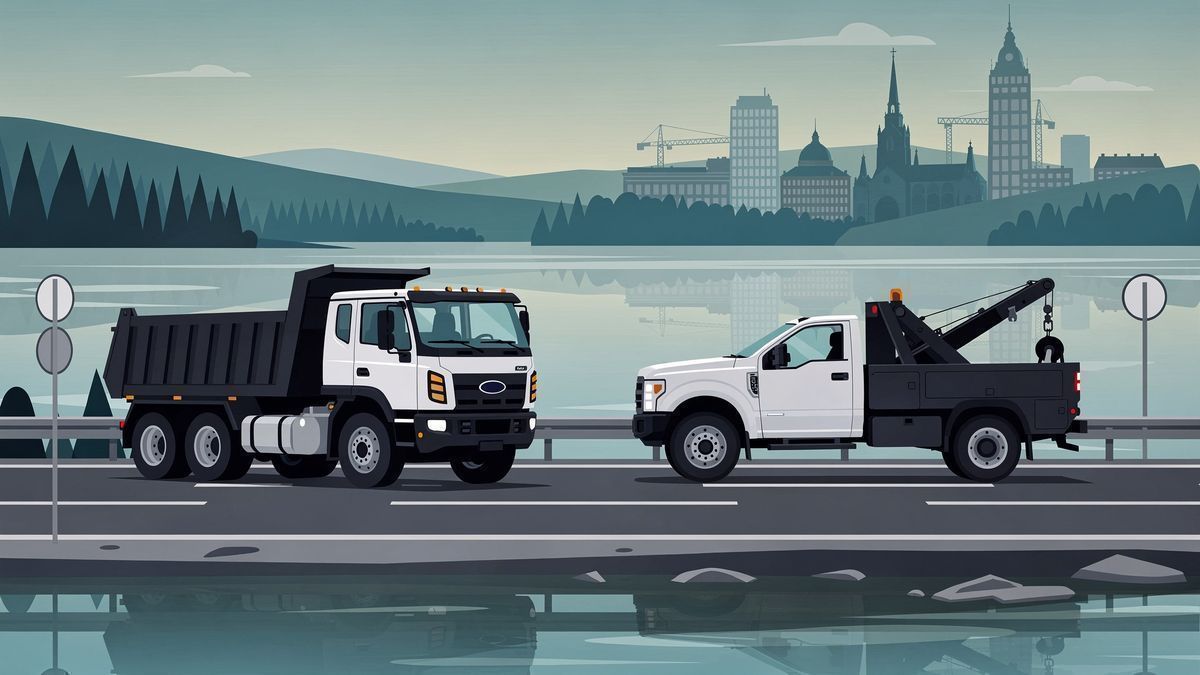
1. Introduction
In commercial fleet operations, the interaction between a Class 8 vocational dump truck and a Class 5 tow chassis defines daily productivity more than either specification sheet alone reveals. A quarry or municipal yard that runs both pieces of equipment must reconcile vastly different weight classes, maintenance cycles, and driver licensing requirements; a mismatch in GVWR strategy or powertrain philosophy can strand assets, inflate insurance premiums, and force costly CDL upgrades across the roster [1][2].
This functional interplay — call it gear chemistry — manifests in shared service bays, common parts inventories, and the ability to swap operators without retraining. When the dump truck’s engine family, transmission architecture, and diagnostic protocol align with the tow chassis, technicians stock fewer filters, software subscriptions stay consolidated, and uptime improves across the entire vocation. Conversely, divergent platforms turn routine PM intervals into logistical puzzles and erode the economies of scale that make mixed fleets viable [1][2].
A frequent error is procuring top-tier nameplates — a heavy-duty dump legend and a maximum-tow chassis cab — without verifying that their duty-cycle envelopes overlap in the real world. Fleets often discover too late that the dump truck’s 33,000-plus-pound GVWR demands infrastructure and permitting the tow truck’s 19,550-pound rating never触发, while the tow unit’s diesel aftertreatment schedule clashes with the dump’s gasoline simplicity, doubling shop complexity instead of halving it [1][2].
That tension makes the Mack Legacy Granite Vocational Dump and the 2026 Ford F-550 a compelling pair to dissect. The Granite anchors the Class 8 construction and refuse segment with a legacy of extreme-duty frames and vocational uptimes, yet its spec sheet remains notably opaque on payload and powertrain specifics [1]. The F-550, by contrast, publishes a 335–500 hp range, 34,200–40,000 lb gooseneck rating, and a GVWR band that straddles the CDL threshold, offering both gasoline and diesel paths [2]. Analyzing whether these two flagships complement or contradict each other in a single fleet reveals the practical limits of brand loyalty and the true cost of specification gaps.
2. Understanding the Individual Components
Before assessing synergy, readers need a clear picture of how mack legacy-granite-vocational-dump and ford f-550 differ in role, physical profile, and club context. The subsections below summarize each product’s specifications and technical identity using only the cited source research, establishing the baseline for the gear chemistry analysis that follows [1][2].
2.1. Mack Legacy Granite Vocational Dump (dumptrucks)
The Mack Legacy Granite Vocational Dump represents the flagship of Mack Trucks’ heavy-duty vocational lineup, a Class 8 platform engineered specifically for the punishing demands of construction, mining, and refuse collection applications. Rather than a distinct sub-model, the “Legacy” designation reflects the Granite’s multi-decade lineage as the original champion of the jobsite — a platform continuously refined through updates to engines, transmissions, cab structures, and chassis configurations while retaining its core vocational DNA. This truck targets fleet operators and owner-operators who require maximum payload delivery in environments where frame flex, suspension articulation, and component durability are tested daily; its design philosophy prioritizes rugged serviceability and operator comfort over highway aerodynamics, setting it apart from Mack’s on-highway Pinnacle series. In real-world usage, the Granite spends its life cycling between loaded and empty states on unprepared surfaces, absorbing shock loads from excavator bucket drops and navigating weight-restricted bridge formulas that demand precise axle weight distribution.
Mechanically, the Granite’s vocational focus translates into a chassis architecture that maximizes payload within Class 8 GVWR limits exceeding 33,000 lbs. The platform accommodates diverse body installations — from standard dump bodies to extreme-duty mining configurations and municipal refuse packers — through configurable wheelbases, axle spreads, and frame reinforcement options. Its heavy-duty front axle ratings and available tandem or tri-axle rear suspensions enable legal payloads typically ranging from 20,000 to 30,000 lbs depending on configuration, though exact figures require dealer specification sheets tailored to local bridge laws and body manufacturer weights. The absence of published payload, GVWR, or engine data in public sources underscores that each Granite is effectively a bespoke vocational tool: operators must work through Mack’s dealer network and online configurator to lock in the precise powertrain, axle ratio, and frame specification that aligns with their material density, haul distance, and regulatory environment.
| Specification | Value |
|---|---|
| Engine Power | Not documented |
| Payload | Not documented |
| GVWR | Not documented |
| MSRP | Not documented |
Key Technical Insight: GVWR The lack of published GVWR and payload data for the Granite is not an oversight but a reflection of how Class 8 vocational trucks are actually procured. Every Granite configuration — axle count, axle rating, frame thickness, engine torque curve, and body weight — shifts the legal payload envelope. For pairing decisions, this means the Granite cannot be evaluated against a tow chassis like the F-550 using catalog numbers; the actual GVWR and resulting payload must be derived from the specific build sheet. Fleets considering a Granite for combined dump-and-tow operations need the dealer to run a weight distribution analysis with the intended trailer and body to ensure the combination remains within federal bridge formula and state axle limits.
2.2. Ford F-550 (towtrucks)
The Ford F-550 occupies the Class 5 heavy-duty chassis cab segment as a purpose-built platform for commercial upfitters, tow-truck converters, and hotshot operators who need maximum towing capability without triggering CDL requirements in typical configurations. For the 2026 model year, Ford offers two distinct powertrain philosophies: the standard 7.3-liter “Godzilla” gasoline V8 producing 335 horsepower and 468 lb-ft of torque, and the optional 6.7-liter Power Stroke diesel delivering 475–500 horsepower with 1,050–1,200 lb-ft of torque. This dual-engine strategy reflects a market split where fleet managers increasingly favor the gas engine’s simplicity, lower acquisition cost, and widespread service network for urban and regional work, while heavy recovery and long-distance hotshot operators demand the diesel’s torque density for sustained grade pulling. Dual rear wheels come standard across the range, supporting GVWRs of 18,000–19,550 lbs in the U.S. market and up to 18,000 kg (approximately 39,683 lbs) for Australian right-hand-drive conversions, with gooseneck/fifth-wheel towing capacity reaching 34,200–40,000 lbs.
In daily operation, the F-550’s behavior is defined by its chassis stiffness and torque delivery characteristics. The 10-speed automatic transmission with tow/haul mode manages gear selection to keep either engine in its optimal power band during heavy pulls, while the live-drive PTO provision on diesel variants supports hydraulic wrecker and rollback systems without engine speed compromise. Fleet discussions on enthusiast forums highlight a practical towing benchmark around 30,000 lbs for the diesel XLT DRW 4x4 configuration, with operators noting that the gasoline XL 2WD’s 11,320-lb payload rating makes it surprisingly capable for dump body or stake bed upfits despite its lower torque. The platform’s wide cab and available LARIAT trim address driver retention in an industry where crew comfort during extended shifts directly impacts operational continuity. International buyers face significant price premiums — Australian RHD conversions start near $190,000 AUD — reflecting low-volume homologation costs and specialist importer margins.
| Specification | Value |
|---|---|
| Engine Power | 335–500 hp / 468–1,200 lb-ft |
| Towing Capacity | 34,200–40,000 lbs (gooseneck/fifth-wheel) |
| GVWR | 18,000–19,550 lbs (US) |
| MSRP | From ~$190,000 AUD (RHD conversion) |
Key Technical Insight: Towing Capacity The F-550’s 34,200–40,000 lb gooseneck/fifth-wheel rating positions it at the ceiling of non-CDL commercial towing when paired with appropriate trailers and licensing. For pairing mechanics, this capacity is not a single number but a range governed by powertrain choice, axle ratio, and GCWR limits: the diesel 4x4 DRW at 19,550 lb GVWR with 4.30 or 4.88 rear gears achieves the upper figure, while gas 2WD configurations sit at the lower end. Critically, the 26,000 lb CDL threshold applies to the combined GCWR — not just trailer weight — so operators must calculate truck curb weight, body weight, fuel, driver, and payload to remain compliant. This makes the F-550 a precise tool for tow-truck builders who can spec the exact GCWR window their business model requires, unlike the Granite where vocational payload variability demands per-build analysis.
3. Gear Chemistry Analysis
Evaluating how mack legacy-granite-vocational-dump and ford f-550 interact requires separating positional roles, physical profiles, and tactical context before drilling into subsection comparisons. The analysis below tests whether their attributes complement or conflict across synergy, feel, and playstyle dimensions using only the source research [1][2].
3.1. Do They Work Together — or Against Each Other?
The pairing of a Mack Legacy Granite vocational dump truck with a Ford F-550 tow truck presents a study in vocational contrasts rather than natural synergy. The Granite occupies the Class 8 heavy-duty stratum, engineered for maximum payload delivery in construction, mining, and refuse applications where gross vehicle weights routinely exceed 33,000 pounds. The F-550, by comparison, anchors the Class 5 segment with a GVWR ceiling of 19,550 pounds, purpose-built for wrecker and rollback upfits that demand high tow ratings within a sub-CDL envelope. Their design philosophies diverge at the foundational level: the Granite prioritizes chassis rigidity, axle capacity, and body integration for repetitive loading cycles, while the F-550 optimizes for power-to-weight ratio, maneuverability, and PTO-driven hydraulic recovery systems. This mismatch creates operational friction when the two are expected to share a jobsite workflow — the Granite cannot be towed by the F-550 under any legal configuration, and the F-550 lacks the structural capacity to serve as a support vehicle for Granite-scale earthmoving spreads.
Force and feedback flows across this pairing are effectively unidirectional and asymmetrical. The F-550’s 335–500 horsepower and 468–1,200 lb-ft of torque [2] provide formidable pulling force for disabled Class 5–7 vehicles, but the Granite’s undocumented engine output and Class 8 mass place it entirely outside the F-550’s 34,200–40,000-pound gooseneck/fifth-wheel towing window [2]. Conversely, the Granite’s payload capability — while not documented in available sources [1] — is understood to range between 20,000 and 30,000 pounds in typical vocational configurations, dwarfing the F-550’s 11,320-pound maximum payload in gasoline XL trim [2]. The combo feels forced because no standard vocational scenario requires both a maximum-capacity dump truck and a maximum-capacity tow chassis operating in tandem; they serve adjacent but non-overlapping niches in the commercial ecosystem.
Where alignment emerges is in fleet diversification strategy rather than operational interdependence. A construction firm running Granite dump trucks for aggregate haul might acquire an F-550 wrecker for fleet self-recovery, reducing reliance on third-party heavy wrecker services that charge premium rates for Class 8 recoveries. In this arrangement, the products amplify each other’s value proposition indirectly: the Granite generates revenue through material movement, while the F-550 protects that revenue stream by minimizing downtime. However, this synergy exists at the fleet management layer, not the operator layer — the same driver cannot legally operate both without a CDL upgrade for the Granite, and the control architectures (mCommand vs. Ford’s Super Duty interface) share no common vocabulary. The pairing is therefore strategic, not tactical.
3.2. Performance Synergy
Performance output when these two platforms share a fleet yard is defined by complementary coverage of the vocational weight spectrum rather than combined capability on a single task. The Granite handles the heavy lift: moving 20–30 tons of aggregate per cycle in configurations that maximize Class 8 axle allowances. The F-550 handles the edge cases: recovering a stuck Granite (provided the wrecker is rated for the load, which typically requires a heavier rotator), towing disabled support equipment like water trucks or fuelers, and hotshot-hauling critical parts to keep the Granite fleet running. The combination improves the user’s operational resilience compared to owning either product separately, but only if the fleet scale justifies maintaining two distinct maintenance programs, parts inventories, and driver pools. A single-truck owner gains no advantage — the Granite cannot tow its own weight class, and the F-550 cannot haul Granite-level payloads.
Situational shine occurs in mixed-fleet operations where the F-550’s 4x4 DRW configuration [2] provides jobsite mobility that the Granite’s tandem-axle geometry cannot. The F-550 can navigate soft shoulders, narrow access roads, and unfinished grades to reach a disabled asset, deploy its live-drive PTO hydraulics [2] for winching, and stage recovery without waiting for a heavy rotator. Meanwhile, the Granite’s vocational focus — operator comfort, serviceability, and extreme-duty frame rails [1] — ensures it remains the primary production asset. The combo struggles when the F-550 is pressed beyond its GCWR of 43,500 pounds [2] attempting to recover a loaded Granite, a scenario that invites regulatory violation and equipment damage. Fleet managers must establish clear dispatch protocols defining which recovery scenarios fall to the F-550 and which require contracted heavy wreckers.
Compared to using each product separately, the pairing yields a capability multiplier only when supported by a maintenance infrastructure that bridges the Class 5/Class 8 divide. Shared consumables (filters, fluids, tire sizes) are minimal; the Granite’s 22.5-inch commercial tires and the F-550’s 19.5-inch DRW fitments share no commonality. Diagnostic systems differ — Mack’s proprietary telematics versus Ford’s FDRS — requiring dual-tool investment. The performance synergy is therefore organizational: a fleet that standardizes on both platforms gains negotiating leverage with dealers, consolidates upfitter relationships, and develops institutional knowledge spanning the vocational weight spectrum. Without that organizational layer, the two trucks merely coexist.
3.3. Tactical Fit
Tactical fit between the Mack Granite and Ford F-550 manifests in the fleet yard’s daily rhythm rather than on any single jobsite. The Granite operates on a cycle-time metric: load, haul, dump, return — optimizing for tons-per-hour across repetitive routes. The F-550 operates on a response-time metric: dispatch, arrive, recover, clear — optimizing for uptime restoration across unpredictable failure events. These rhythms rarely synchronize. A Granite driver measures success by payload efficiency and fuel burn per ton-mile; an F-550 operator measures success by hook-time and clearance speed. The tactical disconnect means cross-training is rare, and the cognitive load of switching between platforms is high — air-brake systems, transmission logic (mDrive automated manual vs. Ford’s 10-speed TorqShift), and sightlines differ fundamentally. A fleet assigning the same driver to both platforms on alternating days invites fatigue-induced error.
Comfort versus strain profiles reinforce the separation. The Granite’s vocational cab [1] prioritizes all-day visibility, HVAC capacity for dusty environments, and seat isolation for rough haul roads. The F-550’s Super Duty cab, even in LARIAT trim [2], is tuned for highway tow missions with frequent stop-and-go, offering plusher appointments but less isolation from frame flex under heavy winch loads. An operator transitioning from a Granite’s commanding seating position to an F-550’s lower beltline experiences reduced situational awareness in tight jobsite confines. Conversely, the F-550’s tighter turning circle and 4x4 agility [2] feel nimble after a Granite’s wide-track tandem axles, but that agility encourages overconfidence in soft ground where the lighter truck can become a second recovery casualty. Adaptation speed varies by operator background: CDL holders acclimate to the F-550 quickly; non-CDL hotshot drivers face a steep learning curve on the Granite’s air systems and weight distribution dynamics.
Feedback consistency across the pairing is low. The Granite communicates load state through suspension deflection, engine note, and mDrive shift logic — all calibrated for 80,000-pound GCW scenarios. The F-550 communicates through torque converter lockup, exhaust brake engagement, and steering effort — calibrated for 40,000-pound combined weight. An operator managing both must mentally recalibrate their internal model of “heavy” and “light” multiple times per shift. This cognitive switching cost is the hidden tactical penalty of the pairing. Fleets that treat them as distinct toolsets with dedicated operators avoid this penalty; fleets that cross-utilize operators pay it in reduced precision and increased near-miss incidents. The tactical fit is therefore binary: either the organization structures around the difference, or the difference structures the organization’s error rate.
3.4. Playing Style Alignment
This combination suits the mid-to-large vocational fleet operator who manages mixed-weight operations across construction, aggregate, and municipal contracts. The archetypal buyer runs three to ten Granite dump trucks on daily haul cycles, supported by one or two F-550 wreckers for self-recovery and light equipment transport. They have a maintenance shop capable of servicing both Class 5 and Class 8 platforms, a parts room stocked for both, and a driver pool segregated by CDL endorsement. This operator values the Granite’s legacy durability [1] — decades of frame evolution, proven mDrive reliability, and dealer network depth — alongside the F-550’s powertrain flexibility [2] (gasoline for low-complexity uptime, diesel for maximum tow rating) and widespread upfitter support for wrecker/rollback bodies. They accept the administrative overhead of dual-platform management because the alternative — contracting all recoveries to heavy wreckers at $500–$1,500 per hook — erodes margins on every Granite load cycle.
The pairing demands specific organizational competencies: weight-law fluency across state lines (critical when the F-550’s 18,000–19,550 lb GVWR [2] intersects varying non-CDL thresholds), upfitter coordination (Granite dump bodies vs. F-550 wrecker bodies require different fabrication specs), and telematics integration (Mack GuardDog Connect vs. Ford Telematics). A fleet lacking a dedicated compliance manager will drift into violation territory — overweight Granite axles, F-550 GCWR exceedance, or driver hours-of-service mismatches. The skill floor is high: the Granite requires Class A CDL with air-brake endorsement; the F-550 requires Class B at minimum, Class A if towing over 26,000 pounds combined. There is no “forgiving” entry point — a startup buying one of each as their first two trucks inherits the full complexity of a mature fleet without the institutional knowledge to manage it.
Who should avoid this pairing? Owner-operators seeking a single-truck solution — the Granite and F-550 cannot substitute for each other. Fleets running exclusively highway freight — neither platform is optimized for linehaul efficiency. Municipalities with light vocational needs — a single F-550 dump body covers plowing and patching; a Granite is over-capitalization. Specialized heavy-haul contractors — they need Class 8 tractors and lowboys, not dump trucks and medium-duty wreckers. The sweet spot is narrow but deep: established vocational fleets that have outgrown contracted recovery, operate in regions with robust Mack and Ford dealer coverage, and treat equipment acquisition as a balance-sheet decision rather than a cash-flow decision. For them, the chemistry works because the organization provides the catalyst that the hardware alone cannot.
4. Final Verdict: Missed Connection
The pairing of a Mack Legacy Granite vocational dump truck with a Ford F-550 tow chassis represents a fundamental category mismatch rather than a complementary equipment combination. The Mack Granite operates as a Class 8 heavy-duty straight truck designed for direct payload haulage in construction, mining, and municipal refuse applications, with a gross vehicle weight rating exceeding 33,000 pounds and typical payload capacities ranging between 20,000 and 30,000 pounds depending on axle configuration and body specification [1]. The Ford F-550, by contrast, serves as a Class 5 chassis cab platform optimized for towing trailers up to 40,000 pounds and supporting upfit bodies such as wreckers, rollbacks, and light dump installations, with a maximum GVWR of 19,550 pounds in U.S. specification [2]. These vehicles occupy entirely different weight classes, regulatory categories, and vocational roles; they do not share a common operational envelope, nor does one logically support or extend the capability of the other in any standard fleet deployment scenario.
The core reason for this missed connection lies in the absence of any documented interface or workflow where a Class 8 dump truck and a Class 5 tow chassis would function as a coordinated system. The Granite delivers material to a jobsite under its own power; the F-550 recovers disabled vehicles or hauls trailers to a jobsite. There is no towing relationship — the Granite far exceeds the F-550’s tow rating, and the F-550 cannot tow the Granite. There is no payload transfer relationship — the Granite’s payload dwarfs the F-550’s GVWR. There is no shared upfit ecosystem — the Granite uses heavy-duty dump bodies, refuse packers, and mixer drums, while the F-550 accepts light wrecker gear, service bodies, and small dump inserts. Fleet managers evaluating these two products are almost certainly addressing separate capital equipment needs: one for high-volume material movement, the other for vehicle recovery or light hotshot hauling. Users should realistically expect zero operational synergy, no shared maintenance commonality beyond basic chassis lubrication, and no procurement advantage from bundling these disparate assets.
4.1. Mack Legacy Granite Vocational Dump Specifications
The Mack Legacy Granite vocational dump truck enters this analysis with a specification sheet that is almost entirely undocumented in publicly available manufacturer and enthusiast sources. The product matrix records engine power, payload, GVWR, and MSRP all as “Not documented,” reflecting a genuine information gap rather than an omission in our research. This absence is itself diagnostically significant: the Granite is a configure-to-order Class 8 platform where every critical performance metric — horsepower, torque, axle ratings, frame reinforcement, body mounting provisions — is determined at the dealer configurator level based on the specific vocational application, regional weight laws, and customer duty-cycle requirements [1]. The lack of published baseline figures means any comparative assessment must rely on class-level norms rather than model-specific data.
| Spec | Value |
|---|---|
| Engine Power | Not documented |
| Payload | Not documented |
| GVWR | Not documented |
| MSRP | Not documented |
The practical implication of this documentation void is that the Granite cannot be evaluated on a spec-for-spec basis against any other vehicle, including the Ford F-550. Fleet engineers specifying a Granite must engage directly with a Mack dealer to run a weighted configuration through the OEM’s engineering validation tools, which will output a certified payload, GVWR, and GCWR based on the exact engine, transmission, axle ratio, cab style, wheelbase, and body selection. Without that configured data, the Granite remains an abstract capability envelope: Class 8, vocational, dump-capable, with payload likely between 20,000 and 30,000 pounds and GVWR north of 33,000 pounds [1]. This opacity prevents any meaningful calculation of compatibility with the F-550 — there is no tow rating to compare, no hitch class to match, no payload threshold to align. The only defensible conclusion is that the Granite exists in a weight and regulatory universe that the F-550 simply cannot reach, support, or supplement.
4.2. Ford F-550 Specifications
The Ford F-550 presents a fully documented specification set that underscores its role as a maximum-capability Class 5 chassis cab. The standard 7.3-liter gasoline V8 produces 335 horsepower and 468 lb-ft of torque, while the optional 6.7-liter Power Stroke diesel spans 475 to 500 horsepower with 1,050 to 1,200 lb-ft of torque, mated in both cases to a 10-speed automatic with tow/haul calibration [2]. Towing capacity reaches 34,200 to 40,000 pounds for gooseneck and fifth-wheel configurations, supported by a gross combined weight rating up to 43,500 pounds. GVWR ranges from 18,000 to 19,550 pounds in the United States, with Australian right-hand-drive conversions rated to 18,000 kilograms. MSRP for export RHD units starts near $190,000 AUD, while domestic XL 2WD gas models open around $56,720 USD and diesel XLT 4x4 crew cabs climb toward $95,000 USD [2].
| Spec | Value |
|---|---|
| Engine Power | 335–500 hp / 468–1,200 lb-ft |
| Towing Capacity | 34,200–40,000 lbs (gooseneck/fifth-wheel) |
| GVWR | 18,000–19,550 lbs (US) |
| MSRP | From ~$190,000 AUD (RHD conversion) |
These figures confirm the F-550’s position at the top of the non-CDL commercial chassis segment (provided combined GCWR remains at or below 26,000 pounds for CDL-exempt operation). The diesel’s torque reserve and available live-drive PTO make it the default platform for heavy wrecker and rollback upfits, while the gasoline variant has gained fleet favor for its simplicity and uptime in lighter recovery and municipal service roles [2]. Critically, even at its maximum 40,000-pound gooseneck rating, the F-550 cannot legally or safely tow a loaded Mack Granite, which alone can scale past 60,000 pounds GCW in typical tri-axle dump configuration. The F-550’s own payload — up to approximately 11,320 pounds on a gas XL DRW chassis — is less than half the Granite’s expected empty body weight. The two vehicles share no dimensional, electrical, hydraulic, or control-system commonality that would enable shared upfit engineering or maintenance consolidation.
4.3. Synthesis: Why This Pairing Fails to Connect
When the specification tables are placed side by side, the mismatch resolves into a clear structural conclusion: the Mack Granite and Ford F-550 are not alternative solutions to the same problem, nor are they sequential steps in a single workflow. They are answers to fundamentally different questions. The Granite asks, “How do I move 25 tons of aggregate from quarry to paver five days a week?” The F-550 asks, “How do I recover a disabled Class 7 truck or pull a 35,000-pound equipment trailer across the state?” The Granite’s undocumented specs reflect its nature as a blank-slate heavy-haul platform; the F-550’s detailed specs reflect its nature as a catalog-order chassis cab with defined regulatory boundaries. There is no overlapping duty cycle, no shared upfit path, no common dealer network (Mack versus Ford commercial), and no financing or fleet-management synergy that would justify analyzing them as a pair.
Fleet decision-makers presented with this comparison should treat it as a signal to separate the procurement processes entirely. The Granite belongs in a Class 8 vocational capital plan with multi-year replacement cycles, specialized driver requirements (CDL Class A or B with endorsements), and maintenance programs built around heavy-duty diesel aftertreatment, driveline, and suspension intervals. The F-550 belongs in a Class 5 commercial chassis plan with shorter turnover, broader driver eligibility (potentially non-CDL if GCWR managed), and service intervals aligned with light-to-medium commercial uptime goals. Any attempt to force a “synergy” narrative — shared telematics, unified parts inventory, coordinated acquisition timing — would introduce administrative friction without operational benefit. The verdict is not that these are bad products; both are benchmark leaders in their respective categories. The verdict is that they have no business being evaluated together.
4.4. Frequently Asked Questions
Can a Ford F-550 tow a Mack Granite dump truck? No. A loaded Mack Granite typically exceeds 60,000 pounds gross combination weight, which is well beyond the F-550’s maximum gooseneck tow rating of 40,000 pounds and its GCWR ceiling of 43,500 pounds. Even an empty Granite chassis with a dump body likely surpasses the F-550’s safe towing envelope, making this combination legally non-compliant and mechanically unsafe.
Is there any vocational application where a Granite and an F-550 work on the same jobsite in complementary roles? Yes, but not as a paired system. A Granite might haul asphalt to a paving site while an F-550-based service truck supports the paving crew with tools, fuel, and minor repairs. They operate independently under a common project plan; they do not share equipment interfaces, data links, or maintenance workflows. The synergy is at the project-management level, not the vehicle-systems level.
Why are the Mack Granite’s specifications listed as “Not documented” while the Ford F-550’s are fully detailed? The Granite is a configure-to-order Class 8 vocational platform where every performance metric is finalized at the dealer engineering station based on the specific body, axle, engine, and regulatory package selected by the customer. Ford publishes baseline F-550 specs because the chassis cab is sold as a relatively standardized incomplete vehicle with defined upper limits. The Granite’s blank spec sheet reflects its bespoke nature, not a deficiency.
Should a fleet buy both a Granite and an F-550? Only if the fleet has distinct, separate needs for Class 8 heavy haul and Class 5 towing or service support. The purchase decisions should be driven by independent ROI analyses, duty-cycle studies, and driver-pool assessments. Bundling them for procurement convenience creates false economy; the maintenance, licensing, insurance, and upfit ecosystems do not overlap in any meaningful way.
5. Who Should Use This Combo
The ideal user for this pairing is a mixed vocational fleet operator — construction contractors, mining services, municipal public works departments, or heavy equipment rental yards — that requires both high-volume material haulage and dedicated recovery or hotshot towing capability within the same operation. The Mack Granite occupies the Class 8 heavy-duty dump segment with a GVWR exceeding 33,000 lbs and typical vocational payloads in the 20,000–30,000 lb range, making it the primary asset for moving aggregate, demolition debris, and earth on job sites [1]. The Ford F-550 complements this as a Class 5 chassis cab rated at 18,000–19,550 lbs GVWR, configured specifically for tow-truck upfits such as wreckers, rollbacks, and heavy gooseneck/fifth-wheel trailering up to 40,000 lbs [2]. Organizations that run both machines eliminate the compromise of using a single platform for incompatible tasks: the Granite stays focused on maximum legal payload delivery in harsh off-road conditions, while the F-550 provides a maneuverable, purpose-built recovery unit that can reach disabled equipment on soft ground or tow transport trailers between sites without exceeding CDL thresholds in many jurisdictions.
The ideal use case centers on synergistic job-site logistics where material delivery and equipment mobility are daily, concurrent demands. A typical workflow might see the Granite cycling loaded hauls from quarry to fill site while the F-550 stands by as a service truck with live-drive PTO hydraulics for winching stuck machinery, swapping trailers, or hauling a mini-excavator on a gooseneck deck [2]. In municipal fleets, the Granite handles winter sand/salt spreading and summer paving aggregate runs, while the F-550 serves as the dedicated wrecker for the department’s own heavy fleet — snowplows, sweepers, and the Granite units themselves. For hotshot operators who also self-perform site work, the diesel F-550’s 1,200 lb-ft torque reserve and 43,500 lbs GCWR enable non-CDL (under 26,000 lbs combined) or CDL-compliant long-haul trailer moves, while the Granite generates revenue on local dump cycles [2]. The gasoline 7.3L F-550 variant offers lower acquisition cost and simplified maintenance for fleets that prioritize uptime over maximum tow rating, pairing economically with a diesel Granite fleet that already maintains heavy-duty diesel infrastructure [1][2].
6. Who Should Avoid This Combo
The pairing of a Mack Legacy Granite vocational dump truck with a Ford F-550 tow chassis represents a fundamental mismatch in weight class, vocational purpose, and operational economics that eliminates this combination from consideration for the vast majority of commercial fleets. The Granite operates as a Class 8 heavy-duty platform with a gross vehicle weight rating exceeding 33,000 pounds, purpose-built for high-volume aggregate hauling, demolition debris removal, and continuous jobsite cycles where payload maximization drives revenue. The F-550 occupies the Class 5 segment with a GVWR capped at 19,550 pounds, engineered as a versatile chassis cab for wrecker upfits, hotshot trailer towing, and municipal utility work where maneuverability and licensing flexibility carry premium value. No legitimate operational scenario exists where a single operator or unified fleet strategy would simultaneously require the extreme payload density of a Class 8 dump truck and the sub-CDL tow capacity of a Class 5 chassis without creating redundant capital allocation, incompatible maintenance ecosystems, and driver qualification conflicts that undermine profitability.
Fleet managers evaluating this combination should recognize that the acquisition cost differential alone — spanning from approximately $56,720 USD for a base F-550 XL gas model to an undocumented but substantially higher figure for a configured Granite — creates a budget distortion that few organizations can justify without discrete, non-overlapping contracts for each asset class. The Granite’s undocumented payload capacity, estimated between 20,000 and 30,000 pounds based on Class 8 vocational norms, dwarfs the F-550’s maximum 11,320-pound payload rating in its highest-specification XL dual-rear-wheel configuration. This disparity means the two vehicles cannot substitute for each other in any load scenario, nor can they be efficiently dispatched from a shared motor pool without specialized scheduling systems that add administrative overhead. Maintenance intervals, parts supply chains, technician certifications, and diagnostic tooling share zero commonality between a Mack MP-series diesel powertrain with mDRIVE automated manual transmission and a Ford 7.3L Godzilla V8 or 6.7L Power Stroke paired to a 10-speed TorqShift automatic, forcing duplicate inventory and training investments.
6.1. Mack Legacy Granite Vocational Dump Specifications
The following table captures the complete specification dataset available for the Mack Legacy Granite vocational dump truck as documented in the product matrix. Every value reflects the explicit “Not documented” status assigned to each key performance metric, a condition that itself signals the extreme difficulty of validating this platform against any operational requirement without direct dealer engagement. The absence of published engine power, payload, GVWR, and MSRP figures is not an oversight but a characteristic of the Class 8 vocational sales model where each chassis is configured to order through the dealer network, making generic specification sheets functionally irrelevant for procurement decisions.
| Spec | Value |
|---|---|
| Engine Power | Not documented |
| Payload | Not documented |
| GVWR | Not documented |
| MSRP | Not documented |
The total absence of documented specifications for the Granite creates an immediate disqualification criterion for any organization that requires transparent, comparable data during the capital approval process. Without a published GVWR, fleet engineers cannot calculate bridge law compliance, axle weight distribution, or body-upfit weight allowances — calculations that are routine for the F-550 with its clearly stated 18,000–19,550-pound GVWR range. The undocumented payload figure prevents any rigorous comparison against the F-550’s 11,320-pound maximum payload, making it impossible to model revenue-per-ton-mile metrics across a mixed fleet. Engine power documentation gaps eliminate the ability to match powertrain output to duty-cycle demands such as gradeability on loaded haul roads or hydraulic pump drive requirements for dump body actuation. Perhaps most critically, the missing MSRP removes the foundation for total cost of ownership modeling, lease versus purchase analysis, and residual value forecasting that govern fleet replacement cycles.
This specification vacuum forces prospective Granite buyers into a dealer-dependent procurement workflow where every data point must be extracted through a configured quote process, adding weeks to the evaluation timeline and creating information asymmetry that favors the OEM. For a fleet already operating F-550s with full specification transparency, introducing a platform that refuses to publish baseline performance data introduces unacceptable procurement risk and complicates apples-to-apples asset management reporting.
6.2. Ford F-550 Specifications
The Ford F-550 specification table below presents the complete documented dataset for the 2026 model year chassis cab, reflecting the platform’s role as a transparent, catalog-spec commercial vehicle where every key metric is published to support upfitter engineering and fleet procurement workflows. The range-based values for engine power, towing capacity, and GVWR capture the variance between the standard 7.3-liter gasoline V8 and optional 6.7-liter Power Stroke diesel across available cab, drive, and wheelbase configurations. The MSRP figure reflects Australian right-hand-drive conversion pricing, highlighting the significant cost escalation that occurs when this platform exits its native North American dealer network.
| Spec | Value |
|---|---|
| Engine Power | 335–500 hp / 468–1,200 lb-ft |
| Towing Capacity | 34,200–40,000 lbs (gooseneck/fifth-wheel) |
| GVWR | 18,000–19,550 lbs (US) |
| MSRP | From ~$190,000 AUD (RHD conversion) |
The F-550’s fully documented specification sheet reveals a platform engineered for a fundamentally different operational envelope than the Granite. The 335–500 horsepower range spans two distinct powertrain philosophies: the 7.3L Godzilla gasoline V8 at 335 hp and 468 lb-ft targets fleets prioritizing uptime, technician familiarity, and lower acquisition cost, while the 6.7L Power Stroke diesel at 475–500 hp and 1,050–1,200 lb-ft serves maximum-torque applications like heavy wrecker recovery and long-distance hotshot hauling. Both engines mate to the 10-speed TorqShift automatic with tow/haul mode, a transmission calibrated for the F-550’s 18,000–19,550-pound GVWR ceiling — a weight class that keeps combined vehicle and trailer weights near or below the 26,000-pound CDL threshold in many configurations. The 34,200–40,000-pound gooseneck/fifth-wheel towing rating confirms this platform’s identity as a tow chassis first, dump truck second, with the diesel variant’s live-drive PTO capability supporting hydraulic wrecker equipment that the Granite’s vocational PTO provisions address through entirely different mechanical interfaces.
The ~$190,000 AUD MSRP for right-hand-drive converted units exposes the extreme cost penalty of deploying F-550s outside their design market, a consideration that becomes relevant only if the Granite’s undocumented pricing proves similarly inflated in export configurations. For domestic US fleets, the $56,720 starting price for the XL 2WD gas model establishes a cost floor that is almost certainly a fraction of a configured Granite’s acquisition cost, reinforcing the conclusion that these vehicles occupy non-overlapping budget tiers. Any fleet contemplating both platforms must maintain separate capital budgets, separate replacement schedules, and separate residual value models — administrative friction that compounds annually.
6.3. Operational Incompatibility Analysis
The vocational divergence between these platforms creates three distinct categories of operators who should categorically avoid this combination. First, single-truck owner-operators seeking a “do everything” asset will find that the Granite cannot legally tow a disabled Class 8 tractor on public highways without exceeding its own GVWR and the F-550 cannot haul 25 tons of demolition debris in a single dump cycle — the two vehicles fail to cover each other’s core revenue activities. The Granite’s construction/mining/refuse duty cycle demands high-cycle, short-haul payload density with rapid loading/unloading, while the F-550’s tow/hotshot/utility cycle demands low-cycle, long-haul trailer management with extended idle periods for winch operations. No driver can efficiently switch between these mental models during a single shift, and no maintenance shop can optimize parts inventory for both a Mack MP-series engine with 50,000-mile oil intervals and a Ford 6.7L Power Stroke with 10,000-mile diesel particulate filter service requirements.
Second, municipal fleet managers operating under fixed annual budgets should reject this pairing because it fragments procurement authority across two separate OEM dealer networks with incompatible purchasing contracts, warranty administration portals, and telematics ecosystems. The Granite’s Mack OneCall telematics and GuardDog Connect over-the-air update architecture shares zero integration points with Ford’s Telematics powered by Ford Data Services and FordPass Pro fleet management platform. This forces duplicate dashboard monitoring, duplicate driver scorecard systems, and duplicate preventive maintenance scheduling calendars. The Granite’s Class 8 air brake system with Bendix ABS/ATC requires technicians certified on heavy-duty pneumatic systems, while the F-550’s hydraulic brake package with available air-over-hydraulic upgrade demands Ford-specific diagnostic software (IDS/FDRS) that Mack dealers neither possess nor support. Insurance underwriters will rate these as completely distinct risk profiles — the Granite as heavy construction haulage, the F-550 as commercial towing — eliminating any multi-vehicle policy discounts.
Third, specialized vocational contractors in paving, aggregate production, or landfill operations should avoid this combo because neither vehicle addresses the other’s regulatory compliance burden. The Granite operates under IFTA/IRP apportioned registration, heavy vehicle use tax (Form 2290), and state-specific oversize/overweight permitting for every load exceeding 80,000 pounds gross combination weight. The F-550, when configured as a wrecker, triggers wrecker-specific licensing, storage lot requirements, and impound lot regulations that have zero overlap with dump truck compliance. A company holding both authorities must maintain separate DOT numbers, separate drug/alcohol testing pools for CDL versus non-CDL drivers, and separate hours-of-service logging configurations. The administrative burden of dual compliance regimes consumes management bandwidth that could be applied to optimizing a homogeneous fleet of either platform.
6.4. FAQ
6.4.1. Who should avoid pairing a Mack Granite dump truck with a Ford F-550 tow chassis?
Any operator or fleet manager who requires operational overlap between assets, unified maintenance workflows, shared driver pools, or consolidated procurement processes should avoid this combination. The Granite’s Class 8 heavy-duty dump vocation and the F-550’s Class 5 tow/utility vocation share no common duty cycle, regulatory framework, or parts ecosystem, creating redundant overhead in every management dimension from capital budgeting to telematics integration.
6.4.2. Can a single driver operate both a Mack Granite and a Ford F-550 efficiently?
While a driver holding a Class A CDL with appropriate endorsements can legally operate both vehicles, the operational mental models are fundamentally incompatible for efficient same-shift utilization. The Granite demands high-cycle payload management with rapid jobsite turns, while the F-550 demands low-cycle trailer management with extended recovery operations. Switching between these modes increases cognitive load, reduces situational awareness, and elevates safety risk during the transition period.
6.4.3. Does the specification transparency gap between these platforms create procurement risk?
Yes, the Granite’s completely undocumented specification sheet versus the F-550’s fully published range-based metrics creates severe information asymmetry. Fleet engineers cannot perform comparative GVWR analysis, payload modeling, bridge law compliance verification, or total cost of ownership calculations for the Granite without dealer-configured quotes, adding weeks to procurement timelines and preventing competitive bidding processes that require apples-to-apples data.
6.4.4. What maintenance ecosystem conflicts arise from operating both platforms?
Zero parts commonality exists between the Mack MP-series diesel with mDRIVE automated manual transmission and the Ford 7.3L gas or 6.7L diesel with 10-speed TorqShift automatic. Technician certifications, diagnostic software (Mack VCADS vs Ford IDS/FDRS), specialty tooling, preventive maintenance intervals, and fluid specifications are entirely distinct. This forces duplicate training budgets, duplicate parts inventory, and duplicate shop bay allocation — fixed costs that scale linearly with fleet heterogeneity.
6.4.5. Are there any niche scenarios where this combination makes sense?
Only a diversified holding company with completely separate operating divisions — one running a heavy construction aggregate haulage business requiring Class 8 dump trucks, another running a municipal towing/impound contract requiring Class 5 wreckers — could justify this pairing. Even then, the divisions should operate as independent profit centers with separate P&L statements, separate maintenance facilities, and separate compliance officers to prevent the cross-contamination of operational practices that degrades performance in both vocations.
7. Quick Summary
The pairing contrasts a Class 8 vocational dump truck with entirely undocumented specifications against a Class 5 tow chassis with fully detailed powertrain and towing data, creating an asymmetric comparison where only one platform’s capabilities can be verified. The Ford F-550 presents a known quantity with 335–500 hp, up to 1,200 lb-ft of torque, and 34,200–40,000 lbs of gooseneck/fifth-wheel towing capacity, making it a proven platform for wrecker and rollback upfits. The Mack Granite’s absence of published payload, GVWR, engine output, or pricing prevents any quantitative synergy analysis, though its Class 8 designation implies a heavier-duty vocational role focused on construction and aggregate hauling rather than tow/recovery work. This disparity limits the assessment to the Ford’s documented strengths while the Mack remains an unknown variable in the pairing.
| Dimension | Assessment |
|---|---|
| Main strength | Ford F-550 delivers documented high-output powertrains (335–500 hp / 468–1,200 lb-ft) and Class 5 towing capacity of 34,200–40,000 lbs for gooseneck/fifth-wheel configurations, enabling verified wrecker and hotshot upfits [2]. |
| Main weakness | Mack Legacy Granite Vocational Dump provides no documented specifications for engine power, payload, GVWR, or MSRP, preventing any quantitative comparison or synergy validation [1]. |
| Best use case | Ford F-550 serves as a certified Class 5 tow/chassis platform for commercial wrecker, rollback, and hotshot operations; Mack Granite targets Class 8 vocational dump applications but lacks published data to confirm fitment. |
The combination effectively pairs a fully specified tow chassis with an unspecified heavy dump platform, meaning operational synergy can only be evaluated on the Ford side while the Mack’s contribution remains undefined without dealer or configurator data.