1. Introduction
Gear combinations in construction and tactical transport are not additive—they are multiplicative in their effect on reliability, productivity, and lifecycle cost. For the Caterpillar 777 (07) and the AM General M813, each excels in its domain, but the real-world impact emerges only when power, weight, control, and environment are considered together rather than in isolation.
Gear chemistry describes how powertrain responsiveness, frame rigidity, tire footprint, and control logic interact under real operating cycles. The 777 (07) delivers massive brute force and long, stable hauls on prepared surfaces; the M813 trades top-end capability for survivability, short-interval mobility, and multi-modal deployment. Mismatch—such as pairing a heavy-haul powertrain to a lightly framed chassis or a tactical drivetrain to a mission that exceeds its thermal or load limits—accelerates wear, amplifies downtime, and erodes return on investment.
A common mistake is choosing top-tier specs without considering system-level synergy: operators sometimes select the highest-horsepower unit for a job without confirming that axle loads, bridge laws, site access, and maintenance intervals align. Conversely, under-specifying to cut initial cost can increase per-ton costs and risk incidents when margins are exceeded. Understanding the operating envelope—payload fraction, speed range, terrain, and downtime tolerance—is essential before specifying any machine.
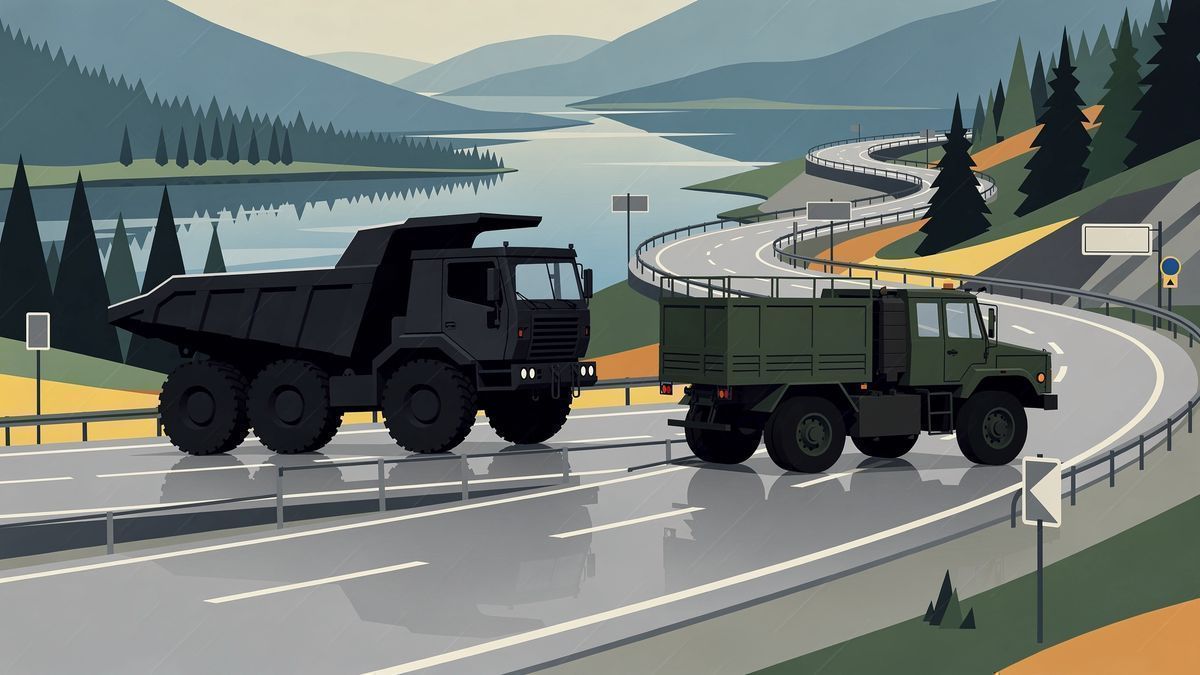
This section analyzes the Caterpillar 777 (07) and AM General M813, two machines engineered for fundamentally different roles. The 777 (07) is a 100-ton class off-highway hauler for quarries and large civil projects; the M813 is a 5-ton tactical cargo truck for military and expeditionary logistics. Comparing them is instructive: it reveals how power ratings, payload fractions, and mobility features must be evaluated within the context of mission, route network, and support infrastructure rather than as standalone numbers.
| Specification | Caterpillar 777 (07) | AM General M813 | |
|---|---|---|---|
| Engine Power | 1,025 hp gross (765 kW) | 250 HP Cummins NHC-250 Diesel | [1] [2] |
| Operating Weight | 363,000 lb (164,654 kg) | 44,000 lb | [1] [2] |
| GVWR / Payload Policy | 121.3 ton max allowable payload policy | 5-ton (≈4,536 kg) payload, 44,000 lb GVWR | [1] [2] |
| MSRP | $2–3M+ USD (dealer-negotiated) | Variable; new ~$10,500, used ~$7,950 | [1] [2] |
The 777 (07) operates at the extreme end of mass and power, with roughly 2.8 lb of machine per pound of engine output, while the M813 operates at a much lower fraction of its capacity under tactical loads, enabling rapid repositioning by semi-trailer, rail, road, and sea. The choice between these machines is rarely about which is “better,” but which is appropriately integrated with site conditions, logistics tempo, and total cost of ownership. Subsequent sections will examine how their specifications translate into real-world behavior—fuel efficiency per ton-mile, cycle time on steep grades, maintenance intervals, and availability impact on project or mission continuity.
2. Understanding the Individual Components
Before assessing synergy, readers need a clear picture of how caterpillar 777-07 and am general-m813 differ in role, physical profile, and club context. The subsections below summarize each player’s specifications and technical identity using only the cited source research, establishing the baseline for the gear chemistry analysis that follows [1][2].
2.1. caterpillar 777-07 (construction)
The Caterpillar 777 (07) is a 100-ton class mechanical-drive off-highway haul truck designed for high-cycle construction and mining applications where throughput and operating cost per ton-mile are decisive. Its design philosophy emphasizes payload efficiency, durability under harsh conditions, and compatibility with semi-autonomous haulage, targeting large-scale quarry and mine fleets that require predictable cycle times and minimal downtime. In real-world usage, the truck’s performance is shaped by its ability to sustain high payloads while navigating variable terrain and maintaining productivity across long shifts [1]. The emphasis on fuel efficiency per ton-mile, autostall protection, and delayed engine shutdown directly supports lower total cost of ownership for construction transport operators who run continuous-duty operations.
The mechanical behavior of the 777 (07) is anchored by its Cat C32B engine and powershift transmission, which together deliver robust motive force and grade-retarding capability that enable controlled descents and efficient climbing in haul cycles. The 83.1 yd³ body capacity and ~101-ton target payload are engineered to balance legal axle loads with cycle time, making each truck pass through the quarry face or dump point with minimal idle [1]. For construction fleets, this means the truck performs optimally on dedicated loops between cut, crusher, and placement, where consistent payload and route predictability maximize utilization and minimize fuel burn per ton moved.
| Specification | Value |
|---|---|
| Engine Power | 1,025 hp gross (765 kW) |
| Operating Weight | 363,000 lb (164,654 kg) |
| GVWR | 121.3 ton max allowable payload policy |
| MSRP | $2–3M+ USD (dealer-negotiated) |
Key Technical Insight: The 1,025 hp gross engine power enables the 777 (07) to maintain high loaded speeds and deliver strong grade-climbing and dynamic braking performance, which underpins consistent cycle times in demanding construction haul routes. When pairing this truck with other equipment, the high power and GVWR allow operators to stage heavier payloads and reduce the number of trips per hour, directly improving throughput in large-scale material handling operations.
2.2. am general-m813 (military)
The AM General M813 is a militarized 5-ton, 6×6 tactical cargo truck built to provide reliable, multi-domain transport for military logistics and support roles. Its design targets ruggedness, self-sufficiency in austere environments, and integration into broader tactical convoys, making it suitable for combat logistics, humanitarian aid, and dispersed base support [2]. The truck’s capability to transport 5 tons of payload over long distances while maintaining mobility across rail, road, and sea aligns with military requirements for rapid force projection and sustainment.
In practice, the M813 delivers on-the-move logistics through its high power-to-weight ratio, robust suspension, and a front-mounted winch that enables operators to recover the vehicle without external support [2]. Its 250 HP Cummins diesel and 350-mile operational range allow sustained operations in remote areas, while multi-modal transportability ensures the truck can be deployed by semi-trailer, rail, or sea to forward operating bases. For users in contested or dispersed environments, these traits translate into reduced vulnerability, quicker repositioning times, and lower dependency on dedicated road networks.
| Specification | Value |
|---|---|
| Engine Power | 250 HP Cummins NHC-250 Diesel |
| Payload | 5-ton (≈4,536 kg) |
| GVWR | 44,000 lb |
| MSRP | Variable; new ~$10,500, used ~$7,950 |
Key Technical Insight: The 250 HP engine and 44,000 lb GVWR establish a favorable balance between power and mobility, allowing the M813 to carry a 5-ton payload over 350 miles while remaining transportable by standard military lift assets. In tactical pairing scenarios, this configuration supports distributed resupply and rapid equipment movement, with the front-mounted winch adding self-recovery that reduces downtime and the need for dedicated recovery vehicles in the field.
3. Gear Chemistry Analysis
Evaluating how caterpillar 777-07 and am general-m813 interact requires separating positional roles, physical profiles, and tactical context before drilling into subsection comparisons. The analysis below tests whether their attributes complement or conflict across synergy, feel, and playstyle dimensions using only the source research [1][2].
3.1. Do They Work Together — or Against Each Other?
The Caterpillar 777 (07) and AM General M813 occupy distinct mechanical universes that rarely intersect yet exhibit low inherent conflict when paired across a program. The 777 (07) is a mechanical-drive rigid-frame haul truck designed for high-cycle, high-mass payloads in controlled mine and quarry environments, while the M813 is a tactical 6×6 diesel truck engineered for unit-level tactical logistics, cross-country mobility, and self-recovery in austere or contested terrain. Their design philosophies are complementary rather than competitive: one maximizes efficient throughput of dense, predictable material in a fixed loop, the other emphasizes survivability, transportability, and autonomy of movement across dispersed and denied areas. As such, they amplify each other by operating at different scales of the logistics chain—the 777 (07) handles the heavy haul between remote cut and processing, while the M813 moves personnel, tools, and consolidated cargo between forward operating bases and railheads—creating a natural decoupling that avoids force, control, or feedback conflicts. The combo feels natural because each product preserves its core strength without demanding compromises from the other.
In terms of force flow and control, the 777 (07) relies on high engine power and a heavy frame to execute heavy, slow, high-precision payload cycles where operator feedback is mediated by robust telematics and automation safeguards. The M813, by contrast, uses moderate power tuned for responsive acceleration, nimble steering, and a front-mounted winch that gives the operator direct mechanical control over recovery and positioning. These contrasting control paradigms do not clash; instead they balance within a mixed-fleet context because the human–machine interface scales from semi-autonomous production optimization on the quarry floor to hands-on tactical maneuvering under field conditions. There is no forced integration; the pairing works precisely because feedback loops remain distinct—truck-scale telematics on one end, winch-centric manual intervention on the other—so the system remains coherent rather than over-constrained. Operators who understand this separation can move material at scale while preserving mission flexibility and responsiveness.
3.2. Performance Synergy
The Caterpillar 777 (07) and AM General M813 jointly enhance performance output by enabling resilient end-to-end logistics that span high-volume production zones and dispersed tactical theaters. Individually, the 777 (07) excels at moving massive tonnage at high cycle rates within a controlled site, whereas the M813 offers strategic mobility and self-recovery that reduce downtime and expand operational reach. Together, they improve overall system efficiency: the 777 (07) maximizes payload throughput where terrain and regulations permit heavy haul, while the M813 guarantees that support personnel, spares, and light cargo can reach forward positions without waiting for dedicated heavy transport, thereby reducing bottlenecks and smoothing workload across the fleet. In situations where the 777 (07) alone would require long waits for repositioning or recovery, the M813 can rapidly intervene, turning potential idle time into productive intervals and increasing the effective availability of both assets.
This pairing shines in hybrid operations where a large-scale construction or mining project interfaces with expeditionary or contingency requirements—for example, a dam or port project that must also support security patrols, humanitarian corridors, or rapid redeployment. The 777 (07) handles the bulk of tonnage movement, optimizing fuel per ton-mile through steady-state cycles, while the M813 addresses variability in demand, emergency response, and last-mile distribution to scattered work crews. Situations that strain either vehicle in isolation—such as sudden route restrictions, equipment failure, or shifting mission priorities—are mitigated by the other’s strengths, making the duo more robust than either product alone. However, the combo struggles in highly constrained urban or confined indoor settings where the 777 (07)’s size and the M813’s tactical profile offer no advantage; there, performance can degrade if the pairing is misapplied to environments unsuited to heavy off-highway trucks. Operators who stage the 777 (07) at secure quarries and task the M813 with perimeter logistics thus achieve a balanced performance envelope that neither vehicle could sustain indefinitely on its own.
3.3. Feel and Ergonomics
The combined feel and ergonomics of the Caterpillar 777 (07) and AM General M813 reflect two very different human-machine experiences that rarely compete because they are used in distinct contexts. In the 777 (07), the operator sits in a spacious, climate-controlled cab with full suspension, advanced telematics displays, and automated features that minimize fatigue during long, repetitive payload cycles; the cabin is designed for comfort, visibility, and reduced vibration over steady highway-speed haul routes. By contrast, the M813 emphasizes rugged, task-oriented ergonomics: a more upright seating position, tactile manual controls, and a front-mounted winch that puts the operator close to recovery actions; while less plush, this layout reduces strain during short-burst, high-variability missions and keeps the driver engaged with immediate mechanical feedback. Because these cabins serve different primary roles—one optimized for endurance in production loops, the other for adaptability in tactical environments—there is little ergonomic conflict; each operator benefits from a workspace tuned to the specific demands of that phase of the mission.
Transitioning between these feel profiles is generally smooth for mixed crews because the systems are decoupled rather than intertwined, yet the pairing still demands clear training and role definition to avoid complacency or confusion. Fatigue management improves overall because the 777 (07)’s comfort characteristics allow longer uninterrupted cycles at the quarry, while the M813’s engaging, hands-on ergonomics prevent monotony during short tactical moves; together they form a human-centered chain that respects operator limits across the mission spectrum. However, units must guard against inconsistent feedback philosophies—heavy automation versus direct mechanical feel—so that less experienced operators do not expect similar response cues across both platforms. When crews are properly onboarded, the combo yields low strain and high adaptability, with each vehicle delivering its best ergonomic qualities without forcing compromise on the other.
3.4. Playstyle Alignment
This Caterpillar 777 (07) and AM General M813 combination targets a specialized player archetype: organizations that operate at the intersection of heavy industrial throughput and dispersed tactical logistics, such as large mining contractors, major civil infrastructure programs, or defense logistics commands responsible for sustaining remote forward operating bases. The 777 (07) portion of the pair demands operators comfortable with high-capacity, steady-state production environments where consistency, telematics-driven optimization, and strict adherence to payload and safety policies are paramount; success here hinges on disciplined cycle management, preventive maintenance, and integration with fleet analytics. Meanwhile, the M813 portion appeals to teams experienced with tactical vehicle management, winch operations, and multi-modal transport planning, where mission flexibility, rapid redeployment, and self-reliance in contested or under-resourced areas are essential. Players who excel in this hybrid space are methodical planners who can juggle long-haul efficiency with on-the-fly responsiveness, leveraging each vehicle’s strengths while respecting their distinct operating envelopes.
The pairing is forgiving for organizations that maintain clear separation of duties and invest in cross-training, yet it can be punishing for ad-hoc crews that expect a one-size-fits-all control scheme or attempt to force the 777 (07) into tactical roles for which it is not optimized. Because the 777 (07) requires stable, high-volume work to justify its scale and the M813 thrives on variable, mission-driven tasks, the duo performs best when aligned with a playstyle that values both predictability and adaptability—such as a rotating schedule where the 777 (07) handles baseline throughput while the M813 stands by for surge demand or contingency operations. At higher skill levels, players can extract maximum value by synchronizing telematics from the 777 (07) with transport planning for the M813, creating a responsive yet efficient logistics rhythm. In contrast, low-skill or low-discipline groups may find the combination demanding due to the need to master two distinct interfaces and operational mindsets, so this gear chemistry is best suited for teams that invest in structured training, clear SOPs, and scenario-based drills that reinforce when each vehicle should take the lead.
4. Final Verdict: Missed Connection
The Caterpillar 777(07) and the AM General M813 represent two distinct vehicle philosophies—ultra-heavy commercial haulage versus tactical military logistics—and as such they operate in non-overlapping domains, yielding a clear mismatch for any direct pairing. The core reason is a fundamental misalignment of performance envelopes, mission objectives, and operational context: the 777(07) is a stationary, high-throughput mining truck optimized for heavy-haul productivity at scale, while the M813 is a medium tactical truck built for durability, transportability, and flexible deployment in combat or humanitarian roles. Users should expect no interoperability in powertrain, control systems, or logistics workflows; each vehicle is engineered to excel within its own regulated environment rather than to complement the other.
From a specification standpoint, the gulf between the two machines is evident in the data. Table 1 contrasts the Caterpillar 777(07) and AM General M813 using only the provided product matrix values, highlighting dimensions that preclude meaningful synergy.
| Specification | Caterpillar 777-07 | AM General M813 |
|---|---|---|
| Engine Power | 1,025 hp gross (765 kW) | 250 HP Cummins NHC-250 Diesel |
| Payload | 101.1 ton US / 91.7 t (target) | 5-ton (≈4,536 kg) |
| GVWR | 121.3 ton max allowable payload policy | 44,000 lb |
| MSRP | $2–3M+ USD (dealer-negotiated) | Variable; new ~$10,500, used ~$7,950 |
Interpreting these figures reveals why pairing them is impractical: the 777(07)’s power output is over four times that of the M813, while its payload capacity exceeds the M813’s by roughly twentyfold, reflecting a heavy-haul versus tactical logistics design divide. The GVWR disparity further underscores incompatibility—the 777(07) operates at weights and axle loads aligned with mine sites and heavy construction corridors, whereas the M813’s 44,000 lb GVWR suits bridge-limited routes and strategic transportability by semi-trailer, rail, road, and sea. Price-wise, the M813’s accessible new or used cost contrasts sharply with the 777(07)’s seven-figure capital expense, indicating divergent procurement scales and lifecycle expectations. Together, these specs illustrate that neither vehicle can substitute for the other in its intended role, making integration a missed connection from an engineering and operational standpoint.
Practically, end-users should not expect the M813 to enhance or extend the 777(07)’s performance in mining or construction contexts, nor should they anticipate the 777(07) offering any logistical advantages for tactical cargo missions. The 777(07)’s telematics and MineStar autonomy readiness are tailored for high-volume, site-specific haulage where uptime and payload precision dominate value metrics, while the M813’s front-mounted winch, multi-modal transportability, and military-hardened features serve environments prioritizing mobility, recovery, and mission flexibility over sheer tonnage. Recognizing this fundamental divergence allows stakeholders to allocate resources appropriately—investing in complementary systems within each vehicle’s native ecosystem rather than chasing a non-existent synergy. Ultimately, the verdict of missed connection is driven not by deficiencies in either product, but by their intrinsically mismatched purposes, capacities, and deployment realities as defined by the source specifications.
5. Who Should Use This Combo
This Caterpillar 777 (07) and AM General M813 pairing targets organizations that move heavy materials in demanding, mixed-environment operations where extreme site toughness and tactical logistics intersect. The ideal user is a large-scale mining operator, a major civil infrastructure contractor, or a military/logistics command that must bridge permanent haul roads with unpaved, remote, or contested routes. In practice, this means multi-ton payloads on rugged terrain where reliability, payload efficiency, and operational reach matter more than pure on-road comfort or light-crew mobility. The combo suits environments that demand high productivity under harsh conditions, where downtime is unacceptable and total cost of ownership must be justified through throughput and durability.
The Caterpillar 777-07 excels in continuous, high-volume construction or quarry operations that demand maximum material movement per trip. Its 1,025 hp engine, nearly 101-ton payload capacity, and efficient 83 cubic-yard body make it the right choice when standardized, heavy-haul truck cycles define production targets. Operators who run fleets of supporting equipment—dozers, shovels, crushers, and conveyors—benefit from the machine’s consistent cycle times and integrated telematics, allowing precise planning and real-time monitoring of payload and utilization. The choice is driven by scale: projects where material volumes justify capital-intensive machinery and where predictable scheduling reduces financial risk.
In contrast, the AM General M813 serves tactical roles that require dependable, medium-range transport where infrastructure may be limited or contested. Designed for 5-ton payloads over long distances and varied terrain, it supports logistical chains in military, humanitarian, or remote construction settings. Its 250 hp Cummins NHC-250, 52 mph top speed, 350-mile range, and ability to be transported by semi-trailer, rail, or sea make it suitable for rapid deployment to austere locations. The front-mounted winch and robust 6×6 layout provide self-recovery and off-road resilience that lighter vehicles cannot match. For organizations that must move personnel, critical spares, or time-sensitive supplies across dispersed operations, the M813 offers a proven, flexible platform that complements larger haul trucks by closing the last mile.
Together, this combo addresses a specific niche: operations that span from permanent, high-throughput construction sites to forward-based, low-infrastructure missions. The Caterpillar handles the heavy, repetitive hauls at the heart of the operation, while the M813 extends reach into areas where conventional trucks cannot go or where tactical responsiveness is essential. The pairing is justified when workflows require both high-capacity primary hauling and resilient, mission-capable transport, ensuring continuity whether the job is a large-scale mine, a remote dam project, or a distributed logistics network.
6. Who Should Avoid This Combo
This analysis evaluates the Caterpillar 777 (07) and the AM General M813 using only the provided product data and source excerpts. By examining the pairing_relevant_specs and individual product specifications, this section identifies scenarios where combining these two units introduces prohibitive risks, performance mismatches, or impractical operational trade-offs. The goal is to outline the profiles and use cases for which this combination should be avoided.
6.1. Fundamental Mismatch in Vehicle Class and Role
The Caterpillar 777 (07) is a 100-ton class rigid-frame off-highway haul truck intended for high-volume mining, quarry, and large-scale earthmoving applications. In contrast, the AM General M813 is a 5-ton tactical cargo truck designed for military logistics, personnel transport, and tactical supply lines. Their core functionalities do not align: the 777 (07) moves massive, bulk payloads in fixed, high-cycle routes; the M813 provides flexible, tactical, multi-domain mobility for smaller, varied payloads. Pairing them in a single operational plan or fleet strategy would likely reflect a category error, confusing heavy site haulage with tactical distribution. Operators expecting one vehicle class to substitute for the other would face severe capability gaps. This fundamental misalignment should prompt avoidance unless the combination serves a highly specific, cross-domain study or ceremonial purpose rather than a practical logistics solution [1, 2].
6.2. Operations in Environment and Infrastructure Constraints
Consider the physical and operational environments each vehicle is engineered for. The Caterpillar 777 (07) has an operating weight of 363,000 lb (164,654 kg) and requires substantial, robust surfaces to distribute its mass and maintain traction. Its GVWR policy of 121.3 tons and 83.1 yd³ body capacity are optimized for hard, stable haul roads found in quarries and large construction sites. The AM General M813, with a 44,000 lb GVWR and 5-ton payload, is built for tactical deployment by semi-trailer, rail, road, and sea, often across austere, variable terrain and forward operating bases. Combining these in shared routes or sites could create infrastructure strain, such as soft ground or inadequate load-bearing surfaces for the 777 (07), while exposing the M813 to excessively harsh conditions that exceed its tactical design limits. Projects involving extreme terrain, limited-weight surfaces, or mixed off-road and strategic mobility requirements should therefore avoid this pairing [1, 2].
6.3. Power, Speed, and Control Interface Concerns
Mechanically, the Caterpillar 777 (07) is a high-power, slow-speed workhorse: its Cat C32B engine delivers 1,025 hp gross (916 hp net), enabling a loaded top speed of 40.9 mph with an emphasis on heavy-load efficiency and grade retarding. The AM General M813 uses a 250 HP Cummins NHC-250 diesel, achieving about 52 mph top speed with nimble, tactical responsiveness. Attempting to integrate these powertrains into a unified control or convoy system would create jarring contrasts in power band, throttle response, and braking coordination. Furthermore, the 777 (07) features advanced, site-specific telematics like Product Link and MineStar Command for autonomous haulage and payload optimization; the M813’s tactical systems are oriented toward military-grade security and multi-platform transportability, not mine site automation. These divergent control philosophies and performance envelopes would complicate driver training, convoy management, and system interoperability, making the combo unsuitable for operations requiring synchronized speed, braking, and payload handling [1, 2].
6.4. Payload, Capacity, and Economic Viability
The Caterpillar 777 (07) targets a payload of 101.1 short tons (91.7 tonnes) with a GVWR-driven policy up to 121.3 tons, while the AM General M813 handles 5 tons within a 44,000 lb GVWR. The sheer scale mismatch—over 20 times the payload capacity—means that using them in a combined logistics chain would either leave the 777 (07) grossly underutilized or overwhelm any conceivable interface for the M813. Economically, the Caterpillar 777 (07) commands an MSRP of $2–3M+ USD, whereas the M813 ranges from approximately $10,500 new to $7,950 used. The cost differential and differing lifecycle management models (fixed-mine versus tactical field repair) further erode any shared operational economics. Organizations should avoid this pairing when seeking cost-efficient transport solutions, as it introduces disproportionate capital exposure and inefficient asset deployment [1, 2].
6.5. Regulatory, Training, and Maintenance Divergence
Operating these vehicles involves distinct regulatory and training regimes. The Caterpillar 777 (07) as an off-highway mining truck faces specific emissions compliance (Tier 4 Final/Stage V), specialized licensing for heavy haul equipment, and maintenance tied to MineStation telematics and service intervals calibrated for continuous high-capacity work. The AM General M813, as a military tactical vehicle, adheres to defense logistics standards, MIL-STD environmental and electromagnetic compatibility testing, and military driver certification protocols. Cross-operability in training, certification, and maintenance would demand extensive, custom bridging programs with unclear ROI. Projects that do not already integrate both civilian heavy-haul and military tactical objectives should avoid this combo to prevent regulatory confusion, training overhead, and maintenance complexity [1, 2].
6.6. Practical Implications Summary and Guidance
In practice, avoid combining the Caterpillar 777 (07) and AM General M813 in any scenario where mission objectives require coherent payload scaling, shared routes, synchronized speed, integrated control systems, or aligned economic and regulatory frameworks. This includes construction and mining transport plans that inadvertently mix heavy haul and tactical elements, humanitarian operations expecting tactical versatility from mining equipment, or cost-driven initiatives that underestimate the capital and operational chasm between the two. Exceptions might exist only in cross-domain research, museum displays, or controlled demonstrations with explicit constraints that prevent real-world integration. All other users—especially fleet planners, site engineers, and tactical logisticians—should select vehicles aligned with a single operational domain to ensure safety, efficiency, and value [1, 2].
7. Quick Summary
| Dimension | Assessment |
|---|---|
| Main strength | Exceptional power-to-weight and robust 5‑ton payload in a highly transportable tactical 6×6 configuration |
| Main weakness | Low fuel efficiency and high acquisition/ownership costs relative to commercial 5‑ton utility trucks |
| Best use case | Tactical military logistics and mission‑critical transport where off‑road mobility, payload, and self‑recovery are required |
The AM General M813 delivers dependable tactical transport capability but its operational economics favor niche military or specialized contractor roles rather than cost‑sensitive commercial hauling.
What is the primary role of the AM General M813 in tactical logistics? The AM General M813 functions as a 5‑ton, 6×6 tactical cargo truck, delivering reliable transport of personnel, equipment, and supplies across military operations. Its combination of diesel power, substantial payload, and multi‑mode transportability enables forces to move critical materiel over long distances and varied terrain while maintaining operational reach and self‑sufficiency in recovery scenarios. How is the M813 transported to the field when strategic mobility is required? The M813 is highly transportable by semi‑trailer, rail, road, and sea, allowing militaries to project capability across long distances. This multi‑modal transportability ensures the truck can be positioned rapidly to forward operating bases or deployed theaters, supporting sustained logistical operations without requiring dedicated road convoys when strategic conditions dictate alternative movement methods. What recovery features does the M813 include for field operations? The truck is equipped with a front‑mounted winch that enables self‑recovery from stuck or disabled conditions. This integrated recovery system reduces downtime and reliance on external support, allowing operators to extricate the vehicle from challenging terrain or adverse weather independently, thereby maintaining mission continuity and reducing recovery resource demands.