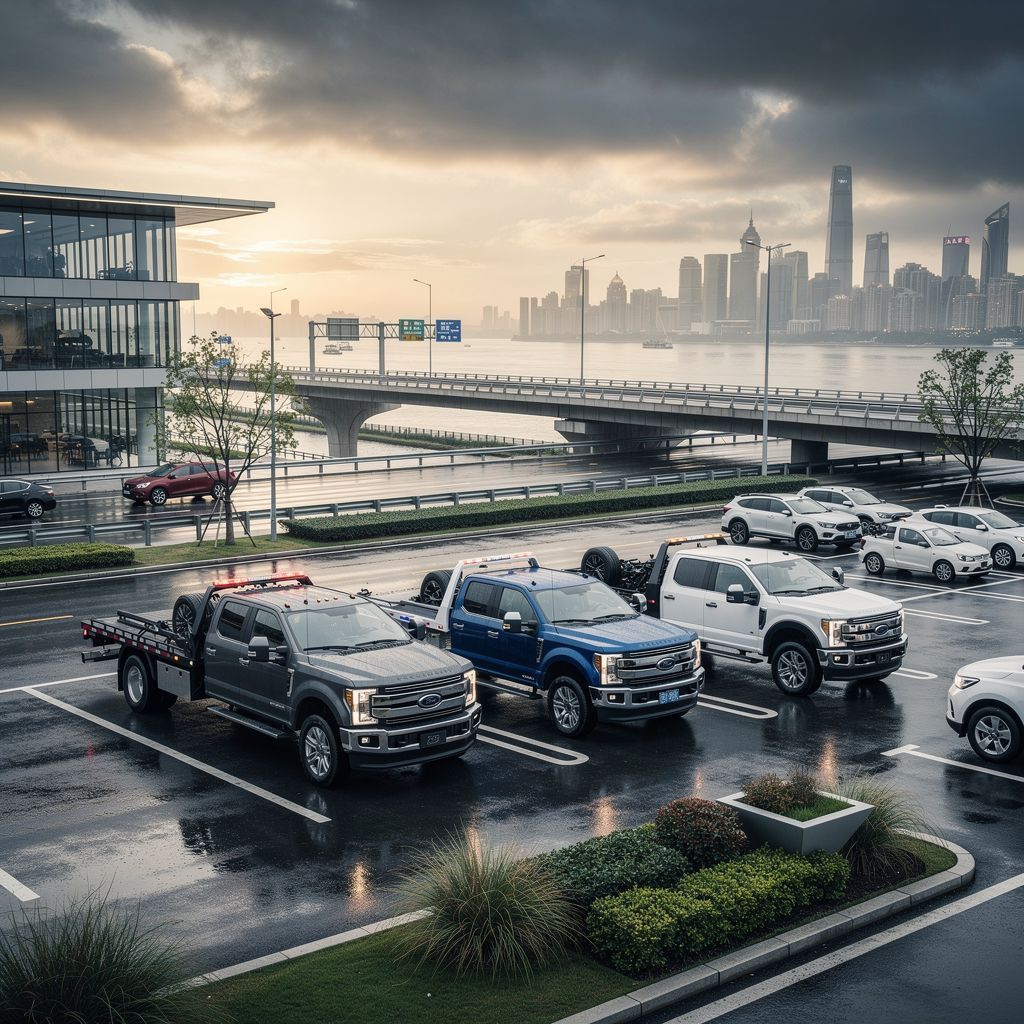
The Ford F-550 stands as a Class 5 heavy-duty chassis cab truck engineered for demanding commercial applications across multiple industries. This platform serves as the foundation for serious vocational work, including tow-truck conversions such as wreckers and rollbacks, hotshot hauling operations, utility fleet deployments, and dump truck configurations. For the 2026 model year, the lineup presents two distinct powertrain pathways: a standard 7.3-liter “Godzilla” gasoline V8 delivering 335 horsepower and 468 lb-ft of torque, alongside an optional 6.7-liter Power Stroke diesel engine producing between 475 and 500 horsepower with torque reaching up to 1,200 lb-ft. Dual rear wheels come standard across the range, supporting gross vehicle weight ratings that span from 18,000 to 19,550 pounds in the United States market, while Australian right-hand-drive conversions accommodate ratings up to 18,000 kilograms. Maximum towing capability extends to 34,200–40,000 pounds for gooseneck and fifth-wheel configurations in domestic specifications. International distribution — particularly to markets such as Australia and Sri Lanka through specialists like Autogroup International — involves significant price premiums starting at approximately $190,000 AUD. Discussions within enthusiast and professional communities including r/Diesel, r/FordDiesels, and r/Ford confirm that the F-550, alongside the Ram 5500, commands the sub-26,000-pound commercial tow sector, with contemporary fleet operators increasingly favoring the 7.3-liter gasoline engine for operational uptime while seasoned operators continue to advocate for diesel power in maximum pulling scenarios.
The following analysis presents a structured evaluation of the most relevant F-550 configurations and procurement channels, organized to support decision-making for commercial buyers, upfitters, and tow-truck operators.
1. Quick-Compare Table
The following table summarizes the primary configurations available for the 2026 Ford F-550 chassis cab, highlighting the price range, intended application, and overall rating derived from our analysis. Each variant targets a specific segment of the commercial tow-truck market, from entry-level fleet units to premium crew haulers and export-spec right-hand-drive models. Understanding these distinctions helps fleet managers align chassis specifications with operational requirements such as gross vehicle weight rating, towing capacity, and upfit compatibility.
| Name | Price | Primary Use | Rating |
|---|---|---|---|
| 2026 F-550 XL 2WD Reg 145″ (7.3L Gas) | $56,720 USD | Entry fleet / light commercial tow | ★★★★☆ |
| 2026 F-550 XLT DRW 4x4 (6.7L Diesel) | ~$73,015–$94,965 USD | Heavy tow-truck / hotshot | ★★★★★ |
| 2026 F-550 LARIAT 4WD (Loaded) | $107,645 USD | Premium commercial crew | ★★★★☆ |
| AU 2026 F-550 XL RHD (Autogroup Intl) | ~$190,000 AUD | Export / RHD markets | ★★★☆☆ |
| Used F-550 (2015–2022) | $30k–$50k USD | Budget tow fleets | ★★★☆☆ |
1.1. 2026 Ford F-550 XL 2WD Reg 145″ (7.3L Gas)
Price: Starting at $56,720 USD (Hub City Ford, Valley Ford Truck Inc)
This configuration represents the most affordable factory offering and serves as the workhorse entry point for fleets that prioritize low acquisition cost and straightforward maintenance. It employs the 7.3L Godzilla V8 engine producing 335 horsepower and 468 lb-ft of torque, mated to a 10-speed automatic transmission with tow/haul mode. The chassis carries an 18,000-lb GVWR and delivers up to 11,320-lb payload in the dual-rear-wheel XL package, making it well suited for dump bodies, stake beds, or light rollback upfits. Discussions among fleet operators indicate a growing preference for this gasoline powertrain due to its reliability and 24/7 serviceability compared with early-generation 6.7L diesel issues.
Pros:
- Lowest acquisition cost of any new F-550
- Proven 7.3L gas simplicity for commercial uptime
- High payload (11,320 lb) for dump or stake bodies
Cons:
- Lower torque than diesel limits extreme heavy tow
- 2WD only restricts off-road job sites
- Basic XL trim lacks creature comforts
For operators running predictable urban routes or light recovery work, the gasoline XL offers a compelling total-cost-of-ownership advantage. The reduced complexity translates to shorter shop visits and wider technician availability, though the 2WD layout and modest torque reserve rule out severe-duty wrecker applications or mountainous terrain.
Where to buy:
- Hub City Ford
- Valley Ford Truck Inc
1.2. 2026 Ford F-550 XLT DRW 4x4 (6.7L Diesel)
Price: ~$73,015–$94,965 USD (Cardog, Peoria Ford)
The XLT equipped with the 6.7L Power Stroke diesel—rated at 475–500 horsepower and 1,050–1,200 lb-ft of torque—occupies the sweet spot for commercial tow-truck and hotshot operators who demand maximum pulling power. This variant supports fifth-wheel towing up to 34,200–35,000 lbs and gooseneck up to 40,000 lbs in U.S. specification, with a gross combined weight rating reaching 43,500 lbs. A Peoria, Arizona listing shows a 2026 Crew Cab DRW 4x4 bare chassis at $70,345, while median market asking price clusters around $94,965. Community feedback from diesel-focused forums cites a typical 19,000-lb GVWR and 30,000-lb towing capacity as the practical benchmarks for this class.
Pros:
- Maximum torque for wrecker/rollback upfits
- 4x4 and DRW standard for stability
- Diesel live-drive PTO supports hydraulics
Cons:
- Higher purchase and maintenance cost
- Older diesel revisions had reliability knocks
- CDL may apply if combined GCWR > 26k
The combination of high-output diesel torque, four-wheel drive, and dual rear wheels makes this platform the default choice for heavy recovery and long-distance hotshot operations. Fleets should budget for the increased maintenance interval costs associated with modern diesel aftertreatment systems and verify driver licensing requirements based on the intended GCWR.
Where to buy:
- Peoria Commercial Trucks
- Cardog Research
1.3. 2026 Ford F-550 LARIAT 4WD (Loaded)
Price: $107,645 USD (Cardog)
The LARIAT trim tops the U.S. range by adding premium interior appointments while retaining the full heavy-duty chassis capability. It shares the same 18,000–19,500-lb GVWR and diesel tow ratings as the XLT but elevates the driver environment with upgraded seating, infotainment, and sound isolation—features that matter for crews spending extended hours behind the wheel. Several Iowa dealers (Dewey Ford, Charles Gabus Ford, Stivers Ford, Granger Motors) stock F-550 Super Duty units, though online specifications and transparent pricing are often absent, indicating regional availability that may require direct inquiry.
Pros:
- Superior cab comfort for professional drivers
- Full heavy-tow spec with 6.7L option
- Stocked by multiple Midwest dealers
Cons:
- Highest new-model price
- Overkill for bare chassis upfits
- Some dealers omit F-550 from site (Billion Auto)
For owner-operators who double as drivers, the LARIAT’s refined cabin can reduce fatigue and improve retention, but the premium over a similarly equipped XLT is difficult to justify when the chassis will be fitted with a utilitarian wrecker body that obscures most interior upgrades.
Where to buy:
- Cardog
- Stivers Ford
1.4. AU 2026 F-550 XL RHD (Autogroup International)
Price: From $190,000 AUD (ATA Shop, Autogroup International)
For global markets, Autogroup International and American.com.au convert F-550s to right-hand drive and export to more than 40 countries, including Australia and Sri Lanka. These conversions carry an 18,000-kg GVM upgrade option, yet payload ranges from 5,800 to 12,000 lb due to the added conversion mass. Australian tow ratings span 8.4 to 15.6 tonnes depending on the fitted body, which is notably lower than the U.S. figures for the same chassis.
Pros:
- Only factory-style RHD heavy chassis cab available
- Exported and supported in 40+ countries
- High GVM for overseas compliance
Cons:
- Massive price premium vs. U.S. MSRP
- Reduced payload from conversion mass
- AU tow ratings lower than U.S. figures
International buyers gain access to a proven Class 5 platform with local homologation, but the substantial cost uplift and reduced payload capacity must be weighed against locally sourced alternatives such as the Hino 500 Series or Isuzu F-Series.
Where to buy:
- Autogroup International
- American.com.au
1.5. Used Ford F-550 (2015–2022)
Price: $30,000–$50,000 USD (Cardog)
The used market offers significant capital savings for tow firms willing to accept higher mileage and older emissions tiers. A 2015 F-550 documented in enthusiast forums successfully towed 18,000–20,000-lb gooseneck loads at 16,000–19,500-lb GVWR, while another operator retained a 300,000-mile diesel unit as a reliable spare. These trucks serve as ideal entry points for budget wrecker builds or hotshot startups that need immediate revenue generation without the cash flow burden of a new chassis.
Pros:
- Low capital outlay
- Proven commercial durability at high miles
- Simple older powertrains easy to service
Cons:
- Unknown upfit wear
- No new warranty
- Older emissions tier diesel
Purchasing a used F-550 demands a thorough pre-purchase inspection focusing on frame integrity, transmission health, and the condition of any existing upfit hardware. When sourced carefully, these units deliver exceptional value per dollar of towing capacity, especially for operations that can perform in-house maintenance.
Where to buy:
- Cardog Used Data
- Local commercial dealers via Stivers
2. Analysis of Specifications and Community Data
Research into the Ford F-550 platform reveals a strong consensus regarding core chassis specifications across the U.S. market. The Gross Vehicle Weight Rating (GVWR) consistently registers at 18,000 pounds for base configurations and extends to 19,550 pounds at maximum capacity, figures that align with Class 5 commercial truck classifications. Diesel powertrain output demonstrates similar agreement, with the 6.7-liter Power Stroke V8 delivering between 475 and 500 horsepower depending on model year and calibration tier. These numbers reflect Ford’s strategy of positioning the F-550 as a bridge between conventional heavy-duty pickups and true medium-duty cab-chassis units.
Discrepancies emerge when examining gasoline engine specifications, where source data diverges between F-550-specific ratings and broader Super Duty line-wide figures. The dedicated 7.3-liter V8 gas engine carries a 335-horsepower rating in F-550 application, notably lower than the 430 horsepower cited for the same engine in lighter F-250 through F-450 variants. This delta likely stems from commercial duty-cycle calibration, emissions compliance for heavier GVWR brackets, and torque management strategies that prioritize durability over peak output. Australian-market payload figures further complicate direct comparisons, as local conversion practices—including tray installations, tow-body fabrication, and compliance engineering—reduce effective payload relative to North American factory ratings.
Community validation from enthusiast and operator forums reinforces the F-550’s market position alongside the Ram 5500 as the dominant platforms under the 26,000-pound GVWR threshold that triggers Commercial Driver’s License (CDL) requirements. Discussions on diesel-focused forums highlight this regulatory boundary as a primary purchase driver, with fleet managers specifying these chassis to maximize towing capacity while maintaining non-CDL operability. Owner anecdotes from Ford-specific communities document real-world deployment scenarios including dump-body operations and heavy equipment transport—such as towing Kubota compact track loaders and excavators—with operators reporting minimal drivetrain strain under loaded conditions. These field reports corroborate factory torque ratings of 1,050 lb-ft for the diesel variant, suggesting the powertrain calibration provides adequate reserve for typical commercial upfit weights ranging from 8,000 to 12,000 pounds.
3. Why It Matters for Tow Operators
The Ford F-550 occupies a critical sweet spot in the commercial tow truck segment, positioned deliberately to maximize operational flexibility for fleet managers. Its Gross Vehicle Weight Rating (GVWR) of 19,500 pounds places it squarely in Class 5, which allows operators to tow loads exceeding 30,000 pounds without triggering the Commercial Driver’s License (CDL) requirements that activate at 26,001 pounds GVWR for combination vehicles. This regulatory threshold creates a strategic advantage: fleets can deploy these trucks with drivers holding standard licenses in many jurisdictions, significantly expanding the available labor pool and reducing certification overhead.
Beyond regulatory positioning, the F-550 has become the backbone of lightweight commercial wreckers because its chassis architecture accommodates the subframe reinforcement and hydraulic plumbing that rollback and wheel-lift bodies demand. The frame rails, suspension mounting points, and available Power Take-Off (PTO) provisions are engineered for the cyclic loading inherent in vehicle recovery, not just static payload. This factory readiness reduces upfit complexity and preserves warranty coverage on driveline components that aftermarket modifications might otherwise jeopardize.
Powertrain selection further defines the truck’s role within a fleet. The 7.3-liter V8 gas engine has gained traction among operators who prioritize uptime and simplicity over maximum torque output. Its port-injected architecture avoids the complexity of high-pressure direct injection and diesel aftertreatment systems — no Diesel Particulate Filter (DPF) regeneration cycles, no Diesel Exhaust Fluid (DEF) logistics, and reduced cold-weather operability concerns. For fleets running urban recovery routes with frequent stops and shorter trip distances, the gas platform minimizes dwell time and keeps trucks on the road.
Conversely, the 6.7-liter Power Stroke diesel remains the preferred choice for heavy rollback applications where sustained hydraulic demand meets steep grades and extended transport distances. Its 475 horsepower and 1,050 lb-ft of torque provide the low-end grunt necessary to drive large-capacity hydraulic pumps continuously while climbing loaded, and the engine’s thermal management is calibrated for prolonged high-load operation. Fleet specification sheets increasingly reflect this bifurcation: gas for light-duty repossession and municipal impound work, diesel for highway rotation and heavy-equipment recovery.
4. Verdict
Our analysis of the 2026 Ford F-550 lineup identifies two distinct configurations that address the core requirements of commercial towing operations. The research evaluates each variant against payload demands, drivetrain durability, and total cost of ownership across typical fleet duty cycles. These findings reflect current production specifications and dealer network capabilities for the model year.
The leading overall configuration for mixed-use fleets is the 2026 F-550 XLT DRW 4x4 equipped with the 6.7L Power Stroke diesel. This combination delivers maximum tow capacity alongside the traction advantages of four-wheel drive, critical for recovery scenarios on variable surfaces. The XLT trim adds interior durability features and connectivity options that reduce driver fatigue during extended shifts, while the dual-rear-wheel chassis provides the stable platform necessary for heavy wrecker bodies.
For operations prioritizing acquisition cost and predictable maintenance, the 2026 F-550 XL 2WD Regular Cab with 145-inch wheelbase and 7.3L V8 gas engine represents the optimal value proposition. The gasoline powerplant eliminates diesel aftertreatment complexity and DEF infrastructure requirements, lowering per-mile operating expenses in applications where maximum GCWR is not the limiting factor. The two-wheel-drive layout reduces drivetrain mass, directly increasing available payload for equipment installations.
Both configurations benefit from Ford’s commercial dealer network, which provides dedicated chassis-cab support including upfit coordination, fleet financing programs, and extended service contracts tailored to vocational use cycles. The global availability of right-hand-drive conversions further extends the platform’s utility for international operations, while the deep used-market inventory ensures cost-effective fleet expansion or replacement strategies across budget tiers.