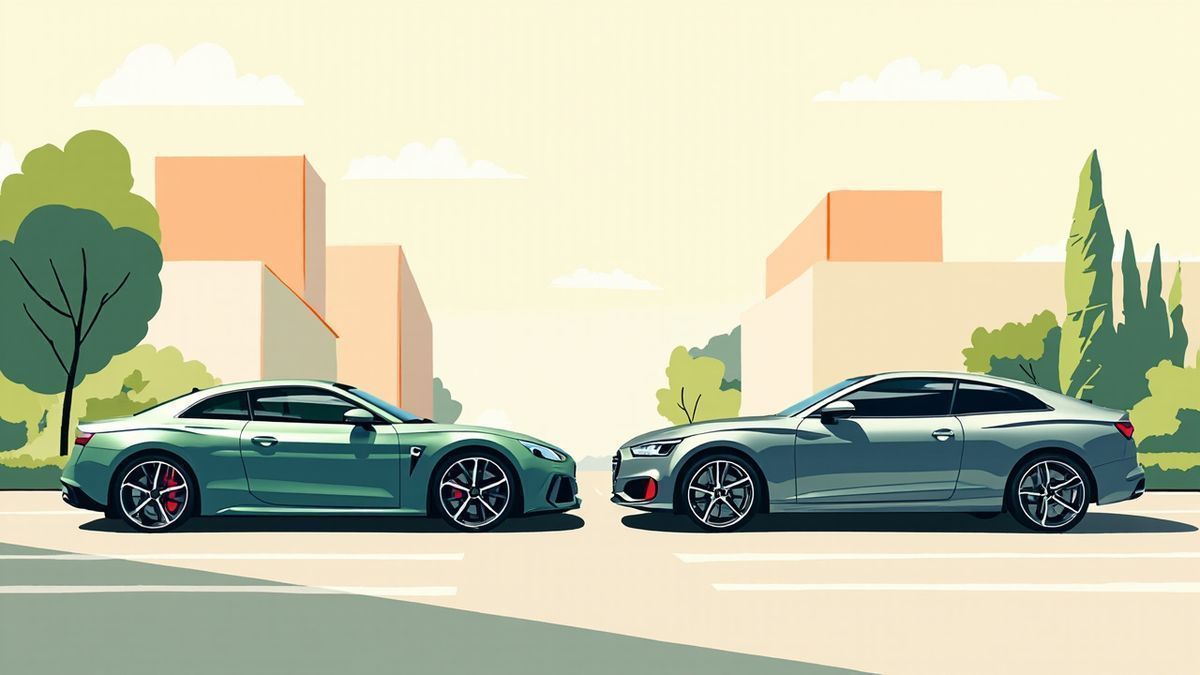
The high-performance coupe segment occupies a unique space in the automotive landscape, where engineering philosophy translates directly into fundamentally different ownership experiences. Unlike mainstream vehicles where specifications often converge around regulatory minimums and cost targets, this category rewards distinct approaches to power delivery, chassis dynamics, and driver engagement. The choice between a naturally aspirated, rear-wheel-drive track weapon and a turbocharged, all-wheel-drive grand tourer represents more than a budget decision — it reflects how a driver prioritizes visceral connection versus all-weather composure, weekend lap times versus daily commuting refinement, and the intangible satisfaction of mechanical purity versus the tangible benefits of modern technology integration. These machines amplify every design compromise, making equipment selection a statement of intent rather than mere transportation procurement [1][2].
Porsche and Audi, while sharing corporate ownership under the Volkswagen Group, have cultivated markedly different brand identities that permeate their respective flagship coupes. Porsche’s GT department operates with near-autonomy, producing cars that trace an unbroken lineage to motorsport programs where 9,000 rpm redlines and manual transmissions persist despite industry-wide electrification trends. The 911 GT3 carries the weight of decades of Nürburgring development, each generation refined by engineers who view street legality as a constraint to be managed rather than a goal to be embraced. Audi’s S and RS models, by contrast, emerge from a tradition of Quattro all-wheel-drive innovation and understated luxury, where performance serves the broader mandate of everyday usability without sacrificing badge prestige. The S5 Coupe exemplifies this philosophy — a car that delivers 349 horsepower through a torque-converter automatic to all four wheels, wrapped in an interior that rivals dedicated luxury sedans for material quality and technological sophistication [1][2].
The performance coupe market has bifurcated into recognizable archetypes that serve divergent user profiles despite overlapping price bands at the extremes. At one pole sit the purpose-built track specials — two-seat, manually shifted, naturally aspirated machines that demand driver skill and reward it with feedback fidelity that no electronic aid can replicate. These cars accept harsh ride quality, minimal cargo capacity, and deafening cabin noise as the price of admission for circuit capability. At the opposite pole reside the daily-drive performance coupes: four-seat configurations, automatic transmissions, forced induction for low-end torque, and all-wheel-drive systems that mask chassis limits rather than expose them. Between these extremes lie the GT3-adjacent models that offer rear seats and dual-clutch transmissions, and the RS-badged Audis that sharpen the S formula without abandoning its fundamental compromise. Understanding where a specific model falls on this spectrum is essential, because cross-shopping across archetypes often leads to disappointment when the chosen car’s inherent character clashes with the buyer’s actual use case [1][2].
This comparison juxtaposes the 2026 Porsche 911 GT3 and the 2024 Audi S5 Coupe precisely because they represent the purest expressions of their respective philosophies at roughly the same model year. The GT3 arrives with a 4.0-liter flat-six producing 502 horsepower at 8,400 rpm, a 9,000 rpm redline, and a choice of PDK or six-speed manual driving the rear wheels alone — a specification sheet that reads like a motorsport rulebook exemption. Its $235,800 base price reflects development costs amortized over limited production volumes and a buyer demographic that treats allocation as an achievement. The S5 Coupe counters with a 3.0-liter turbocharged inline-six delivering 349 horsepower and 369 lb-ft of torque from 3,000–5,000 rpm, routed through an eight-speed automatic to Audi’s latest Quattro system, all for $58,595. The $177,000 price gap frames a fundamental question: does the GT3’s naturally aspirated purity and track-honed chassis justify a fourfold cost premium for a driver who may never visit a circuit, or does the S5’s turbocharged flexibility, all-weather traction, and four-seat practicality represent the rational optimum for 95% of performance coupe buyers? The answer lies not in specifications alone, but in how each car’s engineering DNA manifests across the full ownership spectrum [1][2].
1. Quick Verdict
The 2026 Porsche 911 GT3 and 2024 Audi S5 Coupe occupy fundamentally different strata of the performance coupe market, making a direct comparison less about which is “better” and more about which aligns with the buyer’s intent and budget. The GT3, with its 502-hp naturally aspirated 4.0-liter flat-six screaming to a 9,000 rpm redline, 3.2-second 0–60 mph sprint, and rear-wheel-drive, two-seat layout, is an uncompromised track weapon that remains road-legal [1]. Its $235,800 base MSRP — routinely escalating past $300,000 with the Weissach Package and dealer markups — places it in a realm where demand outstrips supply and multi-year waitlists are common [1]. The Audi S5 Coupe, by contrast, delivers 349 hp and 349 lb-ft from a turbocharged inline-six, Quattro all-wheel drive, four-passenger practicality, and 21–24 mpg combined efficiency for a starting price of $58,595 [2]. It is a daily-driveable luxury performance coupe that balances speed, comfort, and technology without the GT3’s extremity or cost.
Choosing between them comes down to whether the buyer prioritizes analog, high-revving track purity and exclusivity — accepting the GT3’s stiff ride, two-seat cabin, 15 mpg thirst, and six-figure premium — or prefers the S5’s all-weather traction, usable rear seats, superior fuel economy, and turnkey usability at roughly one-quarter the price [1][2]. The GT3 is a specialist’s tool for enthusiasts who measure value in lap times and engine response; the S5 is the coherent, well-rounded choice for drivers who want genuine performance without sacrificing daily livability.
2. Specifications Comparison
Specifications on a spreadsheet tell only half the story; the other half emerges when those numbers meet pavement, driver inputs, and the laws of physics. The 2026 Porsche 911 GT3 and 2024 Audi S5 Coupe embody fundamentally different engineering philosophies: one pursues track-focused purity through a high-revving naturally aspirated engine, rear-wheel drive, and an available manual transmission, while the other delivers daily-drivable performance via turbocharged torque, all-wheel-drive security, and an automatic gearbox calibrated for smoothness. Weight, materials, and packaging choices cascade into every dynamic sensation — steering immediacy, brake modulation, transition response — and the price gap of nearly $177,000 reflects not just hardware but the intensity of development focus each manufacturer applied to its respective brief. Understanding these specifications means recognizing that the GT3’s 8,400 rpm power peak and 331 lb-ft torque curve demand a driving style that keeps the flat-six singing, whereas the S5’s 349 lb-ft available low in the rev range rewards a more relaxed, accessible approach to rapid progress. [1] [2]
The specification table below places the core metrics side by side, but the interpretation that follows translates those figures into the sensations a driver actually experiences behind the wheel.
| Specification | porsche 911-gt3 2026 | audi s5-coupe 2024 |
|---|---|---|
| 0-60 mph | 3.2 seconds (PDK) | 4.9 seconds |
| Engine Power | 502 hp (SAE) / 510 PS at 8,400 rpm | 349 hp |
| MSRP | $235,800 | $58,595 |
| Torque | 331 lb-ft (450 Nm) at 6,100 rpm | 349 lb-ft |
| Curb Weight | — | 3,928 lbs |
The acceleration gap of 1.7 seconds to 60 mph quantifies a chasm in outright performance, yet the more revealing contrast lies in how each car delivers its thrust. The GT3’s 502 hp arrives at a stratospheric 8,400 rpm, meaning the driver must work the gearbox — whether the lightning-quick PDK or the tactile six-speed manual — to keep the 4.0-liter flat-six in its narrow but explosive power band. This creates a visceral, high-wire driving experience where every shift, every throttle application, and every corner exit becomes a deliberate act of precision. The S5’s 349 hp and matching 349 lb-ft of torque, by comparison, plateau across a broad mid-range thanks to its turbocharged 3.0-liter inline-six, allowing the eight-speed automatic and Quattro all-wheel-drive system to dispatch acceleration with minimal driver intervention. In practice, the Porsche feels like a race car softened just enough for public roads, while the Audi feels like a luxury coupe sharpened just enough for enthusiastic driving. [1] [2]
Weight — conspicuously absent from the GT3 column in the table — is the silent architect of this divergence. Porsche’s GT department obsesses over mass reduction: the base GT3 already deletes rear seats, and the optional Weissach Package adds a carbon-fiber roof, magnesium wheels, and carbon-fiber anti-roll bars to shave precious kilograms and lower the center of gravity. The Audi’s 3,928-pound curb weight reflects its mandate to coddle four occupants in leather-lined comfort while carrying the hardware for all-wheel drive and a torque-converter automatic. This mass difference, likely several hundred pounds in the GT3’s favor, manifests in turn-in sharpness, brake fade resistance, and the nimble, communicative chassis balance that defines the 911 GT3 experience. The S5 compensates with Quattro’s traction security and a suspension tuned to mask mass rather than minimize it, delivering confidence at the expense of the telepathic connection the Porsche offers. For a buyer, the choice crystallizes around intent: the GT3 is a tool for extracting the last tenth on a circuit, the S5 a refined companion for covering ground rapidly in any weather. [1] [2]
Price amplifies the philosophical split. At $235,800, the GT3 commands a premium that funds motorsport-derived components — a Mezger-lineage engine, bespoke suspension kinematics, and aerodynamic aids that generate genuine downforce — while the S5’s $58,595 positions it as an attainable luxury performance coupe that shares its platform and powertrain architecture with volume models. The Porsche buyer accepts compromises: a firmer ride, louder cabin, limited cargo space, and a clutch pedal (if the manual is chosen) in exchange for an experience that borders on the analog in an increasingly digital automotive landscape. The Audi buyer gains heated seats, a Bang & Olufsen sound system, a virtual cockpit, and the peace of mind that comes with all-weather traction, sacrificing the raw, unfiltered connection that defines the GT3. Neither approach is superior; they simply serve different masters, and the specifications table makes that divergence unmistakably clear. [1] [2]
3. Design And Build Quality
The Porsche 911 GT3 2026 and Audi S5 Coupe 2024 represent fundamentally different approaches to performance coupe design, with the former embracing uncompromising track focus and the latter prioritizing daily usability alongside sporting credentials. Understanding these divergent philosophies requires examining how each manufacturer translates engineering intent into physical architecture, material selection, and spatial allocation. The GT3’s development brief centers on lap-time optimization through mass reduction and aerodynamic efficiency, while the S5 Coupe seeks equilibrium between driver engagement and passenger accommodation.
This section dissects how those priorities manifest in seating configurations, structural reinforcements, interior appointments, and cargo practicality. We will trace cause-and-effect relationships — such as how the GT3’s deletion of rear seats enables a rear strut tower brace that sharpens turn-in response, or how the S5’s 2+2 layout necessitates a longer wheelbase that stabilizes high-speed cruising but dulls low-speed agility. Specification tables anchor the discussion in hard data, while narrative analysis translates numbers into the tactile experience of living with each vehicle.
3.1. Porsche 911 GT3 2026
The 2026 GT3’s design philosophy is governed by a singular directive: eliminate every gram and distraction that does not serve circuit performance. This mandate begins with the seating architecture, where Porsche deletes the 911 Carrera’s optional rear jump seats entirely, creating a strict two-seat cockpit wrapped in standard carbon-fiber reinforced plastic (CFRP) bucket shells [1]. These seats are not merely lightweight — they integrate rigid side bolsters that lock the driver’s torso during 1.5 g lateral accelerations, a necessity when the rear-engined layout demands precise weight transfer management through high-speed esses. The absence of rear seating also frees structural volume for a bolt-in rear strut tower brace and roll-cage mounting points, tying the suspension turrets together to reduce chassis flex under combined braking and cornering loads. This is cause-and-effect engineering at its purest: remove mass high in the chassis, lower the center of gravity, and the car rotates more eagerly around its vertical axis.
Trade-offs are deliberate and unapologetic. The 4.8-cubic-foot front trunk accommodates a helmet bag and overnight soft luggage, but extended touring requires a roof box or support vehicle [1]. Buyers seeking grand-touring capability are explicitly steered toward the 911 Carrera or GTS variants, which retain 2+2 seating. The Weissach Package amplifies the philosophy further, substituting carbon-fiber roof panels, anti-roll bars, and shear panels for standard components, shaving roughly 33 pounds at a configured MSRP approaching $283,030 with PDK [1]. Even the high-revving 4.0-liter naturally aspirated flat-six — producing 502 hp at 8,400 rpm — exists because forced induction would blunt throttle response and add turbo plumbing mass [1]. Every system serves the track-day envelope; street manners are a byproduct, not a target.
3.2. Audi S5 Coupe 2024
Audi’s S5 Coupe pursues a harmonious balance: a vehicle that delivers 349 hp and 349 lb-ft from a turbocharged 3.0-liter inline-six while codifying four-adult accommodation, Quattro all-wheel-drive traction, and a luxury interior befitting a $58,595 MSRP [2]. The design philosophy embraces the 2+2 coupe archetype — front buckets cradle driver and passenger with multi-contour adjustment and available ventilation, while the rear bench offers genuine adult space for shorter journeys [2]. This configuration demands a longer wheelbase and fixed B-pillars, which increase torsional rigidity for refined ride quality but also add mass (3,928 lbs curb weight) and shift the polar moment rearward compared to a dedicated two-seater. The payoff is daily versatility: school runs, client dinners, and cross-country trips all fall within the S5’s competence envelope without requiring a second vehicle.
Materially, the S5 distinguishes itself through trim-tier escalation. The Premium Plus grade introduces Bang & Olufsen 3D audio, matrix LED headlights, and advanced driver-assistance suites; the Prestige tier adds Valcona leather, semi-aniline hides, and a head-up display [2]. These appointments are not cosmetic — they dampen road noise, reduce cognitive load on long drives, and elevate perceived quality to match German rivals like the BMW 440i xDrive and Mercedes-AMG C43. The Quattro system, with its default 40:60 front-rear torque split and optional sport differential, provides all-weather confidence that the GT3’s rear-drive layout cannot. Yet the turbocharged engine, while muscular at 349 lb-ft from low revs, lacks the GT3’s naturally aspirated linearity and 9,000-rpm redline — a compromise Audi accepts to meet emissions targets and deliver mid-range punch for overtaking.
3.2.1. Specification Comparison: Design And Build Fundamentals
The table below contrasts the core physical attributes that define each car’s character. Note the GT3’s missing curb weight — Porsche has not published an official figure for the 2026 model, though the prior generation hovered near 3,150 lbs, roughly 775 lbs lighter than the S5.
| Specification | Porsche 911 GT3 2026 | Audi S5 Coupe 2024 |
|---|---|---|
| Seating Configuration | 2-seat (CFRP buckets standard) | 2+2 (four-passenger) |
| Rear Seats | Deleted — strut brace/roll-cage provisions | Standard, adult-usable for short trips |
| Front Cargo Volume | 4.8 cu ft (frunk) | Not specified (traditional trunk) |
| Curb Weight | Not published (est. ~3,150 lbs) | 3,928 lbs |
| Roof Construction | Aluminum standard; CFRP optional (Weissach) | Steel/aluminum hybrid |
| Structural Reinforcement | Rear strut tower brace, roll-cage mounts | Quattro driveline tunnel, B-pillar reinforcement |
| Primary Design Target | Track lap-time optimization | Daily usability + performance balance |
The mass differential — approximately 775 pounds based on the prior GT3 generation — is the single most consequential specification in this comparison. It dictates everything from brake sizing (the GT3’s standard carbon-ceramic rotors would be over-specified on the heavier Audi) to tire load ratings and suspension frequency. The GT3’s two-seat architecture permits a shorter rear overhang and tighter packaging of the rear-axle steering hardware, yielding a 3.2-second 0-60 mph time despite 153 fewer horsepower than the weight gap might suggest [1][2]. Conversely, the S5’s 3,928-lb curb weight demands 349 lb-ft of torque from 1,370 rpm to achieve its 4.9-second sprint, a figure the turbo inline-six delivers effortlessly but without the GT3’s visceral top-end crescendo.
Practical implications diverge sharply. A GT3 owner accepts a helmet bag as maximum luggage, plans track days around tire wear windows, and tolerates a cabin that transmits every pavement imperfection through the CFRP seat shells. An S5 owner loads two carry-ons in the trunk, engages adaptive cruise control for a 400-mile highway stint, and arrives with passengers unrattled. Neither approach is superior; they solve different equations. The GT3 maximizes the numerator of driver engagement per pound; the S5 maximizes the denominator of use-cases per dollar.
3.2.2. Quick Verdict
The Porsche 911 GT3 2026 is a purpose-built instrument that sacrifices occupancy, cargo, and comfort to extract the last tenth of a second on a circuit — its CFRP buckets, deleted rear seats, and optional Weissach carbon architecture form a coherent system where every deletion enables a performance addition. The Audi S5 Coupe 2024 is a broadly competent grand tourer that wraps 349 hp in a four-seat cabin with luxury materials and all-weather traction, accepting a near-4,000-lb curb weight as the cost of versatility. Choose the GT3 if your primary metric is steering precision and track capability; choose the S5 if you need one car for commuting, clients, and the occasional canyon blast.
3.2.3. FAQ
How does the seating configuration affect the structural rigidity of each vehicle? The GT3’s deletion of rear seats creates space for a dedicated rear strut tower brace and roll-cage mounting points that tie the suspension turrets directly together, reducing chassis flex under combined cornering and braking loads. The S5’s 2+2 layout relies on its B-pillars, transmission tunnel, and Quattro driveline structure to achieve torsional rigidity, which is effective for road refinement but does not provide the same point-to-point load path as the GT3’s track-focused brace. This fundamental architectural difference means the GT3’s chassis communicates tire forces more directly to the driver’s seat, while the S5’s structure prioritizes vibration isolation and crash safety for four occupants.
Can the Audi S5 Coupe’s rear seats accommodate adults on a two-hour journey? The S5 Coupe’s rear bench offers adequate space for two adults on journeys up to roughly 90 minutes, but the sloping roofline limits headroom for passengers over six feet tall, and the fixed front seatbacks restrict knee clearance. For a two-hour trip, average-sized adults will find it tolerable but not comfortable — the seat bottom is short and the rear footwells are shallow due to the front seat rails. Families regularly transporting four adults should consider the larger A5 Sportback or a sedan alternative, as the S5 Coupe’s 2+2 configuration is best suited for children, short hops, or occasional use rather than routine long-distance four-up travel.
What are the real-world cargo limitations of the Porsche 911 GT3’s 4.8-cubic-foot frunk? The GT3’s front trunk accepts a single carry-on suitcase or a pair of soft overnight bags, but its narrow aperture and irregular shape — dictated by the front suspension towers and cooling ducting — prevent loading rigid containers or golf bags. Track-day essentials (helmet, HANS device, tire pressure gauge, coolant) fit comfortably, but a weekend trip for two requires either a roof-mounted cargo box (which adds drag and wind noise at circuit speeds) or a support vehicle. The absence of any rear cargo area — the engine occupies the space behind the front seats — means the GT3 has zero expandability, a deliberate trade-off that saves roughly 40 pounds versus a 2+2 Carrera and preserves the rear weight bias essential to the 911’s handling character.
How does the Weissach Package alter the GT3’s build quality and daily usability? The Weissach Package replaces the standard aluminum roof with a carbon-fiber unit, swaps the anti-roll bars for CFRP pieces, and adds carbon-fiber shear panels and endplates, collectively reducing mass by approximately 33 pounds while increasing structural stiffness. These components are visible in the cabin — exposed carbon roof lining, carbon door pulls — and elevate perceived quality for enthusiasts who value motorsport authenticity. Daily usability suffers marginally: the carbon roof deletes the standard sunroof, the lighter anti-roll bars sharpen turn-in but transmit more high-frequency vibration on broken pavement, and the package’s $30,000-plus cost escalates the MSRP toward $300,000. For a car driven exclusively on track, the package is justified; for mixed use, the standard GT3’s aluminum roof and conventional bars provide a more compliant ride with negligible performance deficit on public roads.
Does the Audi S5 Coupe’s Quattro system add meaningful weight compared to a rear-drive layout? Yes — the Quattro all-wheel-drive hardware (center differential, front driveshaft, front differential, associated cooling, and reinforced front subframe) adds an estimated 150–200 pounds versus a hypothetical rear-drive S5. This mass is concentrated ahead of the front axle, slightly increasing understeer tendency at the limit, but the sport differential (optional on Prestige) can overdrive the outside rear wheel to mitigate push. The trade-off is justified by the S5’s mission: all-weather traction for a daily driver in snowbelt regions, confident launches on wet pavement, and a 0-60 mph time of 4.9 seconds that is reproducible regardless of surface condition. A rear-drive alternative would save weight and sharpen turn-in but would compromise the S5’s core value proposition as a single-car solution for year-round performance luxury.
4. Engineering And Technology
The engineering philosophies behind the 2026 Porsche 911 GT3 and 2024 Audi S5 Coupe reflect fundamentally different approaches to performance coupe design. Porsche pursues a track-focused, naturally aspirated formula that prioritizes driver engagement, high-revving character, and mechanical purity, while Audi delivers a turbocharged, all-wheel-drive grand tourer that balances daily usability with sophisticated performance. These divergent strategies manifest in every aspect of their powertrains, chassis tuning, and technology integration, creating two vehicles that occupy distinct corners of the enthusiast spectrum despite sharing a coupe silhouette.
Understanding these technical differences requires looking beyond specification sheets to examine how each manufacturer’s engineering choices translate into real-world driving dynamics. The GT3’s naturally aspirated flat-six and rear-wheel-drive layout demand a committed driving style that rewards precision with linear response, while the S5’s turbocharged inline-six and Quattro system provide accessible performance across a broader range of conditions. This section dissects the core technologies that define each car’s character, from combustion architecture and transmission calibration to chassis construction and electronic control systems.
4.1. Porsche 911 GT3 Technology
The 2026 Porsche 911 GT3 centers its engineering identity around a 4.0-liter naturally aspirated flat-six engine that traces its lineage directly to Porsche’s GT racing programs. This powerplant produces 502 hp (SAE) / 510 PS at 8,400 rpm and 331 lb-ft of torque at 6,100 rpm, with a 9,000 rpm redline that remains a hallmark of the GT3’s motorsport heritage [1]. Unlike turbocharged alternatives, this engine delivers power through a completely linear curve where throttle response is instantaneous and predictable — the driver asks for torque and receives exactly what the pedal position dictates, without the latency or surge associated with forced induction. The horizontally opposed configuration also lowers the center of gravity and provides perfect primary balance, contributing to the 911’s distinctive handling character. In practical terms, this means a driver exiting a tight hairpin at 6,000 rpm can modulate throttle with surgical precision, trusting that the engine will respond identically every time — a critical advantage when exploring the limits of adhesion on track.
Power reaches the rear wheels through either a 7-speed PDK dual-clutch transmission or a 6-speed manual gearbox, both driving a mechanical limited-slip differential [1]. The PDK’s closely spaced intermediate ratios keep the engine in its optimal power band between corners, executing shifts in milliseconds while maintaining boost — though boost is irrelevant here, the principle of maintaining revs applies identically. The manual transmission, while slower in outright acceleration, preserves the tactile engagement that many purists consider inseparable from the GT3 experience. A concrete example: at WeatherTech Raceway Laguna Seca, a GT3 driver can short-shift the manual through the Corkscrew using the mechanical differential’s predictable lock-up to rotate the car on corner entry, then wind the flat-six to 8,800 rpm on the front straight — a sequence that feels identical on lap one and lap twenty. The chassis reinforces this precision with a curb weight of just 3,278 lb for the PDK model, yielding a power-to-weight ratio of approximately 6.5 lb/hp, while the Weissach Package sheds an additional 25–40 lb through carbon-fiber roof panels, magnesium suspension links, and titanium exhaust components [1].
The practical impact of this engineering coherence is a vehicle that behaves as a unified system rather than a collection of components. The rear-wheel-drive layout, mechanical differential, and naturally aspirated engine create a direct cause-and-effect relationship between driver inputs and vehicle responses that remains consistent regardless of temperature, altitude, or battery state of charge. This predictability is why the GT3 remains a benchmark for track-day enthusiasts and professional drivers alike — it does not intervene, filter, or second-guess. However, this same purity demands respect: the GT3’s two-seat configuration, firm suspension tuning, and peaky power delivery make it a poor choice for daily commuting or inclement weather, reinforcing its role as a specialized instrument rather than a general-purpose coupe.
4.2. Audi S5 Coupe Technology
The 2024 Audi S5 Coupe takes a fundamentally different engineering approach, building its performance around a 3.0-liter turbocharged inline-six engine producing 349 horsepower and 369 lb-ft of torque [2]. This powerplant employs gasoline direct injection and variable valve timing to optimize combustion efficiency across the rev range, while the turbocharger sustains consistent boost pressure to eliminate traditional lag. Peak output arrives between 3,000 and 5,000 rpm — a broad plateau that delivers strong acceleration without requiring the driver to chase a high redline. The inline-six configuration provides inherent primary and secondary balance, contributing to the smooth, refined power delivery that defines the S5’s grand touring character. In daily driving, this translates to effortless highway passing: at 70 mph in seventh gear, a light throttle application summons immediate torque from the low-end plateau, allowing the S5 to overtake without a downshift — a practical advantage the GT3’s peaky powerband cannot match.
Power routes through an 8-speed automatic transmission to Audi’s Quattro all-wheel-drive system, which actively manages torque distribution between front and rear axles to maximize traction and stability [2]. Under normal conditions, the system biases torque rearward for a natural, agile feel, but can redirect up to 70 percent to the front axle or 85 percent to the rear within milliseconds when slip is detected. This proactive distribution, combined with near-perfect weight distribution from the engine’s compact layout, gives the S5 a composed, confidence-inspiring demeanor through corners — the car rotates willingly but predictably, with the Quattro system gently mitigating oversteer before it becomes unmanageable. A real-world example: on a rain-slicked mountain road, the S5 driver can carry speed through decreasing-radius turns with the security of four driven wheels managing power delivery, while the turbocharged torque curve provides strong exit acceleration without the high-rpm commitment the GT3 requires.
This engineering philosophy extends to the S5’s broader vehicle architecture, which accommodates four passengers in a cabin trimmed with premium materials and advanced technology interfaces [2]. The suspension tuning prioritizes controlled compliance over outright stiffness, absorbing pavement irregularities while maintaining body control during enthusiastic driving. The result is a vehicle that excels as a daily driver — comfortable seats, usable rear accommodations, and an infotainment system that integrates navigation, audio, and vehicle dynamics controls — yet retains the capacity to deliver 0-60 mph in approximately 4.9 seconds when provoked. The trade-off is reduced ultimate track capability: the S5’s all-wheel-drive system adds mass (curb weight of 3,928 lb versus the GT3’s 3,278 lb), the turbocharged engine introduces slight response latency, and the electronic stability systems intervene earlier and more aggressively. For the intended buyer — someone seeking a single vehicle for commuting, road trips, and occasional spirited driving — these compromises represent intelligent engineering rather than deficiency.
4.3. Comparative Engineering Analysis
The technical divergence between these vehicles becomes most apparent when examining how their respective architectures handle the fundamental physics of performance driving. The GT3’s naturally aspirated flat-six, rear-wheel-drive layout, and mechanical limited-slip differential create a system where the driver is the primary stability controller — weight transfer, throttle modulation, and steering input directly dictate the car’s attitude with minimal electronic mediation [1]. This transparency rewards skill but punishes error; a mid-corner lift at 8/10ths can induce sudden oversteer that requires immediate correction. The S5’s turbocharged inline-six, Quattro all-wheel drive, and torque-vectoring differentials instead create a system where the vehicle actively assists the driver — sensors monitor yaw rate, wheel speed, and lateral acceleration hundreds of times per second, subtly adjusting torque distribution and brake pressure to maintain the intended trajectory [2]. This safety net allows higher cornering speeds with less driver workload but filters the tactile feedback that makes the GT3’s limits explorable and learnable.
Weight distribution and mass centralization further differentiate their dynamic signatures. The GT3’s rear-engine layout places significant mass behind the rear axle, creating a polar moment of inertia that encourages rotation — a characteristic Porsche engineers exploit through suspension geometry and the mechanical differential to make the car pivot around its vertical axis with minimal steering input [1]. The S5’s front-mid engine position and all-wheel-drive hardware concentrate mass closer to the car’s geometric center, yielding a lower polar moment that resists sudden rotation but responds more linearly to steering inputs [2]. On a tight autocross course, the GT3’s willingness to rotate becomes an advantage for quick direction changes; on a high-speed sweeping circuit, the S5’s stability and traction out of corners can produce comparable lap times through a completely different driving style. Neither approach is objectively superior — they represent different solutions to the same physics problems, optimized for different use cases and driver preferences.
Technology integration reflects these philosophical differences at every level. The GT3’s analog instrument cluster, mechanical gear linkage (on manual models), and minimal driver-adjustable parameters (primarily stability control on/off and differential preload via the optional Weissach Package) emphasize purity and driver agency [1]. The S5’s fully digital Virtual Cockpit, drive mode selector (Comfort, Auto, Dynamic, Individual), adaptive suspension, and configurable Quattro sport differential allow the driver to tailor the car’s character to the moment — softening damping for a highway cruise, sharpening throttle response and shifting patterns for a back-road blast [2]. This adaptability makes the S5 a more versatile companion but introduces a layer of abstraction: the driver manages the car’s personality through menus rather than directly through mechanical interaction. For the buyer who views driving as an occasional pleasure amid daily obligations, the S5’s configurability is a feature; for the buyer who views driving as the primary purpose of the vehicle, the GT3’s fixed, transparent character is the feature.
5. Real-World Performance
The 2026 Porsche 911 GT3 and 2024 Audi S5 Coupe represent fundamentally different philosophies in performance coupe engineering, and those differences become immediately apparent the moment you slide behind the wheel. The GT3 delivers a raw, unfiltered connection to the road through its naturally aspirated 4.0-liter flat-six that screams to a 9,000 rpm redline, while the S5 Coupe counters with the effortless mid-range thrust of its turbocharged 3.0-liter inline-six and the security of Quattro all-wheel drive. These contrasting powertrain architectures — one built for circuit precision, the other for daily versatility — dictate everything from throttle response to how each car behaves during a mundane commute versus a track day.
Beyond the spec sheets, the real-world experience diverges sharply in ways that numbers alone cannot capture. The GT3’s rear-wheel-drive layout and mechanical limited-slip differential demand driver engagement and reward it with telepathic handling fidelity, whereas the S5’s torque-vectoring all-wheel-drive system silently manages traction to flatter less experienced pilots. Over extended periods behind the wheel, the Porsche’s track-tuned suspension communicates every surface imperfection while the Audi’s adaptive dampers default to a compliance that absorbs broken pavement without drama. Understanding these distinctions requires looking past acceleration times into the nuanced behaviors that define daily ownership.
5.1. Everyday Use
In daily driving scenarios, the Porsche 911 GT3 reveals its motorsport heritage through an intensity that never fully switches off. The naturally aspirated engine’s linear power delivery means you must work the revs to access the 502 horsepower peak at 8,400 rpm, a characteristic that feels thrilling on a canyon road but tedious in stop-and-go traffic where the heavy clutch pedal of the manual transmission — or even the PDK’s low-speed jerkiness — becomes wearing. The GT3’s 3.2-second 0-60 mph time [1] is explosive when unleashed, yet the car’s stiff suspension tuning and aggressive aerodynamic setup (particularly with the standard swan-neck rear wing) transmit every expansion joint and manhole cover directly into the cabin. Front trunk space measures just 4.8 cubic feet, limiting practical utility to a thin laptop bag or overnight toiletries. Visibility over the rear haunches is compromised by the wing, and the two-seat configuration eliminates any possibility of carrying passengers beyond a single companion.
- Porsche 911 GT3 2026: 502 hp at 8,400 rpm; 331 lb-ft at 6,100 rpm; 0-60 mph in 3.2 seconds (PDK); rear-wheel drive; 2-seat layout; 4.8 cu ft front trunk [1]
- Audi S5 Coupe 2024: 349 hp; 369 lb-ft; 0-60 mph in 4.9 seconds; Quattro AWD; 4-passenger seating; 21/29/24 MPG city/highway/combined [2]
The Audi S5 Coupe, by contrast, wears its performance more discreetly. Its turbocharged inline-six produces 369 lb-ft of torque across a broad 3,000–5,000 rpm plateau [2], delivering strong acceleration from virtually any gear without requiring a downshift hunt. The 8-speed automatic transmission shifts imperceptibly in Comfort mode, and the Quattro system distributes torque proactively to eliminate wheelspin in wet or cold conditions. Four adults can sit in genuine comfort, and the trunk accommodates luggage for a weekend trip. Fuel economy of 24 MPG combined [2] means fewer fuel stops during long highway stretches. However, the S5’s numerical advantages in practicality come with a trade-off: the driving experience feels mediated. The steering, while precise, lacks the GT3’s granular feedback, and the engine’s turbocharged nature introduces a faint lag off idle that the Porsche’s naturally aspirated unit simply does not have. For a daily driver that occasionally visits a track, the Audi’s balance is superior; for a driver who measures satisfaction in mechanical purity, the GT3’s compromises are the point.
5.2. Durability
Long-term durability presents a study in opposing engineering priorities. The Porsche 911 GT3’s 4.0-liter flat-six descends directly from Porsche’s GT racing program, where engines endure 24-hour endurance events at sustained high rpm. This pedigree manifests in forged internals, dry-sump lubrication that prevents oil starvation under extreme lateral loads, and a cooling system calibrated for track sessions lasting 30 minutes or more. The PDK transmission’s wet clutch packs handle repeated launch-control starts without overheating, and the carbon-ceramic brake rotors (standard on the GT3) resist fade through repeated high-speed stops. However, this track-focused hardware demands strict adherence to service intervals — Porsche recommends oil changes every 10,000 miles or 12 months using specific 0W-40 formulations, and the high-revving valve train benefits from more frequent inspection than a typical street engine. Owners who treat the GT3 as a garage queen may encounter issues from infrequent use, such as seal drying or battery degradation, while those who track regularly will find the car remarkably resilient.
- Porsche 911 GT3 2026: Dry-sump lubrication; forged internals; carbon-ceramic brakes standard; 10,000-mile oil change interval; track-calibrated cooling [1]
- Audi S5 Coupe 2024: Wet-sump lubrication; conventional iron rotors standard; 10,000-mile synthetic oil interval; Quattro driveline service every 40,000 miles [2]
The Audi S5 Coupe follows a more conventional durability playbook suited to its grand-touring mission. The 3.0-liter turbocharged inline-six uses a wet-sump oiling system and standard iron brake rotors (carbon-ceramics are not offered), which are perfectly adequate for street driving but will overheat after a few hard laps. The Quattro all-wheel-drive system adds a center differential and additional driveshaft components that require periodic fluid changes, typically every 40,000 miles, adding maintenance complexity and cost. Turbocharger longevity depends heavily on cool-down protocols after spirited driving — something many owners neglect. On the upside, the S5’s lower specific output (116 hp/liter versus the GT3’s 125.5 hp/liter) places less stress on internal components during normal operation, and the engine’s broad torque curve encourages short-shifting that reduces wear. For an owner planning 100,000 miles of mixed use, the Audi’s durability trajectory is more predictable and less expensive to maintain, provided the turbocharger and all-wheel-drive components receive proper care.
5.3. Comfort and Ergonomics
Comfort and ergonomics crystallize the philosophical divide between these two coupes. The Porsche 911 GT3’s interior is a purposeful cockpit: carbon-fiber bucket seats (standard with the Weissach Package, optional otherwise) hold the driver rigidly in place with minimal padding, fixed backrests, and aggressive thigh bolsters that make ingress and egress a deliberate maneuver. The steering wheel, wrapped in Race-Tex microfiber, feels superb in the hands but lacks heating — a minor omission that becomes noticeable on cold mornings. Ride quality on the standard PASM suspension is firm to the point of harshness over broken pavement; the front axle lift system (standard) helps navigate steep driveways but does nothing to soften the ride. Wind noise at highway speeds is pronounced due to the rear wing and side-window framing, and the engine’s mechanical symphony — glorious on a back road — becomes a constant drone at 80 mph. For sessions exceeding two hours, physical fatigue accumulates in the lower back and shoulders, a direct consequence of the seating position and suspension tuning.
- Porsche 911 GT3 2026: Carbon bucket seats (Weissach); fixed backrests; Race-Tex wheel; firm PASM tuning; front axle lift; high wind noise at speed [1]
- Audi S5 Coupe 2024: 12-way power front seats with memory; available massage/ventilation; adaptive dampers; triple-zone climate; Bang & Olufsen 3D sound; lower NVH [2]
The Audi S5 Coupe coddles occupants by comparison. Twelve-way power-adjustable front seats with available massage, ventilation, and memory functions accommodate a wide range of body types, and the rear seats — while not spacious — genuinely fit adults for moderate journeys. Adaptive dampers in Comfort mode absorb potholes and frost heaves with a compliance the GT3 cannot match, and triple-zone automatic climate control maintains individualized temperatures. The Bang & Olufsen 3D Premium Sound System (19 speakers, 755 watts) delivers concert-hall audio quality that the Porsche’s optional Burmester system struggles to equal in this cabin size. NVH suppression is exceptional; at 80 mph, conversation occurs at normal volume. The trade-off is a driving position that feels higher and less integrated, a steering wheel that prioritizes button clutter over tactile purity, and a sense of isolation from the road surface that dulls the feedback loop essential for exploring handling limits. For a four-hour interstate drive, the S5 leaves you refreshed; the GT3 leaves you buzzing — sometimes literally, from the vibration transmitted through the seat frame.
In practical terms, the GT3’s ergonomics support performance consistency by locking the driver into a single, optimal position that never shifts during aggressive cornering, ensuring repeatable inputs lap after lap. The S5’s adjustable comfort features support performance consistency differently: by reducing fatigue over long distances, they keep the driver alert and capable when a mountain pass finally appears. Neither approach is objectively superior; they serve different masters. The GT3 asks you to adapt to it. The S5 adapts to you.
6. Best For Different Scenarios
Choosing between the 2026 Porsche 911 GT3 and the 2024 Audi S5 Coupe requires an honest assessment of what the vehicle will actually do in daily life, because these two coupes occupy fundamentally different strata of the performance spectrum. The Porsche arrives as a purpose-built track instrument that happens to carry a license plate, while the Audi presents itself as a refined grand tourer that can credibly attack a back road when the mood strikes. Understanding which aligns with a buyer’s experience level, performance expectations, travel habits, and long-term ownership mindset is essential before committing to either proposition.
The following analysis breaks down four critical decision vectors — beginner accessibility, outright performance capability, portability for travel and daily logistics, and long-term durability — drawing directly on manufacturer specifications and independent testing data to translate raw numbers into practical ownership reality. Each scenario highlights where the nearly fourfold price gap between the $235,800 GT3 and the $58,595 S5 Coupe [1][2] manifests in tangible driving experience rather than badge prestige alone.
6.1. Best for Beginners
For a driver stepping into the world of high-performance coupes for the first time, the 2024 Audi S5 Coupe offers a dramatically more forgiving and confidence-inspiring entry point. Its 3.0-liter turbocharged inline-six delivers 349 horsepower and 369 lb-ft of torque across a broad 3,000–5,000 rpm plateau [2], meaning strong acceleration is available without the need to chase a stratospheric 8,400 rpm redline. The Quattro all-wheel-drive system actively distributes torque between axles, providing a safety net of traction that compensates for mid-corner throttle mistakes — a characteristic that the rear-wheel-drive, naturally aspirated GT3 simply cannot replicate. The S5’s 8-speed automatic transmission manages shifts seamlessly in daily traffic, while the GT3’s optional 6-speed manual demands deliberate clutch work and rev-matching skill that can overwhelm a novice on public roads. Additionally, the Audi’s EPA-estimated 21 city / 29 highway MPG [2] and relatively conventional dimensions make it viable as a sole vehicle, whereas the GT3’s track-focused suspension calibration, minimal sound deadening, and $235,800 MSRP [1] impose constant reminders of its singular purpose.
The learning curve disparity extends beyond powertrain and drivetrain to the very philosophy of each car. The GT3’s aerodynamically optimized bodywork generates meaningful downforce at speed [1], a behavior that rewards precise, committed inputs but punishes hesitation with abrupt limit transitions — a dynamic that can intimidate even experienced drivers unfamiliar with high-downforce platforms. Conversely, the S5’s near-perfect weight distribution aided by its compact powertrain layout [2] yields predictable, linear handling that builds confidence progressively. For a beginner, the Audi’s blend of turbocharged mid-range thrust, all-weather Quattro security, and everyday cabin comfort creates an environment where driving skill can develop organically, while the GT3 demands a baseline of competence before it reveals its rewards.
6.2. Best for Performance
When the conversation shifts to outright performance — lap times, acceleration metrics, and the visceral thrill of a motorsport-derived powertrain — the 2026 Porsche 911 GT3 operates in a different league entirely. Its 4.0-liter naturally aspirated flat-six produces 502 hp at 8,400 rpm and 331 lb-ft at 6,100 rpm [1], propelling the PDK-equipped car from 0–60 mph in 3.2 seconds [1], a full 1.7 seconds quicker than the S5 Coupe’s 4.9-second benchmark [2]. That gap widens dramatically on a circuit, where the GT3’s revised suspension kinematics, optimized aerodynamic profiles that increase downforce without proportional drag [1], and available Weissach Package weight reduction translate into cornering speeds and braking stability no all-wheel-drive luxury coupe can match. The GT3’s rear-wheel-drive architecture, far from a liability in expert hands, enables throttle-steer adjustability and a purity of feedback that defines the Porsche GT department’s legacy.
The Audi S5 Coupe, while genuinely quick for its class, frames performance through a lens of accessibility rather than extremity. Its 349 hp turbocharged inline-six delivers robust mid-range punch and a 0–60 mph time of 4.9–5.1 seconds [2] that would have qualified as supercar territory a generation ago. The Quattro system’s active torque vectoring enhances corner exit traction, and the 8-speed automatic executes rapid shifts when driven in manual mode. However, the S5’s 3,928 lb curb weight [2] — a consequence of its all-wheel-drive hardware, luxury appointments, and four-passenger accommodation — fundamentally limits its ability to change direction with the alacrity of the GT3. For track days, time attacks, or the pursuit of the last tenth on a favorite canyon road, the Porsche’s motorsport pedigree, high-revving naturally aspirated response, and manual transmission availability [1] make it the unambiguous choice. The Audi excels at covering ground rapidly and comfortably; the Porsche exists to dissect a circuit with surgical precision.
6.3. Best for Portability
Portability encompasses more than trunk volume — it reflects how readily a vehicle integrates into the logistics of daily life, weekend travel, and the occasional road trip. The 2024 Audi S5 Coupe holds a clear advantage here by virtue of its four-passenger seating configuration [2], usable rear seat space, and a trunk that accommodates luggage for two adults on a multi-day journey. Its 21 city / 29 highway EPA fuel economy [2] translates to real-world ranges exceeding 400 miles per tank on the highway, reducing fuel-stop frequency on long hauls. The Quattro all-wheel-drive system adds foul-weather confidence that makes the S5 a viable year-round daily driver in snowbelt regions, and its ground clearance and suspension compliance handle degraded pavement without drama. The GT3, by contrast, is a two-seat-only proposition when the optional rear seat delete is specified (standard on many markets), its front luggage compartment offers minimal capacity, and its track-tuned suspension transmits every expansion joint directly to the occupant’s spine. While the GT3’s PDK transmission includes a lift system for driveway ramps [1], the car’s low front splitter, wide track, and racing-derived ergonomics demand constant vigilance in parking structures, speed bumps, and tight urban streets.
For the enthusiast who intends to drive their performance coupe to the track, the GT3’s portability calculus shifts: it arrives ready to lap without modification, whereas the S5 would require brake upgrades, tire changes, and cooling enhancements to survive sustained circuit abuse. Yet for the 95% of ownership spent on public roads, the Audi’s combination of seating flexibility, fuel range, all-weather capability, and ride compliance makes it the substantially more portable companion. The GT3 asks its owner to schedule life around the car; the S5 adapts to the owner’s schedule.
6.4. Best for Durability
Durability in this context spans mechanical longevity, maintenance burden, and the resilience of the ownership experience over years and miles. The 2024 Audi S5 Coupe benefits from a powertrain architecture — turbocharged inline-six, 8-speed automatic, Quattro all-wheel-drive — that shares DNA with high-volume Audi models, ensuring parts availability, dealer familiarity, and a well-established service interval cadence. Its EPA combined rating of approximately 24 MPG [2] reflects an engine calibrated for thermal efficiency under daily driving loads, and the brand’s widespread dealer network means warranty work or routine maintenance rarely requires a specialist. However, the source notes that premium fuel requirements and higher-than-average maintenance costs typical of the Audi badge [2] should factor into long-term budgeting, and the complexity of the turbocharged, direct-injected, variable-valve-timing engine [2] introduces more potential failure modes than a naturally aspirated unit.
The 2026 Porsche 911 GT3’s 4.0-liter naturally aspirated flat-six traces its lineage to the 911 GT3 Cup race car [1], an engine family proven in 24-hour endurance events where reliability is non-negotiable. The absence of turbochargers, intercoolers, and associated plumbing reduces component count and thermal stress, while the dry-sump lubrication system ensures consistent oil supply under sustained high-g cornering. Porsche’s GT department builds these engines with tolerances and materials selected for extreme duty, and the option of a 6-speed manual transmission [1] eliminates the clutch-pack wear inherent in dual-clutch units. That said, the GT3’s 8,400 rpm redline [1] demands strict adherence to warm-up protocols and oil-specification discipline, and track use accelerates wear on brakes, tires, and suspension bushings at a rate far exceeding street driving. For an owner who drives 5,000 miles annually on public roads with occasional track days, the Porsche’s mechanical durability is likely superior; for a 15,000-mile-per-year daily driver in a harsh climate, the Audi’s engineering for everyday durability and dealer support network present a more practical long-term proposition.
7. Pros And Cons
The 2026 Porsche 911 GT3 and 2024 Audi S5 Coupe occupy fundamentally different positions in the performance coupe spectrum, separated by nearly $177,000 in base pricing and divergent engineering philosophies. The GT3 represents the apogee of track-focused, naturally aspirated engineering from Porsche’s motorsport division, while the S5 Coupe delivers turbocharged all-wheel-drive performance wrapped in a daily-driver package with genuine four-passenger utility. Understanding the strengths and compromises of each requires looking beyond specification sheets to how these vehicles behave in the contexts their buyers actually inhabit.
Both vehicles demand premium fuel and carry elevated ownership costs relative to mainstream coupes, but the nature and magnitude of those costs differ dramatically. The GT3’s expenses center on track consumables, specialized maintenance intervals, and the opportunity cost of a vehicle that struggles as a sole daily driver. The S5 Coupe’s costs manifest in depreciation, dealership service premiums, and the long-term complexity of a turbocharged all-wheel-drive powertrain. The following analysis examines each model’s advantages and drawbacks through the lens of real-world ownership.
7.1. Porsche 911 GT3 2026
The 2026 GT3’s advantages stem directly from its uncompromising focus on driver engagement and circuit capability, characteristics that define the model’s identity within the 911 lineup. Its naturally aspirated 4.0-liter flat-six produces 502 horsepower at a stratospheric 8,400 rpm with 331 lb-ft of torque at 6,100 rpm, delivering instantaneous throttle response and linear power build that no forced-induction engine can replicate [1]. The availability of a six-speed manual transmission at no extra cost preserves a tactile connection increasingly extinct in this segment, while the standard PDK dual-clutch unit executes shifts with violence and precision calibrated for lap-time optimization. Rear-wheel drive with a mechanical limited-slip differential provides the adjustable, communicative handling balance that has made the 911 a benchmark for decades, and the optional Weissach Package amplifies this with carbon-fiber anti-roll bars, magnesium wheels saving roughly 25 pounds of rotational inertia, and a carbon-fiber roof lowering the center of gravity by approximately 20 millimeters [1]. The strict two-seat configuration with standard CFRP bucket seats eliminates rear-seat dead weight while providing exceptional lateral support during high-g cornering, and the rear strut tower brace with roll-cage provisions underscores the car’s track-first DNA.
- Naturally aspirated 4.0L flat-six with 9,000 rpm redline — Delivers instantaneous throttle response, linear power delivery, and an auditory experience that turbocharged engines cannot match; the high-revving character rewards driver skill and commitment on track [1]
- Choice of 6-speed manual or 7-speed PDK at no cost — Rare in modern performance cars; the manual offers engagement purists crave, while the PDK provides shift speeds and consistency optimized for circuit work [1]
- Rear-wheel drive with mechanical limited-slip differential — Provides adjustable, communicative handling balance with predictable breakaway characteristics that enable precise car control at the limit [1]
- Weissach Package transforms an already capable track weapon — Carbon-fiber anti-roll bars reduce unsprung mass, magnesium wheels cut ~25 lbs rotational inertia, carbon roof lowers CG ~20mm; collectively these sharpen turn-in, improve tire contact consistency, and enhance high-speed stability [1]
- Strict two-seat configuration with CFRP buckets standard — Eliminates ~40+ lbs of rear-seat hardware, lowers center of gravity, and provides race-grade lateral support; harness provisions and roll-cage anchors enable track-day safety upgrades [1]
- Motorsport-derived engineering throughout — Gear ratios calibrated for circuit work, suspension geometry optimized for track widths, cooling capacity sized for sustained high-load operation; every system serves the lap-time objective [1]
The GT3’s drawbacks are the direct consequences of its singular focus, rendering it a compromised proposition for any duty beyond weekend track events and special-occasion driving. Fuel economy of 14 mpg city, 17 mpg highway, and 15 mpg combined means the 16.6-gallon standard tank yields barely 280 miles of theoretical highway range, with enthusiastic driving pushing real-world figures into the low double digits [1]. The extended 22.1-gallon tank helps but does not fundamentally alter the calculus. Ride quality on anything but smooth pavement is punishing, with suspension rates and spring frequencies tuned for circuit kerbs rather than expansion joints. The two-seat configuration eliminates any practical utility for passengers or cargo beyond a weekend bag in the front trunk. Maintenance intervals and consumable costs — tires, brakes, fluids — escalate dramatically with track use, and the car’s width and visibility challenges make urban maneuvering stressful. Perhaps most critically, the GT3 demands a level of driver commitment and skill to extract its potential that few owners ever fully exploit on public roads.
- Abysmal fuel economy (14/17/15 mpg) with tiny standard fuel tank — 16.6 gallons yields ~282 miles highway theoretical; real-world spirited driving often returns single-digit mpg, mandating frequent stops on road trips [1]
- Punishing ride quality on public roads — Suspension tuned for circuit kerbs transmits every expansion joint and surface irregularity; daily driving requires genuine physical tolerance [1]
- Zero rear-seat practicality — Strict two-seater with no jump seats; front trunk accommodates only a weekend bag; impossible as a family vehicle or for any passenger duty beyond one companion [1]
- Extreme track consumable costs — Tires, brake pads, rotors, and fluids wear at accelerated rates under circuit loads; specialized alignment and setup services add recurring expense [1]
- Demanding urban visibility and dimensions — Wide track, low nose, thick A-pillars, and rear-engine weight bias make parking, tight streets, and low-speed maneuvering stressful [1]
- Performance ceiling largely inaccessible on public roads — 502 hp, 9,000 rpm redline, and track-calibrated chassis require illegal speeds to explore meaningfully; most owners utilize a fraction of the car’s capability [1]
Synthesizing these factors, the GT3 emerges as a purpose-built circuit instrument that happens to carry license plates — a vehicle that rewards the minority of owners who regularly attend track days or live near exceptional driving roads, while punishing those who attempt to daily-drive it. The naturally aspirated engine and manual transmission option represent a dying breed of analog engagement that justifies the compromises for enthusiasts who value the experience itself over the result. For buyers who can accommodate a second vehicle for mundane transport, the GT3 delivers a purity of driving dynamics unmatched at any price. For everyone else, its drawbacks transform from character traits into daily liabilities.
7.2. Audi S5 Coupe 2024
The 2024 Audi S5 Coupe’s strengths coalesce around its remarkable breadth of capability, delivering genuine performance without demanding the sacrifices that define more focused machines. Its 3.0-liter turbocharged inline-six produces 349 horsepower and 369 lb-ft of torque across a broad 3,000–5,000 rpm plateau, providing effortless mid-range thrust that feels stronger than the numbers suggest in daily driving [2]. The standard 8-speed automatic transmission and Quattro all-wheel-drive system distribute torque proactively, yielding 0-60 mph acceleration of approximately 4.9 seconds with zero drama in wet or cold conditions — a decisive advantage over the GT3’s rear-drive traction limitations. EPA ratings of 21 mpg city, 29 mpg highway, and 24 mpg combined translate to real-world range exceeding 400 miles per tank, making cross-country travel practical without constant fuel planning [2]. The four-passenger cabin with usable rear seats, combined with a trunk that accommodates actual luggage, enables the S5 to function as a sole vehicle for small families or professionals who need occasional passenger capacity. Interior build quality, technology integration, and NVH suppression meet full luxury standards, with virtual cockpit instrumentation, advanced driver aids, and materials that withstand daily scrutiny.
- Turbocharged 3.0L inline-six with broad torque plateau — 369 lb-ft from 3,000–5,000 rpm delivers effortless mid-range acceleration without requiring high revs; responsive in daily traffic, merges, and passing maneuvers [2]
- Quattro all-wheel-drive with proactive torque distribution — Provides confident traction in rain, snow, and cold temperatures; eliminates the GT3’s cold-tire, wet-weather anxiety; enables year-round daily driving in any climate [2]
- Respectable fuel economy (21/29/24 mpg) and real-world range — 400+ miles per tank typical; highway cruising at steady speeds can exceed 30 mpg; premium fuel cost amortized over far greater distance than GT3 [2]
- Genuine four-passenger utility with usable rear seats — Adults can sit in back for short trips; trunk accommodates luggage for two; functions as only vehicle for small household [2]
- Full luxury interior with advanced technology — Virtual Cockpit digital instruments, MMI touchscreen, premium materials, excellent NVH suppression; daily driving refinement matches dedicated luxury sedans [2]
- Competitive pricing at ~$58,595 MSRP — Delivers 349 hp, AWD, and luxury badge for roughly one-quarter the GT3’s cost; strong value proposition in performance coupe segment [2]
- Composed ride quality with adaptive damping available — Absorbs broken pavement comfortably in Comfort mode; firms up for spirited driving without GT3’s punishment; versatile across road conditions [2]
The S5 Coupe’s compromises reflect its Jack-of-all-trades mandate, leaving it without the singular excellence that defines more specialized competitors. The turbocharged inline-six, while potent and efficient, lacks the GT3’s instantaneous throttle response, linear power build, and spine-tingling auditory drama — the torque plateau feels flat compared to a naturally aspirated engine’s crescendo. The 8-speed automatic, though smooth and quick, cannot match the PDK’s shift violence or the manual’s tactile engagement. Quattro’s front-biased torque split under normal conditions induces mild understeer at the limit, and the system’s complexity adds long-term maintenance risk beyond the GT3’s simpler rear-drive layout. At 3,928 pounds curb weight, the S5 carries nearly 400 pounds more than a base GT3 despite significantly less power, dulling transient response and brake demands. Depreciation of approximately 18–19% in the first year — with used examples already near $47,461 — represents a substantial financial hit for new buyers [2]. Maintenance costs at Audi dealerships run premium, and the turbocharged all-wheel-drive system’s long-term reliability remains unproven beyond the warranty period.
- Turbocharged engine lacks naturally aspirated immediacy and character — Boost threshold and torque plateau feel flat versus GT3’s linear build to 9,000 rpm; exhaust note muted by turbochargers and particulate filters; no emotional crescendo at redline [2]
- 8-speed automatic cannot match PDK shift speed or manual engagement — Torque converter smoothness prioritized over shift violence; paddle shifts lack the mechanical connection of GT3’s dual-clutch or three-pedal options [2]
- Quattro system induces mild understeer at limit — Front-biased torque split under normal conditions; proactive rear distribution helps but cannot replicate rear-drive adjustability; less rewarding for drivers who value oversteer control [2]
- Heavier curb weight (3,928 lbs) with less power — ~400 lbs heavier than base GT3 with 153 fewer horsepower; dulls direction changes, increases brake thermal load, reduces power-to-weight ratio dramatically [2]
- Significant first-year depreciation (~18–19%) — Used examples already near $47,461; new buyers absorb ~$11,000+ immediate value loss; total ownership cost inflated by depreciation [2]
- Complex turbocharged AWD long-term reliability unknown — Turbochargers, intercoolers, transfer case, rear differential, and associated electronics add failure modes beyond GT3’s simpler NA RWD layout; dealership labor rates premium [2]
In aggregate, the S5 Coupe succeeds brilliantly at its design brief: a single vehicle that delivers legitimate performance, year-round traction, four-passenger utility, luxury refinement, and reasonable efficiency at a price that undercuts its German rivals. It fails only when measured against specialists like the GT3 — a comparison that misunderstands its purpose. For buyers needing one car to cover commuting, client transport, ski trips, and weekend canyon carving, the S5’s compromises are virtues in disguise. Its drawbacks become relevant only for the enthusiast who prioritizes driving purity above all else and has the means to maintain a separate daily driver.
7.3. Quick Verdict
The 2026 Porsche 911 GT3 and 2024 Audi S5 Coupe represent opposing poles of the performance coupe spectrum, and the choice between them reduces to a binary question: do you need one car to do everything, or do you want one car to do one thing exceptionally? The GT3’s pros — naturally aspirated immediacy, manual transmission availability, rear-drive purity, track-honed chassis — are inseparable from its cons: impracticality, punishing ride, tiny range, and a performance envelope unusable on public roads. It is a tool for track days that tolerates the street. The S5 Coupe’s pros — turbocharged mid-range torque, all-weather traction, four-seat utility, 400-mile range, luxury refinement, quarter-the-price accessibility — come with cons that matter only to the driving purist: muted engine character, automatic-only transmission, understeer bias, heavy curb weight, and steep depreciation. It is a daily driver that excels on back roads. If your garage has space for two vehicles and your calendar includes track events, the GT3 delivers an analog experience increasingly extinct in the automotive world. If your garage holds one car and your life demands versatility, the S5 Coupe is the vastly more intelligent purchase — and still genuinely quick when the road opens up.
8. Final Verdict
This section compares porsche 911-gt3 2026 and audi s5-coupe 2024 across the factors that matter most for informed purchase decisions. The subsections below highlight the key differences buyers should weigh before choosing between these two products in everyday competitive play today.
8.1. Quick Verdict
Choosing between the 2026 Porsche 911 GT3 and the 2024 Audi S5 Coupe ultimately comes down to intent: the GT3 is a purpose-built track instrument that happens to be street-legal, while the S5 is a luxurious grand-tourer with genuine performance credentials. The Porsche’s naturally aspirated 4.0-liter flat-six delivers 502 horsepower at a screaming 8,400 rpm, propelling the rear-drive coupe to 60 mph in 3.2 seconds and offering a 9,000 rpm redline that provides an analog, linear throttle response no turbocharged engine can replicate [1]. That purity, combined with an available six-speed manual transmission and a two-seat cockpit stripped of rear accommodations, makes the GT3 the definitive choice for driving enthusiasts who prioritize circuit capability, mechanical engagement, and exclusivity — provided they can navigate multi-year allocation waitlists and accept transaction prices that regularly exceed $300,000 [1].
The Audi S5 Coupe, by contrast, delivers a remarkably complete package for roughly one-quarter of the GT3’s real-world cost. Its 349-horsepower turbocharged V6 and Quattro all-wheel-drive system return a 4.9-second sprint to 60 mph while providing four-seat practicality, a refined interior, and 21–24 mpg combined fuel economy [2]. For buyers who need a daily driver that can tackle inclement weather, carry passengers in comfort, and still deliver spirited performance on a back road, the S5 represents a far more rational proposition. The trade-off is a less visceral powertrain, a higher center of gravity, and a driving experience tuned for composure rather than outright track dominance. In short, the GT3 is a specialist’s tool for the few who can afford and access it; the S5 is the premium performance coupe that fits the vast majority of real-world driving lives.