1. Executive Summary
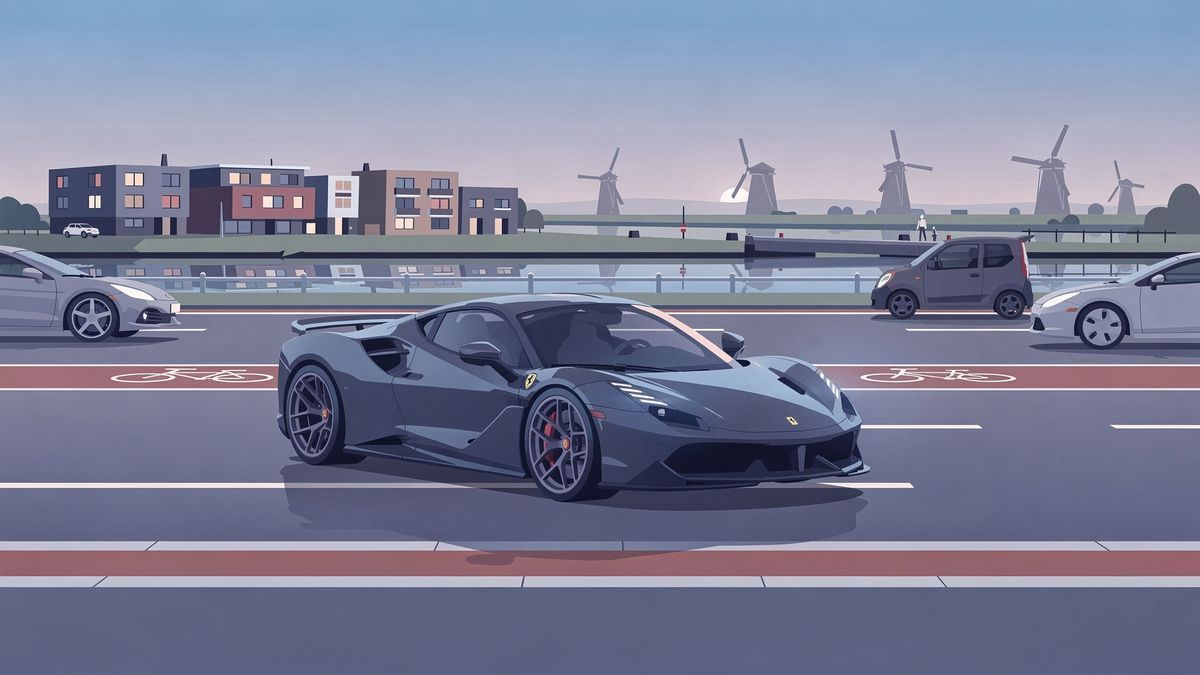
The Ferrari SF90 Stradale represents a milestone for the Prancing Horse as its first series-production plug-in hybrid electric vehicle and the current-generation flagship supercar, produced from 2019 to the present. This 2-passenger mid-engine sports car integrates a 4.0-liter twin-turbocharged V8 with three electric motors, forming a plug-in hybrid architecture that produces approximately 1,000 cv (~986 hp) and 800 Nm (590 lb-ft) of torque. The synergy between combustion and electric power enables a 0–100 km/h sprint in 2.5 seconds and a top speed of roughly 340 km/h (~211 mph), positioning the SF90 Stradale at the pinnacle of Ferrari’s road car lineup under WLTP passenger car classification.
Pricing reflects its exclusive positioning, with base MSRP ranging from approximately $507,000 to $593,950 USD depending on market and trim, while the track-focused SF90 XX Stradale commands secondary prices from $890,000 to over $1.6 million. The synthesis of performance, electrification, and exclusivity defines the SF90 Stradale, with on-road presence balanced by substantial operational costs and charging considerations that potential owners must carefully evaluate in real-world usage scenarios.
2. Introduction & Overview
The Ferrari SF90 Stradale marks a historic milestone for the Italian marque as its first series-production hybrid supercar, debuting in 2019 to commemorate the 90th anniversary of Ferrari’s foundation. The name “SF90 Stradale” integrates “SF” for Stradale Ferrari and “90” honoring this anniversary, while the vehicle is constructed on a mid-engine, rear-wheel-drive architecture adapted to accommodate sophisticated hybrid propulsion. The model family includes the standard coupe and Spider convertible, the performance-focused Assetto Fiorano trim, and the limited SF90 XX Stradale from Ferrari’s Special Series lineup.
In a quantitative analysis conducted by Car and Driver, the 2025 model achieved a score of 9.5 out of 10, reflecting its execution as a highly refined supercar within the current market. The SF90 Stradale has been overtaken by the Ferrari 849 Testarossa, which introduces a 1,050 cv combined output rating derived from the same 3,990 cc twin-turbo V8 unit supplemented by three electric motors. This succession highlights the model’s transitional significance, bridging traditional internal combustion performance with the electrified direction of the brand.
3. Powertrain & Hybrid Architecture
The SF90 Stradale integrates a 3,990 cc 4.0-liter twin-turbocharged V8 positioned in a rear-mid layout, producing roughly 769–780 horsepower on its own. This architecture feeds power to the rear wheels via an F1-derived 8-speed dual-clutch transmission, establishing the performance baseline before hybrid augmentation.
Complementing the V8, three electric motors add about 214 horsepower, with one front-axle unit enabling electric all-wheel drive and torque vectoring via Ferrari’s eSSC system. The remaining two motors sit between the engine and transmission, replacing a conventional torque converter for immediate thrust delivery. The hybrid package offers around 120 kW in pure electric drive, allowing low-speed eTravel, while the Spider specifies 162 kW from its electric motors.
Together, the internal combustion and electric systems yield approximately 986 horsepower in standard tune and 1,000 cv in Qualify mode, delivering seamless power and minimal turbo lag. Peak combined torque reaches 800 newton-meters at 6,000 rpm, blending contributions from both the ICE and electric motors. The eAWD layout and advanced torque vectoring enhance grip and cornering stability, while the 8-speed transmission ensures rapid shifts that balance responsiveness and efficiency.
WLTP testing indicates the coupe consumes 6.1 liters per 100 kilometers with 154 grams per kilometer of CO₂, and the Spider figures 6.9 liters with 156 grams per kilometer. The all-electric range is about 25 kilometers, with real-world owner observations indicating roughly 10–15 miles of practical zero-emission driving, consistent with its classification as a passenger car under test procedures.
4. Performance Capabilities
The SF90 Stradale’s performance credentials position it within the leading tier of production cars capable of remarkable speed. It achieves acceleration from 0 to 100 km/h in 2.5 seconds, with the 0 to 60 mph sprint requiring approximately 2.5 seconds, while the top speed reaches roughly 340 km/h (about 211 mph). These numbers underscore the manufacturer’s focus on pushing the boundaries of road-legal velocity.
The synergy between the robust V8 combustion engine and the integrated electric propulsion units creates a driving sensation distinct from traditional supercars. Instantaneous torque from the electric motors effectively neutralizes the delay inherent in conventional turbocharged powerplants, allowing the V8 to deliver its signature resonant exhaust note and progressive power curve without compromise. Furthermore, the all-wheel-drive architecture and sophisticated torque vectoring system channel this immense power to the ground with precision, enhancing grip and confidence-inspiring handling dynamics in diverse conditions.
An especially significant facet is the deployment of Qualify mode, which unlocks the total combined system output of 1,000 cv for a limited duration. By orchestrating the battery’s discharge strategy and recalibrating the internal combustion engine’s mapping, this function is intended to provide an extra margin of performance for demanding scenarios like circuit laps or decisive passing maneuvers on open roads.
5. Dimensions, Passenger Capacity & Practicality
5.1. Physical Dimensions
The SF90 Stradale is a large, wide supercar by any standard. Its dimensions are as follows: length of 4,710 mm, width of 1,972 mm, height of 1,186 mm, and a wheelbase of 2,650 mm. The car’s 2-meter width makes it one of the broadest production supercars on the market, which has practical implications for parking, garage fitting, and ease of ingress and egress.
5.2. Passenger Capacity
The SF90 Stradale seats exactly 2 passengers. The seating layout follows Ferrari’s traditional front mid-engine configuration, with the ICE positioned behind the cabin and the electric motors situated at the front axle. The seating layout is explicitly confirmed as a 2-passenger setup, and the vehicle is classified as a 2-door/2-passenger configuration.
5.3. Practicality & Daily Drivability
Despite its supercar credentials, the SF90 Stradale offers surprising practicality. The cabin is described as “surprisingly spacious and comfortable,” accommodating tall passengers — an unusual trait for a mid-engine supercar. The Spider variant’s retractable hard top contributes to exceptional occupant space, while the hybrid system enables electric-only driving for short urban commutes, adding everyday usability.
However, practical limitations exist. The SF90 has no front trunk, and cargo space is limited to the area behind the engine and seats. The car’s considerable width complicates ingress and egress, particularly with optional racing seats. As a daily driver, the SF90 provides electric-only capability and a luxurious interior, but owners report reliability concerns including battery failures, oil leaks, and steering module issues.
6. Pricing & Global MSRP Analysis
Pricing for the Ferrari SF90 Stradale reflects a complex matrix of variant, market jurisdiction, trim designation, optional equipment packages, and the new or pre-owned condition. Ferrari does not publish a single, authoritative global manufacturer’s suggested retail price on its own product pages, meaning these figures are aggregated from market data rather than direct from source [3]. The following table summarizes pricing data derived from multiple market analyses:
| Variant | MSRP / Price (USD) | Source |
|---|---|---|
| Coupe (base, CarBuzz listing) | $524,814 | CarBuzz [10] |
| Coupe (base, automonitor.io) | ~$507,000 | automonitor.io [6] |
| Spider (CarGurus MSRP) | $572,439 | CarGurus [19] |
| 2025 model (C&D) | $593,950 | Car and Driver [7][8] |
| SF90 XX Stradale (C&D) | from $890,000 | Car and Driver [8] |
| XX Spider (CarGurus MSRP) | $991,706 | CarGurus [19] |
| XX Stradale market value | $1.6M–$2.0M | hyper.luxe [14] |
| CPO (Ferrari Philadelphia) | $455,995–$459,995 | Ferrari Philadelphia [1] |
| Australian market (CarsGuide) | A$846,888 | CarsGuide [13] |
| India (ex-showroom) | ₹7.50 Crore (~$90,000 USD) | mycarjunction [11] |
| Resale / listing range (Exotics Wanted) | $507K–$525K base | Exotics Wanted [9] |
| Average market ask (used) | ~$467,000 | Tarva [18] |
| Used US market (Ferrari Approved) | $415,500–$509,900 | Ferrari Approved [3][19] |
| Used German market (Ferrari Approved) | €340,000–€550,000 | Ferrari Approved [10][7] |
MotorTrend describes the SF90 Stradale as Ferrari’s “most expensive model,” with pricing noted as “well over $500,000” [5]. Realistic transaction prices typically range $50,000 to $250,000 above the listed MSRP, varying by specific variant and prevailing market conditions [6]. The base MSRP underscores the model’s flagship status, and extensive optional packages can substantially increase the final price, as noted in market research [17].
6.1. Notable Discrepancies
Pronounced variances exist across different pricing sources. For instance, CarBuzz lists a base MSRP of $524,814, whereas Car and Driver records $593,950 for the 2025 model; this delta may stem from different model years, trim levels, or methodological variations between data collectors [7][10]. CarGuters provides the highest MSRP figures, with the Spider at $572,439 and the XX Spider at $991,706, likely reflecting fully optioned configurations or current-model-year positioning [19]. The India-specific figure of ₹7.50 Crore (approximately $90,000 USD) from mycarjunction is markedly lower than typical Western market prices and likely accounts for local taxation, import duties, or represents a different model year; its direct comparability to global pricing is uncertain [11].
On the secondary market, the SF90 XX Stradale commands a value between $1.6 million and $2.0 million, a premium driven by its extreme rarity and focused track-oriented specification [14]. Certified pre-owned offerings from Ferrari’s official dealer network provide access at more structured price points, spanning approximately $415,500 to $509,900 in the United States and €340,000 to €550,000 in Germany through authorized channels [3][10][19].
7. Spider Variant Specifications
The SF90 Spider presents a convertible interpretation of the flagship plug-in hybrid system, sharing the coupe’s core powertrain architecture while introducing a retractable hard top. This integration results in a supercar defined by passenger comfort and dynamic capability, combining a combined output of 1,000 cv (~986 hp) with an ICE contribution of 780 cv from the 4.0L twin-turbo V8 and electric motor output of 162 kW (~217 hp). Performance figures remain consistent with the coupe, achieving 0–100 km/h in 2.5 seconds, while WLTP data indicates fuel consumption of 6.9 liters per 100 kilometers and CO₂ emissions of 156 grams per kilometer, with an all-electric range of approximately 25 kilometers. The practical implications of the folding roof system are reflected in a slight efficiency decrease and a manufacturer’s suggested retail price of $572,439, demonstrating a balance between transformative design and high-performance execution.
8. Critical Reception & Analysis
The Ferrari SF90 Stradale has garnered extensive praise from prominent automotive publications, with each analysis underscoring its exceptional capabilities. Top Gear, Car and Driver, Evo Magazine, Road & Track, MotorTrend, Automobile Magazine, carsales.com.au, and Top Speed have all dedicated comprehensive analyses to this remarkable vehicle. Notably, Car and Driver awarded the 2025 model a rating of 9.5 out of 10, a testament to the SF90’s outstanding performance.
Top Speed provides a detailed breakdown of the SF90 Stradale, describing it as a 2020-model-year plug-in hybrid electric vehicle (PHEV) sportscar. With an approximate power output of 1,000 horsepower, a manufacturer’s suggested retail price (MSRP) around $524,000, and a qualifying mode for full output, the SF90 offers an unparalleled driving experience. Its all-wheel-drive (AWD) system, coupled with a near-rear-wheel-drive feel, ensures exceptional handling, while both coupe and Spider body styles cater to diverse preferences.
carsales.com.au, in their analysis, echoes the SF90’s status as a hybrid hypercar, confirming its approximate 1,000 horsepower output. Ferrari Lake Forest, an official dealer, elaborates on the car’s powertrain, comprising a twin-turbo V8 engine and electric motors, which combine to deliver instant electric torque and sustained V8 thrust. The dealership lists the SF90 in various trims, including coupe, Assetto Fiorano, Spider, and XX.
FerrariChat, a popular enthusiast forum, features owner reviews that praise the SF90’s 1,000 horsepower output and instant torque delivery. Owners also note the car’s substantial width, which, while providing a sense of occasion, can make ingress and egress somewhat challenging compared to other Ferrari models like the 296 GTB. The car feels larger and more special, adding to its allure.
thecarscompare.com offers a comprehensive research guide that further validates the SF90’s hybrid supercar status, confirming its 2-passenger seating configuration and flagship pricing. This extensive analysis from various sources underscores the SF90 Stradale’s position as a true standout in the world of high-performance sportscars.
9. Reddit Community Insights
Community discussion on digital platforms provides varied real-world observations regarding the SF90 Stradale. Specific conversations include analysis of the SF90 XX Stradale and Spyder reveal, while other threads detail ownership experiences with the standard model. Additional discussions compare the SF90 directly against the 296 GTB, and longitudinal updates confirm the vehicle’s standing over a two-year ownership period.
The hybrid powertrain is documented as producing approximately 1,000 hp, situating the car’s performance between a Porsche 911 Turbo and a Bugatti within the sportscar hierarchy. It carries a weight penalty of approximately 100 kg over the 296 GTB yet generates roughly 170 bhp more power, positioning it above the 488/F8 lineage in Ferrari’s hierarchy. The manufacturer’s suggested pricing is sub-$400,000, likely reflecting 2021 pricing or transaction figures below MSRP. The cabin is described as surprisingly spacious, comfortably accommodating tall passengers, which is uncommon for a mid-engine layout. The AWD drivetrain and hybrid system contribute to approachable handling, even during daily use. As a daily driver, the SF90 offers electric-only motoring and a luxurious interior, though ownership presents reliability concerns such as battery failures, oil leaks, and steering module issues.
10. Successor Context: The Ferrari 849 Testarossa
The all-new Ferrari 849 Testarossa has been revealed as the SF90 Stradale’s successor [2]. This next-generation model frames the evolution of Ferrari’s hybrid program, positioning the 849 as a significant step forward while maintaining continuity in its foundational powertrain philosophy. The progression illustrates a measured but impactful refinement in performance and efficiency metrics that define the current generation supercar.
Key comparisons between the two models highlight the evolutionary nature of Ferrari’s hybrid program. The 849 Testarossa produces 1,050 cv combined output, up from the SF90’s approximately 1,000 cv [2]. The ICE alone produces 830 cv with 842 N·m of torque, compared to the SF90’s approximately 769–780 hp and 800 Nm [2]. The electric motor contribution remains similar at approximately 220 cv [2]. Both cars share a dry weight of 1,570 kg [2]. The 849 accelerates from 0–100 km/h in under 2.3 seconds, improving upon the SF90’s 2.5 seconds [2]. Its top speed exceeds 330 km/h [2]. The 849 features a 7.45 kWh battery and an EV range of approximately 25 km [2]. Its European MSRP is listed at €460,000 [2]. The 849 Testarossa is positioned as a more powerful, lighter, and more efficient successor while retaining the same core 3,990 cc twin-turbo V8 architecture [2].
The performance delta between the 849 Testarossa and the SF90 Stradale reflects a focused effort to extract more from the established architecture without a fundamental redesign. Drivers experience a noticeable increase in acceleration and top-end capability, translating to a more visceral and urgent surge down the road and track. The retention of the core 3,990 cc twin-turbo V8 ensures that the mechanical symphony familiar to Ferrari enthusiasts remains largely intact, even as peak power figures climb. Practically, the modest increase in electric range and battery capacity suggests the engineering priority remains the combustion experience, with electrification serving primarily to augment immediate power delivery and assist efficiency during lower-speed maneuvers. The significant price and the substantial performance gains position the 849 as a halo machine, representing the pinnacle of the current V8 hybrid formula for those seeking the highest level of Italian performance.
11. Conclusion
The Ferrari SF90 Stradale represents a landmark moment in automotive history as Ferrari’s first series-production plug-in hybrid supercar and a flagship that delivers approximately 1,000 cv of combined output from a 4.0-liter twin-turbo V8 paired with three electric motors. Delivering a 0–100 km/h time of 2.5 seconds and a top speed of approximately 340 km/h, the SF90 Stradale positions itself at the peak of global sports car performance with its 2-passenger mid-engine layout.
Pricing spans from approximately $507,000 to $593,950 USD for the base coupe, with the Spider starting at $572,439 and the track-oriented XX variants commanding prices well above $890,000, reflecting the breadth of the lineup. The model has earned widespread critical acclaim, highlighted by accolades such as a 9.5/10 from Car and Driver for the 2025 model, and has resonated strongly with enthusiast communities for balancing hybrid performance, daily usability, and Ferrari heritage. Its legacy seamlessly transitions to the Ferrari 849 Testarossa, which inherits the same hybrid architecture while increasing output and efficiency, underscoring Ferrari’s commitment to electrified high-performance motoring.