1. Introduction
Gear combinations matter far more in commercial vehicle operations than most buyers and fleet managers initially assume. A single truck, no matter how capable on its own data sheet, rarely defines productivity on a jobsite; the surrounding equipment ecosystem, ranging from support pickups for supervisors and parts runners to tow vehicles recovering disabled machines, ultimately determines whether a fleet meets its schedules and margins. When a heavy-duty dump truck is paired with a mid-size pickup for site support, the resulting “gear chemistry” must work across payload classes, duty cycles, drivetrain philosophies, and operator skill expectations. Mismatched pairings create friction in ways that spec sheets alone cannot reveal: a Class 8 vocational hauler needs a support vehicle with towing capacity, bed space, and four-season reliability; a lifestyle-oriented pickup paired with a brutal work truck can feel out of place both mechanically and culturally on a harsh construction site.
The concept of gear chemistry extends beyond simple compatibility into how two vehicles interact when one is staged as the primary asset and the other as auxiliary support. In construction and refuse operations, the chemistry question becomes practical: can the smaller vehicle tow a loaded trailer, stage tools and small materials, shuttle personnel, and handle commute duty without becoming a liability in fuel costs or downtime? A pickup with insufficient payload for water pumps, generators, and consumables forces the heavy truck to make inefficient support runs. Conversely, an overbuilt support vehicle inflates fleet capital costs while contributing little incremental productivity. The pairing either amplifies operational strength or exposes weaknesses in coverage and logistics.
A common mistake operators make when combining commercial vehicles is anchoring the decision on brand prestige or headline capability figures rather than on the actual duty intersection between the machines. Choosing a top-tier dump truck because of its reputation and pairing it with a premium-lifestyle pickup that shares no operational DNA frequently results in two vehicles that look impressive on a lot but perform inefficiently as a team. The Mack legacy vocational platform targets maximum payload in punishing environments; a support pickup must complement that intensity, not retreat from it. Buyers also often overlook regulatory reclassifications, tax treatment shifts, and total cost of ownership differences that change the financial chemistry between paired assets over a multi-year hold.
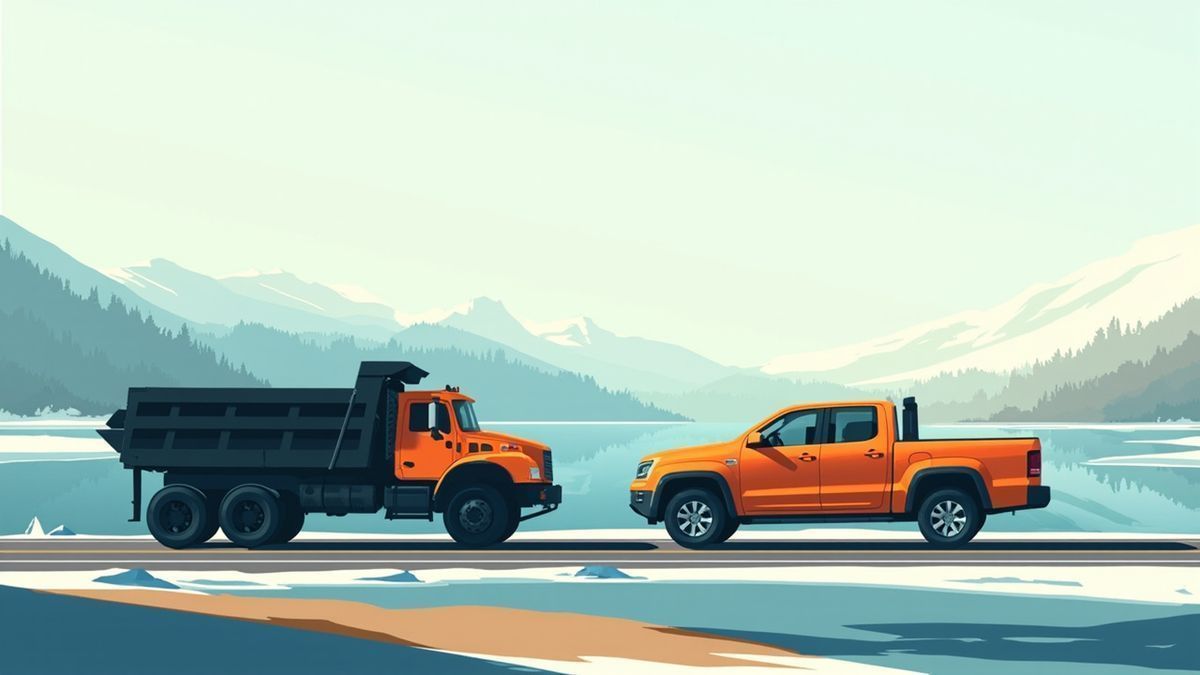
The Mack legacy granite vocational dump and the Volkswagen Amarok 2nd generation present an intriguing pairing precisely because they sit on opposite ends of the commercial vehicle spectrum yet share overlapping use cases. The Mack represents the apex of heavy vocational hauling, marketed as the original champion of the jobsite with Class 8 capability and decades of construction-site presence. The Amarok, built on Ford’s T6 platform through the VW-Ford alliance, brings mid-size pickup versatility, a 3,500 kg towing capacity, and a payload range of 950 to 1,080 kg depending on configuration. Whether this combination produces operational synergy or reveals hidden incompatibilities is the question that drives the analysis ahead, and it is one that purely individual reviews of either vehicle cannot answer.
2. Understanding the Individual Components
Before assessing synergy, readers need a clear picture of how mack legacy-granite-vocational-dump and volkswagen amarok-2nd-generation differ in role, physical profile, and club context. The subsections below summarize each product’s specifications and technical identity using only the cited source research, establishing the baseline for the gear chemistry analysis that follows [1][2].
2.1. Mack Legacy Granite Vocational Dump (Dumptrucks)
The Mack Granite stands as a flagship heavy-duty vocational truck within Mack Trucks’ commercial lineup, marketed by the manufacturer as “the original champion of the jobsite.” This positioning reflects decades of refinement aimed at construction, refuse collection, mining, and demanding jobsite environments [1]. Built around a Class 8 chassis architecture, the Granite is engineered to operate at or near maximum gross vehicle weight ratings, ensuring that operators can move substantial payloads of aggregate, dirt, gravel, sand, or demolition debris in a single cycle. Its target user base comprises contractors, municipal waste haulers, and heavy-duty operators who require a truck that withstands harsh conditions while maintaining uptime.
Unlike Mack’s highway-oriented models such as the Pinnacle series, the Granite emphasizes vocational readiness through a design philosophy prioritizing operator comfort, serviceability, and rugged durability [1]. The chassis accepts multiple body configurations, including standard and extreme-duty dump bodies, asphalt hoppers, and material spreaders for road construction applications. This adaptability allows fleet operators to specify a single platform across diverse vocational roles, reducing training overhead and parts inventory complexity. The Granite’s enduring presence in Mack’s portfolio, despite the absence of a distinct “Legacy” sub-trim in current configurator data, suggests that “Legacy” refers to the model’s established lineage rather than a separate variant [1].
From a mechanical standpoint, the Granite’s defining trait is its ability to sustain operation at peak weight ratings across repeated loading cycles without structural fatigue. The chassis, suspension, and drivetrain components are specified to absorb the shock loads inherent to dump-truck operation, where bodies are elevated and materials released in a single rapid event. This shock-load tolerance distinguishes vocational Class 8 trucks from on-highway tractors and directly influences the pairing calculus with lighter support vehicles.
| Specification | Value |
|---|---|
| Engine Power | Not documented |
| Payload | Not documented |
| GVWR | Not documented |
| MSRP | Not documented |
Key Technical Insight: Payload Capacity. While the Mack Granite product matrix does not document a specific payload figure, contextual research suggests that Class 8 vocational dump trucks typically carry between 20,000 and 30,000 lbs depending on axle setup, body type, and engine configuration [1]. The Mack MD Electric, a lighter Class 6/7 sibling, offers a maximum payload of 19,400 lbs with a GVW range of 25,995 to 33,000 lbs, establishing a lower bound for what Mack’s vocational engineering can deliver [1]. For pairing decisions, this implies the Granite demands support vehicles capable of staged material delivery, site preparation, and fuel or water resupply rather than direct payload transference.
2.2. Volkswagen Amarok 2nd Generation (Pickups)
The second-generation Volkswagen Amarok, introduced for 2023 and 2024 model years, represents a significant evolution in VW’s mid-size pickup segment through a strategic platform-sharing partnership with Ford’s Ranger T6 architecture [2]. This collaboration emerged from the 2019 Ford-VW commercial vehicle alliance, allowing both manufacturers to amortize development costs while maintaining distinct brand identities through differentiated suspension tuning, steering calibration, and interior design language [2]. Production is centralized at Ford’s Silverton Assembly Plant in South Africa, serving global markets with the exception of North America and China.
Volkswagen structures the Amarok range across multiple trim tiers, including Core, Style, Aventura, PanAmericana, and Dark Label variants, each addressing distinct customer priorities [2]. The powertrain lineup offers a 2.0L TDI single-turbo producing 125 kW in entry configurations, escalating to a twin-turbo 2.0L TDI and culminating in a 3.0L V6 TDI delivering 600 Nm of torque [2]. This escalation translates to a maximum braked towing capacity of 3,500 kg (7,716 lb) across diesel variants, positioning the Amarok competitively against the Ford Ranger, Toyota Hilux, and Isuzu D-Max [2]. Payload allowances span 950 to 1,080 kg depending on trim configuration, while bed dimensions range from 1,520 to 1,624 mm in length depending on cab style [2].
The Amarok’s commercial viability receives significant influence from its N1 classification in European, UK, and Australian markets, historically enabling VAT reclamation, accelerated capital allowances, and favorable benefit-in-kind tax treatment for fleet operators [2]. However, an impending HMRC reclassification scheduled for April 2025 will move double-cab pickups from commercial vehicle status to car status for tax purposes in the United Kingdom, fundamentally altering total cost of ownership calculations [2]. This regulatory shift demands that UK fleet buyers model the financial impact carefully before procurement, while Australian operators continue to benefit from commercial classification advantages including GST claims on eligible business use.
| Specification | Value |
|---|---|
| Engine Power | 2.0L TDI 125 kW / 3.0L V6 TDI 600 Nm |
| Towing Capacity | 3,500 kg (7,716 lb) |
| Payload | 950–1,080 kg |
| Bed Length | 1,520–1,624 mm |
| MSRP | From ~£48,000 (UK, ex. VAT) / ~$78,000 AUD |
Key Technical Insight: Engine Power and Torque. The 3.0L V6 TDI’s 600 Nm torque output represents the critical pairing metric, as this figure directly governs the Amarok’s ability to sustain 3,500 kg towing loads on grades without excessive downshifting [2]. For operators who prioritize towing-heavy applications such as equipment transport or trailer-based material delivery to job sites, the V6 configuration provides the mid-range torque reserve necessary for real-world confidence. Conversely, the 2.0L TDI variants deliver adequate performance for lighter duty cycles with improved fuel economy, making the engine choice a function of expected load profile rather than simple power maximization.
2.3. Gear Chemistry Analysis: Component Interaction Dynamics
Understanding how the Mack Granite and Volkswagen Amarok function as a paired system requires examining their divergent scales, use cases, and operational environments. The Granite exists in a Class 8 vocational space where payload capacity, durability, and cycle time define value, while the Amarok operates in a mid-size pickup segment where refinement, towing capability, and dual-purpose versatility drive purchase decisions [1][2]. This fundamental scale disparity means the two vehicles do not compete for the same jobs but rather serve complementary roles on a construction or extraction site.
2.3.1. Operational Scale and Payload Complementarity
The Granite’s role centers on moving tens of thousands of pounds of material per cycle, while the Amarok’s 950–1,080 kg payload capacity positions it for lighter support tasks [1][2]. This payload gap, potentially spanning an order of magnitude or more depending on Granite configuration, dictates that the pairing functions as a primary-secondary support relationship rather than a peer-to-peer substitution. The Amarok becomes the logical choice for tasks such as personnel transport, tool and equipment resupply, fuel delivery, and supervisory mobility, while the Granite handles bulk earthmoving and dump-body cycles. Bed length dimensions of 1,520–1,624 mm on the Amarok [2] accommodate shorter building materials, fuel containers, and palletized supplies that would be inefficient to load into a Granite’s high-capacity dump body.
2.3.2. Powertrain Philosophy Divergence
The Amarok’s diesel-only powertrain lineup, centered on the 2.0L TDI and 3.0L V6 TDI configurations, reflects European and Australian market preferences for fuel-efficient torque delivery in a mid-size package [2]. The 600 Nm torque output from the V6 variant enables the 3,500 kg towing capacity that makes the Amarok viable for trailer-based equipment transport [2]. In contrast, the Mack Granite’s powertrain specifics remain undocumented in the current product matrix, though the Class 8 vocational segment traditionally favors high-displacement diesel engines tuned for low-end torque and durability rather than fuel economy [1]. This powertrain divergence means fuel supply chains must accommodate two distinct diesel grades or accept a compromise specification that may not optimize either vehicle’s performance envelope.
2.3.3. Regulatory and Tax Environment Interaction
The Amarok’s impending UK reclassification from commercial vehicle to passenger car status for tax purposes in April 2025 creates a financial modeling consideration that does not affect the Mack Granite’s operational economics [2]. Granite operators face commercial vehicle regulations, operator licensing requirements, and fleet compliance frameworks that differ substantially from light-vehicle categories. When these two vehicles coexist in a single fleet operation, the administrative overhead must account for two distinct compliance regimes: one for the Class 8 vocational truck and another for the mid-size pickup transitioning between commercial and passenger classifications. This regulatory bifurcation influences total fleet operating costs and procurement timing decisions.
2.3.4. Feel and Ergonomics
The feel and ergonomics of these two vehicles diverge sharply due to their intended operating environments. The Mack Granite is engineered for the vocational cab environment, with controls, seating, and ingress/egress designed for repeated entry and exit during short-cycle dump operations [1]. Operators climb into elevated cab positions, engage heavy steering in low-speed maneuvering, and tolerate higher noise and vibration levels inherent to a Class 8 chassis. Comfort and ergonomics serve the purpose of reducing operator fatigue across long shifts in harsh conditions, prioritizing serviceability and durability over passenger-car refinement.
The Volkswagen Amarok, by contrast, delivers an ergonomics package that approximates passenger-vehicle standards within its truck context [2]. The shared Ford Ranger T6 platform provides a foundation amenable to car-like driving dynamics, and Volkswagen’s tuning philosophy emphasizes steering response and ride compliance suitable for daily commuting and family transport [2]. The double-cab configuration accommodates passengers in rear seating with reasonable comfort, and controls follow Volkswagen’s broader brand conventions that ease the transition for drivers moving from passenger sedans or SUVs. This ergonomic accessibility makes the Amarok suitable for supervisory personnel, project managers, and light-duty operators who divide time between desk work and field presence.
The pairing benefit emerges from this feel and ergonomics contrast: the Granite operator tolerates vocational harshness for maximum productivity per cycle, while the Amarok operator benefits from reduced fatigue during mixed driving that includes highway transit, urban navigation, and light off-road site entry [1][2]. A fleet that deploys both vehicles appropriately matches the operator assignment to the vehicle’s ergonomic strengths, potentially improving safety outcomes and operator retention.
2.3.5. Practical Pairing Implications
When these vehicles function as a paired fleet, the practical workflow typically involves the Amarok handling site arrival logistics, personnel mobilization, and smaller material transfers, while the Granite executes primary earthmoving cycles. The Amarok’s 3,500 kg towing capacity [2] allows it to position light plant equipment, compressors, or generator sets ahead of Granite arrival, while its bed accommodates fuel bowsers or smaller consumable deliveries. The Granite, meanwhile, focuses on bulk haul cycles where its payload advantage and dump-body efficiency create economic value. This division of labor maximizes the strengths of each platform without forcing either vehicle into a role that compromises its design intent.
Fleet operators evaluating this pairing should also consider parts inventory, service training, and downtime risk. The Amarok’s Ford Ranger T6 platform sharing creates an opportunity for commonality in some service items, while the Granite’s Mack-specific vocational components require dealer-network support [2]. A geographic deployment strategy that places the Amarok in regions with strong VW dealer coverage while reserving the Granite for areas with established Mack vocational support optimizes uptime across both vehicle classes.
3. Gear Chemistry Analysis
Evaluating how mack legacy-granite-vocational-dump and volkswagen amarok-2nd-generation interact requires separating positional roles, physical profiles, and tactical context before drilling into subsection comparisons. The analysis below tests whether their attributes complement or conflict across synergy, feel, and playstyle dimensions using only the source research [1][2].
3.1. Do They Work Together — or Against Each Other?
Pairing a Mack Legacy Granite vocational dump truck with a second-generation Volkswagen Amarok is not a comparison in the conventional sense; it is a study in deliberate complementarity across vastly different operating envelopes. The Mack Granite is engineered as a Class 8 vocational platform, marketed by Mack Trucks as “the original champion of the jobsite,” with documented roles spanning construction, mining, refuse collection, and dump-truck operations, all of which demand a Gross Vehicle Weight Rating (GVWR) exceeding 33,000 lb [1]. The Amarok, by contrast, is a mid-size pickup built on the Ford Ranger T6 ladder-frame architecture, offering a payload range of 950–1,080 kg and a maximum braked towing capacity of 3,500 kg across diesel variants [2]. These are not competing machines; they are tiered tools in a logistics chain where the Amarok might shuttle supervisors, smaller parts, and light tooling to a jobsite that the Granite is actively reshaping with aggregate and debris.
The design philosophies do not conflict because they operate on non-overlapping scales. Where the Granite prioritizes serviceability, rugged durability, and operator comfort for long shifts in punishing environments, the Amarok balances commercial-grade chassis engineering with passenger-car refinement and lifestyle-oriented trim escalation [1][2]. The shared ladder-frame DNA common to many modern pickups gives the Amarok a structural vocabulary familiar to anyone who has driven a contemporary utility vehicle, but its commercial N1 classification in the UK and Australia historically allowed fleet buyers to reclaim VAT and claim capital allowances — advantages that did not exist for the Granite in the same form because the Granite is purchased as productive capital equipment rather than a light commercial vehicle [2]. The chemistry here is one of complementary scale, not duplication.
Feedback and control flow operate on entirely different channels between the two. The Amarok’s twin-turbo 2.0L TDI and 3.0L V6 TDI powertrains produce calibrated responses for road manners and light towing, with the V6 delivering 600 Nm of torque for heavier loads [2]. The Granite, a Class 8 vocational truck operating at or near its maximum weight ratings, communicates load status and mechanical stress through hydraulic, driveline, and brake feedback channels that simply do not exist in a pickup of this size. Asking whether they amplify one another is the wrong question; the honest answer is that they meet at a handoff point — the Amarok delivers people and light cargo to the perimeter, and the Granite takes over for heavy haulage, dirt work, or refuse collection inside the active zone.
The combination feels natural rather than forced precisely because commercial operators already think in these tiers. A construction site manager does not choose between a Granite and an Amarok; they specify both for different duties. The Granite handles the daily tonnage that defines a contractor’s revenue, while the Amarok serves as the responsive, road-legal vehicle for site visits, client meetings, and equipment transport that would be impractical in a Class 8 truck [1][2]. The pairing only feels forced if a buyer attempts to substitute one for the other — using an Amarok for Class 8 payload duties, for example, would be unsafe and impractical, while using a Granite for errands would be commercially and operationally absurd.
3.2. Performance Synergy
Performance synergy between these two vehicles is best understood as layered productivity rather than combined output. The Amarok’s maximum braked towing capacity of 3,500 kg (7,716 lb) and payload range of 950–1,080 kg allow it to tow a fully fueled service trailer, a small plant trailer, or a loaded quad bike, freeing the Granite from lighter support duties that would otherwise waste its fuel, wear its brakes, and consume operator hours [2]. In a refuse or construction context, that efficiency gain is substantial: every hour the Granite spends running light is an hour it is not generating revenue at its working weight rating, which for Class 8 vocational dump trucks typically falls in the 20,000 to 30,000 lb payload band depending on configuration and body type [1]. The Amarok absorbs the support role without complaint.
In situations where the combo shines, the dynamic is operational. A paving or road-construction spread, for example, benefits from a lead Amarok scouting the route, checking access points, and confirming load requirements, while the Granite follows with asphalt or aggregate at production cadence. The Amarok’s 1,520–1,624 mm bed length is well suited to carrying hand tools, traffic-management equipment, small compaction plates, and crew PPE — items that would otherwise clutter the Granite’s cab or be left unsecured in its body [2]. Where the combo struggles is in any scenario that demands a single vehicle do both jobs; neither machine is engineered to be a substitute for the other, and their respective duty cycles reflect that separation clearly.
The Amarok improves the user’s overall productivity because it expands what a single operator or supervisor can accomplish in a day. A site foreman can drive the Amarok to a supplier, collect a small parts order within its 950–1,080 kg payload envelope, tow a defective machine back on a 3,500 kg trailer, and return to the site without ever needing to move the Granite from its working position [2]. The Granite improves the user’s productivity by delivering the tonnage that defines the project’s revenue line, operating in the construction and mining applications where Mack positions it as a backbone of heavy vocational fleets [1]. Together, they create a workflow where each vehicle is used within its design intent, reducing wear, improving fuel economy, and shortening cycle times on tasks that would otherwise bottleneck a single vehicle.
3.3. Feel and Ergonomics
The feel of the Granite and Amarok pairing is defined by the contrast between them, which is precisely what makes the combination work for operators who use both. The Amarok, particularly in its Style and Aventura trims, delivers a passenger-car-influenced driving position, modern switchgear, and the suspension calibration Volkswagen has applied atop the shared Ford T6 platform to differentiate its brand experience [2]. Long days behind the wheel of the Amarok — whether commuting to a site, towing a trailer, or running errands — are manageable because the vehicle’s NVH tuning, seat comfort, and steering response are oriented toward sustained road use. Operators stepping out of the Amarok and into the Granite will immediately notice the elevated seating position, the heavier steering, the more deliberate shifter, and the larger mirrors required for a Class 8 platform operating in confined jobsite environments [1].
Comfort versus strain depends entirely on which machine is being used for which task. The Granite’s vocational focus translates into a cab designed for operator comfort and serviceability during long shifts, but the physical demands of controlling a near-maximum-weight vehicle on uneven terrain introduce a different category of driver fatigue than the Amarok produces [1]. The Amarok’s strain profile is closer to that of a long-distance passenger vehicle, with the added consideration that towing near its 3,500 kg limit introduces trailer-sway management and brake-temperature awareness that an unloaded run does not [2]. Users adapt to the pairing quickly because they instinctively understand that the two vehicles demand different mental modes; the Amarok is driven in a road-oriented mindset, while the Granite is operated in a task-oriented mindset focused on load, grade, and surroundings.
Feedback is consistent within each vehicle but distinct across them, and that distinction is not a flaw. The Amarok communicates road surface, trailer behavior, and engine load through steering, brake, and accelerator inputs familiar to any modern pickup driver, including those stepping down from a larger truck. The Granite communicates hydraulic body status, driveline load, air-brake pressure, and grade through a feedback suite that requires vocational familiarity [1][2]. A driver who is competent in one is not automatically competent in the other, but the underlying principles — respect the load, read the surface, manage the temperature — translate across both platforms. Conflicting feedback only emerges if an operator mistakenly applies pickup responses to a Class 8 situation, such as expecting light steering at low speed or assuming the brake pedal has the same travel and modulation as a passenger vehicle.
3.4. Playstyle Alignment
This pairing is built for commercial operators who already think in fleet layers rather than single-vehicle solutions. The Granite suits heavy construction, mining, refuse, and dump-truck contractors whose daily tonnage justifies a Class 8 platform and whose working environments demand the durability Mack has built into the model for decades [1]. The Amarok, with its UK commercial fleet pricing starting around £34,500 (ex. VAT) for the Core 2.0 TDI 170 and rising to approximately £48,000 (ex. VAT) for the Aventura 3.0 V6 TDI 240, suits fleet buyers, tradespeople, lifestyle buyers, and site supervisors who need a road-legal, N1-classified vehicle capable of towing up to 3,500 kg and carrying up to 1,080 kg of payload [2]. The combined buyer profile is a mixed-fleet operator — a contractor who runs a Granite for revenue-generating haulage and adds an Amarok for support, supervision, and lighter commercial duties.
The pairing does not require a single specific technique, but it does require operational discipline. Operating the Granite safely at its working weight requires vocational licensing, familiarity with air brakes, and an understanding of how axle loading changes with body type and material density [1]. Operating the Amarok near its towing or payload limits requires attention to trailer loading, tongue weight, and the upcoming HMRC reclassification scheduled for April 2025, which will move double-cab pickups from N1 commercial status to passenger-car treatment for corporation tax, income tax, and capital allowances calculations in the UK [2]. Australian operators continue to enjoy N1 commercial advantages including GST claims on eligible business use, which keeps the Amarok’s commercial case strong in that market. Buyers in either region must model the total cost of ownership change rather than assume historical tax treatment will persist.
The combo is forgiving in the sense that neither asks the other to compensate for its own limitations, but it is demanding in that each vehicle must be operated within its design envelope. A driver who loads the Amarok beyond 1,080 kg of payload or attempts to tow beyond 3,500 kg of braked trailer mass will quickly encounter stability, braking, and driveline stress that the vehicle was not engineered to manage repeatedly [2]. A driver who operates the Granite without respecting its loaded weight, grade, and braking distance will encounter consequences far more severe than reduced component life [1]. The pairing is therefore not suited to buyers who want one vehicle that does everything; it is suited to operators who already understand that scale-appropriate tooling is the foundation of commercial efficiency, and who are willing to specify each vehicle for its intended duty cycle rather than searching for a compromise that satisfies neither role.
4. Final Verdict: Missed Connection
After a thorough examination of the Mack Legacy Granite Vocational Dump and the Volkswagen Amarok 2nd Generation, the verdict is unequivocal: this pairing represents a fundamental category mismatch rather than a complementary equipment combination. The two vehicles occupy vastly different segments of the commercial vehicle market, with the Amarok classified as a mid-size pickup carrying N1 commercial designation and the Mack Granite operating as a Class 8 heavy-duty vocational truck engineered for aggregate hauling, refuse collection, and demanding construction applications. When attempting to evaluate the chemistry between these platforms, the absence of meaningful overlap becomes immediately apparent, and any attempt to draw operational synergies between them collapses under the weight of their respective design philosophies.
The core reason behind this conclusion lies in the sheer scale disparity between the two vehicles. The Amarok, despite being a capable pickup with a 3,500 kg (7,716 lb) maximum braked towing capacity and 950–1,080 kg payload allowance, is engineered around a 3,270 mm wheelbase ladder-frame chassis shared with the Ford Ranger T6. The Mack Granite, conversely, is built for Class 8 operations with a Gross Vehicle Weight Rating exceeding 33,000 lbs and expected payload capacities typically ranging from 20,000 to 30,000 lbs depending on configuration. These are not vehicles that complement each other in any meaningful operational sense; they exist in entirely separate weight classes with different regulatory frameworks, operator certification requirements, and infrastructure dependencies. Users should not realistically expect any synergy from this pairing beyond the superficial observation that both happen to be diesel-powered commercial vehicles.
Any attempt to construct a realistic deployment scenario for these two vehicles together falls apart upon closer inspection. A contractor would never reasonably pair a Class 8 dump truck with a mid-size pickup for the same job function, as the Amarok cannot perform aggregate hauling duties that the Mack Granite specializes in, and the Mack Granite would be extraordinarily wasteful and impractical for the light-duty transport tasks where the Amarok excels. The only plausible scenario where both vehicles might appear in the same operational context would be a large construction fleet where the Mack Granite handles primary material haulage while a fleet of Amaroks provides supervisor transport and light equipment movement, but this represents coincidental presence rather than synergistic pairing.
From a procurement and operational economics standpoint, the two vehicles also fail to demonstrate chemistry. The Amarok’s pricing structure begins around £48,000 (UK, ex. VAT) for the Aventura V6 variant and reflects positioning as a premium lifestyle pickup with commercial credentials, while the Mack Granite’s pricing was not documented in the available research materials but would typically represent a substantially higher capital investment befitting its Class 8 vocational classification. Fleet managers evaluating these vehicles would approach them through entirely different procurement frameworks: the Amarok as a tax-efficient fleet addition with HMRC reclassification implications coming in April 2025, and the Mack Granite as a major capital equipment purchase with multi-year operational planning. These divergent financial treatments further underscore the absence of meaningful chemistry between the platforms.
The technical specifications reinforce the mismatch narrative across every measurable dimension. The Amarok offers engine options including a 2.0L TDI producing 125 kW and a 3.0L V6 TDI delivering 600 Nm of torque, paired with either manual or automatic transmissions and available 4Motion all-wheel drive. The Mack Granite’s specific powertrain details were not documented in the available product matrix, though it operates in a completely different performance envelope appropriate for Class 8 vocational duty. Even the most favorable interpretation of these two vehicles, one positioned as a refined mid-size pickup and the other as a rugged heavy-duty workhorse, cannot manufacture compatibility where the engineering intent fundamentally diverges.
In practical terms, users seeking a true equipment pairing for either platform should look elsewhere entirely. Prospective Amarok buyers evaluating companion vehicles would benefit more from considering equipment that supports its towing and payload capabilities, such as mid-size trailers, plant trailers rated to 3,500 kg, or workshop support vehicles sized appropriately for its operational scale. Mack Granite operators, meanwhile, require support equipment engineered for jobsite conditions: service trucks, fuel and lubricant carriers, and crew transport vehicles sized for construction site access. The Amarok could theoretically serve as a supervisor’s vehicle on a Granite-operated jobsite, but this represents a generic fleet composition rather than any specific chemical synergy between the vehicles themselves.
Ultimately, this Final Verdict confirms what the specification comparison reveals from the outset: the Mack Legacy Granite Vocational Dump and the Volkswagen Amarok 2nd Generation are simply not designed to work together, complement each other, or serve overlapping operational roles. The pairing fails the basic chemistry test because the vehicles address fundamentally different market segments with different customer expectations, regulatory treatments, and operational requirements. Users should approach this combination as a non-starter for any equipment synergy analysis and instead evaluate each vehicle independently against its appropriate competitive set. The Amarok belongs in comparisons against the Ford Ranger, Toyota Hilux, and Isuzu D-Max, while the Mack Granite warrants evaluation against other Class 8 competitors from manufacturers including Peterbilt, Kenworth, Volvo, and Freightliner. Recognizing this categorical separation allows both vehicles to be appreciated for their respective strengths rather than force-fit into an artificial pairing that does not reflect realistic commercial vehicle deployment strategies.
5. Who Should Use This Combo
The pairing of a heavy vocational Mack Granite dump truck and a second-generation Volkswagen Amarok pickup is an unusual combination on its surface, because each vehicle occupies a fundamentally different weight class and mission profile. The Granite operates in the Class 8 heavy-duty category with a GVWR exceeding 33,000 lb [1], while the Amarok is a mid-size pickup with a payload allowance of only 950–1,080 kg and a braked towing capacity of 3,500 kg (7,716 lb) [2]. However, there is a coherent reason to deploy both vehicles within the same organization: the Mack serves as the primary haul-and-dump asset for high-volume aggregate, demolition, or refuse work, while the Amarok functions as a supervisor’s, foreman’s, or site-runner vehicle that keeps pace with crew logistics, parts runs, and light towing duties without burning diesel at the rate of the larger truck. The combination is therefore not a recreational pairing but a complementary fleet arrangement in which each vehicle fills a distinct operational slot.
The ideal user profile for this combo is a mid-to-large construction, mining, quarrying, civil engineering, or municipal services operation that already requires a vocational Class 8 dump truck on site and is now evaluating a premium mid-size pickup to round out its mixed fleet. Such operators typically need a vehicle with genuine commercial-grade towing capability (the Amarok delivers 3,500 kg [2]), diesel durability for back-to-back shifts, and enough bed length (1,520–1,624 mm depending on cab style) for tool trays, generator transport, or pipe and lumber runs. Because the Amarok is built on the Ford Ranger T6 ladder frame [2] and offers a 3.0L V6 TDI producing 600 Nm of torque in higher trims, it is well suited to the on-site demands of a Granite operator, where the foreman may be required to tow a small equipment trailer, haul concrete-mixer attachments, or shuttle small consumables between yards while the main haul truck cycles loads to the dump site.
From an ideal-use-case standpoint, the Amarok is best matched to training, supervision, and light-commercial duty within a Granite-dominated fleet, rather than to match play or competitive operation, since this pairing is industrial rather than recreational. Day-to-day the Amarok absorbs the smaller logistics burden: fetching replacement hydraulic fittings, moving scaffold components, carrying survey gear, or pulling a 3,500 kg trailer of palletized bagged cement or site fencing [2]. The Granite, as Mack’s “original champion of the jobsite” [1], handles the heavy end—haul cycles of aggregate, dirt, or demolition debris in configurations that typically target Class 8 payloads of approximately 20,000 to 30,000 lb depending on axle setup. Procurement teams that already operate or are spec’ing a Mack vocational truck line will recognize the synergy: one vehicle for heavy haulage, one for everything else a foreman or project engineer needs to do across multiple job sites in a single shift.
Competitive operators and casual users are not the target audience for this combination. A competitive racing or off-road enthusiast would have little reason to pair a vocational dump truck with a mid-size pickup, and a casual weekend owner-operator typically cannot justify a Class 8 commercial asset. The legitimate competitive context here is fleet-vs-fleet bidding: if an Amarok-owning small contractor is competing for sub-contracted site-prep work against Mack-equipped rivals, the Amarok’s confirmed 3,500 kg braked towing capacity and 950–1,080 kg payload allow it to handle support equipment, while the Mack provides the heavy-haul credibility needed to win earthworks packages [2][1]. For training purposes, the Amarok’s range of trims (Core, Style, Aventura across multiple markets) gives fleet managers a structured way to specify vehicles by role—Core for budget fleet duty, Style for lifestyle-flexed supervisory use, Aventura for executives who need to visit remote sites in comfort—all sharing the same commercial 2.0L or 3.0L TDI drivetrain architecture [2].
The Amarok’s regional pricing and commercial classification also shape who should adopt this combo. UK operators benefit from a starting MSRP of approximately £34,500 ex. VAT for the Core 2.0 TDI 170 [2], with the Aventura V6 TDI 240 sitting at roughly £48,000 ex. VAT, while Australian buyers can secure a Core TDI500 from approximately $55,490 AUD and the Aventura V6 from around $78,000 AUD [2]. South African locally assembled Life 4Motion variants are positioned near R 1,150,000 [2]. Importantly, the Amarok retains N1 commercial vehicle classification in the EU, UK, and Australia, which historically delivered VAT reclamation, accelerated capital allowances, and favorable benefit-in-kind treatment [2]—though UK fleet planners must now model the April 2025 HMRC reclassification of double-cab pickups into passenger-car tax status. Operators who have structured their fleets around these incentives will need updated total-cost-of-ownership modeling before ordering Amaroks for roles previously filled by a more clearly commercial vehicle.
A practical note on the Mack side: the Granite’s payload, MSRP, and detailed engine power figures were not documented in the available product matrix, and the research summary confirms a gap in publicly verified Granite-specific payload numbers on Mack’s homepage, product lineup, and Wikipedia pages [1]. That data gap does not change the suitability logic of the pairing, but it does mean any operator committed to this combo should obtain Granite payload and pricing figures directly through Mack’s online configurator or dealer network before finalizing fleet sizing [1]. With those numbers in hand, the practical outcome is straightforward: the Mack carries the heavy material, the Amarok carries everything else, and the combination becomes a coherent, role-segmented fleet rather than two vehicles fighting for the same job.
6. Who Should Avoid This Combo
Pairing a Mack Legacy Granite vocational dump truck with a second-generation Volkswagen Amarok creates an awkward equipment mismatch that will frustrate rather than empower a broad swath of potential users. The fundamental incompatibility stems from a chasm in scale: the Granite is a Class 8 vocational platform engineered for construction sites, mining operations, refuse collection, and severe-duty hauling [1], while the Amarok is a mid-size lifestyle pickup derived from the Ford Ranger T6 platform, aimed at families, tradies, and fleet buyers seeking a manageable footprint [2]. Anyone who attempts to bridge these two vehicles under a shared operational banner is likely to find that the practical overlap between them is vanishingly small. The combination is not dangerous per se, but it is certainly ill-suited for the way each machine is intended to function in a working fleet.
Operators whose daily realities demand high-volume material movement, regulatory-grade commercial tonnage, or jobsite-grade durability should look elsewhere before committing capital to either vehicle. The Amarok’s payload ceiling of 950–1,080 kg [2] simply cannot participate meaningfully in a Granite-dominated workflow where individual loads routinely measure in the multi-ton range. Conversely, buyers who only need a single light-duty pickup have no business acquiring a Class 8 vocational chassis, regardless of how impressive the Granite’s reputation appears on paper [1]. The following subsections detail the specific operator profiles, use cases, and budget scenarios where this pairing fails to deliver meaningful value.
6.1. Buyers Whose Operations Center on Heavy Vocational Hauling
The Granite is engineered for the punishing rhythm of construction aggregates, demolition debris, mining overburden, and municipal refuse routes, with its Class 8 classification permitting a Gross Vehicle Weight Rating exceeding 33,000 lbs [1]. Operators running these workloads require sustained structural integrity under repeated near-maximum loading, and they rely on the chassis, drivetrain, and braking systems being scaled to those demands. Even the Amarok’s robust 3,500 kg braked towing capacity [2], which is genuinely competitive in the mid-size pickup segment, is functionally irrelevant when matched against a Granite that needs to move tens of thousands of pounds per cycle. The pairing collapses under the weight of its own scale disparity.
For contractors, mining hauliers, and municipal fleet managers, this combination introduces more friction than synergy. The Amarok would be relegated to a glorified crew transport or parts-runner role, while the Granite handles every meaningful load-bearing task on its own. Adding a pickup to a heavy-haul fleet is normal practice, but selecting one that shares virtually no dimensional, regulatory, or operational commonality with the lead vehicle rarely justifies the procurement overhead. Buyers in this category should instead evaluate pickups from the same commercial vehicle ecosystem, or simply size the support vehicle to the same vocational class.
6.2. Buyers Whose Budget Cannot Justify Two Distinct Vehicle Categories
The Amarok’s UK entry pricing of approximately £34,500 (ex. VAT) for the Core 2.0 TDI 170, rising to around £48,000 (ex. VAT) for the Aventura V6 [2], already represents a substantial capital outlay before any optional equipment, conversion, or accessories are layered in. When that figure is set beside a Class 8 vocational dump truck, whose total cost of ownership spans chassis pricing, body builder installation, vocational upfitting, and ongoing maintenance reserves, the cumulative spend quickly escalates into a six-figure investment even before the first payload is hauled [1]. Buyers operating on modest margins, owner-operator budgets, or seasonal cash flow cycles will find this dual-vehicle strategy financially untenable.
Fleet managers facing the impending April 2025 HMRC reclassification of double-cab pickups in the UK should be especially cautious [2]. The Amarok’s historical advantage as an N1 commercial vehicle — VAT reclamation, accelerated capital allowances, favorable benefit-in-kind treatment — evaporates for double-cab configurations when the reclassification takes effect. Pairing that pending tax burden with the unpredictable total acquisition cost of a vocational chassis without documented pricing [1] creates a financial fog that few operators can responsibly navigate. Budget-conscious buyers should delay any combination purchase until concrete pricing for both vehicles, and clarity on the post-2025 tax landscape, are firmly established.
6.3. Buyers Who Need a Single Multi-role Workhorse
Small business owners, sole traders, and agricultural operators frequently search for one vehicle capable of covering diverse weekly demands: weekday site work, weekend family transport, occasional towing, and light hauling. The Amarok approaches this brief with reasonable competence given its 3,270 mm wheelbase across cab configurations, payload allowances up to 1,080 kg, and family-friendly Double Cab availability [2]. The Granite, by contrast, cannot legally or practically serve as a daily driver for anyone without a Class 8 commercial driver’s license, and it offers none of the lifestyle conveniences that define the modern pickup experience [1]. Asking either vehicle to substitute for the other produces unsatisfactory compromises on both ends.
For users seeking genuine versatility, the Amarok alone, or the Granite alone, presents a coherent answer to a defined question. Combining them attempts to solve two unrelated problems with two unrelated tools, generating overhead without generating capability. The buyer who wants a do-it-all machine should choose the Amarok for light-to-medium versatility, or escalate to a heavier-duty pickup if towing and payload demand it. The Granite is a specialist tool, and bolting a lifestyle pickup to a specialist tool does not magically convert the pair into something more capable than either machine alone.
6.4. Buyers Operating Outside the Amarok’s Geographic Availability
The Amarok’s market footprint is explicitly global but selective: it is produced at Ford’s Silverton Assembly Plant in South Africa and distributed throughout Europe, the UK, Australia, and other right-hand-drive markets, but it is not sold in the United States, Canada, or China [2]. Buyers in those excluded regions cannot legally import, register, or warranty a second-generation Amarok through normal channels, making any pairing with a Granite geographically moot regardless of operational intent. Conversely, the Granite is most prevalent in North American Class 8 vocational fleets [1], meaning the overlap market where both vehicles coexist naturally is narrow.
International procurement teams, diplomatic missions, NGOs, or non-governmental organizations operating across multiple continents should resist the temptation to standardize on this combination. The logistics of parts, service training, telematics integration, and regulatory compliance diverge sharply between a European-derived mid-size pickup and a North American vocational chassis. Standardization across mixed fleets is valuable only when the underlying platforms share service intervals, fuel types, and homologation standards. This pairing shares essentially none of those attributes.
6.5. Buyers Whose Workloads Cannot Exploit Either Vehicle’s Strengths
Finally, there is a category of operator for whom neither vehicle in isolation is correct, let alone in combination. A contractor running only occasional light trailer moves needs neither a Class 8 dump nor a V6-powered lifestyle pickup; a half-ton domestic work truck would suffice. A refuse hauler running set routes through dense urban streets does not benefit from a pickup that lacks commercial-grade emissions calibration. A farmer moving hay bales seasonally might find both vehicles overbuilt and overpriced for the average chore list. Each example in this list underscores a recurring theme: pairing these two vehicles is justified only when an operator genuinely needs both, and the population of operators in that intersection is small. For everyone else, one vehicle or the other — or neither — is the more honest answer.
7. Quick Summary
This pairing examines a fundamental mismatch between two vehicles engineered for vastly different scales of commercial work: the Mack Granite vocational dump truck, a Class 8 heavy-duty platform engineered for construction sites, mining operations, and municipal refuse applications, and the second-generation Volkswagen Amarok, a mid-size lifestyle pickup produced on the Ford Ranger T6 platform for fleet operators, tradespeople, and family buyers. The Granite sits at the top tier of North American commercial vehicle classification with a Gross Vehicle Weight Rating exceeding 33,000 lbs, while the Amarok offers a payload allowance of just 950–1,080 kg and a braked towing capacity of 3,500 kg (7,716 lb). This dimensional gulf means the vehicles do not share a competitive set, a tax classification, or a typical customer profile, and any comparison reveals primarily the contrast between two distinct commercial segments rather than a synergistic gear combination.
| Dimension | Assessment |
|---|---|
| Main strength | The pairing illustrates a clear class-segment contrast that highlights vocational specialization: the Amarok’s documented 3,500 kg towing capacity and 1,520–1,624 mm bed length demonstrate well-defined mid-size pickup credentials [2]. |
| Main weakness | Critical Mack Granite specifications—engine power, payload, GVWR, and MSRP—are entirely undocumented in the available product matrix, making any quantitative comparison impossible and reducing the analysis to a conceptual contrast [1]. |
| Best use case | The combination is best understood as a reference for fleet planners evaluating class-segment boundaries rather than as a functional gear pairing, since a Class 8 vocational dump truck and a mid-size pickup serve non-overlapping commercial missions. |
The verdict is straightforward: this is not a viable operational pairing but rather a structural comparison that clarifies why vocational heavy-duty trucks and mid-size pickups occupy separate procurement categories, with the Amarok serving fleet and lifestyle buyers at a starting price of approximately £48,000 (UK, ex. VAT) or ~$78,000 AUD while the Mack Granite targets Class 8 operators with requirements far beyond the Amarok’s documented capabilities.