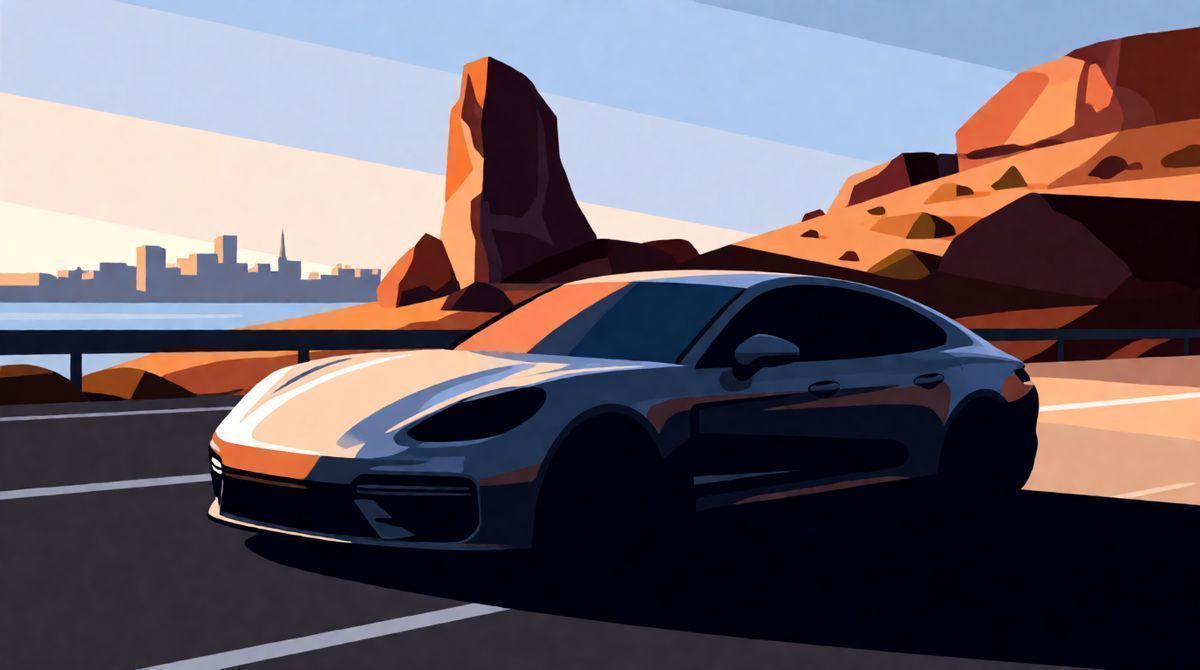
1. Executive Summary
The 2024 Porsche Panamera, a testament to Porsche’s engineering prowess, is the third iteration of the German automaker’s four-door luxury sports sedan. Built on the 972 chassis for its base gasoline variant, the Panamera has consistently challenged conventional categorizations since its introduction in 2009. Offered in seven distinct variants, the 2024 Panamera spans from the rear-wheel-drive base model to the range-topping Turbo S E-Hybrid. Power outputs vary significantly, from 348 horsepower in the entry-level model to a staggering 771 horsepower in the flagship, with 0–60 mph times ranging from a leisurely 5.0 seconds to an astonishing 2.8 seconds. The model is available in gasoline, plug-in hybrid, and full hybrid (Turbo E-Hybrid) configurations, with the latter carrying the separate 976 chassis code. Seating capacity is officially four, but an optional fifth center rear seat can be added, creating a ‘4+1’ layout that balances the Panamera’s sports car dynamics with unexpected practicality. Pricing in the United States ranges from approximately $99,900 for the base model to $245,200 for the Turbo S E-Hybrid, with global market variations pushing Australian prices above A$450,000 for the range-topping variants. This report draws from official Porsche sources, major automotive publications, owner forums, and market analysts to provide a comprehensive analysis of the 2024 Panamera’s specifications, performance, fuel economy, pricing, and passenger credentials.
2. Overview and Model Context
The 2024 Porsche Panamera, a third-generation model, is a unique proposition in the automotive world. It seamlessly blends the dynamics of a sports car with the practicality of a luxury sedan and the versatility of a family vehicle. Porsche categorizes it as a ‘sporting luxury sedan,’ a term that encapsulates its dual nature: it handles like a sports car but offers the space and comfort of a four-door sedan with a sleek, fastback profile.
Technically, the Panamera is a five-door vehicle, featuring four conventional doors and a rear hatch for cargo access. However, it is predominantly marketed and perceived as a sedan. This dual identity sparks interesting debates among automotive publications. Car and Driver and FastestLaps classify it as a ‘4-door hatchback,’ while CarExpert labels it a ‘5-door hatchback.’ Despite these technical classifications, the Panamera’s silhouette is undeniably that of a fastback sedan, with a coupe-like roofline that tapers elegantly towards the rear.
The 2024 Panamera lineup consists of Gasoline, Plug-in Hybrid, and full Hybrid (Turbo E-Hybrid) configurations. Porsche’s global narrative confirms international sales with market-specific pricing and configurations. In the U.S., the 2024 Panamera spans seven variants, from the base rear-wheel-drive gasoline model to the range-topping Turbo S E-Hybrid, as per the official Porsche USA page. The Panamera GTS variant, with its 493 horsepower and $154,200 MSRP, is well-documented and confirmed on carsales.com.au.
3. Body Style and Passenger Capacity
The Panamera is fundamentally a four-seat luxury sports sedan, though this fact sometimes surprises buyers who expect a traditional five-passenger sedan. The predominant sources consistently describe the Panamera as a four-passenger vehicle, emphasizing its engineering priorities: the rear seats are designed for two passengers comfortably, with generous legroom and headroom. The optional center rear seat is a tight, occasional-use position rather than a full-size passenger position — it is premier suited for short trips or children rather than adults on long journeys.
This seating philosophy reflects the Panamera’s deliberate design choice, which Porsche has emphasized since the first generation. The rear passenger accommodation is among the premier in its class, a testament to the manufacturer’s focus on passenger comfort. The Carbuyer UK analysis provides additional detail on rear seat comfort and legroom, noting that the Executive model offers an extended wheelbase for improved rear passenger space. This extended-wheelbase Executive variant is particularly relevant for buyers who prioritize rear passenger comfort, as the additional legroom can make the rear seats genuinely usable for adults on longer trips.
3.1. Seating Configuration
The Panamera’s seating configuration is a four-passenger layout, with a five-passenger option available as an extra-cost feature. The official Porsche narrative confirms a “4+1” seating layout with the optional center seat. This configuration is designed to provide ample legroom and headroom for rear passengers, making the Panamera a comfortable option for those who prioritize passenger comfort.
3.2. Passenger Dimensions and Comfort
The 2024 Panamera’s dimensional data includes passenger volume, headroom, and legroom for front and rear rows, with no third-row seating. Detailed front and rear passenger space measurements are available through iSeeCars and Automobile Dimension databases. What is clear from the qualitative assessments is that the Panamera’s rear passenger accommodation is among the premier in its class, a deliberate design choice that Porsche has emphasized since the first generation. The Car Enthusiast first-drive analysis of the Panamera, Panamera 4, and Turbo E-Hybrid provides additional qualitative assessment of front and rear passenger experience.
3.3. Cargo Space and Practicality
Behind the rear seats, cargo volume is 17.4 cubic feet (approximately 494 liters), expanding to 46.8 cubic feet (approximately 1,328 liters) with the rear seats folded. The Carbuyer UK analysis corroborates these figures, listing boot capacity at 494 liters up to 1,328 liters with seats folded. This cargo capacity is remarkably practical for a vehicle of the Panamera’s size and character — it can easily accommodate multiple large suitcases, grocery runs, or weekend luggage for four passengers. The Panamera is also capable of towing up to 2,200 kg (approximately 4,850 lbs) for petrol models, according to Carbuyer UK. This towing capacity, while not class-leading, is noteworthy for a vehicle of this type and opens up use cases beyond pure passenger transport.
3.4. Reddit Perspectives on Passenger Practicality
Reddit discussions provide valuable real-world owner perspectives on the Panamera’s passenger capabilities. A Reddit discussion in r/Porsche confirms the Panamera provides sufficient rear seating for passengers and practical cargo room for family errands such as Costco grocery hauls, though no dedicated coupe model exists. A Reddit thread in r/cars notes the 2024 Panamera 972 was designed with rear passenger comfort in mind — reportedly at the request of a tall CEO — and confirms the Sport Turismo shooting brake variant is also available. The consensus across these Reddit discussions is that the Panamera is surprisingly practical for a sports car — it can genuinely serve as a family vehicle, though its four-seat configuration means it is not a seven-passenger option.
4. Engine Power and Performance
The 2024 Porsche Panamera’s powertrain spectrum is nothing short of remarkable, catering to a wide range of customer preferences. MotorTrend reports that the 2024 Panamera’s engine power spans from 348 horsepower (base) to a staggering 670 horsepower (Turbo E-Hybrid) across its trims [9]. Porsche’s official U.S. website confirms this range, extending from 348 horsepower to an astonishing 771 horsepower (Turbo S E-Hybrid), with 0–60 mph times varying from 5.0 seconds to a blistering 2.8 seconds [10]. The Porsche Newsroom offers comprehensive data for all six 2024/2025 Panamera variants, including torque figures and driving performance benchmarks (0–100 km/h and top speed) for each configuration [7].
4.1. Detailed Powertrain Breakdown
The entry-level 2024 Panamera (972 chassis) is propelled by a 2.9-liter twin-turbocharged V-6 engine, generating 348 horsepower and accelerating from 0–60 mph in approximately 5.0 seconds [2][6][10]. This represents a significant upgrade over its predecessor, positioning the base Panamera as a genuinely swift sedan. The 353 PS figure from a European-market source aligns with the 348 hp figure, as the two measurements are directly convertible (1 hp ≈ 1.014 PS) [6].
The Panamera 4 E-Hybrid pairs the same 2.9-liter twin-turbo V-6 with an electric motor, combining for 463 horsepower [10]. The 4S E-Hybrid further amplifies output to 536 horsepower and 553 lb-ft of torque, with the electric motor contributing significantly to both straight-line performance and efficiency [8]. Impressively, the 4S E-Hybrid achieves 28 mpg US highway and 54 MPGe combined fuel economy [8].
The Panamera GTS occupies a sweet spot in the lineup, employing a higher-tuned version of the 2.9-liter twin-turbo V-6 to produce 493 horsepower. With a $154,200 MSRP, the GTS offers a compelling blend of performance and value within the Panamera family [19]. Australian market data confirms the GTS variant’s specifications and pricing [18].
Crowning the range, the Turbo E-Hybrid (976 chassis) harnesses a 4.0-liter twin-turbocharged V-8 paired with an electric motor, generating 680 PS (approximately 671 hp). It rockets from 0–60 mph in approximately 3.0 seconds and reaches a top speed of 196 mph [2][9]. The Turbo S E-Hybrid pushes output to an astounding 771 horsepower, achieving a 0–60 mph time of approximately 2.8 seconds — cementing its status as one of the world’s fastest four-door sedans [10]. All models utilize an 8-speed automatic transmission [7][8].
4.2. Performance Analysis
The Panamera’s performance spread is nothing short of extraordinary. The gap between the base model and the Turbo S E-Hybrid is not merely incremental but represents a fundamental shift in driving character. The base 972 model is a swift luxury sedan, while the Turbo S E-Hybrid is a supercar in disguise, offering unparalleled performance for a four-door family car. This range allows Porsche to target buyers with diverse priorities and budgets within a single model line.
Porsche Newsroom data confirms the Panamera’s performance credentials across the lineup, with driving performance benchmarks (0–100 km/h times and top speeds) for each variant [7]. The 4S E-Hybrid’s 536 hp output and 54 MPGe combined rating stand out as a particularly compelling combination, delivering sports car performance with hybrid efficiency [8].
5. Fuel Economy
Fuel economy varies significantly across the Porsche Panamera’s powertrain range, with hybrid variants offering standout efficiency for high-performance vehicles. According to MotorTrend, gasoline models achieve approximately 18 mpg city and 24 mpg highway. The base 2.9L V-6 gasoline model is rated at around 20 MPG combined, while hybrid variants achieve approximately 22 MPG combined. The 4S E-Hybrid leads the pack with 28 mpg US highway and 54 MPGe combined, figures that rival much smaller, less powerful vehicles. MotorTrend reports hybrid variants achieving up to 52 mpg-e in combined driving. In metric terms, fuel consumption ranges from 3.8 liters per 100 km (most efficient hybrid) to 12.4 liters per 100 km (less efficient configurations).
While specific WLTP fuel economy figures for the Australian market were not fully extracted, carsales.com.au provides data for the GTS variant. EPA data for the 2024 Panamera 2.9L 6-cylinder is tracked on FuelEconomy.gov, but the combined MPG figure was listed as ‘Not Available’ at the time of data extraction. This is not uncommon for newly launched model years, and updated ratings are expected as testing data becomes available.
The Panamera’s fuel economy data underscores a key advantage of its hybrid powertrains. They deliver performance figures that would be enviable in a pure sports car while achieving fuel economy competitive with much less powerful vehicles. For buyers prioritizing both performance and efficiency, the hybrid variants represent the optimal choice.
6. Global Price and MSRP
The 2024 Porsche Panamera, a luxurious and high-performing passenger coupe, commands a significant price range that varies based on market, configuration, and trim level. Let’s delve into the pricing landscape, starting with the official Porsche USA page, which serves as the most authoritative source. Here, the base rear-wheel-drive gasoline model is priced at $113,000, while the range-topping Turbo S E-Hybrid flagship starts at $245,200. This wide pricing spectrum of $113,000 to $245,200 represents the official manufacturer’s suggested retail price (MSRP) for the United States market, encompassing all seven variants.
Other sources offer varying price ranges that reflect differences in trim levels, standard equipment packages, and whether destination fees or dealer markup are included. U.S. News lists the starting price at $99,900, while Car and Driver reports a range of $101,550 to $108,550 across trims. MotorTrend lists a range of $115,350 to $169,250, and FastestLaps cites $128,795 to $153,400 for the 4S E-Hybrid variant. A discussion on the Reddit r/cars forum mentions a $100,000 base MSRP for the 972 generation, aligning with the U.S. News figure.
Porsche’s global narrative confirms that the Panamera is sold internationally with market-specific pricing. The official Porsche global page lists prices ranging from $110,100 (US) to CNY 1,138,000 (China), demonstrating significant international price variation driven by local taxes, tariffs, and market positioning. In Australia, CarExpert provides pricing of A$217,518 to A$455,813 across all variants, reflecting right-hand-drive market adjustments and local taxes. The carsales.com.au website offers GTS-specific pricing, and the Renndriver GTS guide confirms a $154,200 launch MSRP for the GTS variant.
The discrepancy across sources is likely due to differences in trim levels (such as Panamera, Panamera 4, GTS, and Turbo S E-Hybrid), standard equipment packages, and whether destination fees or dealer markup are included. No comprehensive worldwide MSRP comparison across all markets was found in the available sources; pricing data is primarily US-, China-, and Australia-centric. The CarExpert Australian pricing reflects right-hand-drive market adjustments and local taxes, which typically add significant cost compared to left-hand-drive markets.
7. Coupe Clarification
The Porsche Panamera prompts consistent classification questions, particularly regarding its coupe designation. The vehicle is not positioned as a traditional coupe but is routinely described as embodying a “coupe-like body” [6] with a “sports car” character [6]. It is fundamentally a four-door (five-door) sedan featuring a fastback roofline that merges sedan practicality with coupe-inspired aesthetics, and no distinct “Panamera Coupe” variant exists within the 2024 model range.
Car and Driver explicitly categorizes the Panamera as a “4-passenger, 4-door hatchback” [9], while CarExpert labels it a “5-door hatchback” [4]. The BMW M8 Gran Coupe frequently serves as a competitor within the large luxury coupe or gran Coupe segment [5], even though Porsche and major automotive outlets maintain the sedan/hatchback classification. This competitor, the BMW M8 Gran Coupe, is developed to challenge large family coupes such as the Audi RS7 and Porsche Panamera [22].
Community conversations on forums also frame the Panamera as a sports sedan instead of a coupe [7][9][15]. The fastback silhouette and coupe-like proportions deliver a distinctly sporting visual presence, yet the four-door layout and hatchback rear entry criteria firmly anchor it within the sedan category. The availability of the Sport Turismo shooting brake variant was discontinued due to sluggish sales [6][7], leaving the standard sedan/fastback body style as the only option currently offered.
8. Dimensions and Physical Specifications
The 2024 Panamera presents a set of dimensional characteristics defined by its configuration as a passenger coupe, with specific metrics provided for passenger volume and accommodations for front and rear rows. The 4S E-Hybrid variant measures 199.0 inches in overall length and has a curb weight of 5,215 lbs, establishing a baseline for its physical presence. The Panamera GTS offers four doors with four proper seats and includes an optional 10.9-inch rear passenger display to enhance occupant experience.
An analysis of data from Carbuyer UK adds important context regarding the vehicle’s physical capabilities, highlighting towing capacity figures up to 2,200 kg for petrol models. The inclusion of an extended wheelbase option for the Executive model is particularly significant, as this modification is implemented to improve rear passenger space. This change translates directly into enhanced legroom and an improved ride quality for rear occupants, making this variant a compelling choice for buyers who prioritize comfort in the rear seating positions.
9. Conclusion
The 2024 Porsche Panamera (972 chassis) represents a remarkable exercise in duality, functioning as a four-seat sports car, a practical family vehicle, and a global luxury flagship simultaneously. This blend is rare within its competitive price bracket, offering a spectrum of performance that caters to diverse driver intentions without compromising its core sporting nature.
The architecture supports four primary occupants as standard, with an available fifth seat that expands its family utility. A generous cargo area of 17.4 cubic feet transitions to 46.8 cubic feet once the rear seats fold flat, while a capable towing limit of 2,200 kg ensures the vehicle can handle real-world tasks. Feedback from drivers highlights its effectiveness for routine activities like grocery shopping and long-distance journeys.
It is important to distinguish the Panamera as a four-door fastback sedan rather than a traditional two-door coupe, as no separate coupe variant is offered for 2024. This configuration directly serves buyers who prioritize rear access and daily usability while still delivering an engaging coupe-like driving position, making it a versatile choice for varied lifestyles.
Pricing aligns with its premium status, with United States starting figures around $100,000 to $113,000 for the base model and extending beyond $245,000 for the top-tier Turbo S E-Hybrid. In Australia, the range extends to over A$450,000 for the highest performance variants, incorporating regional market considerations. The global strategy ensures these models are delivered with region-specific pricing and specification packages.
Ultimately, the 2024 Porsche Panamera 972 succeeds as a cohesive world-class luxury sports sedan, merging thrilling performance with everyday practicality. Whether the priority is an engaging daily driver, a grand touring cruiser, or a versatile family transport, the Panamera fulfills its promise across every application.