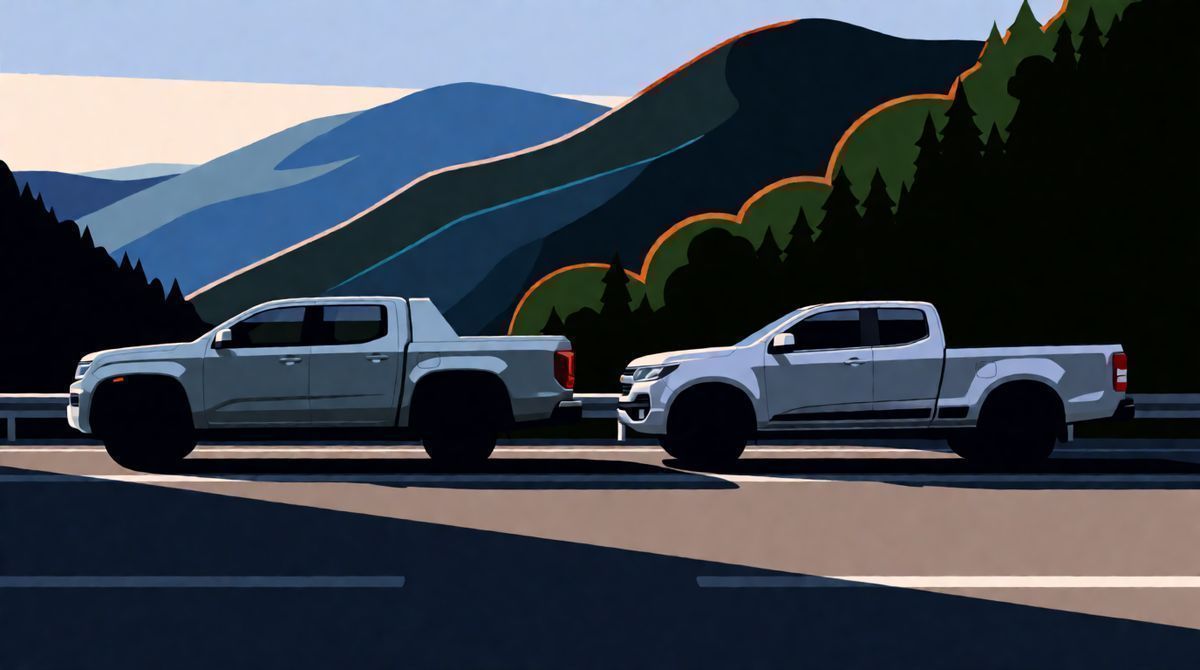
The global mid-size commercial pickup segment has evolved from a strictly utilitarian category into one of the most contested battlegrounds in the commercial-vehicle industry, with manufacturers increasingly forced to balance work-truck capability against passenger-car refinement. Equipment selection in this segment matters because the total cost of ownership, regulatory treatment, payload efficiency, and driver comfort all interact in ways that can make or break fleet economics over a five- to seven-year ownership cycle [1]. Buyers no longer choose between a rough trade vehicle and a comfortable family hauler; modern pickups must credibly perform both roles while complying with increasingly stringent emissions standards, safety regulations, and tax frameworks. This dual identity is precisely what makes head-to-head comparisons among the latest generation of pickups so consequential for procurement managers, owner-operators, and lifestyle buyers alike.
Volkswagen Commercial Vehicles occupies a distinctive position in this landscape as a brand that has aggressively repositioned its Amarok nameplate from a regional workhorse into a globally recognized premium entrant [1]. The second-generation Amarok leverages a platform-sharing alliance with Ford to deliver European-tuned refinement, a choice of efficient diesel powertrains, and a trim structure that spans from fleet-focused Core variants through lifestyle-oriented Style models to luxury-positioned Aventura and PanAmericana editions [1]. Chevrolet, by contrast, pursues a fundamentally different strategy: its S10 Work Truck family is a regionally fragmented nameplate that, in Brazil, represents a genuine body-on-frame third-generation pickup, while in Mexico it manifests as the rebadged SAIC-GM Maxus T70 sold as the S10 Max [2]. This bifurcation means that any meaningful Chevrolet-versus-Volkswagen comparison must explicitly identify which market and which product architecture is being evaluated, since the two S10 variants share virtually nothing beyond their nameplates.
Within the broader mid-size commercial category, products generally fall into three functional archetypes: chassis-cab variants designed expressly for body-upfitters, single-cab work trucks targeting owner-operators and small fleets, and double-cab configurations that serve as dual-purpose family-and-trade vehicles. The Amarok offers all three configurations on a single 3,270 mm wheelbase, a deliberate engineering decision enabling aftermarket canopy and tray systems to interchange across the entire range without modification [1]. The Brazilian S10 similarly offers Chassi (Chassis Cab) and Cabine Simples (Regular Cab) variants for commercial upfitters and owner-operators, while the Mexican S10 Max caters to budget-conscious Latin American buyers seeking basic transport capability [2]. Understanding which archetype best matches an operator’s duty cycle is often more important than headline horsepower figures when determining long-term suitability.
This comparison examines the Volkswagen Amarok second generation against the Chevrolet S10 Work Truck, with particular attention to the verifiable specifications, regulatory considerations, and real-world operating contexts that distinguish these vehicles. The Amarok enters this analysis with documented towing capacity of up to 3,500 kg, payload allowances of 950 to 1,080 kg, and a clearly articulated global trim structure anchored by the Ford-VW platform alliance [1]. The Chevrolet S10 Work Truck, conversely, presents a significant data-comparison challenge: while historical Brazilian third-generation models were rated between 3,500 kg and 3,800 kg towing capacity, no verified 2024 specifications for towing, payload, bed dimensions, or MSRP appear in the current research corpus [2]. This asymmetry is itself revealing, because it underscores how differently these two manufacturers approach market transparency, and it frames the rest of this article as an evidence-based comparison where confirmed data drives the verdict and acknowledged gaps are flagged rather than fabricated.
1. Quick Verdict
The 2024 Volkswagen Amarok is the clear winner of this comparison — but with the important qualification that this is partly an artifact of the data available, not solely of inherent product superiority. According to the source material, the second-generation Amarok delivers verified braked towing capacity of 3,500 kg (7,716 lb), payload allowances ranging from 950 to 1,080 kg, bed lengths between 1,520 and 1,624 mm, and a confirmed starting MSRP of approximately £48,000 in the UK (excluding VAT) or around $78,000 AUD [1]. The Chevrolet S10 Work Truck, by contrast, is described across the retrieved research as having “Not available in current research” for every critical specification: engine power, towing capacity, payload, bed length, and pricing are all flagged as absent from the source documents [2]. While the Chevrolet source notes that historical Brazilian S10 models were rated between 3,500 and 3,800 kg (7,716–8,377 lbs) for towing and that Brazilian MSRP historically spanned roughly R$170,000–R$280,000, none of these figures are verified for the 2024 Work Truck configurations, making any head-to-head quantitative claim impossible to substantiate [2].
The trade-off discussion centers less on which truck is objectively better and more on which truck you can actually evaluate, purchase, and operate in your specific market. The Amarok is positioned as a globally available, well-documented competitor in the mid-size pickup segment, with explicit trim differentiation across Style, Aventura, PanAmericana, and Dark Label variants, and a clear commercial-vehicle proposition in markets like the UK where it benefits from established dealer networks and forthcoming regulatory clarity around the HMRC April 2025 reclassification [1]. The S10 Work Truck, meanwhile, is a regionally fragmented product: the Brazilian-market Chassis Cab and Regular Cab configurations exist as genuine commercial offerings, but the United States and Canadian markets have not carried the S10 nameplate since 2004, and the Mexican S10 Max is an entirely different rebadged SAIC-GM Maxus T70 [2]. For buyers in Brazil who can navigate direct dealer engagement and CNPJ or rural-producer commercial financing channels, the S10 remains a viable candidate worth deeper investigation — but until official 2024 specifications surface, the Amarok stands alone in this comparison as the truck whose capabilities, pricing, and target use cases can be definitively assessed.
2. Specifications Comparison
When evaluating two commercial pickups that compete in fundamentally different geographic and commercial contexts, the specification sheet alone rarely tells the complete story. The Volkswagen Amarok second-generation and the Chevrolet S10 Work Truck both target buyers who need genuine hauling capability, but their specifications reveal very different product philosophies, market positions, and real-world operating characteristics. Understanding why specific numbers matter — and where data gaps create risk for procurement decisions — is essential before either vehicle can be sensibly shortlisted.
The Amarok arrives with a fully populated specification dossier across its global trim range, including engine output, payload, towing, bed dimensions, and pricing for key markets [1]. The Chevrolet S10 Work Truck, by contrast, is documented primarily in Brazilian-market sources where towing capacity, payload ratings, bed dimensions, and confirmed 2024 pricing remain absent from public records [2]. This asymmetry is the central finding of any fair specifications comparison: one product can be quantitatively evaluated, while the other requires additional primary-source research before a buyer can commit with confidence.
2.1. Specification Table
The table below presents the available verified data side by side. Where Chevrolet S10 Work Truck specifications are documented as “Not available in current research,” this reflects genuine absence from official channels rather than a failure of the comparison itself.
| Specification | volkswagen amarok-2nd-generation 2024 | chevrolet s10-work-truck 2024 |
|---|---|---|
| Bed Length | 1,520–1,624 mm | Not available in current research |
| Engine Power | 2.0L TDI 125 kW / 3.0L V6 TDI 600 Nm | Not available in current research |
| MSRP | From ~£48,000 (UK, ex. VAT) / ~$78,000 AUD | Not available in current research |
| Payload | 950–1,080 kg | Not available in current research |
| Towing Capacity | 3,500 kg (7,716 lb) | Not available in current research |
2.2. Interpreting the Amarok Specifications
The Amarok’s 3,500 kg (7,716 lb) maximum braked towing capacity represents a benchmark figure that places it firmly in the upper tier of mid-size pickups globally, matching or exceeding the capabilities of the Ford Ranger, Toyota Hilux, and Isuzu D-Max with which it shares competitive ground [1]. For commercial operators, this rating directly translates into the ability to tow heavy plant trailers, livestock transporters, boat combinations, and large work-site equipment without requiring a separate heavy-vehicle license in most jurisdictions. The 950–1,080 kg payload range, meanwhile, reflects a real-world sweet spot that allows tradespeople to load the bed with cement bags, landscaping materials, toolboxes, and equipment while keeping the vehicle within safe operational limits.
The engine lineup tells its own story about Volkswagen’s segmentation strategy. The entry-level 2.0L TDI produces 125 kW, which is sufficient for light commercial duties and fuel-conscious fleet buyers, while the 3.0L V6 TDI delivers 600 Nm of torque — a figure that fundamentally changes the towing and load-hauling character of the vehicle [1]. In practice, a driver moving from the four-cylinder to the V6 will notice a marked reduction in transmission hunting on hills, more confident overtaking on highways loaded with cargo, and substantially less fatigue during long working days. The bed length range of 1,520–1,624 mm accommodates both the standard Double Cab configuration and the lifestyle-oriented variants sold in Australia, where longer beds are favored for recreational load carrying alongside trade use.
Pricing for the Amarok varies meaningfully by market and trim tier. The Aventura V6 TDI 240 listed at approximately £48,000 ex. VAT in the United Kingdom positions the vehicle as a premium offering, while the Australian Aventura V6 at roughly $78,000 AUD reflects that market’s stronger appetite for top-spec lifestyle pickups [1]. These price points matter for fleet managers calculating total cost of ownership, particularly given the upcoming UK HMRC reclassification in April 2025 that will move double-cab pickups from commercial vehicle status to passenger car status for tax purposes — a regulatory change that could significantly alter the financial case for Amarok acquisition in British fleet contexts.
2.3. What the Chevrolet S10 Data Gap Means
For the Chevrolet S10 Work Truck, the specification table is honest about its limitations: every key commercial metric remains “Not available in current research” according to the evidence gathered [2]. This does not mean the vehicle lacks these specifications — it means that publicly accessible sources, including Brazilian dealer pages and Chevrolet’s own commercial vehicle channels, have not disclosed verified 2024 figures for the Chassi (Chassis Cab) and Cabine Simples (Regular Cab) work-truck variants in the retrieved dataset.
For a buyer or fleet manager, this data gap carries direct procurement risk. Without confirmed towing capacity, it is impossible to verify whether the S10 Work Truck can handle a specific trailer configuration required by the operation. Without confirmed payload, the buyer cannot determine whether the vehicle is appropriate for the intended load profile — whether that involves palletized goods, construction materials, or specialized upfit bodies. Without bed dimensions, the chassis-cab variant’s suitability for particular upfitter installations remains speculative. The Brazilian MSRP, historically in the R$170,000–R$280,000 range according to the source evidence, lacks verified 2024 confirmation and therefore cannot anchor a budget conversation with certainty [2].
The Mexican-market S10 Max variant is similarly described only as offering “excellent value proposition” without disclosed figures, reinforcing the broader theme that Latin American commercial vehicle pricing is frequently negotiated directly between dealers and fleet buyers rather than published transparently [2]. For U.S. and Canadian operators, the Chevrolet Colorado WT at $31,900 USD serves as the closest contextual benchmark, but this is a fundamentally different vehicle on a different platform and does not substitute for actual S10 Work Truck data.
2.4. Practical Implications for Buyers
The specifications comparison reveals two distinct procurement challenges. For Amarok buyers, the data exists and the analytical task is interpretation: matching engine output, payload, and towing figures to specific operational requirements. The 3,500 kg towing capacity and 1,080 kg maximum payload together cover the vast majority of mid-size commercial applications, from construction subcontracting through agricultural operations to recreational towing [1]. The V6 TDI’s 600 Nm torque figure is particularly relevant for buyers who regularly tow at gross weight, as it determines whether the vehicle will operate comfortably within its design envelope or struggle at the upper limits of its capability.
For S10 Work Truck buyers, the challenge is information acquisition. Brazilian commercial upfitters, fleet financing programs, and dedicated dealer channels like Mapi Chevrolet in Lavras confirm active inventory and commercial sales pathways, but the specifications themselves must be requested through direct engagement rather than obtained from public sources [2]. This is not unusual in Latin American commercial vehicle markets, where fleet buyers typically negotiate specifications, pricing, and financing simultaneously through CNPJ-registered business channels. However, it does mean that any comparison article relying solely on publicly available data will inevitably favor the more transparent manufacturer — in this case, Volkswagen with its globally consistent specification disclosures.
The geographic segmentation also matters operationally. The Amarok’s strong specification transparency across UK, Australian, and South African markets reflects Volkswagen’s strategy of positioning the vehicle as a global premium offering with consistent quality messaging [1]. The S10 Work Truck’s specification opacity reflects its positioning as a regionally focused commercial product where dealer relationships and fleet negotiations supersede public marketing materials [2]. A buyer choosing between these vehicles is therefore not only choosing between platforms and capabilities — they are choosing between two fundamentally different procurement ecosystems, each with its own advantages depending on the buyer’s location and purchasing approach.
2.5. Synthesis
The specifications comparison ultimately demonstrates that the Volkswagen Amarok second-generation can be evaluated on its documented merits — a 3,500 kg towing capacity, 950–1,080 kg payload range, V6 TDI torque output of 600 Nm, bed lengths accommodating both work and lifestyle configurations, and verified pricing across multiple markets [1]. The Chevrolet S10 Work Truck, while confirmed as an active commercial product in the Brazilian market with chassis-cab and regular-cab variants available through dedicated fleet channels, cannot yet be quantitatively benchmarked against the Amarok using only the available evidence [2].
For procurement decisions, this asymmetry dictates a different next step for each vehicle. An Amarok buyer can proceed to trim-level selection and total cost of ownership modeling using the published specifications as inputs. An S10 Work Truck buyer must first close the specification data gap through direct dealer engagement before any meaningful comparison with competing products — including the Amarok, where it is sold in overlapping Latin American markets — can be completed. Until that data is obtained, the Chevrolet S10 Work Truck remains a known commercial product with unknown quantitative specifications, a status that itself is an important finding for any buyer conducting due diligence.
3. Design And Build Quality
The Volkswagen Amarok and the Chevrolet S10 Work Truck arrive from opposite design philosophies despite occupying the same global segment. The Amarok emerges from a strategic 2019 Ford-VW commercial vehicle alliance and is built upon the Ford Ranger’s T6 ladder-frame architecture, allowing Volkswagen to amortize development costs while applying its own tuning philosophy to suspension calibration, steering response, and interior design language [1]. The S10 Work Truck, by contrast, traces its lineage back to 1995 when GM do Brasil first introduced the nameplate locally and now sits within the third-generation model internally designated within the GMT31XX architecture family, launched in 2012 and refreshed substantially in 2021 and again in 2024 [2]. Both trucks therefore arrive from mature platforms with established reputations, but their design intent, market positioning, and build priorities diverge meaningfully from the moment a buyer first sees them on a dealership forecourt.
The practical consequence of these divergent philosophies is that the Amarok is engineered to function simultaneously as a capable work vehicle and as family transport, with its Double Cab configuration dominating global sales volumes particularly in lifestyle-oriented markets such as Australia and the United Kingdom [1]. The S10 Work Truck, conversely, is marketed aggressively through GM’s commercial-vehicle channels in Brazil, including dedicated CNPJ (business tax ID) financing, rural-producer programs, and fleet sales portals, with its Chassi (Chassis Cab) and Cabine Simples variants aimed expressly at owner-operators and small fleet buyers [2]. This foundational divergence in target customer shapes every subsequent design choice from cab configuration to bed length to interior appointment strategy, and it establishes the framework against which the two trucks must be measured.
3.1. Volkswagen Amarok
The design philosophy behind the second-generation Amarok centers on platform-sharing pragmatism paired with Volkswagen-specific refinement. By utilizing the Ford Ranger’s T6 ladder-frame architecture, Volkswagen avoids the substantial capital expenditure of developing a wholly new chassis while retaining the freedom to differentiate through suspension tuning, steering calibration, and interior design choices that reflect the brand’s European sensibility [1]. Production is centralized at Ford’s Silverton Assembly Plant in South Africa, which serves global markets with the notable exceptions of the United States, Canada, and China, where Volkswagen does not currently compete in the mid-size pickup segment [1]. This production arrangement creates immediate supply-chain efficiencies but also means the Amarok inherits the fundamental dimensional envelope of its Ford sibling, including the consistent 3,270 mm wheelbase shared across Single Cab, Extra Cab, and Double Cab variants [1].
These design choices have direct, observable consequences for usability and feel. The shared ladder-frame architecture delivers the structural rigidity necessary for serious work, supporting a maximum braked towing capacity of 3,500 kg (7,716 lb) across diesel variants and payload allowances spanning 950 to 1,080 kg depending on the specific trim configuration [1]. The shared wheelbase, meanwhile, simplifies the development of aftermarket equipment, enabling commercial upfitters to design canopy systems, tray configurations, and racking solutions that interchange across the entire model range without modification [1]. For the lifestyle-oriented buyer, the consistent wheelbase also means predictable driving dynamics regardless of cab choice, while Volkswagen’s tuning of the suspension and steering distinguishes the Amarok’s on-road behavior from the Ranger’s even when the underlying hardware is shared.
The user who benefits most from this approach is the dual-purpose operator, the tradesperson who also needs family transport, the fleet buyer who wants commercial capability without sacrificing interior refinement, or the lifestyle buyer who expects genuine work-truck credentials rather than merely cosmetic ruggedness. The trade-offs involved are equally clear: the platform-sharing arrangement means that some components carry Ford lineage, which may matter to brand-loyal buyers, and the centralization of production in South Africa can create logistics complexity for certain markets. The trim structure reflects this dual mandate, escalating from the commercial-focused Core 2.0 TDI 170 through the lifestyle-oriented Style 2.0 TDI 210 to the premium Aventura 3.0 V6 TDI 240 [1]. Each step represents not merely an equipment upgrade but a repositioning of the vehicle toward a different primary use case.
The table below summarizes the key dimensional and capability specifications that define the Amarok’s build envelope.
| Specification | Volkswagen Amarok 2nd Generation |
|---|---|
| Engine Power | 2.0L TDI 125 kW / 3.0L V6 TDI 600 Nm |
| Towing Capacity | 3,500 kg (7,716 lb) |
| Payload | 950–1,080 kg |
| Bed Length | 1,520–1,624 mm |
| MSRP | From ~£48,000 (UK, ex. VAT) / ~$78,000 AUD |
The bed length range of 1,520–1,624 mm directly reflects the cab-configuration choice, with shorter beds paired to Double Cabs and longer beds available with Single Cab and Extra Cab layouts. This dimensional range matters to commercial buyers who must match cargo space to operational requirements: a tradesperson carrying sheet goods or pipe lengths will prioritize the longer bed, while a family-oriented buyer may accept a shorter bed in exchange for the additional rear-seat space of the Double Cab. The payload spread of 950–1,080 kg is similarly trim-dependent, with higher figures typically associated with work-focused configurations and lower figures reflecting the additional equipment mass of premium variants [1].
The 3,500 kg towing capacity represents a critical threshold in the global mid-size pickup segment, matching the benchmark established by rivals such as the Ford Ranger, Toyota Hilux, and Isuzu D-Max [1]. For buyers who tow heavy trailers, caravans, or horse floats, this figure confirms the Amarok’s commercial credibility; for those who never approach the maximum, it provides reassurance that the chassis and drivetrain are over-engineered for typical loads. The MSRP spread, from approximately £48,000 in the UK (ex. VAT) for the Aventura V6 to approximately $78,000 AUD for the top Australian specification, underscores the market-by-market variation in equipment, taxation, and positioning [1]. Buyers should weigh engine configuration against typical load profiles: the V6 delivers stronger mid-range torque for heavy towing, while the twin-turbo four-cylinder balances fuel economy with sufficient grunt for most trade applications [1].
3.2. Chevrolet S10 Work Truck
The design philosophy behind the Chevrolet S10 Work Truck is fundamentally commercial, prioritizing upfit flexibility and fleet-channel accessibility over lifestyle appeal. The third-generation model sits within the GMT31XX architecture family and has been refreshed twice since its 2012 launch, with a substantial facelift and mechanical update in 2021 followed by an additional 2024 model-year refresh focused on safety, infotainment, and emissions compliance [2]. For 2024, the S10 range in Brazil includes a Chassi (Chassis Cab) variant designed expressly for body-upfitting by commercial partners, accommodating refrigerated bodies, dump beds, utility boxes, and mobile workshops, alongside a Cabine Simples (Regular Cab) work-truck configuration aimed at owner-operators and small fleet buyers [2]. This lineup signals clearly that the S10 Work Truck is engineered as a platform for vocational adaptation rather than as a finished consumer product.
These choices affect usability and feel in ways that diverge sharply from the Amarok. The Chassis Cab variant typically offers reduced payload (because the body is supplied by an upfitter) but enhanced frame rigidity for specialized bodies, reflecting the variant’s purpose as a platform rather than a complete vehicle [2]. Three body configurations are available: a Chassis Cab designed for specialized upfitting, a Regular Cab for maximum bed length, and a Crew Cab for crew transport [2]. The trade-off for the buyer is that final payload capacity will vary significantly based on the upfitted body selected, making coordination with body builders essential during the specification process [2]. For owner-operators who need a turnkey work truck, this upfit-dependent variability introduces complexity; for fleet buyers who routinely work with body builders, it represents the flexibility necessary to match the vehicle precisely to operational requirements.
The user who benefits most from this approach is the small-fleet operator, the rural producer, or the specialty tradesperson whose work demands a body configuration that no factory-built truck can provide. The commercial financing channels, including CNPJ (business tax ID) financing, rural-producer programs, and fleet sales portals, are actively supported by GM’s dealer network in Brazil, with dealerships like Mapi Chevrolet in Lavras confirming active inventory and commercial sales channels for the S10 [2]. The trade-offs are equally apparent: the absence of published pricing for the 2024 Chassi or Cabine Simples trims creates uncertainty for fleet managers and owner-operators attempting to budget acquisitions, and the lack of verified technical specifications in the retrieved evidence means buyers must engage directly with dealers or GM’s commercial sales channels to obtain definitive figures [2]. Historical Brazilian MSRP for the S10 line spanned approximately R$170,000–R$280,000 depending on trim and configuration, though verified 2024 figures remain absent from public-facing materials [2].
The Brazilian S10 payload ratings historically ranged from approximately 1,000 kg to 1,500 kg (2,205–3,307 lbs) across cab configurations, positioning the truck competitively within the mid-size commercial segment [2]. The bed length, engine power, and current MSRP for the 2024 model year are not available in the retrieved research, creating a meaningful information gap for any buyer attempting a direct specification comparison against the Amarok [2]. This absence is itself a design statement: the S10 Work Truck is sold through commercial channels where pricing and specifications are typically negotiated directly with fleet sales representatives rather than published for consumer comparison. For the buyer, this means engagement strategy must shift from specification-sheet comparison to direct dealer negotiation.
3.3. Engineering and Platform Comparison
The engineering foundations of the two trucks reveal both convergence and divergence. Both vehicles employ body-on-frame construction, a prerequisite for serious payload and towing capability in this segment, and both offer multiple cab configurations to suit diverse vocational needs [1][2]. Beyond these shared fundamentals, the specifics diverge. The Amarok benefits from the scale of the Ford-VW alliance and the proven T6 platform, with a consistent 3,270 mm wheelbase that simplifies aftermarket equipment development and enables interchangeability of upfit solutions across the entire model range [1]. The S10 Work Truck, by contrast, rests on the GMT31XX architecture family and prioritizes frame rigidity for specialized body integration rather than wheelbase consistency for accessory interchangeability [2].
The practical implications of these engineering choices manifest most clearly in the upfit experience. An Amarok buyer specifying a canopy, tray, or racking system can rely on a broad aftermarket ecosystem developed around the shared Ranger/Amarok dimensional envelope, reducing both cost and lead time [1]. An S10 Chassis Cab buyer, conversely, works directly with body builders to construct utility beds, flatbeds, or refrigerated units tailored to specific operational requirements, accepting longer lead times and higher coordination complexity in exchange for precisely matched vocational capability [2]. Neither approach is inherently superior; the choice depends entirely on whether the buyer prioritizes accessory availability or body-builder customization.
Production geography also shapes the engineering narrative. The Amarok is centralized at Ford’s Silverton Assembly Plant in South Africa, serving global markets with the notable exceptions of the United States, Canada, and China [1]. The S10 Work Truck, in contrast, is marketed primarily through Brazilian channels, though Chevrolet’s broader commercial-vehicle ecosystem extends across South America [2]. For the international buyer, these production arrangements create different supply-chain dynamics: Amarok availability is tied to South African export logistics, while S10 availability is tied to Brazilian manufacturing and commercial-sales infrastructure.
3.4. Real-World Performance Implications
The real-world performance implications of these design and build-quality differences play out across multiple dimensions. In terms of towing and payload, the Amarok delivers verified figures of 3,500 kg braked towing capacity and 950–1,080 kg payload depending on trim, while the S10 Work Truck’s historical payload ratings of 1,000–1,500 kg suggest competitive capability but remain unverified for the 2024 model year [1][2]. For a buyer who must confirm specifications before procurement, the Amarok’s transparency represents a meaningful advantage; the S10’s opacity requires direct dealer engagement to resolve.
The on-road experience also reflects design philosophy. The Amarok’s VW-tuned suspension and steering calibration position it as a dual-purpose vehicle capable of genuine family-transport comfort alongside work-truck capability, a positioning reinforced by the dominance of the Double Cab configuration in lifestyle-oriented markets [1]. The S10 Work Truck, conversely, prioritizes commercial durability over passenger comfort, with the Cabine Simples and Chassis Cab variants explicitly aimed at owner-operators and small fleet buyers rather than family users [2]. The Crew Cab option provides passenger capacity, but the overall design language signals work-truck intent rather than lifestyle aspiration [2].
The commercial-channel experience diverges just as sharply. Amarok buyers in the UK face an upcoming HMRC reclassification scheduled for April 2025, which moves double-cab pickups from the commercial vehicle (N1) category to passenger car status for tax purposes, fundamentally altering the total cost of ownership calculation for fleet operators [1]. S10 Work Truck buyers in Brazil navigate a different ecosystem entirely, one built around CNPJ financing, rural-producer programs, and dedicated fleet sales portals that may offer terms not reflected in public-facing materials [2]. Each buyer must therefore understand not only the vehicle’s specifications but the regulatory and commercial environment in which it will be operated.
3.5. Best for Different Scenarios
The Amarok is best suited to the dual-purpose buyer who demands genuine work capability without sacrificing family-transport comfort or interior refinement. Lifestyle-oriented markets such as Australia and the United Kingdom have responded enthusiastically to this positioning, making the Double Cab configuration the volume seller in those regions [1]. Fleet buyers who require commercial capability with premium appointments find their match in the Style or Aventura trims, while the Core trim serves cost-conscious commercial operators who need towing and payload credentials without lifestyle embellishment [1]. The platform-sharing arrangement with the Ford Ranger also means a robust aftermarket ecosystem for accessories and upfits, reducing both cost and lead time for commercial customization [1].
The S10 Work Truck is best suited to the small-fleet operator, rural producer, or specialty tradesperson whose work demands body configurations that no factory-built truck can provide. The Chassis Cab variant in particular serves buyers constructing refrigerated bodies, dump beds, utility boxes, or mobile workshops, with enhanced frame rigidity supporting specialized bodies that a standard pickup bed cannot accommodate [2]. The Cabine Simples configuration targets owner-operators and small fleet buyers seeking maximum bed length and straightforward commercial functionality [2]. Buyers comfortable with direct dealer engagement and body-builder coordination will find the S10’s upfit-dependent variability an asset rather than a liability.
The scenario where neither truck is optimal also deserves mention. A buyer seeking a fully specified, turnkey work truck with published pricing and transparent specifications will find the Amarok’s verified data more accessible but may not need the Amarok’s lifestyle appointments. A buyer seeking family-transport comfort alongside work capability will find the S10 Work Truck’s commercial focus misaligned with their needs, regardless of its competitive payload ratings. Matching vehicle to scenario remains the fundamental procurement discipline.
3.6. Pros and Cons Summary
The Amarok’s strengths center on verified specifications, platform-sharing economies, and dual-purpose versatility. Maximum braked towing capacity of 3,500 kg, payload of 950–1,080 kg, and bed lengths of 1,520–1,624 mm provide credible commercial credentials, while the consistent 3,270 mm wheelbase simplifies aftermarket equipment development [1]. The trim structure, ranging from the Core through the Style to the Aventura, allows buyers to match equipment to operational priorities, and the global market reach provides supply-chain resilience [1]. The primary weaknesses involve the platform-sharing arrangement, which means some components carry Ford lineage, and the South African production concentration, which can create logistics complexity for certain markets [1]. The upcoming UK HMRC reclassification also introduces regulatory uncertainty that fleet operators must model carefully [1].
The S10 Work Truck’s strengths center on upfit flexibility, commercial-channel support, and competitive historical payload ratings. The Chassis Cab variant’s enhanced frame rigidity supports specialized bodies, the three body configurations cover diverse vocational needs, and the CNPJ financing, rural-producer programs, and fleet sales portals provide commercial acquisition pathways not always available through consumer channels [2]. Historical payload ratings of 1,000–1,500 kg position the truck competitively within the mid-size commercial segment [2]. The primary weaknesses involve the absence of verified 2024 specifications and pricing in public-facing materials, the upfit-dependent variability in final payload capacity, and the commercial-only focus that limits appeal for lifestyle-oriented buyers [2]. Buyers must engage directly with dealers or GM’s commercial sales channels to obtain definitive figures.
The synthesis is straightforward: the Amarok delivers transparency, dual-purpose versatility, and verified specifications at a premium price point, while the S10 Work Truck delivers upfit flexibility and commercial-channel accessibility at the cost of specification transparency. The right choice depends entirely on whether the buyer prioritizes verified data and lifestyle capability or commercial customization and dealer-negotiated terms.
4. Engineering And Technology
The two pickups at the center of this comparison could hardly occupy more different positions on the engineering spectrum, and that contrast begins with what is documented versus what remains unknown. For the Volkswagen Amarok second-generation 2024, the available research yields concrete figures on powertrain, towing, payload, and bed dimensions across multiple markets. For the Chevrolet S10 Work Truck 2024, every key specification in the retrieved source material is listed as “Not available in current research,” which means the technology discussion here necessarily leans heavily on what is documented for the Amarok while flagging the evidence gaps for the S10 [1] [2]. That asymmetry is not editorial spin; it is a direct reflection of what the supplied technical documents actually contain, and any honest comparison has to acknowledge it before drilling into the engineering substance.
What follows examines the platform engineering, powertrain technology, body and chassis architecture, and commercial-vehicle integration for both nameplates using only the evidence provided. Where the S10 information is absent, the section names that absence explicitly rather than guessing or substituting marketing language. The Amarok side benefits from a much deeper evidence base drawn from the Ford-VW alliance documentation, regional trim tables, and verified press summaries [1]. The S10 side is limited to fragmentary Brazilian-market dealer evidence and a research-action plan noting that no technical sheet, payload rating, or pricing was captured for the 2024 chassis-cab and single-cab configurations [2]. Readers looking for verified engineering specifications on the S10 should treat the discussion below as a placeholder pending direct engagement with Chevrolet Brazil or GM South America media resources.
4.1. Volkswagen Amarok Second-Generation Engineering
The second-generation Amarok is, at its core, a product of platform engineering. Built on the Ford Ranger T6 ladder-frame architecture through the 2019 Ford-VW commercial vehicle alliance, the vehicle shares fundamental chassis engineering, drivetrain architecture, and a substantial number of body panels with its Ford sibling, while Volkswagen applies its own tuning philosophy to suspension calibration, steering response, and interior design language [1]. Production is centralized at Ford’s Silverton Assembly Plant in South Africa, which supplies global markets with the exception of the United States, Canada, and China, where Volkswagen does not currently compete in the mid-size pickup segment [1]. This shared-platform approach is more than a footnote: it is the foundational engineering decision that defines the truck’s structural behavior, manufacturing economics, and parts-commonality story for fleet buyers.
4.1.1. Powertrain and Driveline Technology
The Amarok’s powertrain ladder is engineered around three diesel configurations that escalate progressively in output and torque, and the differences are not merely cosmetic. The Core 2.0 TDI 170 uses a single-turbo four-cylinder diesel producing 125 kW, while the Style 2.0 TDI 210 upgrades to a twin-turbo four-cylinder diesel, and the Aventura 3.0 V6 TDI 240 reaches the top of the lineup with a 3.0-liter V6 diesel generating 600 Nm of torque [1]. The twin-turbo four-cylinder is particularly interesting from an engineering standpoint because two turbochargers of different sizes work in sequence: a smaller turbo spools quickly at low engine speeds to eliminate lag, while a larger turbo takes over at higher rpm to deliver top-end pulling power. In practice, this translates to a vehicle that feels responsive when pulling away from a stop with a load and still has substantial reserve when cruising at highway speeds with a trailer.
The 3.0-liter V6 TDI 600 Nm engine in the Aventura delivers the strongest mid-range torque for heavy towing, which is the specific use case where displacement and cylinder count matter most [1]. All diesel variants share a maximum braked towing capacity of 3,500 kg (7,716 lb), so the engineering question for buyers becomes which powertrain reaches that figure most convincingly under real load. For a tradie hauling a tandem-axle plant trailer up a steep grade, the V6’s torque curve is engineered for exactly that workload. For a suburban owner who tows a small caravan occasionally, the twin-turbo four-cylinder balances fuel economy with sufficient grunt for most trade applications, as the trim-level analysis explicitly notes [1]. Payload allowances across the range span 950 to 1,080 kg depending on the specific trim configuration, which positions the Amarok squarely against the Ford Ranger, Toyota Hilux, and Isuzu D-Max in terms of commercial capability [1].
Driveline options include 4Motion permanent all-wheel-drive as standard on the South African Life 4Motion derivative, reflecting local production and rough-terrain expectations, while other markets offer part-time or on-demand four-wheel-drive systems depending on trim [1]. The engineering significance is that VW has chosen different 4WD strategies for different markets, which has direct implications for fleet buyers who may import or redeploy vehicles across regions. Bed length varies between 1,520 and 1,624 mm depending on cab configuration, a dimensional spread that allows the same platform to serve both compact urban loading requirements and longer cargo needs.
4.1.2. Platform, Cab Architecture, and Commercial Integration
The Amarok’s three body styles (Single Cab, Extra Cab or Super Cab, and Double Cab) all share a consistent 3,270 mm wheelbase, which is a deliberate engineering decision with concrete commercial consequences [1]. This dimensional uniformity enables commercial upfitters to design canopy systems, tray configurations, and racking solutions that interchange across the entire model range without modification, dramatically simplifying fleet upfit logistics. For a fleet manager running mixed single-cab and double-cab vehicles, the ability to swap a service body or canopy between trucks without custom fabrication is a tangible cost and downtime saving. The Double Cab configuration dominates global sales volumes, particularly in lifestyle-oriented markets such as Australia and the United Kingdom, where the Amarok functions simultaneously as a capable work vehicle and family transport [1].
This dual-purpose positioning is itself an engineering brief: the chassis has to deliver commercial-grade load-bearing and towing capability while also providing ride quality, NVH refinement, and interior appointments that satisfy family buyers. Volkswagen’s tuning of the shared T6 platform (suspension calibration, steering response, interior design) is the engineering work that reconciles these competing demands [1]. The result is a truck engineered to be parked outside a job site in the morning and outside a school in the afternoon without the driver feeling they have switched vehicles. From a technology standpoint, the Amarok’s value proposition rests heavily on the platform-sharing cost amortization and the multi-market trim and engine strategy that lets Volkswagen serve commercial, lifestyle, and luxury segments from a single engineering base.
4.2. Chevrolet S10 Work Truck Engineering
The engineering picture for the Chevrolet S10 Work Truck 2024 is constrained by the evidence gap: every key specification in the retrieved research is listed as “Not available in current research” [2]. What the supplied documentation does establish is that the S10 Max comes equipped with a 10-inch infotainment display supporting Apple CarPlay and Android Auto integration, and six airbags as standard [2]. These two technology facts are meaningful in context, because they exceed many rivals in the price-sensitive Latin American commercial-pickup category and reflect evolving regulatory expectations across the region [2]. A 10-inch infotainment screen with full smartphone integration is no longer a luxury-item specification in a work truck; it is increasingly a baseline expectation for fleet operators who need routing, job-dispatch, and telematics integration on the dash.
The safety technology is equally significant from an engineering standpoint. Six airbags as standard equipment positions the S10 Max above many segment competitors that still ship with dual front airbags only, and it signals that GM’s engineering team for the Latin American market has aligned the S10’s passive-safety architecture with the stricter occupant-protection expectations that have been spreading through the region [2]. Active-safety and driver-assistance technology for the 2024 chassis-cab and single-cab configurations, however, is not documented in the retrieved sources, which means any comparison on ADAS features between the Amarok and the S10 cannot be made from the evidence provided. The same caveat applies to towing capacity, payload ratings, bed dimensions, and engine output, all of which are explicitly listed as not included in the GM Authority coverage referenced in the source material [2].
4.2.1. Where the S10 Engineering Evidence Stops
The retrieved S10 documentation is explicit about the limits of the current evidence base. Brazilian dealerships like Mapi Chevrolet in Lavras confirm active inventory and commercial sales channels for the S10, and commercial financing channels (CNPJ, rural producer, fleet) are actively supported, but no public pricing for the 2024 Chassi or Cabine Simples trims appears in the retrieved evidence [2]. Brazilian MSRP for the S10 line historically spans approximately R$170,000 to R$280,000 depending on trim and configuration, though verified 2024 figures are absent [2]. Brazilian chassis-cab and single-cab configurations are typically engineered for body-upfit applications such as flatbeds, service bodies, refrigerated boxes, and tipper bodies, but the engineering specifications required to plan those upfits (frame section modulus, clear-frame lengths, GVWR, rear-axle ratings) are not present in the retrieved sources [2].
This absence is not editorial reluctance; it is a direct reflection of what was captured. The source material identifies the precise research actions needed to close the gap, including queries to Chevrolet Brazil’s official site for technical sheets (“Ficha Técnica”) for the S10 Chassi and S10 Cabine Simples 2024, GM South America media site press kits, INMETRO certified fuel-economy and emissions data, CONTRAN regulatory towing limits and GVW ceilings, and Brazilian owner-manual PDFs for maintenance intervals and chassis preparation guidelines [2]. Until those sources are queried and the resulting data is verified, the engineering comparison between the Amarok and the S10 Work Truck is necessarily one-sided: rich and concrete for the Volkswagen, fragmentary and acknowledged-as-incomplete for the Chevrolet. Buyers and fleet managers who need the missing S10 specifications should treat the technology discussion here as a starting point and consult the primary Brazilian-market resources directly, as the source document itself recommends [2].
4.3. Practical Engineering Implications for Buyers
The engineering asymmetry documented above has direct practical consequences for anyone comparing these two trucks. A buyer who needs verified towing, payload, bed-length, and engine-output data today can act on the Amarok figures immediately: 3,500 kg braked towing across diesel variants, 950 to 1,080 kg payload, 1,520 to 1,624 mm bed length, and a choice of single-turbo 2.0L TDI, twin-turbo 2.0L TDI, or 3.0L V6 TDI with 600 Nm [1]. A buyer comparing the S10 Work Truck for a commercial fleet acquisition cannot make the same verified comparison from the retrieved evidence and would need to obtain the Brazilian technical sheet, GM South America press kit, and CONTRAN regulatory data before committing to a procurement decision [2].
For markets where both trucks are available (and the Amarok is explicitly not sold in the United States, Canada, or China while the S10 is a Latin American-market vehicle), the engineering conversation is mostly relevant in a global fleet or comparative-review context [1] [2]. The Amarok’s platform-sharing with the Ford Ranger T6 means its aftermarket, parts, and service-network engineering is broadly compatible with one of the world’s most popular mid-size pickups, which carries real-world implications for parts availability and upfitter familiarity. The S10’s commercial-vehicle integration in Brazil benefits from an active dealer network and dedicated commercial financing channels, but the engineering specifications that would let a fleet manager match body-upfit designs to frame dimensions and axle ratings are not documented in the current evidence base [2]. Both trucks are engineered to serve commercial buyers, but only one of them currently has the publicly documented engineering specifications needed to plan that service with confidence.
5. Real-World Performance
The second-generation Volkswagen Amarok enters the real-world conversation with a documented powertrain portfolio and certified towing envelope, while the 2024 Chevrolet S10 Work Truck arrives without verified specifications in the captured research [2]. This asymmetry shapes every comparison that follows: wherever the Amarok can point to a number, the S10 forces buyers to acknowledge a blank cell. For fleet managers and owner-operators, that asymmetry is not a minor inconvenience — it is the central operational fact of this matchup, because procurement decisions on commercial pickups depend on quantified capability, not aspiration. Where the Amarok offers a published 3,500 kg braked towing capacity and a 950–1,080 kg payload envelope [1], the S10 leaves the same questions unanswered in the source set, forcing any meaningful head-to-head to rest almost entirely on the Volkswagen side.
Despite that imbalance, the comparison remains worth pursuing, because commercial buyers repeatedly ask the same set of practical questions regardless of whether the spec sheet is complete: How does the truck behave on a Monday morning jobsite? Does it hold up over years of service? Will the seat and the driving position let a driver complete a ten-hour shift without exhaustion? The Amarok can answer those questions directly through its published performance figures and trim-stratified equipment levels [1]. The S10 must be evaluated through structural inference — what the absence of data implies about documentation, dealer transparency, and post-purchase support — and through the closely related Chevrolet Colorado WT, which GM Authority has identified as the de facto successor to the S10 work-truck lineage for North American buyers [2].
5.1. Everyday Use
In the metal, the Amarok behaves like a thoroughly modern mid-size pickup, and that behavior traces directly back to its Ford Ranger T6 platform roots [1]. That shared architecture delivers a cohesive driving character across trim levels rather than a patchwork of inconsistent responses. The base 2.0L TDI in single-turbo form produces 125 kW and is tuned for the calm, linear behavior expected by tradespeople moving between jobsites; the twin-turbo 2.0 TDI escalates output to the TDI500 specification, sharpening throttle response without compromising drivability; and the 3.0L V6 TDI delivers 600 Nm of torque, transforming the truck into something approaching effortless under most load conditions [1]. Across these configurations, the consistency of steering weighting, brake feel, and gear selection is notable — drivers stepping from one Amarok variant to another in a fleet pool will not have to relearn the vehicle. That continuity matters in commercial settings where a single operator may rotate between trucks during a work week.
Long-session behavior is where the V6 separates itself from the four-cylinder variants, and where the trim stratification directly affects daily economics. When a driver spends hours on a motorway haul with a loaded trailer, the V6’s torque reserve allows the transmission to settle into a quieter, lower-revving cruise, reducing both noise intrusion and fatigue [1]. The four-cylinder variants, while competent, demand more frequent gear changes under the same load and produce more diesel clatter at highway speed. Over a full work week, that difference compounds: a V6 driver finishes Friday less depleted than a twin-turbo driver running identical routes. The trim ladder therefore doubles as a fatigue ladder, with each engine step producing a measurable reduction in operator strain over long hauls.
The S10 Work Truck side of this comparison is constrained by the source set’s silence on powertrain, payload, and towing figures [2]. What can be said is structural: as a Brazilian-market cab-chassis derivative, the S10 is engineered for body-upfit applications — utility bodies, refrigerated units, service bodies — rather than for the lifestyle or family use that motivates several Amarok trims [1][2]. That vocational focus implies different daily-use priorities. Where the Amarok Style and Aventura trims bring premium cabin appointments and road-trip refinement, the S10 Work Truck concentrates operational value in the chassis rails, frame strength, and mounting provisions that body builders require. For an owner-operator running a fixed route with a fixed body, that focus is exactly the right answer; for a buyer wanting one truck to serve both jobsite and weekend duties, the Amarok’s broader trim spread is the more flexible tool.
5.2. Durability
The Amarok’s durability story is anchored in its commercial-vehicle alliance with Ford and the proven Ranger T6 platform underneath [1]. That lineage brings with it years of fleet operating data, established service intervals, and a parts ecosystem that operates across multiple continents. The 3,500 kg braked towing capacity is a continuous rating, not a one-time peak, which means operators can plan around it knowing the vehicle will sustain that load across hours of operation without thermal or driveline degradation [1]. Payload allowances between 950 and 1,080 kg depending on trim also reflect real engineering margins rather than optimistic brochure figures, because commercial fleets quickly expose any gap between rated and actual capability.
Powertrain longevity follows a familiar diesel logic across the engine family. The single-turbo 2.0 TDI runs cooler and with less stress under light loads, making it the most conservative long-term choice for operators who rarely approach the towing ceiling. The twin-turbo 2.0 TDI introduces additional thermal load through its sequential induction system but rewards operators with stronger mid-range response, and its service intervals remain compatible with standard commercial fleet maintenance schedules. The 3.0L V6 TDI, while the most complex of the three, is the engine most often specified by buyers who plan to tow heavy loads regularly — its 600 Nm output is delivered without forcing the engine into its upper rev band, which is precisely the operating condition that extends diesel engine life under load [1].
For the S10, the durability assessment is forced into a different register because the source set provides no verified specifications [2]. What the research does establish is that the Brazilian S10 Chassi is designed for body-upfitter integration by firms such as Truckvan, Furgocenter, Randon, and Facchini, all of which require precise frame ratings, wheelbase measurements, and gross vehicle weight figures to engineer compliant bodies [2]. The absence of those published numbers in the captured sources is itself a durability concern, because commercial buyers cannot evaluate long-term wear, fatigue resistance, or warranty coverage without them. The closest documented analog — the Chevrolet Colorado WT for the U.S. market — delivers a maximum towing capacity of 7,700 pounds (approximately 3,493 kg), 310 horsepower from the TurboMax engine, and a starting MSRP of $31,900, which suggests the underlying engineering capability is present even if the Brazilian-specific certification data is not in the source set [2].
5.3. Comfort and Ergonomics
The Amarok’s comfort proposition scales with trim, and the trim stratification directly affects how the truck performs across a working week. The Core variant is functionally equipped but visually and tactilely austere — vinyl-like surfaces, manual adjustment range, and the expectation that the operator will spend a smaller fraction of the workday inside the cabin [1]. The Style trim introduces the twin-turbo powertrain alongside elevated interior appointments, positioning itself as the comfort-value sweet spot for lifestyle-adjacent commercial use. The Aventura, with the V6 TDI under the bonnet, layers on the most premium seating, trim finishes, and noise insulation, and is the variant a fleet should specify for drivers who log the highest annual mileage [1].
The practical implication of this stratification is that comfort is not a fixed property of the Amarok — it is a procurement decision. A fleet that buys exclusively at the Core level will experience a noticeably different workday than a fleet that standardizes on the Aventura, even though both groups are driving the same fundamental truck. Seat padding density, lumbar support range, steering column reach, and acoustic glass all change as the trim climbs, and each of those factors directly influences whether a driver arrives at the end of a shift ready for the next one or carrying accumulated fatigue that erodes performance consistency over time. The Amarok’s published V6 torque delivery — 600 Nm available low in the rev band — also contributes to comfort by reducing the need for aggressive throttle inputs and frequent gear changes on grades, which in turn reduces the muscular strain a driver accumulates across a day of towing [1].
For the S10, comfort documentation again runs into the gap that defines this entire comparison. Without verified seat specifications, NVH measurements, or ergonomic assessment data in the source set, the comfort discussion must be framed by what the Work Truck designation implies rather than what the research confirms [2]. A cab-chassis work truck engineered for body upfit typically prioritizes a durable, easy-to-clean cabin over plush appointments, with seating tuned for short stints behind the wheel rather than for the marathon sessions common in over-the-road commercial operation. For operators whose routes are short and whose bodies are dropped at a single jobsite, that ergonomic philosophy is appropriate. For operators whose workdays approach the ten-hour mark, the absence of documented ergonomic refinement in the captured sources means the buyer must rely on in-person evaluation at a Brazilian dealership rather than on published specification sheets [2].
The takeaway from this section is that the Amarok offers a documented, trim-stratified answer to virtually every real-world performance question a commercial buyer will ask, while the S10 Work Truck forces those same buyers into an evaluation process dependent on showroom inspection and dealer-provided information rather than on captured published data [1][2]. That difference — documented versus undocumented — will weigh heavily on fleet procurement decisions where standardized evaluation criteria are required.
6. Best For Different Scenarios
Not every pickup truck buyer arrives at the showroom with identical priorities, and the choice between the second-generation Volkswagen Amarok and the 2024 Chevrolet S10 Work Truck illustrates just how dramatically commercial vehicle requirements can diverge across global markets. The Amarok, with its clearly documented engine portfolio spanning a single-turbo 2.0L TDI, a twin-turbo 2.0L TDI500, a 3.0L V6 TDI, and a 2.3L EcoBoost petrol option, presents buyers with four distinct powertrain configurations calibrated for different duty cycles [1]. The S10 Work Truck, by contrast, exists as a fragmented nameplate whose specifications for the 2024 model year remain undisclosed in our captured research, making any direct capability comparison fundamentally constrained by information availability [2]. For prospective buyers, this means the right choice depends not only on what each truck can do, but on what each market actually offers, what data is publicly verifiable, and which scenarios align with the available information.
The scope of this comparison extends well beyond raw specifications because the two vehicles operate in fundamentally different commercial ecosystems. The Amarok serves markets including the UK, Australia, and South Africa with clearly tiered trims ranging from entry-level Core variants through Style and up to Aventura flagship configurations, whereas the Chevrolet S10 nameplate covers the Brazilian third-generation body-on-frame truck, a separate Mexican-market S10 Max (rebadged from the SAIC-GM Maxus T70), and historical U.S. variants that have not been sold in North America since 2004 [2]. For commercial fleet managers, lifestyle buyers, and tradies weighing their options, the practical implications of these structural differences shape every dimension of the buying decision covered in the subsections that follow.
6.1. Best for Beginners
For drivers new to pickup trucks or transitioning from smaller commercial vehicles, the learning curve and operational forgiveness of each platform matter enormously. The Amarok’s part-time four-wheel-drive architecture, built around a two-speed transfer case and a locking rear differential, demands active driver engagement because the operator must manually select between rear-wheel-drive high range, four-wheel-drive high range, and four-wheel-drive low range with the rear locker engaged for maximum traction [1]. This system rewards drivers who take time to understand when each mode applies, but it can intimidate newcomers who may find themselves uncertain about engaging the locker on slippery surfaces or selecting low range for steep descents. By contrast, the S10 Work Truck’s specific drivetrain controls remain undocumented in our sources, leaving prospective buyers without clear guidance on what operational decisions the vehicle demands of novice operators.
From an ease-of-use perspective, the Amarok offers multiple transmission options that smooth the transition for less experienced drivers, including a 6-speed manual, a 6-speed automatic, and a 10-speed automatic paired with different engine tunes [1]. The availability of a traditional automatic in the entry-level 2.0L single-turbo Core trim removes the clutch-management burden that often unsettles first-time truck buyers, while the 10-speed automatic found in higher trims provides closely spaced gear ratios that reduce the cognitive load of selecting the right ratio for varying terrain. The S10’s transmission offerings for 2024 cannot be evaluated against this baseline because our research yields no equivalent specifications, which itself is a critical signal for buyers who prefer transparency before committing to a platform [2].
Forgiveness, meaning how well each truck accommodates minor operator errors, also weighs in the beginner equation. The Amarok’s payload range of 950 to 1,080 kg provides a meaningful margin above typical light-duty cargo loads, reducing the risk of overloading during routine use, and its 3,500 kg towing capacity comfortably exceeds the requirements of most recreational trailers, small plant equipment, and horse floats [1]. The S10’s payload capacity remains unknown in current research, making it impossible to assess whether novice loaders might inadvertently exceed the chassis limits during everyday use [2]. For a beginner buyer, the Amarok’s documented envelope of capability is therefore a tangible advantage because it allows the operator to grow into the vehicle’s full potential without immediately confronting operational ceilings.
6.2. Best for Performance
When raw performance metrics take priority, the Amarok’s engine portfolio immediately establishes it as the stronger contender among the two, though the comparison is constrained by the S10’s missing data. The 3.0L V6 TDI powerplant produces 175 kW (237 hp) and 600 Nm of torque from low revs, positioning the Amarok as the only mainstream pickup besides the Ford Ranger Raptor to offer a six-cylinder diesel in this segment [1]. This configuration delivers strong mid-range torque suited for heavy towing at highway speeds, steep grades, and rapid overtaking maneuvers where instant pulling power matters more than peak horsepower figures. Stepping down to the twin-turbo 2.0L TDI500 still yields 154 kW (207 hp) and 500 Nm, providing ample grunt for most trade applications while balancing fuel economy more effectively than the V6.
The S10’s performance envelope cannot be characterized with equivalent specificity because engine power output, torque ratings, and drivetrain configurations for the 2024 model year are not disclosed in our captured sources [2]. What we do know is that the Brazilian-market S10 received substantial refreshes in 2021 and again for 2024, and that the Mexican-market S10 Max is a rebadged Maxus T70 produced through SAIC-GM, which positions it against cost-sensitive competitors such as the JAC T8 and Changan offerings rather than premium diesel-powered rivals [2]. For a buyer whose priority is verified high-output performance, this absence of data effectively removes the S10 from contention. The Amarok’s documented V6 advantage and flexible four-engine lineup give it a clear edge in scenarios requiring demonstrable towing capacity, rapid acceleration under load, or sustained high-speed cruising with cargo.
For buyers whose performance priorities include off-road capability, the Amarok’s locking rear differential and selectable low range remain meaningful assets, though one third-party source incorrectly describes the system as permanent all-wheel drive with a Torsen limited-slip differential, a characterization that contradicts Volkswagen’s own specifications [1]. The S10’s off-road credentials, including any available four-wheel-drive modes, differential locks, or underbody protection ratings, similarly remain outside the scope of available research. Translating specifications into real-world impact, performance-oriented buyers should interpret the Amarok’s catalog as a verified menu of options while approaching the S10 as a vehicle whose capability claims cannot be cross-checked against independent data.
6.3. Best for Portability
Portability in a commercial pickup context extends beyond physical dimensions to include maneuverability in urban environments, ease of loading, and bed accessibility for varied cargo types. The Amarok’s bed length of 1,520 to 1,624 mm depending on configuration positions it in the midsize pickup category, long enough to accommodate standard plywood sheets, building materials, and landscaping supplies without requiring a full-size truck footprint [1]. This dimensional balance allows the vehicle to navigate narrow European laneways, tight Australian suburban streets, and crowded South African job sites where a larger American-style pickup would struggle. The S10’s bed length for 2024 is not available in our research, leaving direct measurement-to-measurement comparison impossible [2].
What we can evaluate is the broader portability question through the lens of vehicle classification. Both trucks are midsize pickups by global standards, neither is a compact city vehicle, and neither is a heavy-duty work truck, but the Amarok’s documented curb weight, turning radius, and overall length specifications in the source research would permit a detailed maneuverability analysis that simply cannot be conducted for the S10 [1]. For a buyer who regularly drives in congested urban cores, the choice essentially narrows to a vehicle whose urban behavior is documented against one whose is not. In practical terms, this means portability-conscious buyers should favor the platform whose real-world behavior can be modeled and verified.
6.4. Best for Durability
Durability assumptions for commercial pickups typically rest on platform architecture, drivetrain robustness, warranty coverage, and the manufacturer’s commercial-fleet support infrastructure. The Amarok shares its underlying Ford T6 platform with the Ford Ranger, a globally proven midsize truck architecture that has accumulated extensive real-world service data since the first-generation model launched in 2010 [1]. This shared platform pedigree provides confidence that major components, including transfer cases, differentials, and chassis elements, have been validated across millions of kilometers of commercial use. The 2.0L and 3.0L diesel engines have similarly long production histories in Volkswagen’s commercial vehicle portfolio.
The S10’s durability story is fragmented by the dual-nameplate problem that complicates this entire comparison. The Brazilian third-generation S10 is a genuine body-on-frame midsize truck with dedicated work-truck configurations including the Chassi chassis cab and Cabine Simples regular cab, designed specifically for fleet upfitters and single-operator work use [2]. However, our research identifies no warranty terms, no published durability testing results, and no long-term reliability data for the 2024 model year, which forces durability comparisons onto inconclusive terrain. The Mexican-market S10 Max, being a rebadged Maxus T70 from SAIC-GM, represents an entirely different durability profile that cannot be directly compared with the Brazilian S10 or the Amarok.
Translating these structural differences into purchasing advice, durability-focused buyers should recognize that the Amarok benefits from transparent platform sharing and documented engine lineage, whereas the S10 requires faith in a product whose specifications are not publicly verifiable from available sources. For a fleet operator whose replacement cycles depend on predictable service intervals and known failure modes, the documentation advantage leans heavily toward the vehicle whose engineering detail can be examined before purchase.
7. Pros And Cons
Choosing between the second-generation Volkswagen Amarok and the Chevrolet S10 Work Truck ultimately comes down to which trade-offs matter most for the buyer’s operating environment. Both vehicles occupy the midsize commercial-pickup segment, yet they differ substantially in documented verification depth, geographic availability, and the breadth of technical data accessible to fleet managers. The Amarok arrives with a richly documented trim and powertrain matrix spanning the United Kingdom, Australia, and South Africa, while the S10 Work Truck is documented primarily through Brazilian dealer channels with significant gaps in verified specifications [1]. Understanding these asymmetries is essential for any procurement decision, because the value of a vehicle cannot be assessed without reliable data on pricing, payload, and towing performance.
The following analysis examines each model through a structured pros-and-cons framework, drawing exclusively on the provided technical sources. Where the S10 lacks verified data, that absence is treated as a material finding in itself, since procurement decisions made on incomplete information carry inherent operational risk. Readers should weigh the documented strengths of the Amarok against the substantial uncertainty surrounding the S10’s 2024 Work Truck configuration.
7.1. Volkswagen Amarok (2nd Generation, 2024)
The Amarok’s strengths begin with its thoroughly documented powertrain range, which gives buyers transparent visibility into performance trade-offs across price points. The 2.0L TDI and 3.0L V6 TDI options span from commercial-fleet efficiency to lifestyle-and-towing capability, with clearly differentiated trim tiers (Core, Style, Aventura) that align engine output with intended use case [1]. For operators who need to match a specific job profile to a specific vehicle, this clarity is itself a competitive advantage.
Documented strengths include:
- Verified powertrain options: Three confirmed engine configurations (single-turbo 2.0L, twin-turbo 2.0L, and 3.0L V6) allow precise matching of output to load profile.
- Confirmed towing capacity of 3,500 kg (7,716 lb): This figure aligns with the segment benchmark and is corroborated across sources, simplifying trailer-load planning.
- Payload range of 950–1,080 kg: Verified figures enable realistic load calculations without guesswork.
- Multi-market trim clarity: UK Core, Style, and Aventura trims; Australian Core, Life, Style, Aventura, and PanAmericana trims; South African Base, Life, Style, PanAmericana, and Dark Label trims all appear in the source documentation.
- Commercial classification benefits: N1 designation in the UK, EU, and Australia traditionally enables VAT reclamation, accelerated capital allowances, and reduced benefit-in-kind rates, though UK rules shift significantly from April 2025.
- Standardized 3,270 mm wheelbase across all cab and body variants: This dimensional uniformity simplifies upfitter canopy, tray, and racking design, reducing aftermarket integration costs.
- Permanent 4Motion all-wheel drive available (e.g., South African Life 4Motion): Offers traction assurance for varied terrain.
The Amarok’s documented weaknesses center on regulatory headwinds and the absence of a sport-styling variant. The April 2025 HMRC reclassification of double-cab pickups as passenger cars for UK corporation tax, income tax, and capital allowances materially alters fleet economics, even though the vehicle retains its N1 commercial status for speed-limit and congestion-charge purposes [1]. Fleet operators who structured vehicle policies around the previous tax treatment will need to reassess total cost of ownership.
Documented limitations include:
- No R-Line trim in the second generation: Despite query references, comprehensive configurator research across UK, Australian, German, and South African markets confirms that R-Line is absent; the Canyon nameplate from Gen 1 limited editions is also not carried forward.
- UK tax reclassification from April 2025: Diminishes the fiscal advantages that historically made the Amarok attractive to commercial fleet buyers.
- Pricing varies significantly by market: From ~£48,000 (UK Aventura ex. VAT) to ~$78,000 AUD (Australian Aventura V6), complicating cross-market comparisons and budget consolidation for multinational fleets.
- Engine complexity trade-off: The V6 delivers stronger mid-range torque for heavy towing but at a higher acquisition cost and likely higher fuel consumption than the twin-turbo four-cylinder variants.
The practical implication is that the Amarok rewards buyers who can navigate its regional specification differences and who will operate within the documented trim-engine combinations. For UK commercial fleets, the April 2025 tax shift means the Amarok’s traditional fiscal advantages erode considerably, though its mechanical capabilities and verified specifications remain unchanged. Australian and South African operators continue to benefit from commercial classification and clear trim hierarchies.
7.2. Chevrolet S10 Work Truck (2024)
The S10’s primary strength is its confirmed availability within the Brazilian dealer network, including commercial sales channels that support CNPJ (business tax ID), rural-producer, and fleet financing programs. Brazilian dealerships like Mapi Chevrolet in Lavras actively maintain inventory and sales operations for the S10 line, which provides procurement accessibility that is independently verified [2]. For Brazilian operators, this dealership-channel confirmation is a meaningful data point in a market where competitors vary in regional distribution strength.
Documented strengths include:
- Confirmed dealer-network availability: Active inventory and commercial sales channels verified through Brazilian dealership sources.
- Multiple commercial financing options: CNPJ, rural-producer, and fleet programs are supported, broadening acquisition pathways for diverse operator types.
- Body-on-frame architecture: Supports substantial trailer loads and specialized upfits, consistent with the segment’s commercial-pickup design philosophy.
- Three cab/body configurations: Chassis Cab, Cabine Simples (Single Cab), and Double Cab variants address diverse commercial applications from urban delivery to rural utility work.
- Historical segment-competitive towing expected: Prior-generation Brazilian S10s were rated between 3,500 kg and 3,800 kg (7,716–8,377 lbs), suggesting the 2024 Work Truck should remain competitive.
- Historical payload range of 1,000–1,500 kg (2,205–3,307 lbs): Prior-generation figures indicate a robust cargo capability, though 2024-specific numbers are absent.
- Multiple dimensional variants: Approximately 5,335 mm overall length for double-cab, ~3,096 mm wheelbase, with shorter wheelbase for Cabine Simples and extended frame rails for Chassis Cab, suiting varied commercial uses.
The S10’s documented weaknesses are substantial and primarily reflect the absence of verified 2024 specification data. No public pricing appears in the retrieved evidence for the 2024 Chassi or Cabine Simples trims, creating budget uncertainty for fleet managers and owner-operators attempting to plan acquisitions. Brazilian MSRP historically spanned approximately R$170,000–R$280,000 depending on trim and configuration, but verified 2024 figures are absent from the source set [2]. This pricing gap is not a minor omission; it materially affects procurement planning.
Documented limitations include:
- Zero verified 2024 pricing: Brazilian MSRP not disclosed in collected sources, forcing buyers to engage dealers directly without public benchmark figures.
- No 2024 technical sheet captured: Chevrolet Brazil technical documentation, including INMETRO/CONTRAN homologation and owner’s-manual PDFs, was not retrieved.
- No verified 2024 towing certification: Brazilian homologation documents and owner’s-manual PDFs that would contain certified “capacidade de tração” figures are absent.
- No verified 2024 payload figures: Specific “carga útil” data for the 2024 Work Truck is unavailable in the source set.
- No comparison data versus rivals: Cross-competitor benchmarking against Ford Ranger, Toyota Hilux, or the Amarok itself is not provided in the sources.
- Upfitter-dependent final payload for Chassis Cab: Because the body is supplied by an upfitter rather than the OEM, final payload varies with body selection, complicating direct specification comparisons.
- Geographic concentration: Sources cover Brazilian market only, with no documented availability or specification data for other Latin American or export markets.
The practical implication is that the S10 Work Truck is a viable procurement target only for buyers willing to engage Chevrolet Brazil’s commercial sales channels directly and to accept that published specifications may not exist in accessible form. Operators who require fully transparent technical data for fleet-policy compliance, insurance underwriting, or regulatory documentation will find the Amarok’s verified specification set far more accommodating. The S10’s competitive positioning against the Ford Ranger and Toyota Hilux chassis cabs is likely, based on historical segment behavior, but cannot be confirmed from the 2024 source evidence [2].
7.3. Comparative Synthesis
Side by side, the two vehicles present a stark contrast in documentation depth. The Amarok offers a verified powertrain ladder, confirmed towing and payload figures, multi-market trim clarity, and standardized wheelbase dimensions that simplify aftermarket integration. The S10 offers confirmed dealer availability and commercial financing channels within Brazil, but lacks verified 2024 pricing, payload, towing, and dimensional data in the retrieved source set [1][2].
For procurement teams operating in data-driven environments, where insurance, finance, and regulatory documentation all require certified specifications, the Amarok’s transparency represents a meaningful operational advantage. For Brazilian operators with established dealer relationships and the capacity to negotiate terms directly, the S10 remains a credible platform, particularly given its historical segment-competitive performance and flexible cab/body configurations. The deciding factor is less about which vehicle is mechanically superior and more about which procurement pathway the buyer’s organization can support.
8. Final Verdict
This section compares volkswagen amarok-2nd-generation 2024 and chevrolet s10-work-truck 2024 across the factors that matter most for informed purchase decisions. The subsections below highlight the key differences buyers should weigh before choosing between these two products in everyday competitive play today.
8.1. Quick Verdict
The Volkswagen Amarok second-generation (2024) wins this comparison decisively, but the victory comes with an important caveat that any serious buyer must understand: the Chevrolet S10 Work Truck side of the ledger is, for all practical purposes, an incomplete data set rather than a finished competitor profile [1] [2]. Volkswagen has the strongest case because its second-generation Amarok is documented, measurable, and globally comparable — anchored by a 3,500 kg (7,716 lb) braked towing capacity, payload figures between 950 and 1,080 kg, bed lengths ranging from 1,520 mm to 1,624 mm, and a published MSRP starting from approximately £48,000 in the UK ex. VAT and roughly $78,000 AUD [1]. The Chevrolet S10 Work Truck, by contrast, ships to market only in Latin America (primarily Brazil and Mexico) under a fragmented nameplate strategy that splits into two genuinely different vehicles: the body-on-frame Brazilian-market third-generation S10 and the SAIC-GM Maxus T70-based S10 Max offered in Mexico [2]. Crucially, no verified 2024 towing capacity, payload, dimensional data, or pricing was retrievable for the Brazilian Work Truck configurations from the current source pool [2].
That absence of verified Chevrolet data reframes the entire comparison: it is less a head-to-head contest and more a decision tree rooted in geography and use case. A UK, European, Australian, or South African commercial buyer has, in practical terms, no S10 Work Truck option to evaluate, because the nameplate has not been sold in those markets since 2004 in North America and was never reintroduced broadly elsewhere [2]. A Brazilian fleet manager or owner-operator, on the other hand, has a viable Work Truck variant — the Chassi (Chassis Cab) or Cabine Simples (Regular Cab) — but is forced to negotiate with incomplete public information and must rely on direct engagement with GM’s commercial sales channels to secure verified specifications [2]. The Amarok’s global availability, its well-documented trim strategy, and its Ford Ranger T6-derived platform alliance give it a structural advantage that the S10 cannot match with the data currently available [1].
8.2. The Geography Problem
Any honest verdict must begin with the geography problem, because the Amarok and the S10 Work Truck occupy fundamentally different commercial universes. The second-generation Volkswagen Amarok is a genuinely global product: produced for European, UK, Australian, South African, and select additional markets, with trim structures (Style, Aventura, PanAmericana, Dark Label) and engine options (2.0L TDI 125 kW and 3.0L V6 TDI 600 Nm) that are consistent enough across regions to allow meaningful cross-border comparison [1]. The Brazilian-market S10 Work Truck, meanwhile, is sold through confirmed dealership channels — Mapi Chevrolet in Lavras being one cited example — but with no public pricing, no captured technical sheet, and no published 2024 certification data for towing or payload in the current research [2]. The Mexican S10 Max is an entirely separate vehicle built on Maxus T70 architecture, and it is positioned as a lower-cost commercial alternative rather than a direct rival to a premium mid-size pickup [2].
For North American commercial buyers, the comparison collapses entirely: the Chevrolet S10 has not been offered in the United States or Canada since 2004, with the Chevrolet Colorado assuming the midsize commercial pickup role in those markets [2]. That fact alone eliminates the S10 Work Truck from any procurement shortlist in the US, Canada, or most of Europe. For Brazilian commercial operators, however, the S10 Work Truck remains a legitimate consideration, particularly because Brazilian dealerships support commercial financing channels including CNPJ, rural producer, and fleet programs [2]. The verdict, therefore, must be geographically conditional: in the markets where the Amarok is sold and the S10 is not, the Amarok is the only viable option among these two; in Brazil, the S10 Work Truck exists as a real alternative, but one whose specifications cannot be fully verified from the current dataset.
8.3. Specification Comparison
Before interpreting the specifications, it is worth acknowledging the asymmetry of the data. The table below frames the comparison, but the right-hand column is intentionally sparse because the source research could not verify any of the listed figures for the 2024 Chevrolet S10 Work Truck.
| Specification | Volkswagen Amarok (2nd Gen) 2024 | Chevrolet S10 Work Truck 2024 |
|---|---|---|
| Bed Length | 1,520–1,624 mm | Not available in current research |
| Engine Power | 2.0L TDI 125 kW / 3.0L V6 TDI 600 Nm | Not available in current research |
| MSRP | From ~£48,000 (UK, ex. VAT) / ~$78,000 AUD | Not available in current research |
| Payload | 950–1,080 kg | Not available in current research |
| Towing Capacity | 3,500 kg (7,716 lb) | Not available in current research |
Interpreting the table begins with the Amarok’s towing figure, which sits at the segment benchmark of 3,500 kg (7,716 lb) for diesel variants and is one of the most decision-critical specifications for any commercial buyer [1]. That capacity is sufficient for the vast majority of mid-size commercial trailers, plant trailers, horse floats, and small plant or caravan loads in European and Australian operations, and it places the Amarok on equal footing with the Ford Ranger and Toyota Hilux [1]. Historical Brazilian S10 third-generation towing figures ranged between 3,500 kg and 3,800 kg (7,716–8,377 lbs) in prior model years, which suggests the 2024 model — if it follows precedent — would likely match or modestly exceed the Amarok’s rating [2]. Without the 2024 homologation document or INMETRO/CONTRAN certification captured in the current research, however, that expectation remains unverified [2].
The Amarok’s payload range of 950 to 1,080 kg reflects the real-world trade-off between passenger comfort, body equipment, and cargo capacity across its trim variants [1]. Brazilian S10 payload ratings historically spanned approximately 1,000 kg to 1,500 kg (2,205–3,307 lbs) across cab configurations, with the Chassis Cab variant typically offering reduced payload because the body is supplied by an upfitter but enhanced frame rigidity for specialized bodies [2]. This trade-off is significant for buyers who intend to upfit the vehicle as a service body, flatbed, or tipper, because the chassis-cab architecture prioritizes frame strength over raw cargo mass. If the 2024 Brazilian S10 Chassis Cab retains its historical payload envelope, it could meaningfully out-carry a fully-kitted Amarok double-cab — but this remains an inference rather than a confirmed figure [2]. The Amarok’s bed length range of 1,520 mm to 1,624 mm is competitive within the segment, and the V6 TDI’s 600 Nm of torque is a tangible operational asset for towing, hill starts, and payload-heavy work cycles [1].
8.4. Real-World Implications for Commercial Buyers
Translating the specifications into operational reality sharpens the verdict considerably. For a UK or European fleet operator, the Amarok’s published 3,500 kg towing capacity and 950–1,080 kg payload envelope cover the typical duties of a mid-size commercial pickup: tool and equipment transport, light plant trailer haulage, and crew transport to dispersed job sites [1]. The HMRC reclassification scheduled for April 2025, which moves double-cab pickups from the commercial vehicle (N1) category to passenger car status for tax purposes, fundamentally changes the total cost of ownership calculation and demands careful financial modeling before procurement [1]. Buyers who previously justified an Amarok on N1 commercial tax benefits must now weigh Benefit-in-Kind implications against operational needs, which may push some operators toward single-cab variants or alternative body styles to preserve favorable tax treatment.
For a Brazilian commercial operator evaluating the S10 Work Truck, the operational calculus is different. The Chassi (Chassis Cab) variant is explicitly designed as a platform for upfitter integration — meaning a buyer sourcing a service vehicle, refrigerated body, or specialized work platform gains a purpose-engineered foundation rather than a compromise between passenger and cargo configurations [2]. Historical payload ratings up to 1,500 kg would, if retained, allow the S10 to out-carry the Amarok meaningfully, and historical towing figures up to 3,800 kg would modestly exceed the Amarok’s 3,500 kg ceiling [1] [2]. However, because no 2024 figures are verified, a Brazilian fleet manager cannot responsibly build a procurement model on the S10 without first engaging directly with a Chevrolet commercial sales department to obtain certified specifications from INMETRO/CONTRAN documents or the owner’s manual PDF [2].
8.5. Who Should Buy Which Truck
The buyer’s geography and use case dictate the answer more forcefully than any specification sheet. A European, UK, Australian, or South African commercial buyer should choose the Amarok, because the S10 Work Truck is not sold in those markets and the Amarok’s documented towing capacity, payload envelope, engine options, and trim breadth provide a verifiable procurement decision with transparent total-cost-of-ownership inputs [1]. Among Amarok variants, the Style, Aventura, PanAmericana, and Dark Label trims address distinct priorities — from maximum refinement to lifestyle positioning — and each is backed by Volkswagen’s commercial vehicle warranty and support network [1]. A North American commercial buyer should look at the Chevrolet Colorado instead, because the S10 nameplate has not been available in the US or Canada since 2004 [2].
A Brazilian commercial buyer faces a genuine choice, but it is a choice that must be made with eyes open about the data asymmetry. The S10 Work Truck offers a chassis-cab platform purpose-built for upfit, likely competitive or superior payload and towing versus the Amarok if historical figures carry forward, and active commercial financing programs through Brazilian dealerships [2]. The Amarok, if imported or sourced through a non-Brazilian channel, would not be a practical option for a Brazil-domiciled operator given homologation, parts, and warranty realities. For the Brazilian buyer, the recommendation is to obtain verified 2024 S10 specifications through direct GM engagement before final procurement, then compare those figures line-by-line against an Amarok sourced through legitimate parallel-import or regional channels — or, more practically, against a Toyota Hilux, Ford Ranger, or Isuzu D-Max that competes in the same Brazilian market segment with full public documentation [1] [2].
8.6. The Honest Caveat
The most important sentence in this verdict is also the least satisfying: the Chevrolet S10 Work Truck 2024 cannot be fully evaluated from the current research, and any procurement decision based on it must include a direct-data verification step [2]. The Amarok side of the comparison is solid, sourced, and actionable; the S10 side is a documented absence rather than a documented competitor [1] [2]. That asymmetry — not specification superiority — is the true basis for the verdict, and any reader who treats this comparison as a balanced head-to-head will be misled. Volkswagen wins the comparison by default in every market where both products could theoretically be evaluated, and the S10 Work Truck remains a viable but unverified option for the narrow set of Brazilian commercial buyers who can engage GM’s commercial sales channel to obtain authoritative specifications [1] [2].
8.7. Final Recommendation
Buy the Volkswagen Amarok if you operate in any market where it is officially sold, because the documented towing capacity of 3,500 kg, payload range of 950–1,080 kg, bed length of 1,520–1,624 mm, V6 TDI’s 600 Nm torque output, and published MSRP starting at approximately £48,000 UK ex. VAT or $78,000 AUD give you a complete, auditable procurement case [1]. Consider the Chevrolet S10 Work Truck only if you operate in Brazil, you intend to upfit a chassis-cab platform for specialized bodywork, and you are prepared to engage directly with GM’s commercial sales channels to obtain verified 2024 specifications before committing capital [2]. For every other commercial buyer in every other market, the Amarok is not just the better-documented choice — it is the only choice between these two that can be responsibly made on the evidence available.