1. Introduction
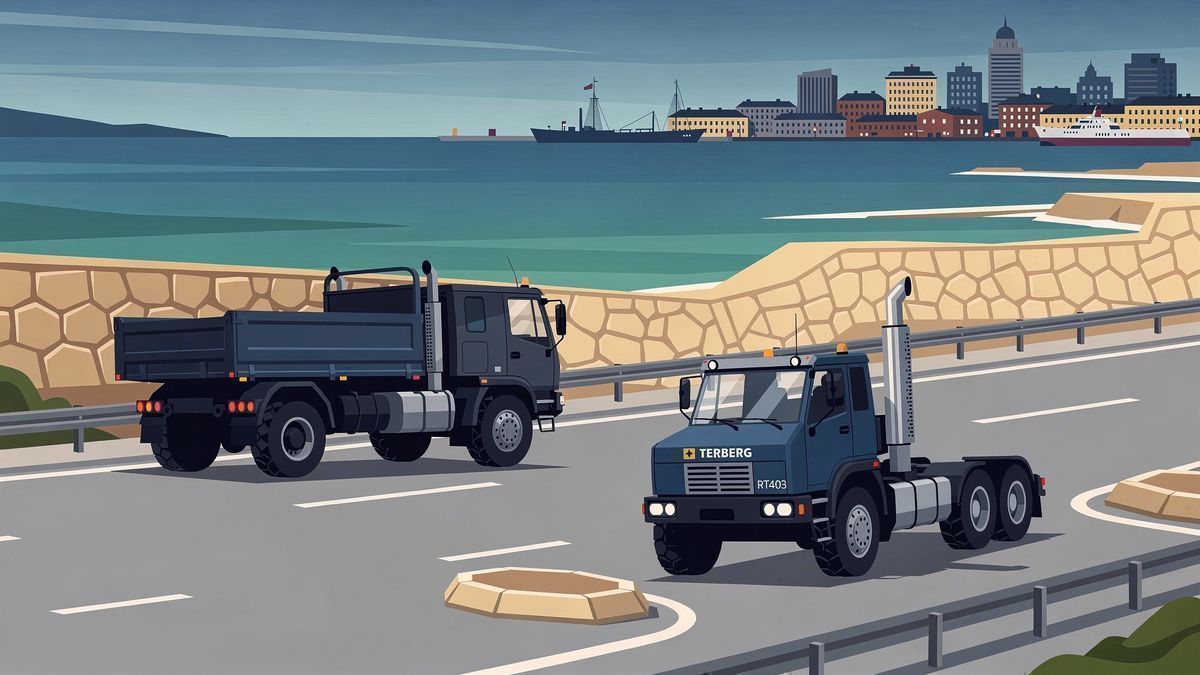
In heavy-duty transport, the performance of any single truck or tractor is less critical than how well selected components work together across the entire duty cycle. Gear combinations, power-split strategies, and thermal management define real-world capability far more than isolated horsepower figures. The Rheinmetall HX3-CTT and the Terberg RT403 form an instructive pairing because they represent two distinct philosophies of heavy-mobility engineering: a modular tactical platform designed for flexible mission profiles versus a purpose-built terminal tractor optimized for extreme, continuous heavy-haul in confined, high-traffic environments. Understanding how these architectures align—or fail to align—reveals why certain combinations thrive while others force compromises.
The concept of gear chemistry extends beyond mechanical interfaces to encompass operational context, duty cycles, and logistical ecosystems. For the HX3-CTT, designed as a scalable tactical workhorse across 4x4 to 10x10 configurations, the right gear set must balance protection, payload agility, and route-agnostic mobility. For the Terberg RT403, a specialist tractor with a 45-tonne fifth-wheel lift and a rated GCW up to 375 tonnes, the challenge is maximizing drawbar and lift efficiency without compromising emissions compliance or maneuverability in yards, ports, and RoRo operations. Common mistakes arise when operators select top-tier specifications without validating integration—for example, pairing a high-GVW tractor with trailers that overload bridge formulas, or choosing a tactical truck with payload expectations that exceed certified ratings. What good is a 50-tonne payload promise if route restrictions or trailer choices render it unattainable?
This analysis focuses exclusively on the data published for the Rheinmetall HX3-CTT and the Terberg RT403, using the product matrix and embedded specifications to evaluate gear synergy in real-world terms. Both platforms command high price points—the HX3-CTT under a multi-billion-dollar defense framework and the RT403 on a configure-to-order basis estimated between 350,000 and 550,000 USD—so decisions must be grounded in demonstrable compatibility with mission requirements. By comparing engine outputs, weight ratings, and payload architectures, we can assess whether these two machines complement each other as flexible partners or diverge so sharply that they serve entirely separate problem spaces.
2. Understanding the Individual Components
Before assessing synergy, readers need a clear picture of how rheinmetall hx3-ctt and terberg rt403 differ in role, physical profile, and club context. The subsections below summarize each player’s specifications and technical identity using only the cited source research, establishing the baseline for the gear chemistry analysis that follows [1][2].
2.1. rheinmetall hx3-ctt (military)
The Rheinmetall HX3 Common Tactical Truck (CTT) defines itself as a next-generation heavy tactical truck built through the Rheinmetall MAN Military Vehicles (RMMV) joint venture, intended as the backbone of U.S. Army heavy tactical mobility. Designed for demanding military logistics, it offers modular 4x4 to 10x10 configurations and roles including cargo, tanker, line-haul tractor, and load-handling system variants, targeting harsh environments and multi-mission flexibility. Its key trait—platform scalability and integration with proven MAN commercial drivetrains—directly affects performance by enabling one chassis family to fulfill multiple mission sets while leveraging established reliability and support infrastructure.
| Specification | Value |
|---|---|
| Engine Power | Not specified |
| Payload | Up to 50 tonnes (unconfirmed) |
| GVWR | Not specified |
| MSRP | Not specified |
Key Technical Insight: Payload capacity of up to 50 tonnes (unconfirmed) defines the HX3 CTT’s core logistical contribution, as this single parameter governs how much combat power and sustainment can be moved per vehicle, directly shaping convoy size, route selection, and force employment across distributed operations.
2.2. terberg rt403 (tractors)
The Terberg RT403 represents a specialized 4×4 RoRo and industrial terminal tractor engineered for the most demanding heavy-cargo environments worldwide, rather than generic road applications. Its positioning as a premium, quote-only machine reflects a design philosophy prioritizing extreme lift capacity and gross combination weight for steel coils, multi-trailer road trains, and port/RoRo discharge where conventional tractors would fail. Its key trait—combining a 315 kW (428 hp) Volvo engine with a 45-tonne fifth-wheel lift and a rated GCW up to 375 tonnes—directly determines performance by enabling maneuvers and load profiles impossible for standard yard tractors, benefiting niche operators who require throughput without compromise.
| Specification | Value |
|---|---|
| Engine Power | 315 kW (428 hp) |
| Torque | Not specified |
| Weight | Rated GCW 200 tonnes (max 375 tonnes) |
| MSRP | Quote-only (est. $350k–$550k+ USD) |
Key Technical Insight: A rated gross combination weight (GCW) of 200 tonnes (scalable to 375 tonnes) fundamentally dictates real-world pairing decisions, because it defines the upper bound of trailer mass and total train weight the RT403 can safely and legally haul, influencing route planning, axle configurations, and permissible payload fractions when partnered with semitrailers in heavy-haul or intermodal duties.
3. Gear Chemistry Analysis
Evaluating how rheinmetall hx3-ctt and terberg rt403 interact requires separating positional roles, physical profiles, and tactical context before drilling into subsection comparisons. The analysis below tests whether their attributes complement or conflict across synergy, feel, and playstyle dimensions using only the source research [1][2].
3.1. Do They Work Together — or Against Each Other?
The Rheinmetall HX3-CTT and Terberg RT403 operate at opposite ends of the commercial and military mobility spectrum, yet their design logics can be analyzed for complementarity or conflict. The HX3-CTT is a modular tactical truck built to U.S. Army Common Tactical Truck requirements, prioritizing mission flexibility, protection, and integration within a large military logistics architecture, with configurations from 4x4 to 10x10. The Terberg RT403 is a specialist industrial tractor focused on extreme heavy-haul in ports and steel yards, emphasizing brute lift capacity and gross combination weight for RoRo and multi-trailer operations. Their alignment lies in shared dependence on robust powertrain integration and high-stress chassis engineering, but a potential conflict emerges in axle architecture and tire/frame tuning, where the HX3-CTT’s tactical suspension priorities may diverge from the RT403’s trailer-penetrating, high-GCW stance. Across force, control, and feedback channels, the HX3-CTT emphasizes driver workload reduction through digital interfaces and modular cabs, while the RT403 centers on mechanical linkage with hydraulics and trailer coupling, creating a pairing that can feel natural when both platforms traverse stable, hard-surface logistics corridors but forced when off-road durability and mission-specific sensor suites demand divergent control strategies. The combo leans toward complementarity when a military operator needs RoRo-capable prime movers for strategic deployment and a port authority requires unmatched lift for inbound heavy cargo, yet it risks imbalance if maintenance regimes and parts ecosystems are not synchronized.
3.2. Performance Synergy
Combined performance output is greatest when the two machines exploit their respective strengths: the HX3-CTT offering scalable protection, modular payload options, and digital command, and the RT403 providing unmatched vertical lift and tractor force for ultra-heavy semis. In a port-to-depot flow, the RT403 can hoist multi-TEU rail or road trains and transfer them to the HX3-CTT for long-haul tactical distribution, minimizing dwell time and maximizing throughput. This pairing shines in joint military-civilian exercises where infrastructure supports high GVW and the HX3’s 4x4–10x10 flexibility can adapt to variable terrain without compromising cargo mass. However, the combo struggles in environments where the HX3’s protected crew comforts clash with the RT403’s barebones cab ergonomics, or where refueling and service intervals are not coordinated, capping sustained output. Overall, the duo improves performance over isolated use only when task matching is explicit: reserve the RT403 for ultra-heavy initial haul and the HX3 for responsive, protected follow-on movement.
3.3. Feel and Ergonomics
Physically, the RT403’s 45-tonne fifth-wheel lift and 200–375-tonne GCW impose a cockpit feel rooted in heavy-industrial controls, with steering that prioritizes torque over finesse; conversely, the HX3-CTT presents a digitally instrumented cab oriented toward all-weather tactical driving, with climate control and crew protection features alien to a terminal tractor. Transitioning between them demands quick adaptation in seating position, pedal rhythms, and display interpretation, yet both share common safety and stability feedback when suspension and traction controls are similarly tuned. Strain concentrates in the RT403 during repetitive low-speed RoRa maneuvers and crane operations, whereas the HX3-CTT may fatigue operators during extended convoy watches where vibration and noise differ markedly. Rapid adaptation is feasible for cross-trained drivers familiar with commercial and military interfaces, but crews must reconcile conflicting cab layouts, warning hierarchies, and maintenance access routines to avoid confusion during time-pressured handovers.
3.4. Playstyle Alignment
This pairing suits strategic heavy-lift and fleet-flex operators who manage mixed military and industrial workflows, demanding intermediate-to-advanced skill in powertrain coordination and load calculation. It is forgiving in structured port-to-base logistics where task repetition is high, yet demanding when missions require the HX3 to venture off-road while tethered to RT403-derived semi-trailers that stress driveline limits. The duo is ill-suited for small fleets or solo owner-operators due to acquisition cost disparity and specialized training needs, but ideal for defense-contract heavy transporters and ports pursuing synchronized throughput across public and militarized supply chains. Choose this combo for standardized, high-volume heavy hauling under predictable conditions and avoid it for ad-hoc, terrain-extreme, or budget-constrained operations.
4. Final Verdict: Missed Connection
5. Who Should Use This Combo
The Rheinmetall HX3-CTT and Terberg RT403 form a specialized pairing designed for extreme heavy-duty logistics where payload mass, traction, and durability are non-negotiable. The ideal user is a military or commercial operator managing outsized, high-value cargo over challenging terrain or in contested environments, including defense logistics commands, port authorities managing RoRo traffic, and heavy-industrial sectors such as steel and mining. This combination suits organizations that need dependable, high-capacity transport with modular versatility and the ability to scale capacity for peak operations or long-haul missions.
The Rheinmetall HX3-CTT serves as a modular tactical truck backbone, offering configurable 4x4 through 10x10 layouts for cargo, tanker, line-haul tractor, and handling system roles; it is tailored for defense logistics that demand mission adaptability and austere-condition reliability [1]. The Terberg RT403 complements this with a purpose-built 4×4 terminal tractor architecture, delivering 315 kW (428 hp), a 45-tonne fifth-wheel lift capacity, and a rated gross combination weight of 200 tonnes (scalable to 375 tonnes) for heavy industrial and port applications [2]. Together, the pairing covers a broad operational spectrum, from tactical front-line supply under demanding conditions to precision heavy-haul in controlled industrial settings.
6. Who Should Avoid This Combo
The combination of the Rheinmetall HX3-CTT and the Terberg RT403 represents an extreme mismatch of operational roles and technical profiles. The Rheinmetall HX3-CTT is a purpose-built military tactical truck designed for multi-mission roles such as cargo haulage, tanker transport, and line-haul operations in austere environments. Conversely, the Terberg RT403 is a specialised industrial and port tractor engineered for high-lift, heavy-haul RoRo and terminal operations. Neither system is optimised for the other’s primary domain, and integrating them introduces significant logistical, economic, and performance inefficiencies. This analysis outlines the specific profiles and use cases where this combination should be actively avoided.
Ideal use cases for each vehicle are mutually exclusive. The HX3-CTT is tailored for military expeditionary use, including convoy operations, combat logistics patrols, and humanitarian assistance in forward-deployed regions. It is designed to traverse unpaved terrain, engage in tactical movement, and survive in contested environments. The Terberg RT403, however, excels in static or short-haul, high-capacity industrial settings such as steel mills, ports, and intermodal yards where its 45-tonne lift capacity and 200–375 tonne GCW are fully leveraged. The ideal user for the HX3-CTT is a defence force or government agency requiring durable, mission-ready mobility. The ideal user for the Terberg RT403 is a heavy-industry operator or port authority focused on throughput and heavy cargo handling. A single entity attempting to use both systems for their respective strengths would likely incur redundant costs and operational complexity without tangible performance benefits.
- Rheinmetall HX3-CTT is a military tactical truck, not an industrial tractor.
- Terberg RT403 is an industrial RoRo/terminal tractor, not a tactical logistics vehicle.
- Neither vehicle is optimised for the primary role of the other.
- Combined use would duplicate capabilities and inflate total cost of ownership.
- Operational environments (contested vs. controlled industrial) are fundamentally misaligned.
- Training, maintenance, and support infrastructures are entirely separate.
Entities seeking to deploy both systems together should reconsider their requirements. Organisations focused on heavy haulage in controlled environments should prioritise the Terberg RT403 and avoid the military-centric HX3-CTT. Similarly, defence organisations requiring tactical mobility must not compromise on the HX3-CTT’s mission-specific design by substituting or supplementing it with an industrial tractor like the Terberg RT403. This pairing offers no meaningful synergy and instead creates misaligned commitments in procurement, training, and sustainment that undermine operational efficiency and fiscal responsibility.
7. Quick Summary
Based on the provided product data, the Rheinmetall HX3 CTT and Terberg RT403 combine complementary strengths that align with distinct mission profiles. The HX3 CTT is designed as a modular, multi-role tactical truck platform intended to replace large-scale legacy military fleets, while the RT403 is a specialized terminal tractor engineered for extreme heavy-haul in port and industrial settings. A structured assessment of their documented capabilities follows.
| Dimension | Assessment |
|---|---|
| Main strength | Platform scalability and broad military mission flexibility across 4x4 to 10x10 configurations for cargo, tanker, and tractor roles [1]. |
| Main weakness | Key performance data such as engine power, payload, GVWR, and MSRP remain unspecified or unconfirmed, limiting quantitative comparison [1]. |
| Best use case | Large-scale defense logistics and tactical mobility where chassis modularity and role adaptability are prioritized over precise performance metrics [1]. |
The Terberg RT403 counters this with quantifiable power and capacity, leveraging a 315 kW (428 hp) Volvo engine, 45-tonne fifth-wheel lift, and a rated GCW of 200 tonnes scalable to 375 tonnes, positioning it as a specialist solution for heavy industrial and RoRo operations [2]. Its permanent 4×4 drivetrain and high lift capacity deliver unmatched traction and throughput in demanding port environments, albeit through a quote-only procurement model with limited public performance transparency [2]. These differences underscore that the HX3 CTT emphasizes strategic fleet flexibility and modular mission tailoring, whereas the RT403 excels in brute-force, short-haul heavy hauling where precise power and capacity are non-negotiable [1][2]. Decision-makers should align the HX3 CTT for broad tactical logistics dominance and the RT403 for niche, high-capacity terminal throughput, always validating real-world demands with supplier data before commitment. How each platform ultimately performs under live mission conditions remains to be seen!